Setting Up on a Herd Bull in Dark Timber
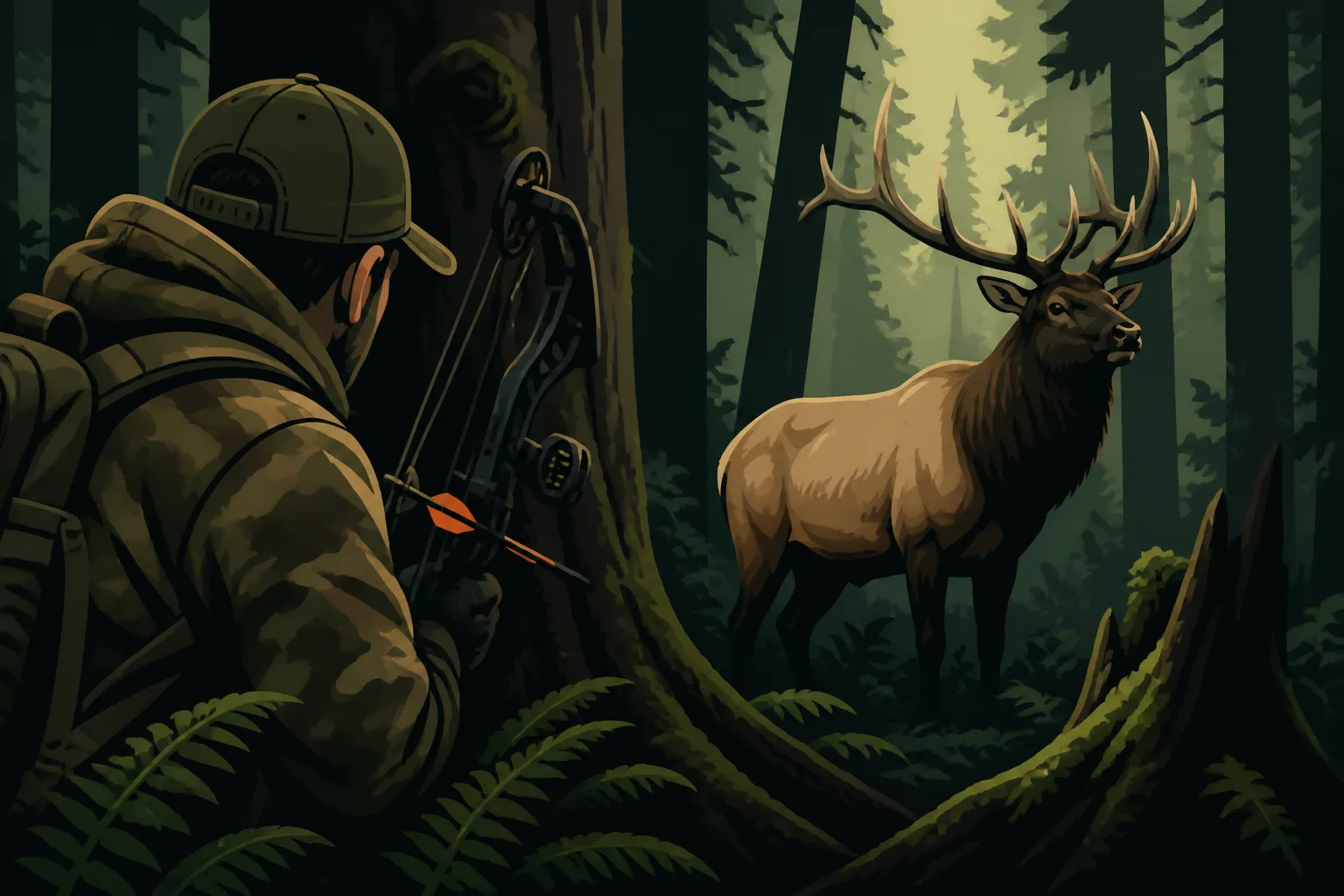
We've all been there: that heart-stopping moment when a bull answers your call, but he's buried deep in a gnarly stand of dark timber, where every step sounds like a thunderclap and visibility is measured in feet. Trying to close the distance on a mature herd bull in that dense, shadowy cover can feel like an impossible task, often leading to frustration and busted stalks. This guide is here to walk you through the nuanced art of setting up on those wary dark timber giants, helping you turn those close encounters into successful hunts in Washington's challenging terrain.
Understanding Dark Timber Dynamics
Dark timber, for a hunter, isn't just a patch of trees; it's a specific kind of environment that demands a unique approach. These areas, typically made up of dense, mature conifers, often with thick undergrowth and littered with blowdowns, are a sanctuary for elk, especially big bulls. Learning to read these environments and understand why elk use them is your first step toward success.
Characteristics of Prime Dark Timber
When we talk about dark timber in Washington, we're picturing those thick stands of Douglas fir, hemlock, or even mature lodgepole pine, often on north-facing slopes or in deep drainages. The canopy is so dense that very little sunlight penetrates, leading to an almost cathedral-like gloom, even at midday. The forest floor can be a tangled mess of salal, huckleberry, and vine maple, all interwoven with fallen logs, moss-covered rocks, and spongy duff. This isn't your open Ponderosa parkland; this is truly dense, claustrophobic habitat. Finding these spots often requires diligent E-Scouting Washington GMUs Before the Draw, looking for areas with dark green canopy signatures on satellite maps. The quiet hunter understands that these aren't merely places where trees grow; they are strategic havens offering security, thermal regulation, and often proximity to bedding.
Why Bulls Seek Dark Timber
A mature herd bull doesn't just wander into dark timber; he chooses it. These areas provide unparalleled security from predators, including human hunters. The dense cover makes it incredibly difficult to spot an elk, and the constant breaking of twigs and rustling of leaves muffles your approach, giving the elk a distinct advantage. Beyond security, dark timber offers thermal cover. In the early archery season, it provides cool shade during warm days, allowing bulls to conserve energy. Later in the season, it can offer protection from cold winds and heavy snow. During the rut, a herd bull will often push his cows into these sanctuaries to keep them consolidated and away from satellite bulls, using the thick cover to maintain control of his harem without expending excessive energy constantly pushing them together. He might even bed down right there in the middle of his cows, feeling untouchable.
Reading Elk Sign in the Shadows
Hunting in dark timber means you often won't see elk until you're right on top of them, so reading their sign becomes paramount. Look for fresh tracks in soft duff or mud, especially large, deep tracks indicating a bull. Check for rubs on small trees or saplings, indicating where a bull has raked his antlers, often leaving behind shredded bark and broken branches. The height and diameter of these rubs can tell you a lot about the size of the bull. Perhaps most importantly, listen. The sounds of an elk moving through thick timber—the cracking of branches, the rustling of brush, even the distinct smell of elk—can give away their presence. If you hear vocalizations, particularly soft chuckles or grunts, you know you're very close. Fresh droppings can tell you how recently elk were in the area, and even their moisture content can hint at the timeframe. Remember, every snapped twig and disturbed patch of moss is a clue in this shadowy environment.
Pre-Hunt Preparation and Scouting
You can't just stumble into dark timber and expect to find a bull. Success in these dense environments begins long before you even set foot in the woods. Thorough preparation and smart scouting are non-negotiable, often making the difference between success and a frustrating, fruitless hunt.
E-Scouting Timbered Areas Effectively
Before you ever lace up your boots, your computer or tablet is your most powerful tool. Using satellite imagery, like that found on platforms like GoHunt, is crucial. Look for vast, unbroken patches of dark green canopy, especially those adjacent to clearcuts, meadows, or water sources—areas where elk might feed or drink before retreating into cover. Pay attention to contour lines: benches, saddles, and small draws within these timbered blocks are natural travel corridors and bedding areas. Identify potential access points, but also mark off areas that look impenetrable; sometimes, the densest, nastiest patches are exactly where a wise old bull will hide. Note any old logging roads or trails that might offer a quieter approach or define a boundary. The more detailed your digital map, the better your chances when you're actually out there.
On-the-Ground Reconnaissance
Nothing beats boots on the ground, even in dense dark timber. Before the season, or even during an off-season scouting trip, venture into these areas. Walk the perimeter, identifying key entry and exit points. Look for existing elk trails—they will often use the path of least resistance, which can be an old game trail or even a subtle deer path. Pay close attention to wind currents and thermals at different times of the day; they can swirl unpredictably in thick timber, and knowing this can prevent you from being winded. Listen for distant bugles and try to pinpoint where they originate. Practice silent movement, walking slowly, picking up your feet, and placing them softly. This is also a good time to get your Rifle Setup for Washington Elk and Deer dialed in for the close-range shots you might encounter. The more time you spend in these woods pre-season, the more confident and comfortable you'll be when it counts.
Gear and Planning for Close-Quarters Hunting
Hunting dark timber requires specific gear and a thoughtful plan. First, your clothing should be quiet and durable; anything that snags or rustles loudly will blow your cover. Layering for Wet Cold Weather is essential, as temperatures can drop significantly under the dense canopy, even if it's warm elsewhere. Boots for Steep Eastside Country (or westside equivalent) with good ankle support and traction are vital for navigating blowdowns and slippery moss. A compact, lightweight pack that won't get hung up on brush is preferred. When it comes to optics, while long-range glassing isn't the priority, good quality binoculars (8x or 10x) are still important for identifying antlers in dim light. Your weapon should be something you can handle quickly and quietly. Finally, always have a good headlamp and extra batteries; if you get an elk down in dark timber late in the day, you'll be packing out in the dark, and a reliable light is non-negotiable for Packing an Elk Out of Washington's Backcountry.
The Art of the Approach
Once you've located a bull in dark timber, getting within range is often the hardest part. It demands patience, meticulous attention to detail, and a profound understanding of how elk perceive their world. This isn't about rushing in; it's about a deliberate, stealthy dance.
Silent Movement Techniques
Moving silently in dark timber is an acquired skill, and it's absolutely critical. Every step must be intentional. Instead of walking, think of it as creeping. Lift your feet high, scanning the ground ahead for loose rocks, dry twigs, or crunchy leaves. Place your foot down slowly, heel first, then roll to your toe, distributing your weight to test the ground before fully committing. If something does snap, freeze immediately. Elk often won't bolt at a single sound if you become instantly still. They'll pinpoint the location of the noise, but if it doesn't repeat, they may dismiss it as another forest sound. Use natural cover like fallen logs or thick brush to break up your silhouette as you move. When you have to cross open patches or noisy areas, move during a gust of wind, or when the bull bugles, using the ambient noise to mask your movement.
Using Wind and Thermals to Your Advantage
The wind is your compass, and in dark timber, it can be notoriously fickle. Under a dense canopy, thermals often create miniature, localized wind currents that can carry your scent in unexpected directions. Always approach from downwind, circling wide if necessary. In the mornings, thermals generally rise, carrying scent uphill. In the evenings, they fall, pulling scent downhill. However, dense timber can create a lag or even reverse these patterns. As you get closer to the bull, stop frequently and use a wind checker to observe how the air currents are behaving right now, at your specific location. Don't assume. A puff of milkweed or a small squeeze bottle of powder will show you precisely where your scent is drifting. A slight shift in the breeze at the wrong moment can send a herd bull crashing out of his sanctuary.
Identifying a Hot Bull's Location
A "hot" bull is one that is actively bugling, interacting with his cows, or challenging other bulls. His vocalizations are your primary locator in dark timber. Listen not just for the bugle itself, but the type of bugle. A challenge bugle, often cut short and aggressive, indicates a bull guarding his harem. A more drawn-out, nasal bugle might be a bull simply advertising his presence. Pay attention to how often he bugles, and if his calls are getting closer or moving away. If you hear chuckles, grunts, or even the distinct sound of antlers rubbing on a tree, you know he's close and likely settled. Use triangulation if possible, listening for the sound from multiple points to narrow down his exact position. Sometimes, the softest cow calls coming from the timber will tell you more about the herd's presence than any bull bugle.
Calling Strategies in Tight Cover
Calling a bull in dark timber is a different game than calling across open meadows. Here, volume can be your enemy, and subtlety is your closest friend. The goal isn't necessarily to draw the bull to you, but to confirm his location, gauge his mood, and perhaps coax him into making a mistake.
Soft Calls and Close-Range Tactics
In dense timber, sound doesn't carry far, and loud calls can be startling or unnatural. Instead of blasting out full bugles, opt for soft cow calls, mews, and subtle chuckles. A few plaintive mews can often get a bull to respond with a soft chuckle or grunt, letting you know he's there without sending him into a panic. Imagine a scenario where you've slowly crept to within 80-100 yards of where you believe the bull is. A simple, quiet cow call might be all it takes to make him answer and reveal his precise location, allowing you to plan your final approach. This is where patience truly shines. Sometimes, just one soft call, followed by a long silence, is more effective than a barrage of aggressive bugles. Remember, the elk are already in their safe zone; they don't need to move far to feel secure.
Setting Up Callers and Shooters
For many hunters, a two-man (or more) calling setup is ideal in dark timber. The shooter positions themselves silently, often 30-60 yards ahead of and slightly to the side of the caller, in a lane with good visibility. The caller stays behind, using soft cow calls and occasional low grunts to simulate a receptive cow or a satellite bull. This tactic aims to draw the herd bull past the caller, putting him directly into the shooter's lane as he comes to investigate. The bull will almost always focus on the sound source (the caller), giving the shooter a precious few seconds to draw their bow or shoulder their rifle undetected. A crucial part of this strategy is knowing your effective range for the terrain. In dark timber, that might mean only 30 yards. Communication between the caller and shooter must be minimal and pre-arranged, relying on hand signals if necessary. This setup is particularly effective for Two-Man Calling Setups on Elk.
Reading a Bull's Response in Timber
A bull's response in dark timber will tell you a lot about his mood and proximity. If he answers with a soft chuckle immediately after your cow call, he's likely close and curious. If he lets out a full, aggressive bugle and you can feel the ground vibrate, he's very close and possibly coming in fast. Conversely, if he ignores your calls or only offers a half-hearted, distant bugle, he might be moving away or simply not interested in engaging. Listen for "footsteps" after a call; if you hear movement, he's coming. If you hear a series of agitated bugles moving further away, he's likely pushing his cows deeper into the timber. A good tactic is to provoke him with a soft grunt or a challenge bugle after he's bugled, but only if you're sure you're positioned correctly and he's heading your way. Adjust your strategy based on his immediate feedback.
| Calling Strategy | When to Use in Dark Timber | Likely Bull Response | Risks |
|---|---|---|---|
| Soft Mews/Chirps | Early approach, confirming location, close range (under 100 yds) | Soft chuckles, grunts, or silent investigation (bull walking in) | Bull ignores or moves away slowly if not interested |
| Low Grunts/Chuckles | Bull is close (under 60 yds), to draw him into a shooting lane, post-bugle | Direct approach, possibly soft bugle, aggression towards sound | Can spook bull if he feels pressured or senses something isn't right |
| Light Bugle (Challenge) | Bull is aggressively bugling, to stop him for a shot, as a last resort | Increased vocalization, charge (rare but possible), silent departure | Bull hangs up, circles, or spooks if not committed to fighting |
| Silent Approach | Always, when closing the final distance, if bull is unvocal | None, relies on visual detection | Bumping elk, missing opportunities due to no sound |
Closing the Distance and Taking the Shot
The final moments of a dark timber setup are often the most intense. Your heart is pounding, visibility is low, and every sound feels magnified. This is where all your preparation culminates, requiring extreme focus and precise execution.
Navigating the Final Yards
Once you've confirmed the bull's location and he's responding, the last few yards are a test of nerve and skill. Continue with silent movement, but now every step is even more critical. You might be crawling, or moving at a snail's pace, placing one foot after the other with agonizing slowness. Use your eyes to scan for any flick of an ear, the shine of an antler, or the dark mass of an elk's body. Often, you'll see only a small part of the animal through the trees. Identify shooting lanes before you need them. Even if you don't have a perfect view, look for open pockets through the brush that a bullet or arrow could pass through. Remember to use wind checkers constantly. It's not uncommon to get within 20 yards of a bull in dark timber, only for him to suddenly appear out of the gloom.
Shot Placement in Heavy Cover
Getting a clean shot in dark timber is notoriously difficult. Unlike open country where you might have a broadside target, here you might only have a quartering-to or quartering-away shot, or a small window through the trees. Prioritize shot placement over shot opportunity. If you don't have a clear, ethical shot at the vitals—the lungs and heart—do not take it. You need to be confident your bullet or arrow will not deflect off a hidden branch. If using a rifle, a robust, controlled-expansion bullet is critical for penetrating the dense hide and bone of an elk. For archery, ensure your broadheads are razor sharp and designed for penetration. Practice Shooting Downhill in Steep Country as well, as you're often on uneven ground. Aim for the "pocket" behind the shoulder, or if quartering away, target the far shoulder to angle into the vitals. Be patient; the bull might shift, offering a better angle if you wait a few more seconds.
Post-Shot Protocol in Timber
After the shot, the work is far from over, and in dark timber, it's even more challenging. If you believe you made a good hit, remain still for at least 30 minutes (for archery) or 15-20 minutes (for rifle). Listen intently for the sound of the elk crashing. Sometimes, even if you don't hear a crash, the bull might have simply bedded down nearby. Mark your exact shooting location, and the last place you saw the elk. Then, begin your blood trail slowly and methodically. Blood Trailing in Salal and Devil's Club can be an absolute nightmare; the dense vegetation can wick blood away or obscure it entirely. Look for disturbed vegetation, broken twigs, and any drops or smears of blood. Don't push too hard, too fast, especially if the trail is sparse. If you lose the trail, grid search the area in ever-widening circles. Once the bull is located, the hard work of Field Dressing in Warm Early-Season Weather and Quartering and Packing an Elk Solo begins. Having a clear plan for getting the meat out of the steep, brushy terrain is essential.
Disclaimer
Hunting is an inherently dangerous activity. This content is for informational purposes only and should not be considered a substitute for professional instruction, proper training, or adherence to all local, state, and federal hunting regulations. Always prioritize safety, ethical hunting practices, and respect for wildlife and the environment.