Two-Man Calling Setups on Elk
Hunting elk in Washington, whether it's the dense timber of the west side or the vast, open breaks of the east, presents a unique challenge, especially when you're trying to outsmart a wary bull on your own. Many hunters find themselves frustrated when a bull hangs up just out of range, unwilling to commit to a solo caller. This guide is all about overcoming that very problem by mastering two-man calling setups, helping you and your hunting partner work together to consistently draw elk into shooting lanes and increase your chances of success.
Understanding the Dynamics of a Two-Man Setup
Going into the woods with a hunting partner brings a huge advantage when it comes to elk calling. It’s not just about having an extra set of hands; it’s about creating a more realistic, dynamic scenario that can often be the difference between a close encounter and a bull that simply drifts away. Thinking about how elk interact in a herd will illuminate why this strategy is so effective.
Why Two Callers Are Better Than One
First and foremost, a two-man setup dramatically increases realism. When you’re alone, trying to mimic a full herd of elk with different vocalizations can be tough. But with two people, you can simulate a small herd – perhaps a primary bull and a few cows, or a satellite bull trying to cut in. This layered sound profile is much more convincing to a real elk, especially an old, wise bull that’s heard it all before. Imagine the difference between a single, static bugle and a dynamic interplay of a bugle followed by soft cow mews and chuckles, all coming from slightly different positions. It just sounds more like the real deal.
Beyond realism, two callers vastly improve your chances of targeting and acquiring an animal. One person can focus solely on the vocalizations, reading the bull's responses, and adjusting the calling strategy in real-time. The other person, the shooter, can be positioned silently, eyes locked on the anticipated approach vectors, rifle or bow at the ready. This division of labor means no fumbling with calls while trying to get into shooting position, and no missed opportunities because you were caught off guard. It's a fluid, coordinated effort that puts you at a significant advantage.
Finally, and perhaps most critically, a two-man setup enhances safety. Hunting in Washington's rugged terrain, whether it's the steep, brushy mountains of the Olympic Peninsula or the vast canyons of the Blue Mountains, can be hazardous. With two people, you have better situational awareness. One person might be focused on the calling sequence, but the other is scanning for approaching game, potential hazards, or other hunters. In an emergency, two people are always better equipped to handle a situation than one. It also means you always have a witness to your shot, ensuring responsible hunting.
Roles and Responsibilities: Caller and Shooter
Successful two-man calling hinges on clearly defined roles. Without them, you’re just two guys making noise in the woods. When you head out to hunt Washington elk, whether in the Gifford Pinchot National Forest or the Colville National Forest, each partner needs to understand their contribution to the collective goal.
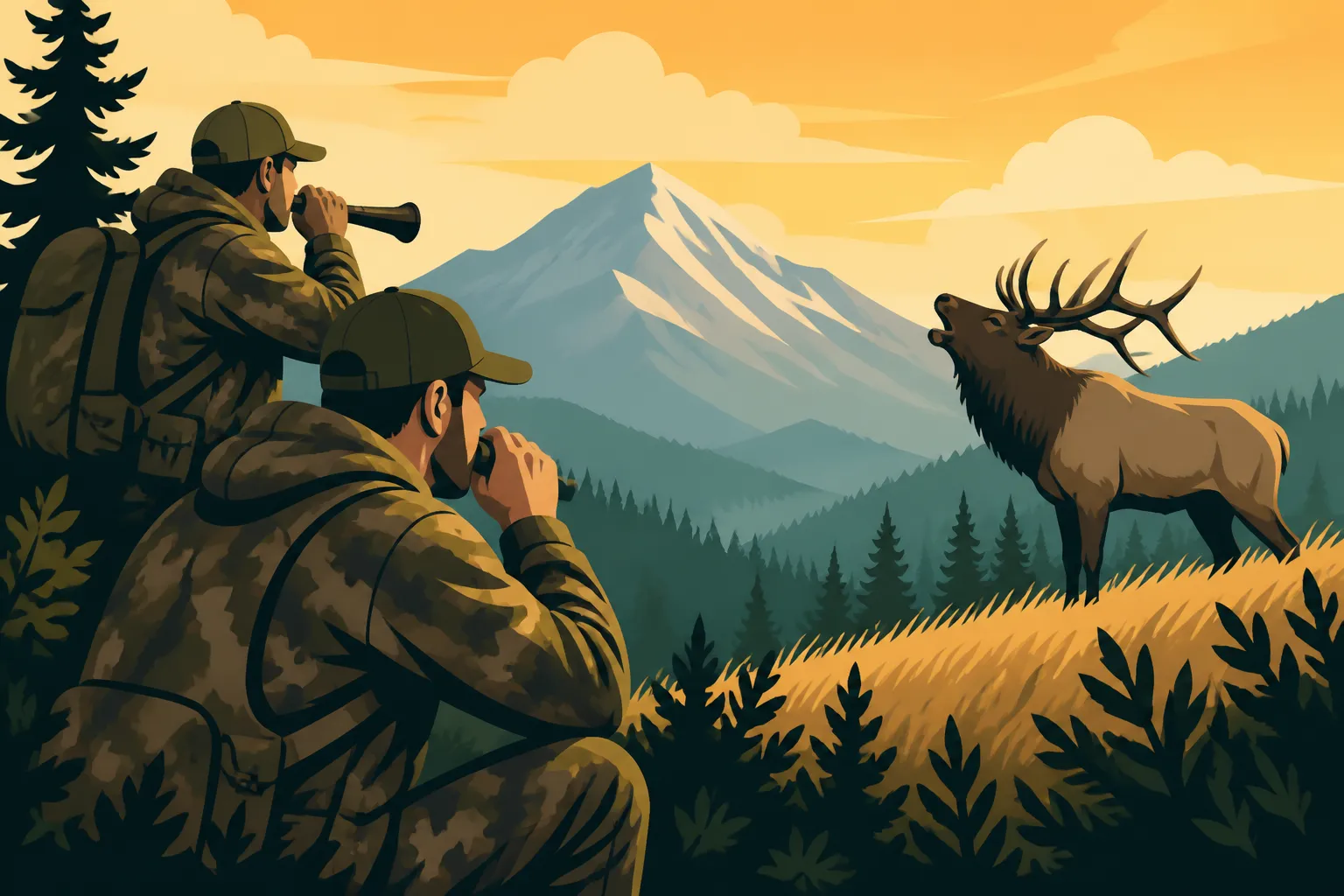
The primary caller is the maestro of the symphony. Their job is to initiate the conversation with the elk, gauge its temperament, and then adjust the calling strategy accordingly. This could mean aggressive bugles if the bull is hot and responding, or softer, seductive cow calls if he’s wary. The caller needs to be patient, listening intently to the bull’s every vocalization, trying to discern his location, his direction of travel, and his intent. Are his bugles getting closer? Is he raking trees? Is he sounding frustrated, or merely curious? The caller's goal is to keep the bull engaged, drawing him closer and closer, ideally towards the waiting shooter. This requires not just skill with a diaphragm or external call, but also a deep understanding of elk behavior and communication.
The shooter, on the other hand, is the silent predator. Their role is to position themselves effectively, often 40-80 yards ahead of the caller, depending on the terrain and desired shot distance. The shooter must be utterly still, hidden in plain sight or behind natural cover, with their weapon ready. Their eyes should be constantly scanning the approach corridors, looking for movement, a flash of antler, or the flick of an ear. They need to anticipate where the bull will likely appear, factoring in wind direction and available cover for the elk. A good shooter will use a rangefinder to pre-determine distances to various landmarks, eliminating guesswork when the moment of truth arrives. They must also be ready to communicate silently with the caller, using pre-arranged hand signals to indicate the bull's proximity or direction, ensuring the caller can adjust their strategy to finish the job.
Communication is Key: Non-Verbal Signals and Strategy
Effective communication between the caller and shooter is absolutely paramount, and in the heat of the moment, it usually needs to be non-verbal. Before you ever step foot in the woods, you and your partner should have a detailed conversation about potential scenarios, setting up a clear system of hand signals or subtle movements that convey crucial information without making a sound.
This pre-hunt planning should cover everything from how you’ll signal a bull is approaching ("thumb up"), to indicating its direction ("point left/right"), its estimated range ("fingers for 10s of yards"), or if it’s "hanging up" and needs more aggressive calling. You should also discuss retreat plans, what to do if the wind shifts unexpectedly, or if another hunter approaches. Having a mutual understanding of these signals means you can react quickly and cohesively when a bull starts to commit. Consider using something as simple as a subtle glance or a slight tilt of the head to convey information. The more you hunt together, the more intuitive this communication will become.
For example, if the primary caller is actively bugling and suddenly sees the bull approaching silently on a different line than anticipated, a quick, pre-arranged signal to the shooter can mean the difference between getting a shot and having the bull slip by unseen. Conversely, if the shooter spots the bull and realizes it's close but heading directly for the caller's position, a signal to "stop calling" or "back up" could redirect the bull for a safer shot. This seamless exchange of information, often happening in mere seconds, is what transforms two individuals into a highly effective elk hunting team. It’s also wise to check current Washington state regulations regarding two-way radio use for hunting, as some areas may have restrictions. Leaving a detailed Leaving a Trip Plan at Home is always a good safety practice, especially for remote two-man hunts.
Mastering Different Two-Man Calling Scenarios in Washington
Washington's diverse landscapes, from the thick coastal forests to the dry, open rangelands east of the Cascades, demand adaptable calling strategies. A two-man setup shines in its versatility, allowing you to tailor your approach to the specific terrain and the elk's behavior. Understanding which setup to deploy and when can significantly increase your success.
The "Come-to-Me" Setup
The "come-to-me" setup is probably the most commonly employed two-man calling strategy, and for good reason: it’s incredibly effective, especially in timbered country. Here, the shooter positions themselves roughly 40-80 yards ahead of the primary caller, depending on visibility and desired shot distance. The caller then initiates the calling sequence, mimicking a cow or a submissive bull, acting as the "bait" to draw the real bull towards their perceived location. The shooter remains silent, hidden, and ready to intercept the approaching elk as it comes towards the sounds.
This setup is ideal for aggressive bulls that are responding well to calls and seem eager to find the source. It works wonders in the dense, dark timber of Western Washington, like the areas around the Willapa Hills Elk Herd, where visibility is limited to short distances. The thick cover helps mask the shooter's position and the caller's slightly different location, making the illusion more convincing. The caller might let out a series of excited cow mews, perhaps some chuckles, and then go silent, letting the bull's curiosity or aggression draw him in. The shooter, nestled behind a blowdown or a thick clump of salal, can anticipate the bull's path and get a clean shot when he steps into an opening. The goal is for the bull to focus intently on the sound, walking right into the shooter's lap.
The "Herd Challenge" Setup
When you encounter a herd bull that's with his cows, particularly in more open or broken terrain, trying to pull him away from his harem can be a monumental task. This is where the "herd challenge" setup comes into play. In this scenario, the primary caller might mimic a subordinate bull attempting to cut into the herd, or even a rival herd bull challenging the dominant one. The shooter is positioned strategically to intercept the dominant bull if he decides to come out to investigate or defend his cows. This might mean the shooter is off to the side, anticipating the bull to circle downwind, or positioned directly in front if the bull is known to charge in.
This setup shines in environments like the more open country of the Colockum Elk Herd unit, or the breaks of Eastern Washington, where you might have visual on a herd from a distance. The caller's strategy here is often more aggressive, using loud, challenging bugles mixed with excited cow talk, as if a rival bull is stirring up the ladies. The bull's territorial instincts are provoked, often causing him to leave his cows to confront the perceived threat. The shooter, having a better vantage point, watches for this reaction and anticipates the bull's approach. It's not uncommon for a herd bull to circle downwind to scent-check the intruding "bull," so understanding how to Reading Clearcuts and Reprod for Blacktail Bucks (even though it's for deer, the principle of anticipating animal movement in cover applies) can help the shooter position for the intercept. GoHunt mapping tools can be invaluable here for identifying potential travel corridors and pinch points where a bull might expose himself.
The "Bait-and-Switch" or "Lost Calf" Setup
Sometimes, you encounter a truly wary bull, or perhaps it's late in the season, and elk are less vocal and more cautious. This is when a "bait-and-switch" or "lost calf" setup can be surprisingly effective. The core idea is to distract the elk's attention, drawing it away from the shooter's position using sound, or to appeal to a more primal instinct.
In a "bait-and-switch," the caller might make a series of aggressive calls, then begin to move, subtly changing their position while continuing to call. This creates the illusion of a moving animal, causing the bull to focus on the sound and direction of the moving caller, while the shooter remains stationary and concealed, ready to take a shot as the bull passes. This works well in moderately thick timber where the bull can hear but not immediately see the caller. For a lost calf setup, the caller uses a series of high-pitched, pleading calf mews. This can sometimes appeal to a cow's maternal instinct, drawing her in, and often a bull will follow. This is particularly useful if you're trying to call in cows or spikes in areas like the pressured units around the Yakima Elk Herd, where bulls might be more hesitant to respond to aggressive bugles. The caller's movement or distress calls divert the elk's focus, allowing the shooter to capitalize on the opportunity.
Practical Considerations for Washington's Diverse Terrain
Washington's hunting grounds are incredibly diverse, from the rain-soaked, dense rainforests of the west to the arid, open sagebrush of the east. A successful two-man calling setup isn't just about the calls themselves; it's about adapting your strategy to the specific challenges and advantages of the terrain you're hunting.
Adapting to Western Washington's Thick Cover
Hunting elk in Western Washington often means navigating a jungle of dense timber, clearcuts choked with reprod, and an understory so thick you can barely see your hand in front of your face. These conditions present unique challenges for a two-man calling setup. Visibility is severely limited, often to just a few yards, which means close-range encounters are the norm. The dense vegetation also dampens sound, making it harder for calls to carry long distances.
In these environments, your shooter and caller should position themselves much closer than in open country, perhaps only 20-50 yards apart. The caller will use shorter, softer calling sequences, relying more on cow mews and chuckles, focusing on drawing the bull into intimate range. Aggressive bugles might still work, but they need to be accompanied by subtle cow calls to sound more natural in the dense cover. The shooter must be absolutely vigilant, anticipating an elk to appear seemingly out of nowhere. Pay close attention to subtle sounds – a twig snap, a rustle in the brush. Techniques similar to Still-Hunting Blacktails in Wet Washington Brush can be highly beneficial for the shooter, moving quietly and deliberately to adjust position if needed. Understanding How Close You Get in Coastal Reprod is vital, as bulls will often hang up just inside the thick stuff. Your communication needs to be almost entirely non-verbal, relying on pre-planned hand signals, as vocal whispers can be heard by an approaching elk.
Navigating Eastern Washington's Open Spaces
Crossing the Cascades to Eastern Washington brings a completely different set of challenges. Here, you'll encounter vast stretches of open sagebrush, wheat fields, timbered draws, and steep, broken canyons. The key challenge in these areas is the sheer amount of open space, which can make spotting wary elk at long distances both an advantage and a disadvantage. Elk in these units, like the ones that call the Okanogan or Blue Mountains home, are often more accustomed to human pressure and can be incredibly cautious.
For these open environments, the shooter and caller can afford to be further apart, sometimes 100-200 yards or more, especially if the terrain offers good visual concealment for the shooter. The caller might need to use more aggressive, louder bugles to carry across the distances and draw a bull out of a distant timber patch or ravine. Effective Glassing Eastern Washington Breaks for Mule Deer techniques, usually applied to deer, are crucial here. Both the caller and shooter should be constantly glassing the surrounding terrain, looking for any sign of movement or a bull hanging up. Wind direction is critical and can shift rapidly in these vast areas; always use a wind checker to ensure you stay downwind of the approaching elk. A hunting app like GoHunt can be incredibly useful for studying topographical features, identifying potential travel routes, and planning your approach, helping you find those hidden draws and saddles where a bull might travel unseen. Remember, Glassing Breaks at First Light is often your best bet for spotting elk before they bed down.
Safety First: Positioning and Awareness
Regardless of the terrain, safety must always be your top priority in any two-man calling setup. When one person is calling and the other is shooting, there's an inherent risk that must be managed through diligent planning and constant awareness.
Always know exactly where your partner is located. Before you even set up, verbally confirm positions and discuss clear lines of sight and potential shot lanes. Never assume your partner is where you think they are. When the shot opportunity arises, the shooter must have a clear understanding of what’s beyond their target – a solid backstop and no chance of hitting their partner. In Washington, wearing hunter orange is required for modern firearm seasons (and often recommended for archery for safety, though not always mandated), and this becomes even more critical in a two-man setup to make each other visible. Carry a reliable two-way radio or satellite messenger for emergencies, especially if you're deep in the backcountry. Even simple verbal confirmations of "I'm set" or "I'm moving" can prevent misunderstandings. While this article focuses on two-man setups, the principles of self-reliance and being prepared, as discussed in Solo Hunting Safety Precautions, still apply to each individual. Always carry a comprehensive first-aid kit and know how to use it, because Washington's wilderness can be unforgiving.
Enhancing Your Two-Man Setup with Advanced Techniques
Once you've mastered the basic two-man calling setups, you can start incorporating more advanced techniques to really seal the deal on those stubborn or call-shy bulls. These additions can add another layer of realism and persuasion to your strategy.
Incorporating Decoys for Visual Confirmation
Adding an elk decoy to your two-man setup can be a game-changer, especially for bulls that hang up just out of sight, needing that final visual confirmation to commit. Decoys work by giving the approaching bull something tangible to focus on, diverting its attention away from the subtle movements of the shooter.
Decoys can be especially effective in moderately open timber or across small clearings where a bull can see the decoy from a distance. The caller should position the decoy a few yards in front of them, or even off to the side, ensuring it's visible to the approaching elk but doesn't obstruct the shooter's view. When a bull rounds a bend or steps into an opening and sees the "elk" that's been bugling or mewing, it often provides the confidence boost needed for it to close the distance. This allows the shooter, positioned silently off to the side, to draw a bow or shoulder a rifle without being detected. However, be aware of the limitations: in very dense cover, a decoy might be useless, and in highly pressured areas, some bulls might be decoy-shy. Always ensure the decoy presents a broadside or quartering-away shot opportunity for the shooter, and never position it in a way that puts your partner in the line of fire.
Reading Elk Body Language and Vocalizations
Truly effective elk calling isn't just about making noise; it's about having a conversation. Both the caller and the shooter in a two-man setup need to be adept at reading elk body language and understanding their various vocalizations. This skill allows you to adapt your calling strategy in real-time and predict the bull's next move.
Listen closely to every bugle. Is it a challenging growl, a frustrated scream, or a softer, more curious call? A bull that’s raking trees or kicking up dust is likely agitated and ready to fight, which might warrant an aggressive response from your caller. Conversely, a bull that’s soft chirping and mewing might be looking for cows, in which case seductive cow calls are more appropriate. Watch for body language: an elk that’s head-on with ears pinned back is likely aggressive, while one that’s pacing or circling might be trying to scent-check you. Understanding the nuances of Bugling and Cow Calling in Washington's Archery Elk Season can provide critical insights. For instance, knowing which Cow Calls That Pull a Bull Off His Herd can be the key to breaking a stubborn bull away from his cows. By pooling their observations, both partners can paint a more complete picture of the bull's intent, leading to better decisions and a higher chance of success.
The Importance of Scouting and E-Scouting
Even the best two-man calling setup won't succeed if you're not in elk. That's why thorough scouting, both in the field and from your couch, is a non-negotiable part of your strategy. Pre-hunt reconnaissance helps you understand the terrain, identify potential bedding areas, feeding zones, and the travel corridors elk use between them.
For field scouting, spend time hiking your chosen Washington GMU before the season. Look for fresh tracks, droppings, rubs, and wallows. Note prominent landmarks, natural funnels, and potential setup locations where a shooter can conceal themselves and a caller can position effectively. Pay attention to prevailing wind patterns and how they might affect your setup. For more advanced planning, E-Scouting Washington GMUs Before the Draw is an invaluable tool. Using satellite imagery and topographical maps, you can identify pinch points, saddles, and benches that elk are likely to use. Platforms like GoHunt offer detailed mapping layers that can show public/private land boundaries, potential water sources, and historical animal movement data, giving you a massive advantage in pinpointing high-probability areas for a two-man setup. By thoroughly scouting, you’re not just looking for elk; you’re looking for the perfect stage to execute your calling strategy.
Two-Man Elk Calling Setups Comparison
Here's a quick overview of the primary two-man calling setups we've discussed, highlighting their ideal uses in Washington's diverse hunting landscape:
| Setup Type | Caller Role | Shooter Role | Ideal Terrain | Elk Behavior Targeted |
|---|---|---|---|---|
| Come-to-Me | Aggressive or seductive "bait" (cow/submissive bull). Keeps bull focused on sound. | Silent, concealed, 40-80 yds ahead, weapon ready. Anticipates path. | Dense timber (Western WA), moderate brush, areas with limited visibility. | Curious or aggressive bulls seeking source of calls. |
| Herd Challenge | Aggressive rival bull, mixing bugles & cow calls to challenge dominant bull. | Concealed, watching escape routes/flanking movements, ready for bull to commit. | More open country (Eastern WA), broken timber, where herds can be seen. | Dominant bulls defending territory/harem. |
| Bait-and-Switch | Calls, then moves to create illusion of moving animal; uses distress calls. | Stationary, concealed, ready to shoot as bull's attention is diverted. | Moderately thick timber, wary bulls, late season when less vocal. | Wary bulls needing distraction, maternal cows. |
Hunting Washington elk with a two-man calling setup is an incredibly rewarding experience that can significantly boost your success rates. By understanding the dynamics, mastering the different scenarios, adapting to the diverse terrain, and incorporating advanced techniques, you and your partner can become a formidable team in the elk woods.
Disclaimer
Please remember that hunting regulations and seasons in Washington State can change. Always consult the most current Washington Department of Fish and Wildlife (WDFW) hunting pamphlet and regulations before heading into the field. Safety should always be your number one priority, including understanding proper firearm handling, knowing your target and what is beyond it, and having appropriate safety gear. This guide is for informational purposes only and does not replace official regulations or professional instruction.