Smoke and Glassing Visibility
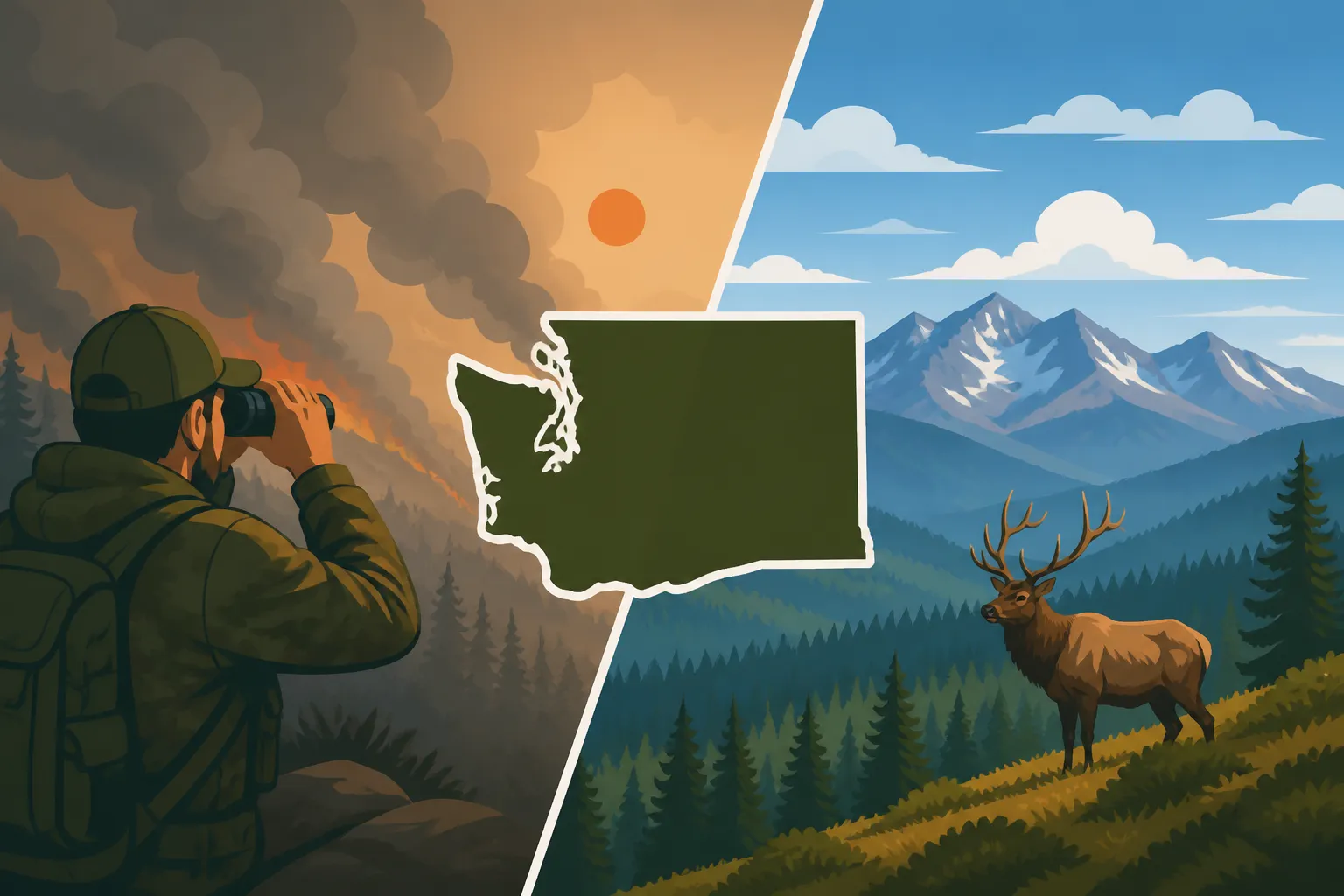
It’s incredibly frustrating to spend months planning your Washington hunting trip, only to arrive in your favorite unit and find the landscape shrouded in a persistent haze. That thick, acrid air doesn’t just make breathing unpleasant; it fundamentally alters the way you hunt, especially when it comes to a crucial tactic like glassing. This guide dives deep into understanding smoke's impact on visibility and offers practical, real-world strategies to help you adapt and succeed, even when the skies are less than clear.
The Frustration of Smoke-Filled Skies
There's nothing quite like the heartbreak of watching your prime glassing spot — a ridge overlooking miles of prime elk or deer country — become utterly useless because of a stubborn layer of smoke. You might have hiked for hours, set up your tripod, and then… nothing. Just a murky wall where crisp mountain peaks and distant game should be. It’s not just a minor inconvenience; it can completely derail a hunt, especially for those of us who rely heavily on optics in the vast, open spaces of Eastern Washington, or even in the clearcuts and burn areas of the Westside.
Why Smoke is Such a Problem for Hunters
Smoke is a triple threat to hunters: it obscures visibility, irritates your eyes and lungs, and can even change animal behavior. When you can't see, you can't identify game, you can't assess legal points, and you certainly can't plan a stalk. The tiny particles in smoke scatter light, essentially creating a natural filter that reduces contrast and makes everything appear flat and gray. This is particularly devastating for long-range glassing, turning what should be a distinct animal shape into an indistinct blur against a smoky backdrop. Imagine trying to pick out a bedded mule deer in a sagebrush flat when the air looks like a perpetual twilight. Your expensive 15x binoculars become little more than glorified paperweights. Beyond visibility, the scent of smoke can also carry for miles, potentially alerting game to your presence, or causing them to shift their patterns entirely, seeking areas with cleaner air. It's a compounding problem that requires a multifaceted approach to overcome.
Differentiating Between Wildfire and Controlled Burn Smoke
Not all smoke is created equal, and understanding its origin can sometimes give you a leg up in predicting its behavior. Wildfire smoke is often dense, unpredictable, and can persist for days or even weeks, blanketing vast regions without warning. It's usually accompanied by emergency closures, severe air quality alerts, and a palpable sense of unease. You can often track active wildfires through resources like InciWeb or local fire department websites, which can help you predict which areas might be affected.
Controlled burn smoke, on the other hand, is generally more localized and predictable. These burns are often managed by state agencies like the Washington Department of Natural Resources (DNR) or the U.S. Forest Service for forest health, reducing fuel loads, and improving wildlife habitat. While they can still create significant haze, they usually occur within specific windows, and their impact zones are often forecast. Agencies typically issue advisories or temporary closures, and the smoke tends to dissipate more quickly once the burn is complete. Knowing the source can help you understand the duration and intensity of the smoke, allowing for more informed decisions. It's always a good idea to check resources like the Washington Department of Ecology's burn bans and smoke forecasts before you head out, especially if you're targeting areas known for active forest management.
Here's a quick comparison of the two:
| Feature | Wildfire Smoke | Controlled Burn Smoke |
|---|---|---|
| Origin | Unplanned, natural or human-caused, uncontrolled | Planned, managed for forest health/fuel reduction |
| Predictability | Low, highly variable wind patterns | Higher, often with announced windows and target areas |
| Duration | Days to weeks, depending on fire containment | Hours to a few days, usually dissipates quicker |
| Area Affected | Broad, regional impact, thousands of acres | Localized, specific burn units, hundreds to thousands of acres |
| Intensity | Often very dense, hazardous air quality | Varies, can be thick but often less widespread and intense |
| Accompanying Issues | Emergency closures, evacuations, extreme danger | Temporary access restrictions, localized advisories |
Practical Strategies for Glassing in Smoky Conditions
When smoke settles into your hunting unit, throwing your meticulously crafted plans into disarray, it's easy to feel defeated. But giving up isn't an option for a Washington hunter. Instead, it's time to pivot, adapt, and employ some specific tactics to overcome the challenging visibility. You can't control the smoke, but you can control how you react to it.
Adjusting Your Optics and Techniques
The first thing you’ll notice in smoky conditions is how your high-magnification optics, which are usually your best friends for picking out distant game, suddenly seem to struggle. The smoke scatters light, making everything look flat and reducing contrast. To combat this, sometimes less is more.
- Reduce Magnification: While counterintuitive, dropping your binocular or spotting scope magnification can actually improve clarity in hazy conditions. Lower magnification gathers more light and provides a wider field of view, making the image appear brighter and less distorted. Instead of trying to crank up your 15x binoculars to see through the murk, try scanning with a good pair of 10x42s. Sometimes that slightly lower power cuts through the haze just enough to reveal what higher power blurs.
- Focus on Contrast Edges: Forget trying to pick out a whole animal. In smoke, you're looking for anomalies – a horizontal line where everything else is vertical, a dark patch against a lighter background, or the distinct edge of an ear or antler tine. Focus your attention on terrain features that naturally create contrast, like the line where timber meets a clearcut, a rock outcrop against a grassy slope, or the darker shade of a ravine. That slight change in texture or color might be the only clue you get.
- Time Your Glassing Sessions: Smoke often settles heavier in the early morning and late evening when temperatures are cooler and the air is still. As the sun rises and warms the atmosphere, thermals can begin to lift the smoke, offering clearer windows around midday. While this might go against traditional prime hunting hours, it could be your best bet for effective glassing. Be patient, take a break during the thickest periods, and be ready to get back on the glass when the air thins, even if it's during the middle of the day. You might have a critical 2-hour window of improved visibility, and you need to be ready to maximize it.
- Move Closer: If glassing from a distance is completely ineffective, the most straightforward solution is to decrease the distance. This might mean getting off your usual glassing knob and moving into timbered areas, still-hunting through cover, or targeting smaller openings where your effective range is naturally reduced. For those used to Glassing Eastern Washington Breaks for Mule Deer, this can be a major shift, requiring a different pace and approach to your hunt. It might mean more walking and less sitting, which can be exhausting but rewarding.
Utilizing Digital Tools and Forecasts
In today's interconnected world, you don’t have to go into a hunt blind to smoke conditions. There are excellent resources available to help you predict and monitor air quality and fire activity.
- Air Quality Apps and Websites: Websites like AirNow.gov and various local air quality monitoring apps provide real-time data on the Air Quality Index (AQI). Look for particulate matter (PM2.5) readings, as these are the fine smoke particles that impact visibility the most. These tools can show you which areas are experiencing heavy smoke and which might have clearer conditions. Sometimes, moving just one GMU over can make a world of difference.
- Weather and Wind Forecasts: Wind is your best friend when it comes to clearing smoke. Pay close attention to wind direction and speed forecasts for your specific hunting area. A strong wind can scour smoke out of a valley in a matter of hours, while a stagnant air mass will let it linger indefinitely. Tools like NOAA or even specialized hunting apps like GoHunt often integrate detailed wind predictions, which are crucial for planning around smoke. If you see a shift to strong winds from a favorable direction, that might be your window.
- Satellite Imagery and Fire Maps: Before and during your hunt, regularly check satellite imagery for smoke plumes. Websites like the National Interagency Fire Center (NIFC) or regional fire incident pages provide maps of active fires and their projected smoke paths. This allows you to visualize how widespread the smoke is and whether it’s moving towards or away from your intended hunting zone. Combine this with e-scouting tools to look at potential escape routes or alternative access points. This kind of proactive research is key for E-Scouting Washington GMUs Before the Draw or even mid-season adjustments.
- WDFW Alerts: Always check the Washington Department of Fish and Wildlife (WDFW) website for any emergency closures or restrictions related to fires or smoke. These can change rapidly, and being caught off guard could mean trespassing or facing unsafe conditions. Understanding Where Washington Posts Rule Changes is vital, as sometimes entire sections of a GMU can be closed down without much advance notice.
Adapting Your Hunting Schedule and Location
Sometimes, the best strategy isn't to fight the smoke, but to avoid it. This might mean shifting your hunting efforts entirely.
- Consider a Change in GMU: If your primary unit is completely socked in and air quality is hazardous, seriously consider if there's a nearby GMU that might be less affected. This is where having a backup plan or a multi-species tag comes in handy. Maybe your elk hunt is a bust in the Cascades due to smoke, but a whitetail unit in Northeast Washington is clear. Flexibility is paramount.
- Focus on Different Habitat Types: Smoke often collects in valleys and low-lying areas. High ridges and exposed benches might have clearer air, especially if there's a breeze. Alternatively, thick timber can offer a kind of visual refuge, as animals might move into it seeking cleaner air or simply because visibility is so poor elsewhere that they feel more secure. This could mean adjusting your approach from long-range glassing to a more active Still-Hunting Blacktails in Wet Washington Brush or working through dense cover on the Eastside.
- Hunt Later in the Season: While not always an option for general seasons, if you have a multi-season tag or a late special permit, holding out until a significant weather event (like a strong rain or a cold front) clears the air can be a game-changer. These events often dramatically improve visibility and can also trigger game movement. Checking Late-Season Snow and Road Access is critical for this strategy.
- Prioritize Safety: Smoke can be disorienting, even in familiar territory. Reduced visibility increases the risk of getting lost, especially when paired with the physical strain of breathing smoky air. Always have a reliable GPS or a phone app with downloaded offline maps, and consider carrying a Two-Way Radio Use While Hunting or a satellite messenger if you’re heading into remote areas. Make sure someone knows your detailed hunt plan, and be willing to pack it in if conditions become truly unsafe.
Long-Term Planning and Mitigation for Smoky Seasons
Dealing with smoke isn't just about on-the-fly adjustments; it's also about building resilience into your overall hunt planning, especially as fire seasons in Washington seem to be getting longer and more intense. Thinking ahead can save you a lot of heartache and wasted time when smoke inevitably rolls in.
Researching Historical Fire Activity and Burn Areas
Knowledge is power, especially when it comes to wildfires. Understanding past fire patterns can inform your choice of hunting units and even specific areas within those units.
- Review Historical Fire Maps: Before you even apply for a tag or buy your general season license, take the time to look at historical fire maps for Washington. These maps, often available through DNR or Forest Service websites, show where major wildfires have occurred in previous years. While a burned area itself can be a great place to hunt a few years post-fire (as new growth provides forage, leading to better deer and elk numbers), areas that burn repeatedly are also likely to experience smoke again. You might find areas that consistently get hit with smoke from prevalent wind patterns, which could influence your decision to hunt there.
- Identify Prevailing Wind Patterns: Researching prevailing wind directions for your chosen GMU during hunting season can give you insight into which areas are most likely to be affected by smoke from a distant fire. If a unit consistently receives smoke from fires burning to its west, for example, you might plan to hunt its eastern fringes or explore units further east. This can be complex, as topography can funnel smoke in unpredictable ways, but general patterns still hold value.
- Understand Post-Fire Habitat Changes: A fire, while initially devastating, also sets the stage for new growth. Hunting a Recent Burn for Elk can be incredibly productive a few years down the line, as fresh forage sprouts. However, recent burns can also be extremely dusty, have falling hazards, and still be prone to small, smoldering fires, which can contribute to localized smoke. Incorporate this into your research; a unit with extensive recent burns might be prone to smoke, but also offer excellent hunting if you can get in after the air clears.
Building Flexibility into Your Hunt Plan
The best defense against smoke-related disappointments is a flexible hunting strategy. Rigidity in the face of nature's unpredictability is a recipe for frustration.
- Develop Backup Units: Never put all your eggs in one basket. Have at least one or two backup GMUs in mind that are geographically diverse from your primary unit. If you're planning to hunt the Colockum or Yakima units on the east side, consider a backup unit on the west side, like the Coweeman or Willapa Hills, or vice-versa. This increases your odds of finding clear air. Tools like the GoHunt platform can be invaluable for quickly scouting alternative units and checking their accessibility and historical success rates, allowing you to adapt on the fly.
- Plan for Different Weapon Seasons: If allowed by your tag, having the flexibility to hunt with different weapons (archery, muzzleloader, modern firearm) can extend your season and increase your chances of hitting a clear-air window. For instance, if archery season is smoky, a late-season muzzleloader or modern firearm hunt might offer clearer, colder conditions. Knowing the rules around Washington's Weapon Choice Rule for Deer and Elk is key here.
- Invest in Reliable Communication and Navigation: When visibility drops to zero, a compass, paper maps, or a fully charged GPS device with downloaded maps become absolutely essential. Don't rely solely on your phone, as cell service is often nonexistent in remote Washington hunting areas, and smoke can sometimes interfere with satellite signals. Before you leave home, make sure you know how to Downloading Offline Maps for Washington on your chosen device. A satellite messenger like a Garmin InReach can be a literal lifesaver for checking weather, sending and receiving messages, and contacting emergency services if you get lost or injured in low visibility conditions.
- Be Ready to Change Tactics Completely: If glassing becomes impossible, be prepared to shift to other hunting methods. This might include still-hunting dense cover, tracking in fresh snow if it comes early, or focusing on water sources if it's dry and hot. Always have a variety of strategies in your arsenal, not just the one that works best on a perfect, clear day. Sometimes, the only way to hunt in the smoke is to get into the thickest stuff and move slowly, covering ground quietly, a completely different game from long-range glassing.
Smoke will likely remain a factor in Washington hunting seasons for the foreseeable future. While it presents undeniable challenges, it doesn't have to ruin your hunt. By understanding its nature, adapting your strategies, and planning proactively, you can still find success and enjoy your time in Washington's wild places, even when the skies are hazy.
Disclaimer
The information provided in this guide is for general informational purposes only and does not constitute professional advice. Hunting regulations, fire conditions, and air quality can change rapidly. Always consult the official Washington Department of Fish and Wildlife (WDFW) regulations, current fire and air quality advisories, and local land management agency rules before planning or undertaking any hunting activity. Hunt safely and responsibly.