Power Banks and Solar Panels
Hunting in Washington's vast and often rugged terrain demands a lot from our gear, and few things are as frustrating or potentially dangerous as a dead battery in your crucial electronics. Whether it's your GPS unit, smartphone with mapping apps, or even a headlamp for a late pack-out, running out of juice far from a power outlet can quickly turn a minor inconvenience into a serious problem. This guide will dive deep into the world of portable power solutions—specifically power banks and solar panels—to help you keep your essential devices charged and ready, ensuring you stay connected, safe, and effective on your next Washington adventure.
The Non-Negotiable Need for Portable Power in Washington's Backcountry
When you venture into Washington's wild country, be it the thick timber of the west side or the vast, open expanses east of the Cascades, you're embracing an environment that often lacks the comforts of modern infrastructure. This isn't your backyard, and a dead phone or GPS isn't just an annoyance; it can seriously compromise your safety, your hunt, and your ability to navigate back to the truck. Trust me, I've been there, staring at a black screen miles from anywhere, and it's a gut-wrenching feeling.
Think about it: how much do you rely on your phone for mapping these days? Even with downloaded maps, the battery still drains. What about your headlamp when you're quartering an animal after dark, or your trail cameras that have been out for weeks, diligently gathering intel? All these tools, which have become indispensable for many of us, demand a reliable power source. Without one, you're not just unplugged; you're often underprepared.
Keeping Your Navigation and Communication Alive
One of the primary reasons to invest in robust portable power is to keep your navigation tools humming. Modern hunting largely revolves around digital maps on smartphones or dedicated GPS units. These devices help us stay on public land, mark waypoints for game sign, navigate tricky terrain, and, most importantly, find our way back to camp or the trailhead, even in unfamiliar country or after dark. However, the battery life of these devices can be significantly impacted by cold weather, constant screen use, or poor cell signal as your phone frantically searches for a tower.
Imagine you're deep in the Colockum or the Blue Mountains, pursuing a bull elk, and you've relied on your phone's GPS to mark a complex series of game trails through dense timber. You make a crucial turn, only to pull out your phone and see that dreaded low-battery warning—or worse, a completely black screen. Panic sets in, even for experienced hunters. Having a reliable power bank means you can quickly recharge that device, restoring your confidence and your ability to navigate safely. This foresight is critical, especially when you've done your homework E-Scouting Washington GMUs Before the Draw, and you know the terrain will test your navigation skills.
Beyond navigation, communication is another vital aspect. While cell service is spotty in many Washington hunting areas, sometimes you just need enough juice to send a quick text message when you hit a patch of service, or to make an emergency call. A charged phone, even if only used for emergencies, is a powerful safety tool. Plus, keeping your headlamp battery topped off means you're not fumbling in the dark when packing out meat after sunset, ensuring you can perform tasks like Field Dressing in Warm Early-Season Weather safely and effectively.
Powering Your Trail Cameras and Scouting Tools
For many of us, trail cameras are an integral part of our scouting strategy. We set them out weeks or even months before the season, hoping to capture images of that elusive bull or buck. But what good is a camera if its batteries die after a week, missing all the action leading up to opening day? While many cameras run on AA or C batteries, constantly replacing them can be expensive and inconvenient, especially if your camera is in a remote location.
This is where portable power banks come in handy for maintenance. You can use them to recharge external battery packs for your trail cameras right in the field, extending their operational life significantly. Imagine checking your cameras and, instead of replacing eight AA batteries, you simply plug an external power bank into a compatible camera pack and let it charge while you check other spots. This not only saves you money on batteries but also minimizes your disturbance in the area. Keeping these critical scouting tools powered is a game-changer for understanding game movement, especially when considering Trail Camera Placement on Ridge Saddles for optimal coverage.
It's not just trail cameras, either. Some hunters use small, portable game callers or other electronic scouting aids that also require power. Having a charging station on hand, even if it's just a sturdy power bank, means you can keep these tools operational throughout your scouting and hunting trips. Don't let a dead battery prevent you from gathering that crucial intel.
Illumination, Comfort, and Emergency Readiness
Beyond navigation and scouting, portable power significantly contributes to your comfort and emergency preparedness in the backcountry. A reliable headlamp is non-negotiable for anyone hunting past sunrise or before sunset. Charging it on the go ensures you're never caught literally in the dark, which can be a real hazard when dealing with uneven terrain or sharp implements. Many modern headlamps are rechargeable via USB, making them perfect candidates for a power bank top-off.
For those venturing into Backcountry Camps in Washington Wilderness, a small power source can make a huge difference. Imagine being able to charge a compact USB-powered lantern for inside your tent, or even a small fan on a surprisingly warm early-season evening. While these are certainly comfort items, they contribute to a more positive hunting experience, allowing you to recover better for the next day's grind. For me, a fully charged headlamp is as important as my knife when I'm Packing an Elk Out of Washington's Backcountry after dark.
And let's not forget true emergency readiness. In a worst-case scenario, having a charged phone or satellite messenger could be the difference between a quick rescue and a prolonged, dangerous situation. Many portable power banks even have built-in LED lights that can serve as a backup flashlight or signal beacon. It’s peace of mind wrapped in a durable package, giving you an extra layer of security when you're far from any help.
Deciphering Power Banks: Your Portable Juice Box
Power banks are arguably the most straightforward and popular portable power solution for hunters. They're essentially large, rechargeable batteries housed in a protective shell, designed to store electrical energy and deliver it to your devices on demand. But not all power banks are created equal, and understanding their specifications is key to choosing one that will genuinely meet your needs in the field.
Capacity, Output, and Input: The Numbers Game
When you're looking at power banks, you'll primarily encounter three critical numbers: capacity, output, and input. Capacity is measured in milliampere-hours (mAh). This number tells you how much energy the power bank can store. A typical smartphone might have a battery capacity of 3,000-5,000 mAh. So, if you have a 10,000 mAh power bank, it can theoretically charge your 3,000 mAh phone about three times. However, there's always some energy loss during transfer, so it's safer to estimate a bit less. For multi-day hunts with multiple devices, you'll want a higher capacity, perhaps 20,000 mAh or even 25,000 mAh, to keep everything running.
Output refers to how much power the bank can deliver to your devices, typically measured in amps (A) and volts (V). Most modern devices charge via USB, and you'll see various USB ports: standard USB-A, faster USB-C, and sometimes USB-C PD (Power Delivery). USB-C PD is excellent because it can deliver more power, meaning faster charging for compatible devices like newer smartphones, tablets, and even some small laptops. If your power bank only has slow USB-A outputs, it might take ages to charge a larger device, which is frustrating when you're trying to quickly top off your GPS before heading out for a morning stalk.
Input is how much power the power bank itself can receive when you're charging it from a wall outlet. A power bank with a low input rating will take a very long time to fully charge, which can be an inconvenience if you're trying to pack for a quick weekend hunt and realize your power bank needs 12 hours to charge from empty. Always look for power banks that offer fast input charging, preferably via USB-C PD, to minimize downtime before your trip.
Durability, Weight, and Real-World Use
Washington weather is notorious for being unpredictable, especially on the west side where rain is a constant companion. That's why durability is paramount for a hunting power bank. Look for models with an IP (Ingress Protection) rating that indicates water and dust resistance. An IP67 rating, for instance, means it's dust-tight and can withstand immersion in water up to 1 meter for 30 minutes. While you might not plan on dropping it in a creek, accidental splashes or a downpour are real possibilities. Shock-proofing is another great feature, as gear often takes a tumble in rugged terrain.
Weight and size are always a trade-off with capacity. A 25,000 mAh power bank will naturally be heavier and bulkier than a 10,000 mAh one. For day hunts or shorter overnighters, a compact, lighter power bank might be sufficient. But for longer trips or when you're running multiple power-hungry devices, you'll need to accept the extra ounces for the added security. When you're trying to manage every ounce in your pack, it's a careful balance. Make sure to consider the long-term effects of cold on your devices, as Phone Battery Management in Cold becomes a critical skill in Washington's autumn and winter seasons.
Finally, real-world performance is key. Before your hunt, fully charge your chosen power bank and test it by charging your actual devices. See how many times it can truly charge your phone or GPS. Pay attention to how quickly it charges them. Nothing is worse than discovering your gear doesn't perform as expected when you're already miles from the truck. Also, consider the type of battery chemistry; lithium-ion (Li-ion) and lithium-polymer (Li-Po) are common and generally safe, but always buy from reputable brands to ensure quality and safety.
Smart Features and Brand Considerations
Many power banks come with additional features that can enhance their utility in the field. Passthrough charging, for example, allows the power bank to charge itself while simultaneously charging your devices. This is particularly useful if you're pairing it with a solar panel. Some have built-in charging cables (USB-C, Lightning, Micro-USB), which can reduce the number of loose cables you need to carry. LED indicators that show the remaining charge are a simple but essential feature. Some even integrate small LED flashlights, which can be a handy backup.
When it comes to brands, many reputable electronics manufacturers make quality power banks. Companies like Anker, Nitecore, and Goal Zero are popular choices among outdoor enthusiasts for their durability and performance. Before I commit to a new piece of tech like a heavy-duty power bank, I often check out the gear reviews from reliable sources or even forums, sometimes found through platforms like GoHunt, to see how they truly hold up in field conditions and how they're rated by other hunters and outdoor adventurers. Looking at a company's warranty and customer service can also give you peace of mind, as outdoor gear takes a beating.
Harnessing the Sun: Solar Panels for Extended Stays
While power banks are excellent for short to medium-length trips, if you're planning an extended stay in Washington's backcountry—think multiple days in a spike camp or a week-long wilderness adventure—you'll eventually run out of stored power. This is where portable solar panels become an invaluable part of your power strategy. They offer the ultimate freedom from electrical outlets, allowing you to replenish your power supply as long as the sun is shining.
Types of Solar Panels and Their Efficiency
Portable solar panels primarily come in two types based on their construction and efficiency: monocrystalline and polycrystalline. Monocrystalline panels are made from a single crystal structure, making them more efficient at converting sunlight into electricity. This means they can generate more power from a smaller surface area, making them ideal for backpackers who need compact, lightweight solutions. The downside is they are generally more expensive.
Polycrystalline panels are made from multiple silicon crystals, which makes them slightly less efficient but also more affordable. They require a larger surface area to generate the same amount of power as monocrystalline panels. For hunting, you'll mostly encounter foldable solar panels that are designed for portability. These can range from small, pocket-sized units (5-10 watts) to larger, multi-panel arrays (20-50+ watts) that can fold down surprisingly compactly. The wattage rating tells you how much power the panel can produce under ideal conditions. A higher wattage means faster charging, but also typically a larger and heavier panel.
A common frustration with solar panels is their variable performance. On a bright, sunny day with direct sun, they can work wonders. But in Washington's often cloudy or shaded forests, especially on the west side, their efficiency drops dramatically. Don't expect miracles if you're trying to charge in dense timber or under heavy cloud cover. They perform best in open areas with unobstructed sunlight, like high ridges or clearcuts.
Portability, Durability, and Charging in the Field
For backpack hunters, portability is paramount. Look for solar panels that are lightweight and fold down into a compact package that can easily strap to the outside of your pack. Many panels come with built-in loops or grommets that allow you to attach them to your backpack, charging devices as you hike. This can be a great way to top off a power bank throughout the day.
Durability is also critical. These panels will be exposed to the elements, so look for rugged construction, water-resistant fabrics, and reinforced stitching. While the solar cells themselves can be delicate, good panels will have a protective coating or laminate. I’ve seen panels take a beating from brush, rocks, and rain, and still keep working, though reduced efficiency is a natural consequence of rough treatment.
When charging in the field, position your panel to get as much direct sunlight as possible. Angle it towards the sun, and if you're stationary for a while (say, glassing a basin for a mule deer), adjust it every hour or so to maximize exposure. For those setting up Backcountry Camps in Washington Wilderness, positioning your panel in an open spot near camp can provide a steady trickle charge to your power banks, ensuring you have enough juice for lights and navigation when evening rolls around.
Pairing Solar with Power Banks for a Robust System
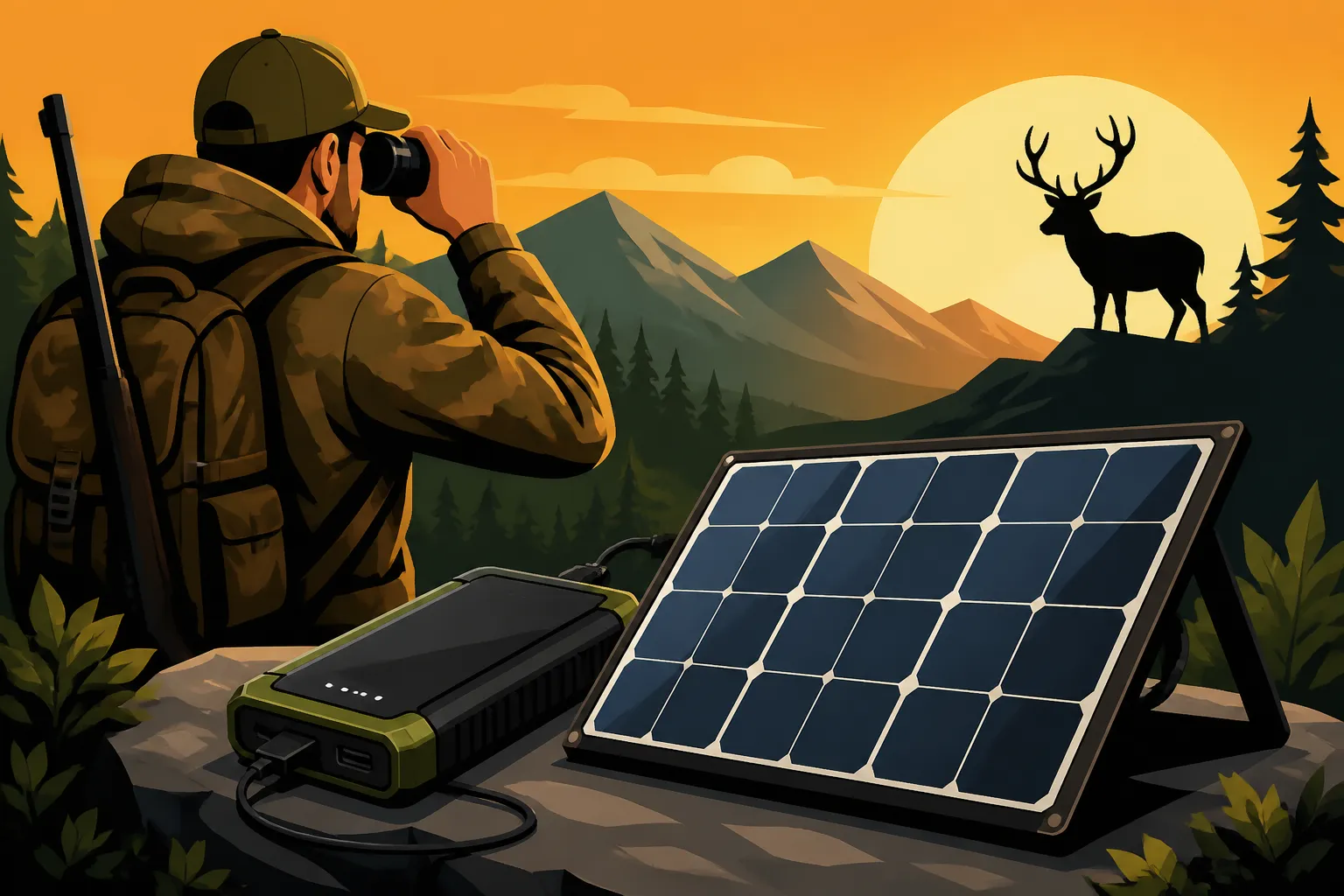
Here's the secret to maximizing portable solar power: don't directly charge your delicate electronics from the solar panel. Solar output can be inconsistent, fluctuating with clouds or movement. These voltage spikes and dips aren't ideal for sensitive devices like smartphones. Instead, use your solar panel to charge a robust power bank, which then acts as a stable buffer to charge your devices.
This two-step process offers several advantages. First, the power bank can absorb the intermittent energy from the solar panel, storing it until you need it. Second, the power bank provides a consistent and regulated power output to your phone, GPS, or headlamp, protecting them from potential damage. Third, you can charge your power bank during the day when the sun is out, and then charge your devices from the power bank in the evening or overnight, regardless of sunlight availability. For multi-day excursions where I'm off the grid entirely, I've found that integrating a quality solar panel with a beefy power bank is the only way to truly stay powered. It’s the kind of long-term solution that serious hunters, often discussing on platforms like GoHunt, rely on to keep their critical electronics functioning.
Understanding the limitations is also important. On dark, rainy days in dense western Washington timber, a solar panel might produce very little power. In these situations, your pre-charged power banks become your primary lifeline. Solar is about extending your stay, not creating power out of thin air.
Integrating Portable Power into Your Washington Hunting Strategy
Bringing portable power into your hunting kit isn't just about throwing a battery pack in your bag. It's about a thoughtful integration into your overall hunt plan, considering your needs, the environment, and potential contingencies.
Planning Your Power Needs Per Hunt
Before any trip, take an inventory of all your electronic devices: smartphone, GPS, headlamp, trail camera batteries, rangefinder, satellite messenger, etc. Estimate how much power each will need. A day hunt will have vastly different power requirements than a five-day spike camp. For a single day, a compact 10,000 mAh power bank might be plenty to top off your phone and headlamp once. For a week-long wilderness trip, you might need a 25,000 mAh power bank paired with a 20W solar panel.
Consider the length of your hunt, the expected weather, and how reliant you are on electronic navigation. If you're hunting familiar ground with physical maps and a compass as your primary navigation, you might need less power than someone exploring a new GMU entirely by GPS. This kind of detailed planning is as important as your Leaving a Trip Plan at Home for your loved ones. Always calculate a little extra; it's better to have too much power than not enough.
| Feature | Power Bank | Portable Solar Panel |
|---|---|---|
| Primary Function | Store energy, provide on-demand power | Convert sunlight into electricity |
| Power Source | Internal rechargeable battery | Sunlight |
| Charging Speed | Fast (depends on output/input) | Variable (depends on sun, panel size) |
| Best Use Case | Short trips, quick charges, cloudy conditions | Extended trips, maintaining charge, bright days |
| Dependence | Needs to be charged from an outlet beforehand | Requires direct sunlight |
| Weight/Size | Varies, usually compact for capacity | Varies, often foldable and lightweight for output |
| Durability | Many rugged options available | Panels can be fragile, need protection |
| Cost | Generally lower for entry-level | Can be higher for efficient, high-wattage units |
Best Practices for Charging and Maintenance in the Field
Once you're out there, a few best practices will ensure your power solutions serve you well. First, keep devices and power banks warm in cold weather. Batteries lose efficiency and drain faster when they're cold. Store them close to your body, in a sleeping bag overnight, or in an insulated pouch. This goes for your phone and GPS too; don't leave them out in the cold truck overnight if you can help it.
Always charge smaller devices from your power bank, not directly from a solar panel. As mentioned, the power bank acts as a stable intermediary. Protect all your gear from rain and moisture. Even "water-resistant" devices can fail if subjected to prolonged wet conditions. Use dry bags, waterproof cases, or simply keep them tucked away in a protected pocket of your pack.
Before every hunt, without fail, pre-charge everything at home. Don't wait until the morning of your trip. Also, for power banks you don't use frequently, it's a good idea to regularly cycle their batteries—charge them fully and then discharge them partially every few months. This can prolong their overall lifespan. One thing I picked up from a tip shared on GoHunt, or a similar community, was to always top off my power banks every few months, even when not in use. It prolongs their life and ensures they're ready when a spontaneous trip comes up, saving you from that last-minute scramble.
Smart Combinations and Backup Plans
The most effective power strategy often involves a combination of tools and a clear backup plan. For serious backcountry hunts, I often carry a large primary power bank (20,000+ mAh) and a smaller, lighter backup power bank (5,000-10,000 mAh) specifically for my headlamp or a quick phone top-off. This redundancy is crucial, especially for Solo Hunting Safety Precautions, where a single point of failure can have severe consequences.
Pairing a solar panel with your largest power bank creates a truly sustainable power system for multi-day trips. Use the solar panel to constantly trickle-charge the main power bank during daylight hours, and then draw from that bank as needed. This allows you to effectively stay off-grid indefinitely, as long as you have adequate sunlight. Don't forget, GPS Units Versus Phone Apps can be a debate, but having power for both means you don't have to choose in a pinch.
Finally, always have a non-electronic backup plan for navigation (physical map and compass) and illumination (extra batteries for a simple headlamp or a backup mini-flashlight). Technology can fail, regardless of how many chargers you have. When you're packing your First Aid Kit for a Remote Hunt, remember that a reliable light source for treating injuries in the dark is just as critical as the bandages themselves. Think layers of protection, not just a single solution.
Disclaimer
This article is for general informational purposes only and does not constitute professional advice. Laws, prices and regulations vary by location and change over time. Consult a qualified professional for guidance on your specific situation.