Blacktail Rut and Antler Growth
Ah, the blacktail rut. If you've spent any time chasing these elusive deer in Washington, you know it's a phase that can fill you with both immense excitement and utter frustration. Pinpointing when and where the bucks will be actively seeking does, all while navigating their dense, often unforgiving habitat, feels like trying to catch smoke in a damp forest. This guide will dive deep into the fascinating world of the blacktail rut and the critical process of antler growth, offering insights to help you understand these secretive animals better and perhaps even tip the odds in your favor.
Understanding the Blacktail Rut in Washington
The blacktail rut, like any deer rut, is a period of intense activity driven by reproduction. However, unlike their mule deer or whitetail cousins in more open country, blacktails often conduct much of their courtship and breeding hidden away in the thick timber and dense understory of Western Washington. This makes observing and understanding their rut behavior a unique challenge.
The Phases of the Rut Cycle
To truly grasp the blacktail rut, it's helpful to break it down into distinct phases. Each phase presents different challenges and opportunities for hunters, and understanding them is key to effective scouting and hunting.
The pre-rut typically begins in late October or early November. During this time, bucks are transitioning from their bachelor groups and starting to feel the hormonal surge. They become more aggressive, beginning to establish dominance hierarchies, and their movements increase as they scent-check for the first does coming into estrus. You'll start to see more rubs on small trees and fresh scrapes on the ground, often along traditional travel corridors or edges of cover. Bucks aren't committed to does yet, but they're actively staking out their territory and letting other deer know they're around. This can be a great time to target bucks as they are still somewhat predictable in their movements before the chaos of the peak rut truly begins.
The peak rut for Washington blacktails usually kicks in from mid-November through the first week or two of December, though this can vary by region and individual deer. This is when the does are most receptive to breeding, and bucks are on constant patrol, driven by an insatiable urge to find and breed them. Forget about finding them consistently bedded in one spot; during the peak, bucks are almost perpetually on the move, chasing does, fighting with rival bucks, and generally expending an incredible amount of energy. This relentless pursuit often means they become less cautious, making them vulnerable if you can intercept them. The challenge is that their movement is often through the densest parts of the forest, making visual encounters fleeting. Knowing when the "Blacktail Rut Dates in Washington" are can be a huge advantage for planning your hunt.
Finally, the post-rut sees a significant decline in breeding activity, usually from mid-December into January. Bucks are exhausted, often having lost a substantial amount of body weight. Their hormonal levels begin to drop, and they shift their focus back to feeding and recovering for the winter. While some does might still come into estrus, the frenetic energy of the peak rut is gone. Bucks become much more difficult to find, often retreating to dense thermal cover or seeking out prime feeding areas to regain their strength. They are vulnerable to harsh winter conditions at this point, so their focus is survival.
Key Rut Triggers and Influences
The timing and intensity of the blacktail rut aren't just arbitrary; they're governed by a complex interplay of environmental and biological factors. Understanding these can give you a better grasp of what to expect each season.
Photoperiod, or the amount of daylight in a 24-hour cycle, is the primary trigger for the rut in all deer species, including blacktails. As the days shorten in the fall, it signals to the does' bodies that it's time to prepare for breeding. This biological clock is remarkably consistent year after year, ensuring that fawns are born at an optimal time in spring when forage is abundant. This is why you'll see a general rut window that holds true across the state, even with slight regional variations. It's the overarching force that drives the entire reproductive cycle.
However, secondary factors can influence the intensity and perceived timing of the rut. Weather conditions, for instance, play a significant role. Cold snaps, especially when preceded by mild weather, can often kick the rut into high gear. When temperatures drop, deer become more active during daylight hours, and the crisp air carries scent further, making bucks more effective at finding does. A heavy rainfall or even snow can also influence deer movement, sometimes pushing them into more visible areas or concentrating them in specific pockets of timber. The impact of a full moon is often debated among hunters, with some believing it encourages more nocturnal rut activity, while others see little correlation. For blacktails, who are already largely crepuscular (active at dawn and dusk), these influences might subtly shift their pattern rather than drastically change it.
Deer density and herd health are also critical. In areas with a healthy buck-to-doe ratio, the rut can be more intense, with bucks having to compete more vigorously for breeding opportunities. This heightened competition can lead to more visible buck activity, including fighting, chasing, and increased sign-making like rubs and scrapes. Conversely, in areas with imbalanced ratios or poor herd health, the rut might seem more subdued or drawn out. Monitoring local populations and herd dynamics, perhaps through resources like GoHunt's data insights, can offer valuable context when planning your hunt.
Blacktail Antler Growth Dynamics
Blacktail antlers are a fascinating display of annual regeneration, growing and shedding in a predictable cycle tied to the deer's physiological state. These bony structures aren't just for fighting; they're also a clear indicator of a buck's age, nutrition, and overall health.
The Annual Cycle of Antler Development
The process of antler growth is a marvel of nature, occurring rapidly each year and following a distinct timeline. Understanding this cycle is crucial for anyone interested in deer management or simply appreciating the biology of these animals.
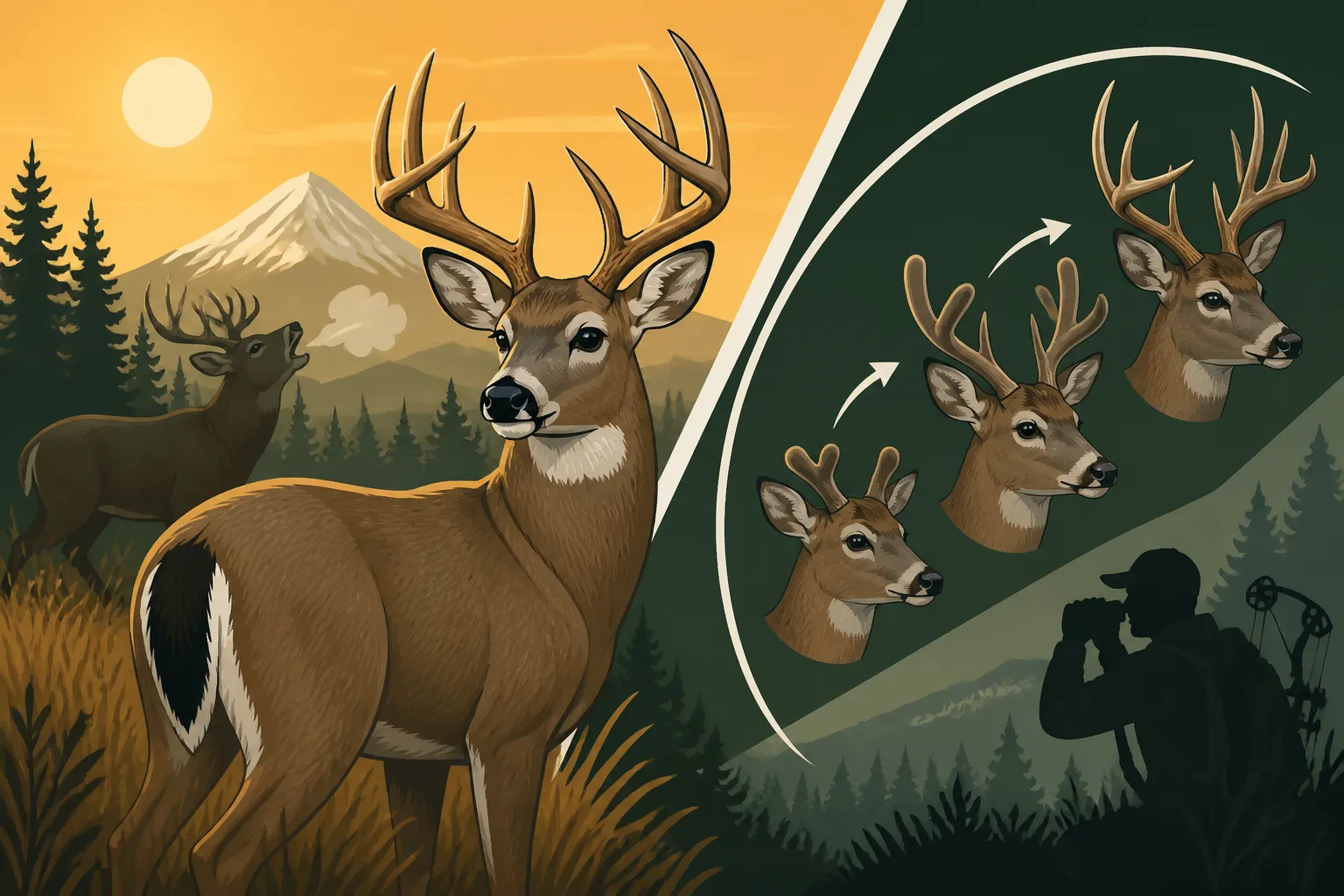
Antler growth begins in spring, typically in March or April, shortly after the old antlers have been shed. Bucks are essentially growing a new set of bones from scratch. This initial growth is rapid, fueled by protein and minerals, and the developing antlers are covered in a soft, fuzzy skin known as velvet. Velvet is rich in blood vessels and nerves, supplying the growing bone with everything it needs. During this phase, the antlers are soft and vulnerable to injury. Bucks are often found in bachelor groups during the summer months, and while their antlers are growing, they are typically quite secretive, staying hidden in dense cover to protect their delicate headgear. This period of growth continues through the summer, with the antlers rapidly increasing in size and mass.
By late summer or early fall, usually around August or early September, the antlers begin to harden, and the velvet dries up. This process is triggered by a change in hormone levels, particularly increasing testosterone. Once the velvet is dry, it begins to itch, and bucks will rub their antlers vigorously against trees, shrubs, and even the ground to remove it. This "velvet stripping" phase marks the completion of antler growth for the year. The newly hardened antlers are now ready for the challenges of the rut. The color of the antlers can vary depending on the type of vegetation a buck rubs against, often taking on darker hues from tannins in cedar or alder.
After the rut concludes and winter sets in, typically from late December through early March, bucks will shed their antlers. The timing of shedding is influenced by several factors, including the buck's age, physical condition after the rut, and local environmental conditions. Older, more dominant bucks often shed earlier than younger bucks or those that are stressed from a tough rut or poor winter forage. The shedding process itself is a natural bone resorption at the pedicle (the base where the antler attaches to the skull), allowing the old antlers to fall off and clear the way for new growth the following spring. Finding a shed antler in the dense Washington woods is like finding a hidden treasure, a testament to a buck's past dominance and resilience.
Factors Affecting Antler Size and Quality
Every hunter dreams of a big-racked buck, but what really contributes to impressive antler growth in blacktails? It's not just luck; it's a combination of critical factors.
Age is arguably the most significant factor in antler development. A blacktail buck typically reaches its peak antler potential between 4.5 and 7.5 years old. Younger bucks, even with good nutrition, are still allocating a significant portion of their energy to body growth, meaning their antlers will be smaller. As a buck matures, its body growth slows, and more energy can be diverted to producing larger, more robust antlers. This is why you'll often see spike or fork-horn bucks in their first year, gradually increasing in points and mass as they age. Learning to judge a buck's age on the hoof can be difficult, especially with the quick glimpses we often get of blacktails, but observing their body characteristics beyond just their rack is helpful.
Genetics also play a role, passed down from both parents. While a buck can only express the genetic potential it inherits, genetics alone won't produce large antlers without proper nutrition. Think of it like a recipe: genetics provide the blueprint, but nutrition provides the ingredients. You might have the genetics for a massive rack, but without enough high-quality forage, that potential will never be fully realized. This is why deer herds in areas with consistently rich forage tend to produce larger-antlered bucks over time.
Nutrition, therefore, is paramount. Blacktails need a diet rich in protein, minerals (especially calcium and phosphorus), and energy to grow substantial antlers. The quality and availability of forage throughout the year directly impact antler size. Areas with abundant clearcuts, replanted timber, and diverse forest understories often provide excellent browsing opportunities for blacktails. Conversely, during harsh winters or droughts, when forage is scarce, a buck might allocate energy away from antler growth to simply survive, resulting in smaller racks the following year. This is where you might see the impact of logging practices; clearcuts, while initially beneficial for creating new browse, can eventually grow into dense reprod, reducing understory forage unless managed.
Overall herd health and stress levels also contribute. A buck constantly fighting disease or dealing with heavy predation pressure might not have the surplus energy to grow impressive antlers. Similarly, a high deer density can lead to increased competition for food resources, potentially limiting antler size across the board. Organizations like the Washington Department of Fish and Wildlife (WDFW) monitor herd health to set hunting seasons and limits that aim to maintain a balanced and healthy population, which indirectly supports optimal antler growth.
Hunting Strategies During the Rut
Hunting blacktails during the rut is often touted as the best time to connect with a mature buck, and for good reason. Bucks are less cautious, more visible, and actively moving. However, it's still Washington blacktails we're talking about, meaning they'll challenge every ounce of your patience and skill.
Locating Rutting Bucks
Finding those elusive rutting bucks requires a combination of smart scouting, understanding their habitat, and leveraging their behavior patterns. It's rarely about sitting and waiting in a wide-open field.
One of the most effective ways to locate rutting bucks is by actively looking for fresh sign. During the pre-rut and peak rut, bucks will be creating a lot of rubs and scrapes. Rubs are typically found on small saplings and trees, where bucks rub their antlers to remove velvet, scent mark territory, and work out aggression. Look for fresh sap dripping and exposed wood. Scrapes are areas on the ground, usually under an overhanging branch, where a buck has pawed away the leaves and debris, then urinated and deposited scent from his tarsal glands. These are essentially calling cards, announcing his presence to does and other bucks. Focus your search for these signs along ridge lines, benches, clearcut edges, and old logging roads – basically, any area that provides both cover and travel corridors. Often, these signs will be concentrated in areas where does are known to frequent.
Using glassing techniques can also be surprisingly effective, even in dense blacktail country. While you won't be seeing deer across vast plains, systematic glassing of clearcuts, recent timber thinnings, or brushy hillsides can reveal a buck on the move, especially at first light or last light. Instead of just scanning, pick apart every shadow, every stump, and every patch of brush with your binoculars. A bedded buck might only reveal a flicker of an ear or the curve of an antler. Often, you'll be glassing areas that are only a few hundred yards deep, but the detail you can pick out with quality optics can make all the difference. Understanding "Reading Clearcuts and Reprod for Blacktail Bucks" is an absolute game-changer here, as these areas often hold excellent forage and cover.
Another crucial strategy is still-hunting. This involves moving incredibly slowly and deliberately through the forest, pausing frequently to listen and scan. Blacktails, especially during the rut, can be surprisingly vocal with soft grunts or the sound of chasing. Pay attention to changes in terrain, dense pockets of cover, and areas with good visibility like older timber stands. When you're in the thick stuff, your pace should be agonizingly slow, perhaps only moving a few yards every minute, using every bit of available cover to mask your approach. This method is particularly effective when Still-Hunting Blacktails in Wet Washington Brush, as the moisture can help dampen your footsteps and make the leaves quieter.
Calling and Decoying Tactics
Once you've located an area with rutting activity, or are moving through one, employing calling and decoying tactics can be the nudge a cautious blacktail buck needs to step into view. These methods aim to mimic the sounds and sights of the rut, appealing to a buck's primal instincts.
Deer calls are a potent tool during the rut. The primary calls to focus on for blacktails are grunts and rattles. A grunt tube can be used to imitate a buck grunt, which can attract other bucks looking for a fight or does seeking a breeding partner. Short, guttural grunts can sometimes stop a buck in its tracks, making him curious enough to investigate. Rattling antlers, or a synthetic rattling device, simulates two bucks fighting. This can be incredibly effective, especially during the peak rut when bucks are competitive. Start with soft clicks and grow into a more aggressive sequence, pausing often to listen for a response. Some hunters also find success with fawn distress calls, particularly in the early rut, as a curious doe or even a buck might come to investigate what the commotion is about. Experimentation is key, as what works one day or in one area might not work the next.
Decoys can also be employed, though they require specific setups and careful consideration in dense Washington terrain. A lifelike doe decoy can draw in a rutting buck who sees a potential breeding opportunity. Position the decoy so it's visible from a distance but also positioned as if it's natural in the environment. Some hunters even use a buck decoy, though this can be more aggressive and might scare off smaller bucks while challenging larger ones. The key with decoys is to ensure you have a safe backdrop, and that any approaching buck will offer a clear shot before he gets too close and potentially spooks. The downside to decoys in thick country is their limited visibility and the logistics of carrying them. However, in certain open clearcuts or old orchard settings, they can be highly effective.
Regardless of whether you're calling or using a decoy, wind direction is absolutely paramount. Blacktails, like all deer, rely heavily on their sense of smell. Always ensure your scent is not blowing towards the area you expect deer to approach from. Play the wind, use scent-eliminating sprays on your gear, and hunt from an elevated position if possible to keep your scent cone above their line of travel. If a buck catches your scent, even the most aggressive rutting behavior will quickly turn into a hasty retreat. Combining calling with smart wind management and understanding buck movement patterns can significantly increase your chances during this exciting time. If you're using a tool like GoHunt, you can often overlay wind direction with terrain features to help predict where your scent might carry and where deer are likely to approach from.
Interpreting Antler Development for Management
Beyond the thrill of the hunt, understanding blacktail antler development offers critical insights into herd health and management strategies. Antlers aren't just trophies; they're biological indicators that tell a story about the deer and its environment.
Age Class and Antler Potential
The size and configuration of a buck's antlers are often a direct reflection of its age, especially when considered alongside other physical characteristics. This understanding helps hunters and wildlife managers make informed decisions.
In their first year, blacktail bucks typically grow spike or fork-horn antlers. These are generally small and indicative of a young animal focusing most of its energy on growing its body. Occasionally, a highly nourished yearling might produce a small three-point, but this is less common. As the buck enters its second year (2.5 years old), you'll often see a significant jump in antler size, with many bucks sporting a legal two- or three-point rack (if specific unit regulations apply, like "Washington's Three-Point Rule and What Counts"). At this stage, they're still growing, but their body size is increasing, and their antlers are becoming more substantial. These bucks are often still somewhat naïve and are the most common age class harvested in general seasons.
As blacktails continue to age, reaching 3.5 to 5.5 years old, their antlers generally show a marked increase in mass, length, and typically more points. This is when a buck starts to approach its prime antler potential. The G3 (third tines) often become more developed, and the overall frame becomes wider and heavier. At this age, bucks are physically mature and have developed more cunning, making them more challenging to hunt. This is the sweet spot for many hunters looking for a mature buck, as they balance robust antler growth with the physical challenge of pursuit.
Beyond 6.5 years old, a buck may start to exhibit signs of declining antler quality, sometimes referred to as "going downhill." While some older bucks maintain impressive racks, others might show a decrease in point count or mass as their body focuses more on maintenance rather than growth. These bucks often have noticeably grey muzzles, swaybacks, and a thicker neck, indicating their advanced age. Observing this progression is crucial for management, as it helps determine the age structure of the buck population and ensures a healthy balance of age classes within the herd.
Evaluating Herd Health Through Antlers
Antlers serve as a direct window into the overall health and nutritional status of a blacktail deer population. Fluctuations in antler quality across the herd can signal environmental changes or population imbalances.
When a blacktail herd consistently produces small or spindly antlers across all age classes (beyond yearlings), it can be a red flag. This often indicates a lack of high-quality forage, either due to overpopulation leading to intense competition for food, or a degraded habitat that simply can't support optimal nutrition. For example, if a large timber cut that once provided abundant browse has grown into dense, shaded reprod, the available food might decline, impacting antler growth for the entire local herd. Such observations can prompt wildlife managers to investigate underlying issues, potentially adjusting harvest quotas or initiating habitat improvement projects.
Conversely, a herd where bucks consistently grow large, symmetrical, and well-massed antlers for their age class generally indicates a healthy population with access to excellent nutrition. These are the signs of a well-balanced ecosystem where deer have ample food, minimal disease, and a good buck-to-doe ratio that allows bucks to mature. Areas like parts of the Willapa Hills or the Olympic Peninsula, known for robust Roosevelt elk and blacktail populations, often demonstrate these characteristics where habitat is rich and relatively undisturbed. This positive sign reflects successful management practices and a thriving environment.
By monitoring antler quality over time, wildlife biologists can track trends in herd health. A sudden drop in antler quality, for instance, might correlate with a severe winter, a widespread disease outbreak (like Blue Tongue Outbreaks in Washington Deer), or a significant habitat alteration. This long-term data collection is vital for making sound management decisions, ensuring sustainable hunting opportunities, and maintaining healthy deer populations for generations to come. Tools like GoHunt can help hunters access historical harvest data and biological reports, offering a broader perspective on the specific units they hunt.
Challenges and Misconceptions
Hunting blacktails, especially during the rut, comes with its own set of unique frustrations and persistent myths. It's crucial to address these head-on to develop realistic expectations and effective strategies.
The Elusive Nature of the Washington Blacktail Rut
Anyone who's chased blacktails knows they're often called "ghosts of the forest" for good reason, especially when the rut kicks in. It's not like hunting wide-open country mule deer where you can spot them from a mile away. The dense, unforgiving terrain of Western Washington makes their rut inherently challenging to observe and hunt.
The dense cover is perhaps the single biggest factor contributing to their elusive nature. Unlike the sprawling sagebrush flats of Eastern Washington where you can glass for hours, blacktail habitat often consists of impenetrable second and third-growth timber, thick clearcuts, and tangled brush like salal and devil's club. Bucks can be actively rutting just yards away, making noise and leaving sign, yet remain completely hidden from view. This means hunters must often rely on close-quarters encounters, impeccable still-hunting skills, and an intimate knowledge of the terrain. The "How Close You Get in Coastal Reprod" is often measured in feet, not yards.
Another challenge is the dispersed nature of the rut. While there's a general timeframe, blacktail does don't all come into estrus at the exact same moment. This means the rut can feel "stretched out," with pockets of intense activity interspersed with quieter periods. Bucks might be concentrated in one basin for a few days, then seemingly vanish as they move to find fresh does. This can make patterning a specific buck incredibly difficult. This also ties into the general "Why Blacktails Are Hard to See" even outside of the rut—they are experts at using cover and melting into the shadows.
Finally, the weather in Western Washington often adds another layer of complexity. The rut frequently coincides with heavy rain, fog, and even early snow. While a good rain can make for quieter walking, it can also reduce visibility to mere yards, soak through gear, and make tracking a challenge. Fog can completely shut down glassing opportunities. Hunters need to be prepared for all conditions, ensuring their Rain Gear for Westside Hunting and layering systems are up to the task of keeping them dry and comfortable. These conditions don't deter the deer, but they certainly test the hunter's resolve and preparation.
Common Myths About Antler Growth
Just like with any wild animal, there are many misconceptions surrounding blacktail antler growth. Dispelling these myths can help hunters better understand deer biology and focus on what truly matters for herd health and management.
One pervasive myth is that a buck's antlers indicate its exact age. While antler size generally correlates with age up to a certain point, it's not a precise measure. A 2.5-year-old buck in a prime nutritional area might have a larger rack than a 3.5-year-old buck in a poor habitat. Conversely, a 5.5-year-old buck might have a smaller rack than a 4.5-year-old due to injury, disease, or post-rut exhaustion. Body characteristics like swayback, neck size, and muzzle color are often more reliable indicators of age for mature bucks than just the antlers alone. Focusing solely on antler size can lead to misjudging a buck's age and potentially removing a younger deer with high future potential.
Another common misconception is that shedding an antler "hurts" the buck. In reality, antler shedding is a natural and painless biological process. It's akin to losing a baby tooth; the bone at the pedicle resorbs, weakening the attachment until the antler simply falls off. Bucks typically show no discomfort during shedding, and it's a completely normal part of their annual cycle. The process is a testament to the incredible regenerative capabilities of deer, as they regrow a completely new set of antlers each year.
Lastly, some hunters believe that feeding deer will automatically produce bigger antlers. While supplemental feeding can improve overall deer health and potentially antler size, it's a complex issue. Simply throwing out corn won't magically create trophy bucks if the deer don't have the genetic potential or if other nutritional needs aren't met. Furthermore, supplemental feeding can concentrate deer, leading to increased disease transmission and localized habitat damage. In many areas of Washington, supplemental feeding is regulated or prohibited due to these concerns. Sustainable antler growth is best supported by improving natural habitat through proper land management, which provides a diverse and abundant natural food source for the entire herd.
Washington-Specific Considerations
Hunting blacktails in Washington comes with its own unique set of circumstances, from varying rut timing across the state to the direct impact of local habitat and weather on deer behavior and antler development.
Regional Rut Variations
While the core photoperiod trigger for the rut remains consistent, localized factors can cause subtle yet significant shifts in when and how intensely blacktails rut across Washington. Understanding these variations can give you a tactical edge.
On the Olympic Peninsula and coastal regions, the rut might sometimes feel a bit later or more drawn out compared to other parts of Western Washington. This could be due to milder weather patterns that don't always trigger a sharp drop in temperature, or subtle differences in food availability. The dense rainforest environment also means bucks are more prone to being secretive, making the rut less outwardly dramatic. Hunters in these areas often rely on patience and still-hunting through the moss-draped timber, listening for the subtle sounds of movement or a buck grunting in the thick brush. The Olympic Unit Roosevelt Elk and blacktails share a similar dense habitat that requires specialized hunting techniques.
As you move towards the Puget Sound lowlands and Cascades foothills, the rut tends to be more concentrated in the traditional mid-November window. These areas often experience more distinct seasonal changes with colder snaps, which can encourage more daylight rut activity. Access to these areas can vary greatly, from private timber lands that require permits to smaller parcels of public land. The habitat is typically a mix of timber, clearcuts, and agricultural edges, offering a more varied landscape for deer movement. Understanding "Hunting Behind Timber Company Gates" and obtaining the necessary permits, often through companies like Weyerhaeuser or Hancock, is crucial for access in many of these regions.
Even within Western Washington, areas with high-quality forage and lower hunting pressure might see bucks reaching their prime antler potential a bit earlier or maintaining larger racks for longer. Conversely, areas with poor habitat or high deer density might experience a slightly earlier or more subdued rut due to nutritional stress. This highlights the importance of scouting specific General Management Units (GMUs) each season and not relying solely on statewide generalizations. Resources like GoHunt can provide unit-specific data and insights that help narrow down your focus based on historical harvest and habitat information.
Impact of Habitat and Climate
The very environment blacktails call home, and the ever-changing climate, play a monumental role in their survival, behavior, and antler growth. These factors are far more influential than many realize.
The dense forest habitat of Western Washington is both a blessing and a curse for blacktails. It provides incredible cover from predators and hunters, but it can also limit foraging opportunities if not properly managed. Old-growth forests, while beautiful, offer little in the way of understory browse. Clearcuts, on the other hand, provide a temporary boom in forage as new vegetation sprouts, but as they grow into dense "reprod," they can become impenetrable and less productive for deer. A healthy blacktail habitat is a mosaic of different successional stages, providing diverse food sources and layered cover. Understanding how "Clearcut Age and Blacktail Numbers" relates to available browse is key to finding productive hunting grounds.
Climate patterns, particularly rainfall and temperature, directly affect forage quality and availability. Washington's typically wet climate ensures lush vegetation for much of the year, which is generally beneficial for antler growth and overall deer health. However, extended dry spells or late-season droughts can reduce the nutritional value of browse, potentially impacting antler development for the following year. Conversely, a mild winter can mean higher deer survival rates, but if followed by a poor spring for forage, it can put stress on the herd.
Winter severity is another critical factor. A mild winter allows deer to retain more body fat and exit the season in better condition, which directly translates to earlier antler growth and better overall antler size in the spring. Severe winters, with deep snow and prolonged cold, force deer to expend more energy simply to survive, often leading to delayed antler growth and smaller racks. This is why you'll often find blacktails utilizing lower elevations and south-facing slopes during the winter to minimize energy expenditure and find what little forage is available. Understanding "Elk Behavior in Deep Snow" can also offer insights into how deer adapt to challenging winter conditions.
Disclaimer
Please remember that hunting regulations, seasons, and access rules in Washington can change annually. Always consult the latest Washington Department of Fish and Wildlife (WDFW) regulations pamphlet and relevant land management agency rules before planning any hunt. This guide is for informational purposes only and does not substitute for official regulations.