Tracking Bucks in Fresh Eastern Washington Snow
The crunch of fresh snow underfoot is a sound many Eastern Washington hunters both love and dread. It promises the chance to finally read the story of a big buck's movements, but also presents the challenge of deciphering faint sign in a landscape that can quickly erase your efforts. If you've ever felt the frustration of losing a hot track or struggling to differentiate between a doe and a trophy, this guide is for you. We’re going to dive deep into the art of tracking mule deer bucks in the new snow, offering practical strategies to turn those elusive whispers into successful encounters.
The Magic and Mystery of Fresh Snow Tracking
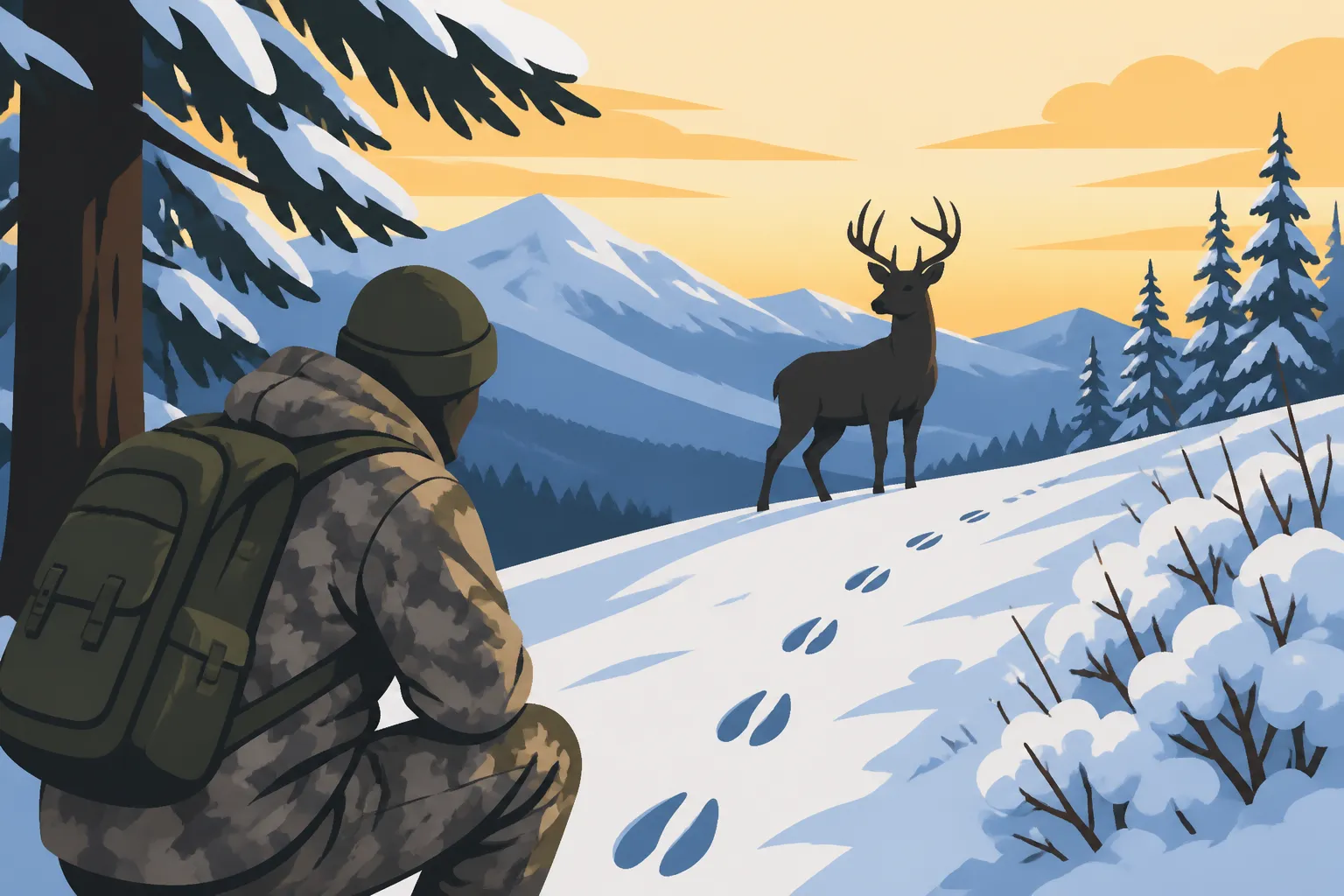
There's something truly special about a fresh blanket of snow in Eastern Washington. It transforms the familiar sagebrush flats, Ponderosa pine ridges, and wheat fields into a pristine canvas, ready to record every hoof print, scrape, and rub. For hunters, it's a game-changer, offering a direct line to understanding deer movement that's simply not available in dry conditions. But while snow simplifies some aspects of hunting, it introduces its own set of complexities, demanding keen observation and a methodical approach.
Distinguishing Fresh Tracks from Old Sign
One of the first challenges when hitting the snowy trails is telling how recent the sign truly is. A track from last night can look very different from one made just an hour ago, and knowing the difference is paramount to not wasting precious time. Fresh tracks will often have sharp, crisp edges, especially in colder, dry snow. You might even see loose snow pushed up at the edges, a clear indicator of very recent passage.
In contrast, older tracks, even those only a few hours old, begin to lose their definition. The edges might soften, melt slightly, or get filled in by falling snow or windblown powder. If the sun has been out, even briefly, the edges of older tracks can start to glaze or ice over. Pay attention to the conditions. If it snowed overnight and stopped at dawn, any track made during the snowfall will have fresh snow within the print itself, while tracks made after the snow stopped will be clean-bottomed. This simple detail can save you miles of tracking the wrong deer.
How Snow Depth and Texture Affect Track Interpretation
Not all snow is created equal, and its characteristics profoundly impact how tracks appear and how easily they can be followed. Light, fluffy powder in a cold snap allows for incredibly distinct, detailed tracks, where you can often discern the dewclaws and even subtle shifts in gait. This is prime tracking snow. However, a strong wind can quickly obscure these tracks, filling them in or drifting snow over them, making your job much harder.
On the other hand, wet, heavy snow or a few inches of slush can make tracks look much larger and more distorted. The hoof might splay more, and the edges will be less defined. While this can make it harder to judge the exact size of the deer, the deeper impression often makes the track easier to follow, especially if the ground beneath is soft. Remember that mule deer tend to move slower in deeper snow, conserving energy, which can make their tracks more concentrated and offer more opportunities for close observation. Understanding these nuances is crucial; a distorted track in heavy snow might actually belong to a smaller buck than you think, or a faint track in a wind-scoured area could be from a substantial animal.
Reading Scrapes and Rubs in a Snowy Landscape
Snow doesn't just record hoof prints; it highlights other crucial sign, turning a mundane landscape into a deer diary. Scrapes, which are typically made by bucks pawing away leaves and dirt to expose bare earth, become even more obvious in the snow. A fresh scrape will have snow piled around the edges of the disturbed area, and you might even find fresh urine within the scrape itself, which stands out starkly against the white.
Rubs, where bucks mark their territory by rubbing their antlers on saplings or small trees, are also easier to spot when snow covers the ground. The fresh bark damage, often with shavings of wood and antler velvet (if early season), contrasts sharply with the snow. Pay close attention to the size of the tree rubbed and the height of the rub. Larger rubs on thicker trees, particularly those with deep gouges, are often indicative of a mature buck. Finding a fresh scrape or rub on a track you're following can be the confirmation you need that you're on the trail of a dominant animal, providing valuable insight into its behavioral patterns.
Decoding the Language of Deer Tracks
Once you've confirmed you're on a fresh track, the real detective work begins. Deer tracks are far more than just impressions in the snow; they're a detailed narrative of the animal's size, sex, speed, and even its mood. Learning to read these subtle cues can mean the difference between chasing a yearling doe and closing in on a mature buck.
Identifying Buck Tracks from Does
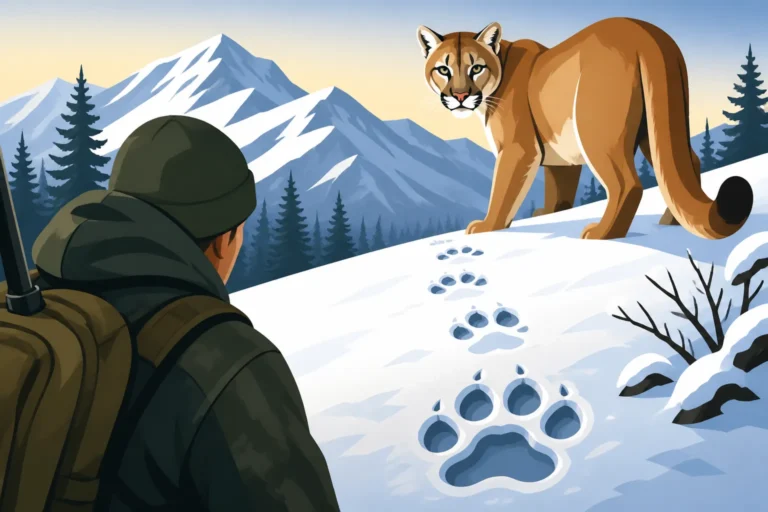
This is often the holy grail of snow tracking: confirming you’re on a buck. While there's no single infallible rule, several indicators, when combined, can give you a high degree of certainty. Generally, buck tracks are larger and rounder than a doe's. A mature buck's hooves often appear more splayed and less pointed at the front than a doe's, especially in soft snow or when pushing through deeper drifts. Look for broader, blunter hoof tips.
Another key indicator is the drag. A heavy-bodied buck, especially one with a good rack, will often exhibit a slight drag mark between its steps as its hooves barely lift clear of the snow. This drag is typically absent or very minimal with does and younger deer. Pay attention to the stride length too; larger deer generally have a longer stride. While a single track might be ambiguous, observing a series of tracks and noting these combined characteristics can greatly increase your confidence. For an easy comparison, here’s a table:
| Characteristic | Mature Buck Track | Doe Track |
|---|---|---|
| Size | Larger, wider | Smaller, narrower |
| Shape | Rounder, blunter toe | More pointed, heart-shaped |
| Stride Length | Longer, consistent | Shorter, sometimes less consistent |
| Drag Mark | Often present, especially in soft snow | Rarely present, or very faint |
| Dewclaw Impression | More likely to show in deeper snow | Less likely to show |
Understanding Gait, Speed, and Direction
The way a deer walks tells you a lot about its state of mind. A leisurely, consistent walk with an even stride suggests a relaxed animal, perhaps feeding or slowly moving between bedding and feeding areas. This is often the ideal track to follow, as the deer is likely not alert or pressured. If you notice a sudden change to a quicker, more erratic trot or even a bounding pattern, it's a clear signal that the deer has been spooked or is moving quickly to escape. When this happens, your approach needs to become even more cautious and calculated.
Direction is obvious, but why the deer is heading that way is the real question. Is it heading into dense timber for bedding, or crossing an open field to reach a food source? Are the tracks leading towards known Mule Deer Winter Range and Survival areas, or perhaps away from recent logging activity? Mule deer in Eastern Washington often travel specific corridors, such as along coulee edges or the fringes of Ponderosa stands. Recognizing these patterns, especially if you’ve spent time E-Scouting Washington GMUs Before the Draw, can help you anticipate where the buck might be headed.
Analyzing Droppings and Urine for Freshness
Just like tracks, deer droppings and urine tell a story of freshness and recent activity. Fresh droppings will be moist, dark, and often clumped together, especially if the deer has been feeding heavily on green forage or browse. As they age, they become drier, harder, and lighter in color, eventually crumbling. If you find warm urine in the snow, you're very close, possibly within minutes of the deer's presence.
The consistency of droppings can also indicate diet and general health. Soft, clumped droppings suggest a diet of lush vegetation, while harder, more pelletized droppings are common when deer are browsing on drier forage. In the winter, deer often switch to a diet of browse like bitterbrush or juniper, which will be reflected in their droppings. This helps you understand what the deer is eating and where it might be focused on feeding, further informing your tracking efforts. Finding a steaming pile of droppings in the snow should kick your senses into overdrive – it means your quarry is likely just over the next rise or bedded nearby.
Mastering the Art of Snow Tracking
Tracking a buck in the snow is a test of patience, observation, and intuition. It's not about speed, but about consistency and understanding the subtle clues the deer leaves behind. The goal isn't just to follow the tracks, but to anticipate the deer's next move.
Pacing Yourself and Staying Focused
The biggest mistake many new trackers make is moving too fast. Speed is your enemy. You need to move at a slow, deliberate pace, ideally scanning about 20-30 yards ahead for the next track while also observing the surrounding terrain. Don’t fixate solely on the tracks; constantly check for rubs, scrapes, broken twigs, or disturbed snow that might indicate the deer's path or a change in direction.
Eastern Washington's terrain can be deceptive, with undulating coulees, rocky outcrops, and dense patches of timber. It’s easy to get distracted or lose the track on a particularly challenging piece of ground. Stay methodical. If you lose the track, don't panic and certainly don't charge off in a random direction. Stop, mark your last known track, and systematically search in expanding circles. Remember, the buck you're after is likely moving slowly and deliberately too, especially in deeper snow, making your patient approach all the more effective.
Using the Wind to Your Advantage
Wind is your most critical ally and potential betrayer in snow tracking. Always strive to keep the wind in your face or quartering into your face. This ensures that your scent is carried away from the deer, minimizing the chance of it winding you before you see it. It also means you'll hear the subtle sounds of the woods more clearly without the wind rushing past your ears from behind.
However, the wind can also be a challenge in open, exposed areas typical of Eastern Washington's sagebrush country or Finding Mule Deer in Wheat Stubble Edges. Swirling winds can carry your scent in unpredictable directions, and strong gusts can erase tracks or make them difficult to discern. In these situations, you might need to adjust your approach, taking a wider arc to stay downwind, even if it means temporarily moving further from the direct line of tracks. When the buck beds down, it will almost certainly pick a spot where it can scent-check its backtrail, so approaching from directly downwind is non-negotiable for a successful stalk.
Navigating Obstacles and Challenging Terrain
Eastern Washington presents a diverse array of challenges, from steep, rocky coulees to dense patches of Ponderosa pine and thick brush. When tracks lead into or across such obstacles, patience is key. Deer are masters of using terrain to their advantage, often traveling along natural funnels, ridge lines, or the path of least resistance.
If the tracks disappear in a dense thicket, circle wide downwind, looking for where the deer might have exited. Don’t bust through the middle, as you’ll likely spook the animal. If tracks cross a rocky area where prints are scarce, look for scuffs, disturbed moss, or even a displaced rock. Deer often follow game trails, even faint ones, through difficult terrain, so keep an eye out for these subtle indicators. When tracks vanish, consult your digital maps (like those on GoHunt) to identify natural crossings, pinch points, or likely travel corridors that the deer would have used. This blend of on-the-ground observation and technological assistance can greatly increase your success.
Closing in on the Bedded Buck
The ultimate goal of tracking is to find the buck in its bed, ideally unaware of your presence. This phase demands extreme stealth, precise observation, and a solid understanding of deer behavior.
Approaching a Likely Bedding Area
As the tracks lead you into thicker cover, north-facing slopes, or pockets of timber that offer thermal protection, your senses must heighten. These are prime bedding areas, especially on cold, sunny days when deer seek warmth or on windy days when they seek shelter. Mule deer often bed on benches or slight rises that offer a good vantage point, allowing them to see or smell approaching danger.
Reduce your pace even further, taking small, deliberate steps. Minimize noise by avoiding snapping twigs or rustling brush. Keep your eyes peeled not just for tracks, but for horizontal lines that might indicate a deer's back, ears twitching, or the glint of an antler. At this stage, your vision should be scanning far ahead and wide to the sides, looking for any part of the deer that stands out against the backdrop. Many bucks will let you walk past if they feel secure, especially if the wind is in their favor and they haven't seen you.
Utilizing Thermal Cover and Wind for the Final Stalk
Mule deer are incredibly adept at finding bedding sites that offer maximum security. This usually means a spot with good thermal cover – thick evergreens, dense brush, or rock outcroppings – and a strong wind advantage. They will typically bed facing downwind, or with the wind at their back and their eyes scanning downwind, allowing them to detect danger from both sight and smell.
Your final approach should always capitalize on this. If the deer is bedded on a north-facing slope under a cluster of Ponderosa pines, try to approach from below or from the side where the wind is carrying your scent away. Use every piece of terrain to your advantage: small depressions, thickets of brush, or larger trees can all provide concealment. Your goal is to get within effective shooting range without being detected. This is where a quiet, well-practiced Archery Practice for Wet Coastal Conditions or a scoped Rifle Setup for Washington Elk and Deer can truly shine.
Executing the Shot on a Bedded Animal
If you've managed to get within range of a bedded buck, congratulations – you've accomplished one of the most challenging feats in hunting. Now, the real test begins. Don't rush the shot. Take a deep breath, stabilize yourself, and confirm the target. Even though the deer is bedded, it might be partially obscured, and you need to ensure a clear, ethical shot.
Wait for the deer to stand, if possible, or aim carefully for the vitals if it remains bedded. Often, a gentle whistle or soft grunt can make a bedded deer stand up, presenting a better target. Be prepared for the deer to bolt at the sound, so your reaction time needs to be immediate. If it does stand and run, mentally mark its escape path. If you take the shot, observe the animal's reaction and listen for any sounds of impact. If it runs, confidently begin Blood Trailing in Salal and Devil's Club after a reasonable wait, following every sign until you recover your buck.
When the Tracks Disappear: Troubleshooting and Persistence
It's inevitable: at some point, you will lose the track. Whether it's due to swirling wind, rocky terrain, or the deer simply going into heavy cover, losing the line is a frustrating but common part of tracking. The key is how you react to it.
The Circle-and-Grid Method for Lost Tracks
When you lose a track, the first rule is to stop, don't move. Look back at the last definitive track and mentally mark its location. This is your anchor point. From there, begin to slowly circle outwards, expanding your search area in ever-widening rings. As you circle, look for any sign – a broken twig, a scuff mark, a disturbed patch of snow, or even fresh droppings.
If circling doesn't yield results, you can employ a grid search. From your last known track, pick a direction and walk in a straight line for about 50-100 yards, systematically scanning. Then, move over 5-10 yards parallel to your first line and walk back. Continue this pattern, effectively "gridding" the area where you suspect the deer might have gone. This methodical approach ensures you don't miss any subtle clues. While it takes time, it's far more effective than randomly wandering.
Anticipating Deer Movement to Relocate the Trail
Good trackers aren't just good at seeing tracks; they're good at thinking like a deer. If you lose a track in a particularly dense section of timber or a steep coulee, ask yourself: "If I were that buck, where would I go next?" Deer often stick to paths of least resistance, follow faint game trails, or utilize terrain features like saddles, ridge lines, or creek beds for travel. They also tend to head towards security cover or known feeding areas.
Consulting digital maps, even basic ones, can help you identify these natural travel corridors. If the track was heading towards a thick draw, check the mouth of that draw for exiting tracks. If it was heading up a ridge, look for tracks coming over the saddle. In Eastern Washington, this might mean anticipating a buck moving from open sage into a patch of Ponderosa pines or dropping into a sheltered coulee. Sometimes the best way to regain a lost track isn't to look for the next print, but to look for the most logical place the deer would appear next.
Knowing When to Call It Quits (Temporarily) and Regroup
There are times when despite your best efforts, the track is simply gone, or the conditions become too difficult (like a sudden heavy snowfall or intense wind). Don't let frustration lead to poor decisions. Sometimes, the best strategy is to temporarily call off the track, especially if daylight is fading or weather is worsening.
Mark your last known location with GPS and head out. Regroup, warm up, and rethink your strategy. A fresh perspective in the morning light, or after a break, can often reveal tracks you missed in your initial exhaustive search. If you’re hunting in a general season, consider if this track is worth pursuing over a fresh, easier track in another area. Knowing when to pause and reset is a sign of an experienced hunter and often leads to more successful outcomes in the long run.
Essential Gear and Preparation for Snow Tracking
Successfully tracking bucks in Eastern Washington snow isn't just about technique; it's also about being properly equipped for the challenging conditions. The right gear can make a miserable day tolerable and significantly increase your effectiveness.
Essential Footwear and Layering for Cold, Wet Conditions
Staying warm and dry is paramount when spending hours or days tracking in the snow. For footwear, invest in high-quality, insulated, and waterproof boots. Look for boots designed for cold weather, often with 600-1000 grams of Thinsulate or similar insulation. Brands like Kenetrek or Schnee's are popular for their durability and warmth. Ensure your boots are well broken in before the hunt to avoid blisters, especially when navigating steep, uneven terrain. Consider packing a second pair of dry socks to change into halfway through the day. Many hunters find gaiters invaluable for keeping snow out of their boots when post-holing through deeper drifts.
Layering is equally critical. Start with a moisture-wicking base layer (merino wool or synthetic, never cotton). Add an insulating mid-layer like a fleece or puffy jacket. Your outer shell should be waterproof and windproof, but also breathable. Think about how active you’ll be; you'll generate a lot of heat while tracking, so you need layers you can easily shed and add. A warm hat and waterproof gloves are also non-negotiable, as you lose a lot of heat through your head and extremities. Being cold and wet will not only make you uncomfortable but will severely diminish your focus and ability to track effectively. This is especially true for Layering for Wet Cold Weather common in Washington.
Optics for Snow and Low Light Conditions
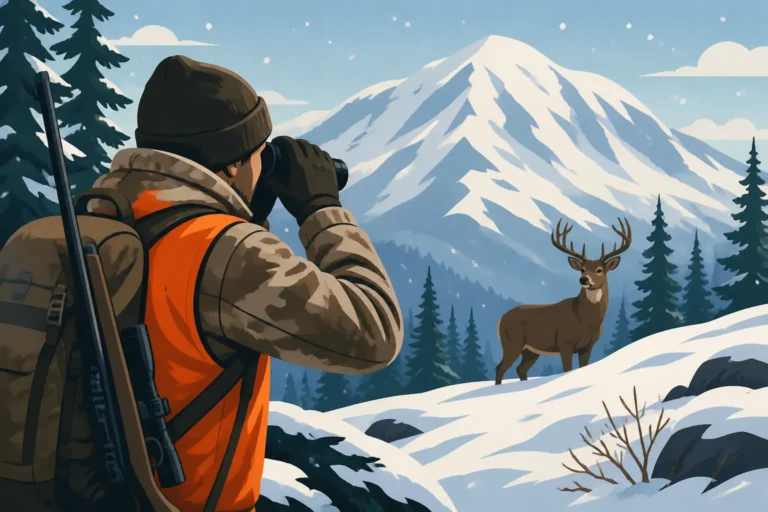
Even in snow, quality optics are essential. Good binoculars, ideally 10×42 or 10×50, are your primary tool for scanning ahead, identifying distant deer, and verifying tracks without having to walk directly to them. Binoculars help you pick apart distant ridges and check for bedded animals in cover before you push too far. In low light, such as early morning or late evening, optics with larger objective lenses (e.g., 50mm) will gather more light, giving you precious extra minutes of visibility.
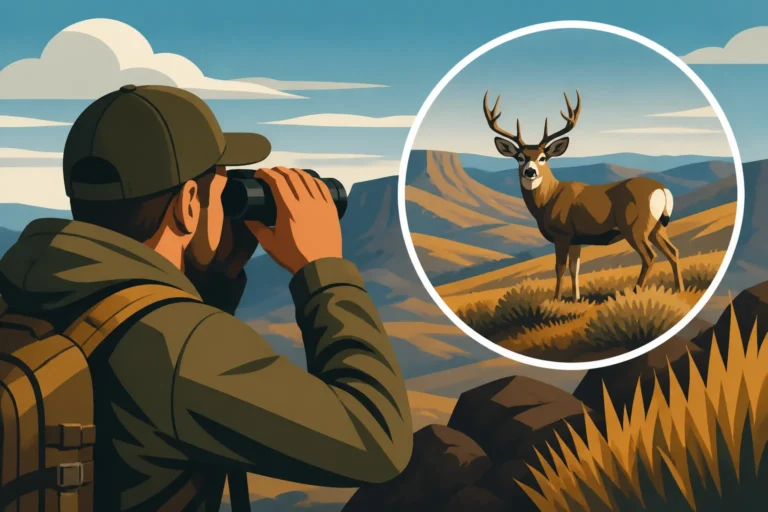
A rangefinder is also a critical piece of gear, particularly in the undulating terrain of Eastern Washington. Snow can make distances deceptive, and angle-compensating rangefinders are invaluable for accurate shot placement on steep slopes. While a spotting scope isn't usually a primary tracking tool, it can be useful for initial Glassing Eastern Washington Breaks for Mule Deer from a distance to pinpoint potential buck activity before you commit to a track.
Navigation and Communication in Remote Snowy Areas
While following tracks can feel intuitive, it's easy to get disoriented, especially if snow obscures familiar landmarks. A reliable GPS unit or a smartphone with a robust mapping app (like onX Hunt or GoHunt) is indispensable. Download offline maps of your hunting area before you lose cell service, which is common in many remote parts of Eastern Washington. Mark your truck, your starting point, and your last known track location.
Beyond navigation, consider communication. Many remote areas lack cell service. A satellite messenger device (like a Garmin inReach or Zoleo) can be a literal lifesaver, allowing you to send messages or trigger an SOS in an emergency. If hunting with a partner, two-way radios can keep you in contact without relying on cell signal. Always remember to tell someone your hunt plan and expected return time. Carrying a small First Aid Kit for a Remote Hunt is also wise, as injuries are always a risk when traversing slick, uneven ground in cold conditions.
Conclusion
Tracking bucks in fresh Eastern Washington snow is an incredible challenge, but one that offers immense rewards. It demands patience, acute observation, and a willingness to learn from every step. By understanding the nuances of snow, deciphering track language, employing methodical tracking techniques, and preparing with the right gear, you can transform a frustrating search into a successful hunt. The snow provides a fleeting opportunity to glimpse into the secret life of a mature mule deer, and with these strategies, you're now better equipped to follow that story to its exciting conclusion.
Disclaimer
Hunting is an inherently dangerous activity. This guide provides general information and recommendations, but individual situations and conditions vary. Always prioritize safety, understand and follow all Washington State hunting regulations, and ensure you have the necessary skills and equipment for your chosen pursuit. The author and publisher are not responsible for any accidents, injuries, or legal infractions that may occur.