Reading Cougar Sign in the Snow
Hunting cougars in Washington has always been a challenging endeavor, made even more so since the ban on using hounds. It often feels like you're searching for a ghost in the vast, dense wilderness, leaving many hunters frustrated and unsure of where to even begin. But when the snow flies and blankets our diverse landscapes, it transforms the hunt, offering a unique opportunity to uncover the secrets of these elusive predators. This guide is all about equipping you with the knowledge to read the language of the snow, deciphering every track and sign to dramatically improve your chances of success in the snowy Washington backcountry.
Why Snow is Your Best Friend for Cougar Hunting in Washington
Let's face it, without the aid of dogs, hunting cougars in Washington is an entirely different beast than it once was. Many hunters who grew up with hounds found themselves at a complete loss after the ban, struggling to adapt to what felt like an impossible task. But nature has a way of helping out, and for cougar hunters, a fresh blanket of snow is the ultimate equalizer, turning an invisible chase into a detective story written across the landscape.
The Post-Hound Ban Reality
For generations, the rhythmic baying of hounds was synonymous with cougar hunting in Washington. Hunters relied on their keen noses and relentless drive to track these powerful cats through dense timber and over rugged terrain. The 1996 statewide initiative I-655 changed all that, making it illegal to hunt cougars with the aid of dogs. This shift fundamentally altered how cougar hunting is approached in our state, pushing hunters to develop new strategies and skills. It's a significant frustration for those who miss the tradition, but it also fosters a deeper connection to the wild and demands a higher level of woodsman-ship.
Suddenly, hunters needed to rely entirely on their own two feet, their eyes, and their understanding of the animal. It became less about pursuing a treed cat and more about understanding the cougar's daily movements, ambush points, and kill sites. Without the vocal guidance of hounds, finding a cougar became an exercise in patience, detailed scouting, and an intimate knowledge of cougar behavior, especially their stealthy movements through familiar territories. The success rates plummeted for many, highlighting the profound impact of the regulatory change and forcing a reevaluation of traditional hunting methods.
Snow Reveals the Unseen
While hunting cougars on bare ground can feel like finding a needle in a haystack, snow changes everything. Every step, every drag, every subtle sign that would normally vanish into the forest duff becomes etched into a pristine canvas. It’s like the forest decided to ink out a detailed map of everything that's passed through, just for you. This visibility isn't just about identifying a track; it's about understanding the cougar's entire story in a particular area.
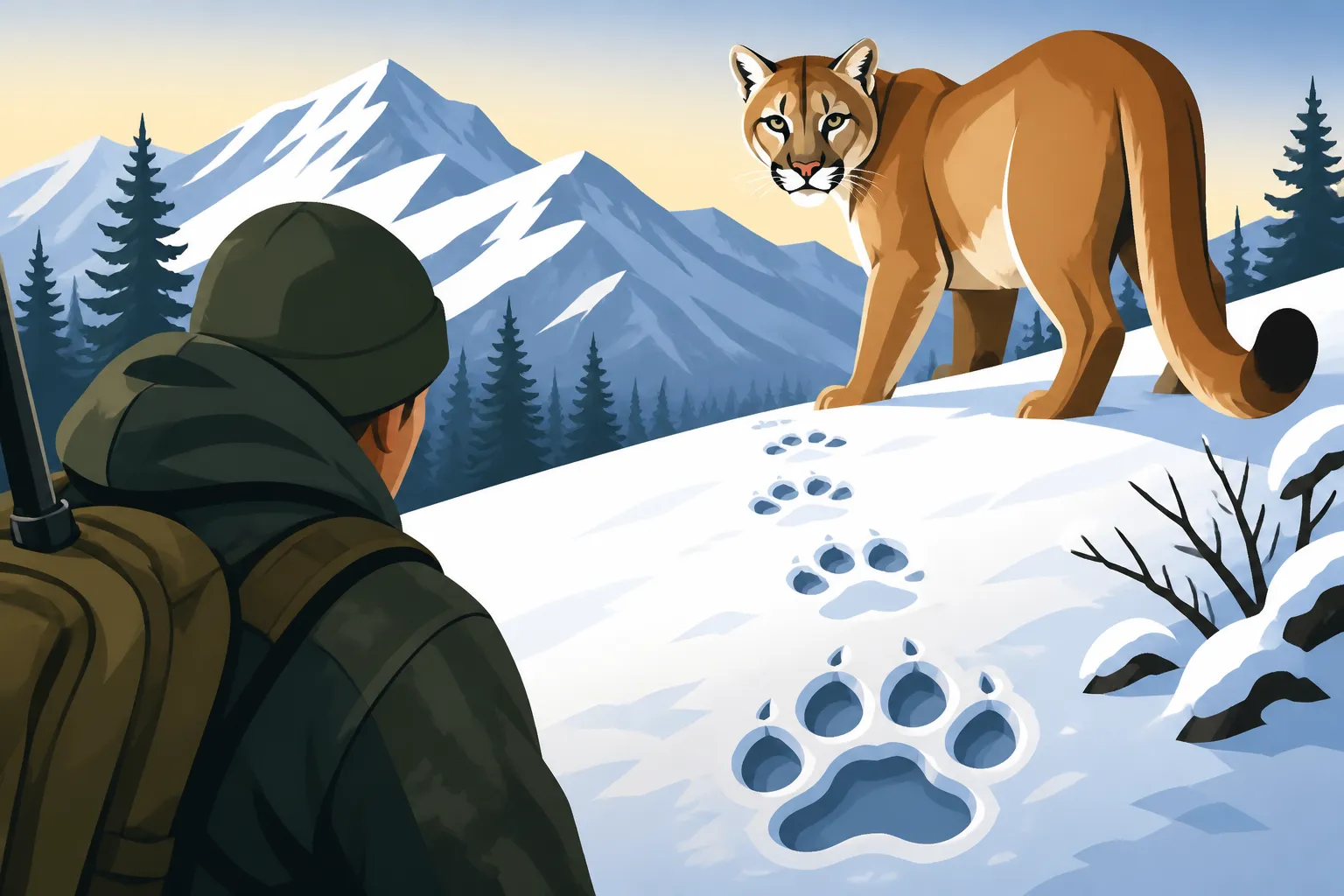
Think about it: on dry leaves or pine needles, a cougar's paw print might be a faint depression that quickly blends with the forest floor. You could walk right past a fresh track and never know it. But in soft, fresh snow, that print is crisp, clear, and unmistakable. You can see the distinct shape of the pads, the absence of claw marks, and the direction of travel with absolute certainty. This stark contrast in visibility is why seasoned cougar hunters often eagerly await the first significant snowfall, knowing it signals the real start of their season.
Moreover, snow doesn't just record tracks; it reveals so much more. The disturbed snow around a cached kill, the subtle spray of urine on a territorial scrape, or the distinct pattern of a bounding cougar chasing prey — these details become glaringly obvious. Without snow, these vital clues are often lost to the elements or simply too subtle for the human eye to detect. It allows hunters to piece together the narrative of a cougar's movements, feeding habits, and even its mood, providing an unparalleled advantage in a hunt where every single piece of information is gold.
Deciphering Cougar Tracks in Fresh Powder
The ability to correctly identify and interpret cougar tracks in the snow is arguably the most important skill for a successful hunt after the hound ban. It's not just about seeing a paw print; it's about understanding what that print tells you about the animal that made it. Learning the nuances between a cougar track and the prints of other animals is your first, most critical step.
Identifying a Cougar Track vs. Other Animals
When you first stumble upon tracks in the snow, your mind will race. Is it a cougar? A coyote? A bobcat? A dog? Knowing the tell-tale signs is paramount. A cougar track is generally quite round, wider than it is long, and exhibits a clear asymmetry. The two leading toes are typically slightly ahead of the two outer toes. Critically, you will almost never see claw marks in a cougar track unless the cat was slipping, climbing, or had just leaped, as their claws are retractable. The most definitive feature is the heel pad, which has a distinctive M-shape or three distinct lobes at the rear.
In comparison, canine tracks – whether from a domestic dog or a wild coyote – are usually more oval, symmetrical, and almost always show prominent claw marks. Their heel pad is typically a single, large lobe. For hunters specifically dealing with coyotes, understanding their tracks can also be helpful for Coyote Density in Eastern Washington. Bobcat tracks, while also lacking claw marks, are significantly smaller than cougar tracks and often appear even rounder, almost perfectly circular, with a different heel pad shape. It takes practice to develop a keen eye for these differences, often best done by following various tracks and observing how they differ in size and shape.
The size of a cougar track can vary, of course, depending on the age and sex of the animal. A mature tom (male cougar) will leave a track upwards of 4-5 inches long, while a female's track might be 3-4 inches, and a juvenile's smaller still. But regardless of size, the fundamental characteristics of no claws, asymmetry, and that specific heel pad remain consistent. Pay close attention to the overall impression, the amount of displaced snow, and how the toes register relative to each other. Don't be fooled by unusual gaits or conditions that might obscure some details; look for the complete picture presented by multiple tracks.
Reading Stride, Gait, and Direction
Once you've confidently identified a cougar track, the next step is to understand what the cat was doing and where it was going. This involves interpreting its stride, gait, and the subtle cues that indicate direction. Cougars, like most cats, often employ a "direct register" gait when walking. This means their hind foot lands almost directly into the impression made by their front foot. This creates a single line of tracks, which can sometimes give the false impression of a smaller animal or even fewer animals than actually passed through. It’s a remarkable adaptation for stealth, but in snow, it becomes a crucial detail to recognize.
Different gaits tell you different stories about the cougar's intent. A steady, purposeful walk with direct register often indicates casual travel or hunting. A trot, where the pattern becomes more distinct and spread out, suggests a faster pace, perhaps moving between hunting areas. When a cougar bounds or gallops, you'll see a clustered pattern of all four feet hitting the ground in rapid succession, often indicating they were spooked, escaping, or making a rapid pursuit of prey. Recognizing these patterns can give you vital clues: if the tracks suddenly shift from a walk to a bound, it might indicate an encounter with another animal or a sudden burst of speed towards potential prey. These principles are very similar to what you’d look for when Tracking a Buck After a Fresh Snow.
Determining the direction of travel from a trackline is usually straightforward but can be tricky in certain snow conditions. Look for the way the snow is pushed up or displaced; the larger pile of snow will typically be at the back of the print, pushed forward by the foot. The pointed toes will also generally face the direction of travel. In soft snow, you might also notice a subtle "drag" mark from the dewclaws or the underside of the foot just before the print, always pointing in the direction the animal came from. Paying attention to the entire track pattern, the orientation of the pads, and any scuff marks will confirm the animal's path, allowing you to confidently follow its trail.
Beyond Tracks: Other Crucial Cougar Sign
While tracks are undoubtedly the most obvious sign in the snow, cougars leave behind a variety of other clues that can be just as important, if not more so, for understanding their presence and activities. Learning to recognize these additional signs provides a more complete picture of a cougar's behavior and habits in a given area.
Scat, Scrapes, and Urinates
Cougar scat offers a direct glimpse into their diet and health. Unlike canine scat, which is often deposited indiscriminately, cougar scat is typically segmented, tubular, and dense, usually containing visible hair, bone fragments, and sometimes even teeth from their prey. In snowy conditions, you might find it on top of the snow, or more commonly, partially buried or scraped over, especially by females. Finding fresh scat can confirm a cougar's recent presence and give you an idea of what they've been eating, which in turn can inform your search for their preferred prey species in the area. The size of the scat can also hint at the size of the cat.
Scrapes are another vital territorial marker that cougars frequently use, and they become especially obvious in snow. A cougar scrape is a pile of dirt, leaves, or snow that the cat creates by scraping its hind feet backward. They'll often urinate on or near these scrapes, using them as scent posts to communicate with other cougars. In snow, these scrapes stand out as clear disturbances, often with a distinct "kick-back" pattern where the snow has been piled. Finding a fresh scrape tells you that a cougar is actively patrolling that area and asserting its presence. These are often found along ridge lines, game trails, or near prominent features.
Urinates, while less distinct than scrapes, are also important. Cougars often urinate in specific spots, especially males, to mark their territory. In snow, a fresh urinate will stain the snow a yellowish color, and you might even see the impression of the snow being disturbed as the urine hits it. Like scrapes, these are often found along travel corridors or in areas where a cougar might want to advertise its presence to rivals or potential mates. The combination of fresh tracks, recent scat, and active scrapes provides undeniable proof of a cougar's recent activity and presence.
Kill Sites and Caches
Finding a cougar kill site is like hitting the jackpot; it confirms a cougar is actively hunting and feeding in that specific area, which is precisely what you need to know to Find a Cougar Track Without Hounds. Cougars are opportunistic predators, but their primary prey in Washington consists of deer and elk, making Cougar Predation on Washington Deer Herds a significant factor in some areas. A fresh kill site will show signs of a struggle, often with scattered hair, disturbed snow, and distinct cougar tracks leading to and from the carcass. Look for signs of a broken neck, which cougars often use to dispatch their prey, and distinct puncture marks on the back of the neck or skull.
One of the most characteristic cougar behaviors is caching their kills. After making a kill, especially a large one like an elk, a cougar will often cover the carcass with snow, leaves, branches, or dirt to protect it from scavengers. In the snow, a cache appears as a mound or disturbed area where the snow has been piled over the prey. You might see parts of the carcass still exposed, or you might only see the subtle bulge in the snow. Fresh tracks will invariably lead to and from the cache, indicating the cougar has recently visited to feed.
If you discover a fresh kill or cache, it presents an incredible opportunity. The cougar will almost certainly return to feed, often multiple times over several days. Ethical considerations are key here: respect the kill, don't disturb it more than necessary, and understand the regulations regarding hunting near bait. This discovery allows you to set up strategically, perhaps observing the area from a distance or planning a still-hunt through the surrounding cover, knowing you are in an active cougar territory. Patience and a quiet approach are paramount when hunting a kill site.
Ageing Tracks and Understanding Snow Conditions
Determining how fresh a cougar track or sign is in the snow is crucial for successful hunting. A track from yesterday might be too cold to follow effectively, while a track from an hour ago is prime. Various factors influence how long a track remains "fresh," and understanding these nuances will sharpen your ability to interpret the story written in the snow.
Factors Affecting Track Age
The lifespan of a track in snow is highly dependent on environmental factors. Fresh snowfall is perhaps the most significant. If new snow falls on top of existing tracks, it effectively creates a timestamp. A track in the top layer of fresh powder means the animal passed through after the last snowfall. If you see old tracks buried under a new dusting, you know the cougar was there before the fresh snow arrived, making that track significantly older and less useful for an immediate hunt.
Beyond new snow, sun exposure is a major culprit for track degradation. Direct sunlight will cause the edges of a track to melt and soften rapidly, even if the air temperature is below freezing. Tracks in shaded areas, like under dense timber on a north-facing slope, will retain their crispness for much longer. Wind also plays a role, eroding fine details and filling in tracks with drifting snow, making them appear older than they are. Lastly, temperature fluctuations, especially freeze-thaw cycles, can drastically alter a track. A track made in soft snow that then freezes solid will retain its shape, but a track made in cold, powdery snow that then experiences a warm spell will melt and deform quickly.
The crispness of the track's edges is your primary indicator of age. A truly fresh track, made within the last few hours, will have sharp, defined edges and a clear impression of the paw pads. As time passes, the edges will soften, become more rounded, and lose definition. The amount of loose snow inside the print can also be a clue; a very fresh print might have tiny, undisturbed snow crystals, while an older print might have more consolidated or wind-blown snow. It's a skill refined through experience, constantly comparing what you see in the field with the prevailing weather conditions.
Interpreting Track Depth and Melt
The depth of a cougar track can offer clues about the animal's weight, its speed, and even the type of snow it was moving through. A deep track in soft, powdery snow could indicate a heavy, mature cougar, especially if it's walking. If the same depth appears for a much shorter stride, it might suggest the cougar was moving at a faster pace, perhaps bounding or galloping, impacting the snow with more force. However, always consider the snow type; a light cougar in deep, fluffy powder might leave a deeper track than a heavy cougar on firm, crusted snow.
Melt and refreeze cycles are the bane of accurate track aging but also offer unique insights. When a track partially melts and then refreezes, it can create a crust around the edges, or even within the print itself, sometimes making it appear older or different than it actually is. These "ghost" tracks are particularly tricky – faint depressions from previous snow layers that have partially melted and refrozen. They can sometimes look like very old, shallow prints from a recent passage, but closer inspection will reveal the crystalline structure of ice rather than fresh snow, or a clear lack of displaced powder.
The key to navigating these complex conditions is cross-referencing all available information. Don't rely on a single track. Look for multiple prints, observe the overall pattern, and check for associated signs like scat or scrapes. Consider the aspect of the slope, the density of the timber, and how these factors influence snow conditions and melt rates. By combining your knowledge of track characteristics, environmental factors, and careful observation, you can build a more accurate timeline of the cougar's presence, improving your chances of finding an actively moving animal.
Strategic Scouting and Hunting with Snow Sign
Once you're adept at reading cougar sign in the snow, it's time to put that knowledge into action. This isn't just about aimlessly wandering; it's about strategic scouting, knowing where cougars are likely to travel, and understanding how to follow a trackline with precision and patience. The snow helps you, but your planning and approach will seal the deal.
Utilizing Topography and Travel Corridors
Cougars are creatures of habit and efficiency. They tend to travel along the paths of least resistance that also offer cover and proximity to prey. In Washington, this means focusing your efforts on ridge lines, benches, dense timber, and the edges of drainages. These areas provide elevated vantage points for hunting, protective cover, and natural corridors for movement. When snow covers the ground, these travel corridors become even more pronounced. You'll often find clear tracklines following game trails along ridges, dropping into saddles, or paralleling a creek bottom.
It's absolutely essential to focus your scouting on areas with high concentrations of deer or elk. Cougars are primarily predatory and will follow their food source. So, if you're finding good sign of healthy deer or Elk Behavior in Deep Snow in a particular area, it's highly probable a cougar is also working that country. Modern mapping tools, like those found on GoHunt or onX Hunt, become indispensable here. You can identify potential travel routes, pinch points, dense cover, and known wintering grounds for deer and elk from your home, significantly narrowing down your search before you even step foot in the snow. This type of E-Scouting a Washington GMU From Home can save you countless hours of unproductive hiking.
Look for areas where different habitat types meet, such as the edge of a clearcut meeting old growth timber, or a dense reprod stand bordering more open country. These "edge habitats" are often prime hunting grounds for cougars, providing both cover and access to prey. Consider the prevailing wind direction; cougars often travel with the wind in their face or crosswind to catch scent, so factor this into your approach. By understanding both the cougar's preferred topography and their prey's habits, you can strategically pinpoint the most likely areas to cut a fresh track.
Following a Trackline and Patience
Once you've cut a fresh cougar track, the real work begins. Following a trackline is a methodical, slow process that demands immense patience and attention to detail. Your primary goal is to remain undetected and avoid contaminating the area around the tracks. Move slowly, always looking ahead for the next print, and constantly scanning the surrounding cover for the cougar itself. It's often helpful to have a second person, if possible, where one person follows the track and the other scans ahead and to the sides, similar to setups used for Calling Cougars Without Dogs in Washington.
There will be times when the track seems to vanish – perhaps the cougar jumped over a log, crossed a patch of bare ground, or moved into extremely dense brush. Don't panic. Expand your search pattern in ever-widening circles from the last confirmed track. Look for subtle disturbances, broken branches, or even faint impressions in areas with minimal snow. Patience is your most valuable asset here. You might spend hours following a trackline only to lose it, only to find it again a short distance away. This slow, deliberate pace, akin to Still-Hunting Pace in Wet Brush, allows you to pick up on nuances you'd miss if you rushed.
Always be prepared for the long haul. A cougar track can lead you for miles over incredibly rugged terrain. Pack plenty of water, high-energy snacks, and emergency gear. Pay attention to the time of day and your distance from your vehicle or camp. Turning back is always an option if conditions become unsafe or you're running out of daylight. Remember, the goal is to ethically harvest an animal, not to get lost or injured. Tracking a cougar in the snow is an immersion into the wild, a true test of your hunting skills, and an experience you won't soon forget.
When and Where to Focus Your Efforts
Timing is everything when it comes to finding cougar sign in the snow. The absolute best time to track is immediately after a fresh snowfall, especially if it's followed by clear, cold weather. This provides a pristine canvas for new tracks and ensures any tracks you find are relatively fresh. Early morning, after a cold night, is also prime, as tracks from the previous evening or night will be crisp and clear. A period of sustained cold will also preserve tracks longer, making it easier to determine their age and follow them for extended periods. This is an important consideration for your Washington Cougar Season and Harvest Guidelines.
When it comes to specific locations, focus your initial efforts on north-facing slopes and in dense, dark timber. Snow tends to last longer in these areas due to less direct sunlight, meaning older tracks will be better preserved and fresh tracks will remain crisp for longer. These areas also provide critical cover for cougars and often serve as bedding areas or travel corridors between hunting grounds. Additionally, concentrating your search in areas known for wintering deer or elk herds is a no-brainer. Cougars will inevitably be where their food is.
Ultimately, hunting cougars with snow sign is a blend of scientific observation, strategic planning, and old-fashioned persistence. By understanding the distinct characteristics of cougar tracks, interpreting other signs like scat and kill sites, and factoring in the dynamic nature of snow conditions, you equip yourself with the tools to unravel the mysteries of Washington's most elusive big cat. It's a challenging but incredibly rewarding pursuit, and the snow provides the perfect opportunity to become a true predator detective.
| Track Feature | Cougar | Coyote | Bobcat |
|---|---|---|---|
| Overall Shape | Round, slightly wider than long | Oval, elongated | Very round, almost circular |
| Claw Marks | Almost always absent (retractable) | Usually present, prominent | Almost always absent (retractable) |
| Toe Symmetry | Asymmetrical (two leading toes) | Symmetrical | Asymmetrical (two leading toes) |
| Heel Pad Shape | M-shaped, 3 distinct lobes at rear | Single, large, heart-shaped lobe | Kidney-bean shaped, two lobes at rear |
| Size (Adult) | 3-5 inches long, 3-5 inches wide | 2.5-3.5 inches long, 2-2.5 inches wide | 1.5-2.5 inches long, 1.5-2.5 inches wide |
| Gait (Direct Reg.) | Often direct register, single line look | Staggered, often slightly offset | Often direct register, single line look |
| Snow Displacement | Clean, crisp edges | More spread, often with claw marks | Clean, crisp edges |
Disclaimer
The information provided in this guide is for educational and informational purposes only. Hunting regulations, seasons, and access rules in Washington can change. Always consult the most current Washington Department of Fish and Wildlife (WDFW) regulations pamphlet and relevant land management agency rules before planning any hunting trip. Hunter safety is paramount; always hunt ethically and responsibly.