Bullet Weight and Construction for Elk
Choosing the right bullet for elk in Washington can feel like an overwhelming task. With so many calibers, weights, and constructions on the market, it’s easy to get lost, especially when you consider the sheer size and resilience of these animals, from the coastal Roosevelt bulls to the Rocky Mountain giants of the east. This guide is here to cut through the noise, helping you understand the critical role bullet weight and construction play in ensuring a clean, ethical harvest, no matter where your Washington hunt takes you.
Understanding Elk Physiology and Bullet Needs
Elk are magnificent animals, but they are also incredibly tough, built with dense muscle, heavy bones, and a thick hide. This isn't like shooting a whitetail. A poorly performing bullet can lead to a long, frustrating, and often unsuccessful tracking job, which is something no hunter ever wants. We owe it to these animals to put them down quickly and humanely, and that starts with understanding their physical makeup and how a bullet needs to perform to achieve that.
The Challenge of Roosevelt vs. Rocky Mountain Elk
Washington is unique in that we have both Roosevelt and Rocky Mountain elk populations. While their core anatomy is similar, the Roosevelt elk, particularly those on the wet, brushy west side, tend to be physically larger, often carrying more sheer mass and denser bone structure, especially in the shoulder and skull. This means a bullet needs to penetrate through a significant amount of tissue, and potentially heavy bone, to reach vital organs.
Rocky Mountain elk, found east of the Cascades, might be slightly smaller in body size on average, but they are still robust animals. The challenge with Rocky Mountain elk often lies in the varied terrain—from open sagebrush to dark timber—which dictates different shot angles and distances. Regardless of the subspecies, you're dealing with an animal that can weigh well over 600 pounds, sometimes pushing 800 pounds for a big bull. Your bullet absolutely has to be up to the task of breaking through that protective layer to deliver the killing blow. This isn't the time to skimp or assume a deer bullet will do the job.
Understanding the Anatomy for Shot Placement
A thorough understanding of elk anatomy is crucial, not just for shot placement but for appreciating why bullet performance matters so much. The vital organs—heart, lungs, and major arteries—are nestled behind a formidable bone structure, particularly the scapula (shoulder blade). A frontal shot can encounter the heavy bone of the humerus or sternum. A quartering-away shot still requires punching through ribs and possibly the diaphragm.
The goal of any ethical shot is to disrupt the central nervous system or cause massive hemorrhaging in the thoracic cavity, leading to rapid blood loss and incapacitation. This requires a bullet that can retain enough mass and energy to penetrate deeply, even after encountering bone, and then expand reliably within the vitals to create a large wound channel. A bullet that fragments too early or fails to expand will simply wound, leading to a much harder recovery and undue suffering for the animal. Shot Placement on a Quartering Elk is a great resource to really dial in those target zones.
Bullet Weight: Finding the Sweet Spot
Bullet weight is one of the most debated topics among hunters, and for good reason. It directly influences a bullet's ballistic coefficient, its retained energy downrange, and its ability to penetrate. For elk, you generally want to lean towards the heavier end of the spectrum for your chosen caliber to ensure sufficient penetration and momentum.
Light vs. Heavy for Different Calibers
When we talk about light versus heavy, it's always relative to the caliber. For instance, a 150-grain bullet might be considered light for a .30-06 Springfield, but it's on the heavier side for a .270 Winchester. Generally, for elk, you want to use bullet weights that are at the upper end of what your cartridge can stabilize and shoot accurately.
For common elk calibers:
- .270 Winchester: Think 140-160 grains. Anything lighter can struggle with penetration on big bulls.
- .308 Winchester: 165-180 grains are excellent choices.
- .30-06 Springfield: 180-200 grains provide outstanding performance.
- .300 Winchester Magnum: 180-200+ grains are ideal, taking advantage of the magnum's velocity.
- 7mm Rem Mag: 160-175 grains are perfect for this flat-shooting magnum.
- 6.5 PRC/Creedmoor: You'll want to be at the heavier end, 140-156 grains, and pair it with a premium bullet construction designed for tough game.
Going too light, even with a magnum, increases the risk of the bullet fragmenting prematurely on bone or not penetrating deep enough to reach the far lung on a broadside shot, especially if you hit the shoulder.
Balancing Kinetic Energy and Momentum
This is where the physics gets interesting. Kinetic energy (KE) is what causes tissue damage and hydrostatic shock, while momentum (MV) is what drives the bullet through obstacles like bone and muscle, ensuring deep penetration. Faster, lighter bullets might initially have higher KE, but they shed velocity and energy quicker. Heavier bullets, even at slightly lower initial velocities, tend to retain more momentum downrange.
For elk, you need a balance of both. A bullet with good momentum will punch through the hide and muscle, often breaking bone, before expanding and transferring its kinetic energy to the vitals. This is particularly important if you're hunting Roosevelt elk in dense timber where shots can be close and angles steep. The bullet needs to power through a lot of material. Resources like GoHunt often publish detailed ballistic data for various bullet weights and calibers, which can be invaluable for comparing how different loads perform downrange. It's not just about the muzzle velocity, it's what the bullet is doing when it hits the animal.
Recoil and Shootability
It's tempting to think that bigger is always better, but a heavy bullet in a powerful magnum can produce significant recoil. If you flinch or struggle to maintain accuracy because of recoil, then the "best" bullet is useless. An accurately placed shot with a slightly lighter, but still suitable, bullet trumps a poorly placed shot with the heaviest bullet available.
When considering bullet weight, be realistic about your comfort level and skill with your rifle. A good rule of thumb is to choose a weight that allows you to confidently place all your shots within a 4-inch circle at your maximum expected hunting range. Practice is key here, and if a heavier bullet makes you anticipate the shot, you might be better off dropping down a few grains or exploring recoil reduction options for your rifle. Remember, Rifle Setup for Washington Elk and Deer isn't just about the rifle; it's about the entire system, including you.
Bullet Construction: Key Designs for Elk
While weight dictates penetration potential, bullet construction dictates how that penetration happens and how the bullet performs once it's inside the animal. This is perhaps even more critical for elk than bullet weight alone. A bullet designed for thin-skinned deer will likely fail to perform adequately on a large bull elk.
Bonded Bullets: Holding Together
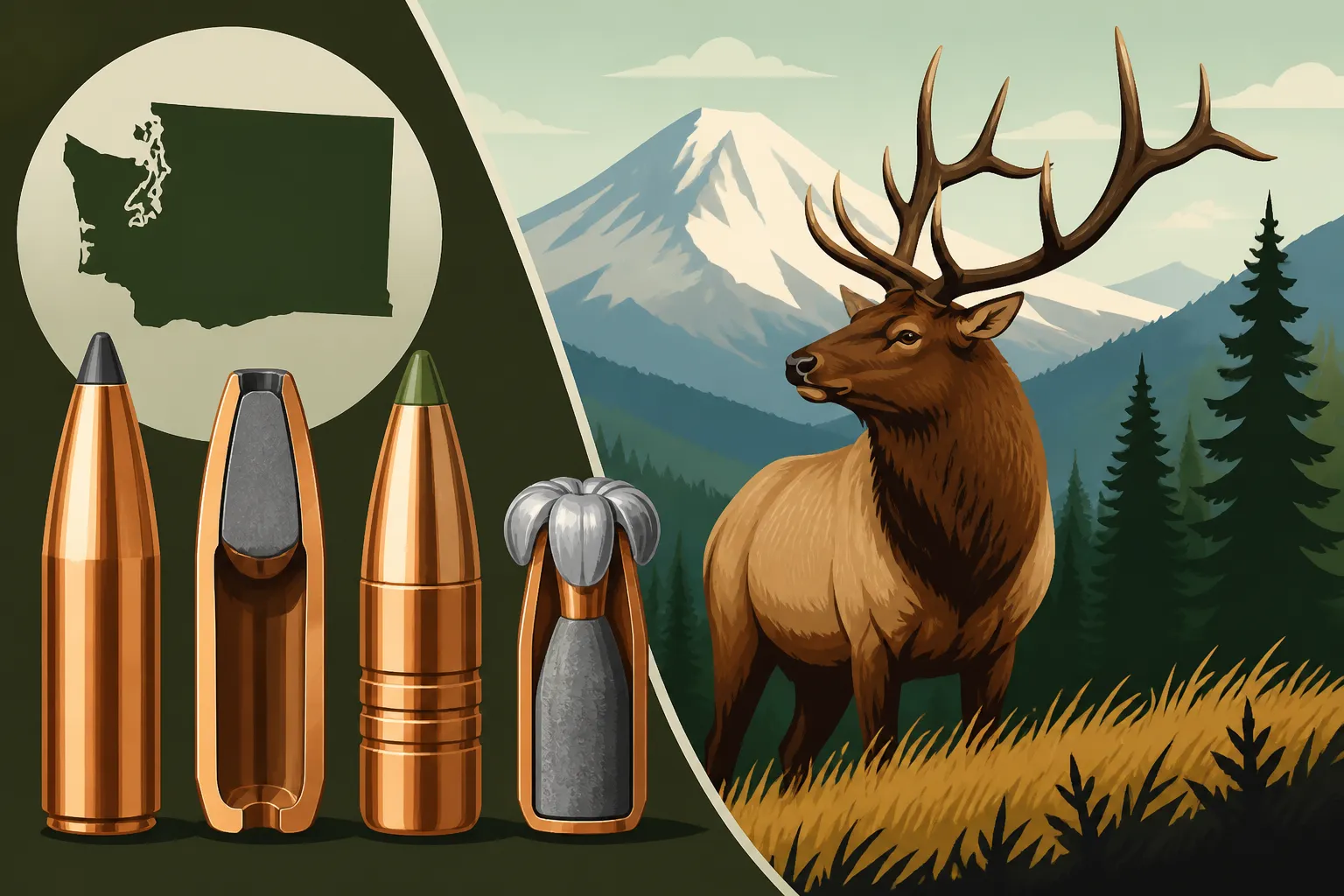
Bonded bullets are a fantastic choice for elk. In these designs, the lead core is molecularly bonded to the copper jacket, either entirely or partially. This strong bond prevents the core from separating from the jacket, which is a common failure point for traditional cup-and-core bullets when they hit heavy bone or muscle.
What you get with a bonded bullet is controlled expansion and excellent weight retention. They'll typically expand to 1.5 to 2 times their original diameter, creating a wide wound channel, but because the core and jacket stay together, they continue to drive deep, ensuring pass-throughs and maximum damage to vital organs. Popular examples include Federal Trophy Bonded Tip, Nosler AccuBond, Hornady InterBond, and Swift Scirocco II. These are often my go-to for tough animals like elk, especially if I'm hunting in areas like the Colockum or Yakima units where shot opportunities might be fleeting and you need complete confidence in your projectile.
Monolithic Solids: Deep Penetration
Monolithic bullets are machined from a single piece of metal, typically copper or a copper alloy, with no lead core. Because there's no lead to separate, they boast near 100% weight retention. This makes them absolute penetrators, often driving through the entire animal, even with heavy bone impacts. They typically expand via petals that peel back, creating a sharp cutting edge and a good wound channel.
Monolithics shine when deep penetration is the absolute priority, such as when targeting the incredibly dense muscle and bone of a large Roosevelt bull or when facing severe quartering shots. Examples include Barnes TSX, TTSX, and LRX, Hornady GMX, and Federal Terminal Ascent. It’s worth noting that monolithic bullets often perform best when driven at higher velocities, so they are particularly effective in magnum cartridges or when selecting the lighter end of the acceptable weight range for your caliber to maximize speed. GoHunt's cartridge guides often highlight bullet speeds, which is a key factor for these designs.
Partitioned and Hybrid Designs
Partitioned bullets, like the iconic Nosler Partition, have been a gold standard for elk and other large game for decades. They feature a lead core divided by a copper partition, creating two distinct sections. The front section is designed to expand rapidly, creating hydrostatic shock and a wide wound channel, while the rear section, protected by the partition, remains intact to ensure deep penetration. This "two-in-one" approach offers both impressive tissue damage and reliable penetration.
Hybrid designs take elements from various constructions. For instance, some modern bullets might have a bonded front section for expansion and a solid rear shank for penetration, or a polymer tip to initiate expansion at lower velocities while maintaining a high ballistic coefficient. The idea is to optimize performance across a wider range of velocities and impact scenarios. These innovations continue to push the boundaries of what's possible, providing hunters with even more reliable options for taking down tough game like Washington's elk. Bullet Weight for Elk Versus Deer delves deeper into why these robust constructions are so important for elk.
Matching Your Bullet to Washington's Terrain
Washington offers a diverse range of hunting environments, from the dense, wet forests of the Olympic Peninsula to the wide-open, arid breaks of Eastern Washington. The terrain you hunt in can, and should, influence your bullet choice, as shot distances and the likelihood of hitting brush or bone vary significantly.
Heavy Cover and Close Shots
If you're still-hunting for Roosevelt Elk of Western Washington in dark timber or thick reprod, your shots are likely to be up close and personal, often within 100 yards, and potentially through light brush. In these scenarios, bullet stability and controlled expansion at high impact velocities are crucial. A bullet that's too fragile can blow up on the shoulder bone at close range, failing to penetrate to the vitals.
For these conditions, a tough, bonded or partitioned bullet is an excellent choice. Their ability to hold together and drive deep after hitting bone is invaluable. Even a monolithic bullet can be a great option, though its expansion might be less dramatic at lower impact velocities. What you don't want is a bullet designed for long-range, high-velocity fragmentation, as it will likely fail prematurely on close-range, high-impact shots. You want something that will consistently punch through.
Long-Range Across Open Valleys
Hunting Rocky Mountain elk in the more open country of Eastern Washington, like parts of the Blue Mountains or the Okanogan, often involves longer shots where ballistic performance becomes more critical. Here, a bullet that retains velocity, has a high ballistic coefficient (BC), and expands reliably at lower impact velocities is desirable. You might be shooting across a canyon at 300-400 yards, maybe even further, and the bullet will have slowed down significantly.
For these longer-range situations, bullets with sleek, aerodynamic profiles and designs that ensure expansion even after considerable velocity loss are key. Many modern hunting bullets incorporate polymer tips to aid expansion at lower speeds. Monolithic bullets, especially those with advanced tip designs, also perform very well here due to their excellent weight retention and deep penetration. Checking ballistic tables, perhaps using a tool like those found on GoHunt, can help you visualize how different bullets perform at extended ranges, ensuring you select one that remains effective at the distances you anticipate shooting.
Terminal Performance: What Happens Downrange
The true test of any hunting bullet happens when it impacts the animal. This is "terminal performance"—how the bullet behaves inside the elk. We're looking for a combination of factors that lead to a quick, humane kill: controlled expansion, deep penetration, and efficient energy transfer.
Controlled Expansion: The Ideal Outcome
Controlled expansion is the holy grail for elk bullets. This means the bullet expands to a larger diameter, typically 1.5 to 2 times its original size, but does so predictably and without fragmenting excessively or blowing up on the surface. This expansion creates a wider wound channel, damaging more tissue as it passes through the vitals.
Bullets that expand too rapidly or fragment into tiny pieces can create impressive initial damage but often lack the retained mass to penetrate deeply enough. Conversely, bullets that don't expand at all (solid non-expanding bullets are generally illegal or strongly discouraged for ethical reasons in most big game hunting) act like ice picks, causing minimal tissue damage despite deep penetration. The perfect balance ensures a devastating wound channel through the lungs and heart without sacrificing the depth needed to hit those critical organs.
Deep Penetration for Pass-Throughs
While expansion creates a wide wound, deep penetration is what truly reaches the vitals and ensures a quick kill. Ideally, you want a pass-through shot, meaning the bullet exits the far side of the animal. Why? A pass-through creates two holes—an entry and an exit—which typically leads to a better blood trail, making tracking much easier, especially in thick Washington brush or challenging terrain.
Moreover, deep penetration ensures that if the bullet encounters a rib, shoulder bone, or even the off-side leg bone, it still has enough energy and integrity to push through and do its job. This is where bonded, monolithic, and partitioned bullets really earn their keep. They're designed to maintain mass and drive forward, even after impacting tough resistance, guaranteeing that they hit the target organs rather than deflecting or stopping prematurely. Blood Trailing in Salal and Devil's Club is tough enough with a good blood trail, you don't want to make it harder with a non-exit wound.
Energy Dump and Hydrostatic Shock
When a bullet impacts an animal, it transfers energy. This energy transfer, especially at higher velocities, can create "hydrostatic shock"—a temporary cavity of displaced tissue that extends beyond the permanent wound channel. While the long-term effects of hydrostatic shock are debated, it's generally accepted that it can contribute to rapid incapacitation by disrupting the nervous system.
A bullet that expands well and penetrates deeply maximizes this energy transfer within the vitals. The goal isn't just to poke a hole; it's to create as much damage as possible within the thoracic cavity, causing rapid depressurization of the lungs, massive blood loss, and systemic shock. The combination of a wide, permanent wound channel, deep penetration through vital organs, and the effects of hydrostatic shock is what brings an elk down quickly and humanely.
Practical Considerations and Testing
Theory is one thing, but practical application is another. Choosing the right bullet also involves considering factors like accuracy with your specific rifle, the importance of testing, and the overall cost and availability of your chosen ammunition. Don't overlook these details; they can make or break your hunt.
Accuracy is Paramount
You could have the most technologically advanced, perfectly constructed elk bullet in the world, but if your rifle doesn't shoot it accurately, it's useless. An ethical shot requires precision. A bullet that delivers 1-inch groups at 100 yards is far superior to a bullet that's theoretically "better" but only groups at 4 inches.
Every rifle is a law unto itself. What shoots wonderfully in one .30-06 might pattern terribly in another identical rifle. This means you must test different bullet weights and brands in your rifle. Don't just buy a box and head to the woods. Get to the range, shoot from a solid bench rest, and determine which load gives you consistent, repeatable accuracy. A good rule of thumb for elk is to be able to keep all your shots within a 6-inch circle at your maximum ethical hunting range. Ideally, you want much tighter groups than that for confidence.
Testing and Practice
Once you've found a bullet that your rifle loves, the work isn't over. You need to practice with it extensively. Shoot from various positions you might encounter in the field—sitting, kneeling, offhand, using a pack as a rest. Practice at different distances, especially those beyond your comfort zone, to understand bullet drop and wind drift. Sighting In Before the Opener is non-negotiable, and regular practice throughout the year is how you build confidence.
Simulate hunting conditions as much as possible. If you hunt in cold, wet weather, try shooting on a chilly, damp day. Understanding how your rifle and ammunition perform under various stresses, and how you perform, is critical. A reliable source like GoHunt might offer articles on range training tips or guides to understanding ballistic calculators, which can help you prepare for real-world hunting scenarios. This testing isn't just about the bullet; it's about the entire system, with you at the center.
Cost and Availability
Premium elk ammunition isn't cheap. These advanced bullet designs require specialized manufacturing processes, and that's reflected in the price. However, consider it an investment in an ethical and successful hunt. The cost of a few boxes of premium ammunition pales in comparison to the time, effort, and money invested in a Washington elk hunt.
Availability can also be a factor, especially in popular calibers or during peak hunting season. It's always a good idea to buy your ammunition well in advance of the season, giving you plenty of time to test it and ensure you have a sufficient supply. Don't wait until the last minute and be forced to choose an unfamiliar or sub-optimal load. Having a backup option in mind, one that also shoots accurately from your rifle, isn't a bad idea either, just in case your preferred bullet becomes scarce.
Comparing Popular Elk Bullet Constructions
To help visualize the differences we've discussed, here's a quick comparison of some common bullet constructions suitable for elk.
| Construction Type | Key Feature | Weight Retention | Expansion | Penetration | Best For |
|---|---|---|---|---|---|
| Traditional Lead-Core | Lead core swaged into copper jacket (e.g., Core-Lokt) | Low-Moderate | Rapid, sometimes uncontrolled | Moderate | Deer, lighter game; generally not ideal for elk |
| Bonded | Lead core chemically fused to copper jacket | High | Controlled, reliable | Deep | All-around elk hunting, especially in varied terrain |
| Partitioned | Lead core divided by internal copper partition | High | Two-stage: rapid front, deep rear | Very Deep | Large, tough game like elk; excellent all-rounder |
| Monolithic | Single piece of copper or copper alloy | Near 100% | Controlled via petals | Extremely Deep | Heavy bone, severe angles, maximum penetration |
| Hybrid Designs | Combines features (e.g., polymer tip, bonded rear) | High | Optimized for range/velocity | Deep | Specific performance niches, often long-range |
This table provides a general overview, but remember that specific designs within each category can vary. Always refer to the manufacturer's recommendations and, most importantly, test them in your rifle!
Ultimately, choosing the right bullet weight and construction for your Washington elk hunt is a personal decision, but it's one that should be informed by a deep understanding of ballistics and terminal performance. Don't underestimate the resilience of an elk, and equip yourself with ammunition that gives you the best chance for a quick, ethical, and successful harvest. Whether you're chasing Rocky Mountain Elk East of the Washington Cascades or big Roosevelt bulls, the right bullet makes all the difference.
Disclaimer
This article is for general informational purposes only and does not constitute professional advice. Laws, prices and regulations vary by location and change over time. Consult a qualified professional for guidance on your specific situation.