Rangefinder Angle Compensation
There’s nothing quite like the heart-pounding moment when a Washington elk steps into an opening, or a blacktail buck materializes on a clearcut. You’ve ranged the distance, you know your hold, and you settle the crosshairs. But what if that distance you just ranged isn't the real distance your bullet or arrow needs to travel? In Washington’s incredibly diverse and often steep terrain, from the rugged slopes of the Cascades to the deep coulees of the eastside, ignoring angle compensation can be the difference between a clean harvest and a frustrating miss. This guide is all about understanding why those steep uphill and downhill shots can play tricks on your trajectory and how modern rangefinders with angle compensation are a crucial tool to make sure your shot is true, no matter the slope.
The Challenge of Washington's Topography for Hunters
Washington is a state of extremes when it comes to terrain. One minute you're still-hunting through relatively flat timber, the next you're peering down into a canyon hoping to spot a mule deer, or climbing a near-vertical clearcut after a Roosevelt elk. This ever-changing landscape is what makes hunting here so rewarding, but it also introduces a significant challenge that many hunters, especially those new to steep country, might overlook: the effect of angles on shot trajectory.
Understanding Line-of-Sight vs. Horizontal Distance
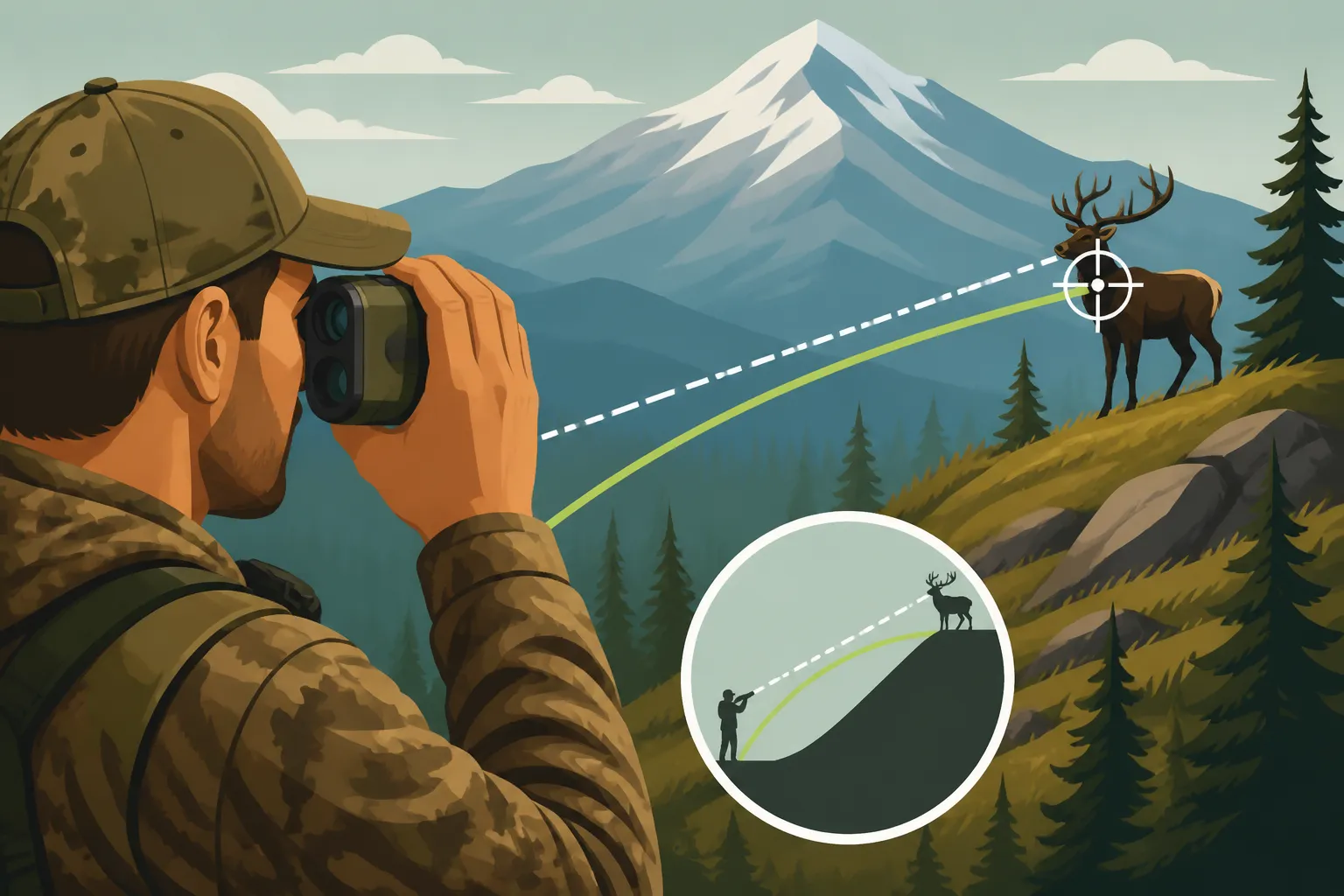
When you point a rangefinder at an animal, it gives you the "line-of-sight" distance – the direct distance between you and the target. This is great for flat ground, but Washington rarely offers truly flat ground. Imagine you're standing on a steep ridge, looking down at an elk 300 yards away. Your rangefinder says 300 yards. Now, if that elk was 300 yards away on perfectly flat ground, your bullet would drop a certain amount. But because you're shooting downhill, gravity acts on the bullet over a shorter effective horizontal distance. The bullet doesn't "feel" the full 300 yards of gravity's pull in the same way.
The opposite is true for an uphill shot. If you're tucked into the bottom of a draw and spot a blacktail buck 200 yards up a steep slope, your line-of-sight range is 200 yards. But again, gravity acts over a shorter horizontal distance. This distinction between the actual distance measured along the line of sight and the effective horizontal distance is absolutely critical for accurate shot placement. Failing to account for this can lead to shooting high on downhill shots or low on uphill shots, even if your hold is perfect for flat ground.
Why Your Brain Tricks You on Steep Angles
It's not just physics working against you; your own perception can be a major culprit too. Humans are notoriously bad at judging distances, especially on inclines or declines. That 100-yard shot straight downhill might feel like 150 yards because of the visual distortion and the effort it takes to get there, but your actual shooting distance is much shorter. Similarly, a grueling climb up a steep slope might make a 70-yard shot feel like a much longer 120 yards. Our brains instinctively compensate for the perceived difficulty of travel, not the actual ballistic reality.
This innate human error is compounded by adrenaline and excitement when you finally have an animal in your sights. Your mind races, you might be breathing heavily from a climb, and suddenly, the ability to accurately gauge distance by eye becomes even more compromised. It’s why relying solely on your gut feeling or even an uncompensated rangefinder readout can lead to ethical dilemmas and missed opportunities in Washington's rugged hunting units. You might be aiming for a magnificent bull in the Naneum Unit, and the excitement makes a 45-degree uphill shot at 250 yards look like 300. If you aim for 300, you're going to sail right over its back.
What is Rangefinder Angle Compensation and How Does It Work?
Given the challenges of Washington's steep hunting grounds, angle compensation in rangefinders isn't just a fancy feature; it's an essential tool for precision. It takes the guesswork out of those tricky angled shots, providing you with the "shoot-to" distance your projectile actually needs to travel.
The Science Behind Angle Compensation
At its core, angle compensation relies on basic trigonometry. When your rangefinder measures the line-of-sight distance to your target and also detects the angle of inclination (uphill) or declination (downhill), it uses a simple calculation, often based on the cosine rule, to determine the true horizontal distance. Think of it like this: if you form a right triangle, the line-of-sight distance is the hypotenuse, and the true horizontal distance is one of the adjacent sides. The angle compensation feature calculates that horizontal side.
The rangefinder then displays this "compensated" or "ballistic" distance, which is the effective distance you should use to apply your ballistic drop data. For example, if you range a target at 300 yards with a 30-degree downhill angle, your rangefinder might tell you the "shoot-to" distance is actually closer to 260 yards. This is because gravity will affect your bullet as if it were traveling 260 yards on flat ground, not the full 300. Many modern rangefinders come equipped with sophisticated algorithms that do this calculation in milliseconds, sometimes even integrating with internal ballistic tables to give you holdover recommendations. Some brands even offer technology like "True Ballistic Range" (TBR) or similar proprietary names to denote their advanced angle-compensating capabilities.
Practical Application: Using an Angle Compensating Rangefinder
Using an angle compensating rangefinder is typically straightforward, designed to be intuitive in the heat of the moment. You simply aim it at your target, press the button, and it provides a readout. What you need to pay attention to are the different numbers displayed. Most high-quality rangefinders will show both the line-of-sight distance (often labeled "LOS" or just the primary number) and the compensated distance (which might be labeled "BAL," "HCD" for horizontal component distance, or similar).
Here's a breakdown:
- For bowhunters: This feature is absolutely non-negotiable, especially for those close-range, extreme-angle shots common in dense western Washington timber. A 40-yard shot straight up or down a tree might only have an effective horizontal distance of 25-30 yards. An arrow's trajectory is far more sensitive to these subtle changes than a bullet's. Using the line-of-sight distance with a bow will almost guarantee a miss over the top of the animal on a downhill shot, or under it on an uphill shot. When you're in a stand or perched on a steep slope, an angle-compensating rangefinder gives you the crucial data you need to make that clean kill. If you're practicing for wet coastal conditions, make sure you're using your angle compensation features regularly.
- For rifle hunters: While a bullet might be less affected at shorter distances, the longer shots common in open eastern Washington country make angle compensation equally vital. Imagine trying to make a 400-yard shot across a deep canyon for a mule deer in the Okanogan Unit. The line-of-sight might be 400 yards, but the 25-degree angle could mean the effective range is closer to 350-360 yards. If you dial for 400, you're going to shoot high. Some hunters like to use tools like the mapping overlays in a service such as GoHunt to identify potential steep shooting lanes during their e-scouting phase, preparing them for where angle compensation will be most critical. This advanced preparation can save precious seconds and ensure accuracy when the moment of truth arrives.
You'll quickly learn to trust the compensated distance for your holdovers or dialing adjustments, as that's the number that truly matters for gravity's effect on your projectile. Always refer to your ballistic chart or calculator using the compensated distance.
When and Where Angle Compensation is Crucial in Washington
Washington's unique geography presents numerous scenarios where angle compensation isn't just helpful, but truly critical. From the rugged peaks to the rolling coulees, understanding where and when to lean on this technology will drastically improve your chances.
Steep Terrain Scenarios East of the Cascades
Eastern Washington is often characterized by its dramatic landscape of rolling hills, deep river breaks, and expansive coulees carved by ancient floods. This is classic mule deer country, but it's also home to Rocky Mountain elk herds, particularly in areas like the Colockum or Blue Mountains. When you're Glassing Eastern Washington Breaks for Mule Deer, you're almost certainly going to encounter animals on steep slopes, either above or below you.
Imagine you're set up on a high point, spotting a nice buck bedded on the opposing side of a deep draw. The line-of-sight range might be 380 yards, but the steep downward angle means your bullet will perform as if it were a much closer shot, perhaps 330 yards. If you hold for 380, you’ll likely shoot high, potentially wounding or missing the animal entirely. Similarly, an elk in a timbered canyon bottom could be 250 yards away line-of-sight, but if you're shooting from above, the compensated distance might be 220 yards. Having this accurate number ensures you're dialing the correct elevation or using the proper holdover, which is paramount when taking those longer shots in open country.
Western Washington Timber and Mountainous Country
While the west side of the state might be known for its dense forests, it's also incredibly mountainous and steep. Roosevelt elk often inhabit these rugged, brushy slopes, making for challenging hunting conditions. Blacktail deer thrive on the numerous clearcuts that slash across the landscape, and these clearcuts often present very steep, broken terrain. Whether you're chasing a bull in the Willapa Hills Elk Herd or a blacktail on a newly logged hillside in the Capitol Peak Unit, you're constantly dealing with elevation changes.
Consider still-hunting through a thick reprod stand on a 45-degree slope. You jump a bull at what feels like 60 yards, but it's directly below you. Your rangefinder gives a 60-yard line-of-sight, but the compensated distance is closer to 45 yards. For an archery shot, this difference is enormous. An arrow shot for 60 yards at that angle will sail right over the animal. Even with a rifle, understanding this compensated distance at closer ranges helps prevent over-shooting. When you're considering Packing an Elk Out of Washington's Backcountry, navigating steep terrain with a heavy load, you appreciate how every shot needs to be precise, as recovering a wounded animal on those slopes is incredibly arduous.
Common Mistakes Hunters Make Without It
The biggest, most common mistake hunters make when neglecting angle compensation is simply aiming for the line-of-sight distance on steep ground. This leads to two primary outcomes:
- Shooting over an animal on a downhill shot: This is the most prevalent error. Because gravity has less effective time to pull the bullet down over the horizontal distance, the bullet will strike higher than it would on flat ground at the same line-of-sight distance. Many hunters have stories of aiming dead on a downhill elk, only to watch the bullet impact harmlessly above its back.
- Shooting under an animal on an uphill shot: While less common, the same principle applies. An uphill shot means gravity is pulling the bullet 'back' toward the earth over a shorter horizontal path. If you compensate for flat ground, your bullet might strike low.
These mistakes often stem from a fundamental misunderstanding of external ballistics combined with the visual deception of steep angles. It's a frustrating situation that can be entirely avoided with the right tool and a bit of practice. Don't let your hunt be ruined by a simple calculation error that your rangefinder could solve for you.
Choosing and Utilizing Your Angle Compensating Rangefinder
Now that you understand why angle compensation is so important, especially for Washington hunting, let's talk about what to look for in a rangefinder and how to integrate it into your overall hunting strategy.
Key Features to Look For
When you're outfitting yourself for Washington's variable terrain and weather, your rangefinder needs to be up to the task. Here are some key features to consider:
- Accuracy and Speed: You need a rangefinder that gives consistent, accurate readings quickly. When that animal steps out, you don't have time to wait. Look for models with high precision, often down to half a yard or less.
- Angle Compensation Modes: Ensure it has a dedicated angle compensation mode (often called HCD, BAL, TBR, etc.). Some cheaper models might show the angle but not calculate the compensated distance for you. That defeats the purpose.
- Display Quality: A clear, bright display is crucial, especially in low light conditions or against varied backgrounds like dark timber or bright snow. Red LED displays are often preferred for their visibility.
- Magnification and Optics: Good optical quality (usually 6x or 8x magnification) helps you pinpoint targets at longer ranges. Look for clear glass with good light transmission. When choosing other optics for Choosing Binoculars for Washington Glassing, consider how your rangefinder will integrate with your overall glassing system.
- Weather Resistance: Washington weather is notoriously unpredictable. Your rangefinder must be waterproof or at least highly water-resistant and fog-proof. You’ll be hunting in rain, snow, and dense fog, and your gear needs to perform.
- Scan Mode: A scan mode allows you to continually range as you pan across an area, which is incredibly useful for ranging multiple animals in a herd or getting a true read on a moving target.
- Budget vs. Features: While top-tier models from brands like Vortex, Leupold, or Sig Sauer offer advanced features and robust construction, there are many mid-range options that provide excellent angle compensation without breaking the bank. Don't compromise on the angle compensation itself, though.
Integrating with Ballistic Calculators and Apps
The compensated distance your rangefinder provides is the golden ticket for accurate shooting. This number is what you'll feed into your ballistic calculator, whether that's a dedicated device, a phone app, or your own hand-written drop chart.
For rifle hunters, understanding your bullet's trajectory at various ranges is essential. Once you have the compensated distance from your rangefinder, you can:
- Consult your drop chart: Find the corresponding drop or holdover for that compensated distance.
- Dial your scope: If your riflescope has external turrets, dial the appropriate elevation correction based on the compensated range. This is especially important for longer shots where Riflescopes for Washington Timber and Open Country may need precise adjustments.
- Use a ballistic app: Many apps integrate directly with rangefinder data (or you manually input it) to give you real-time solutions for wind, elevation, and even lead on moving targets. Some mapping and hunting strategy platforms, like GoHunt, offer integrated ballistic tools or mapping layers that can help you visualize shooting lanes and range estimates, further enhancing your accuracy by allowing you to pre-plan shot scenarios based on terrain data.
For bowhunters, the process is similar. Your pin gaps are set for flat ground, so you'll use the compensated distance to choose the correct pin. If your rangefinder gives you a compensated distance of 32 yards, but you only have 20, 30, and 40-yard pins, you'll know to hold a little high on your 30-yard pin.
Practice, Practice, Practice
Having the best gear in the world won't matter if you haven't practiced with it. Just like you spend time at the range Sighting In Before the Opener or honing your skills for Archery Practice for Wet Coastal Conditions, you need to practice using your rangefinder with angle compensation in real-world scenarios.
- Find varied terrain: Set up targets in your backyard or at a safe range with significant elevation changes. Practice ranging targets both uphill and downhill.
- Compare readings: Range the line-of-sight distance, then switch to compensated mode. Notice the difference. The more you see how much those numbers vary, the more you'll trust the compensated reading.
- Shoot on angles: Once you understand the compensated distance, actually take practice shots at those angles, applying your holdovers or dialing. This builds confidence and muscle memory.
- Under stress: If possible, practice after some light exertion, simulating the physical state you might be in after a strenuous stalk. This helps you get comfortable operating your gear under pressure.
By diligently practicing with your angle-compensating rangefinder, it becomes a seamless part of your hunting routine. You'll move from wondering if your shot is true to knowing it is, which is an invaluable asset in the challenging, yet rewarding, hunting grounds of Washington. Tools like GoHunt can also aid in post-hunt analysis by allowing you to review your movements and shot locations against topographic maps, helping you refine your approach for future hunts on similar terrain.
| Scenario | Line-of-Sight Distance (LOS) | Compensated Distance (BAL/HCD) | Result if Using LOS (typical) | Correct Action (using BAL/HCD) |
|---|---|---|---|---|
| Downhill Rifle Shot | 300 yards | 265 yards | Shoot high over target | Dial/hold for 265 yards |
| Uphill Archery Shot | 40 yards | 32 yards | Shoot low under target | Use 30-yard pin (hold slightly high) |
| Steep Canyon Cross Rifle | 450 yards | 405 yards | Shoot high over target | Dial/hold for 405 yards |
| Tree Stand Archery Shot | 25 yards | 18 yards | Shoot high over target | Use 20-yard pin (hold slightly low) |
| Ridge Line to Valley Rifle | 520 yards | 460 yards | Shoot high over target | Dial/hold for 460 yards |
Disclaimer
This article is for general informational purposes only and does not constitute professional advice. Laws, prices and regulations vary by location and change over time. Consult a qualified professional for guidance on your specific situation.