Choosing Binoculars for Washington Glassing
Trying to pick out a new pair of binoculars for hunting in Washington can feel like you’re staring down a mountain of options, each one promising to be the “best.” It's incredibly frustrating to sift through jargon and endless specifications when all you really want to know is what’s going to help you spot that elusive blacktail in dense timber or pick apart a distant clearcut for elk. This guide is here to cut through the confusion and help you confidently choose the right binoculars for glassing across Washington's incredibly diverse and often challenging hunting landscapes.
Magnification and Objective Lens: The Core Decision
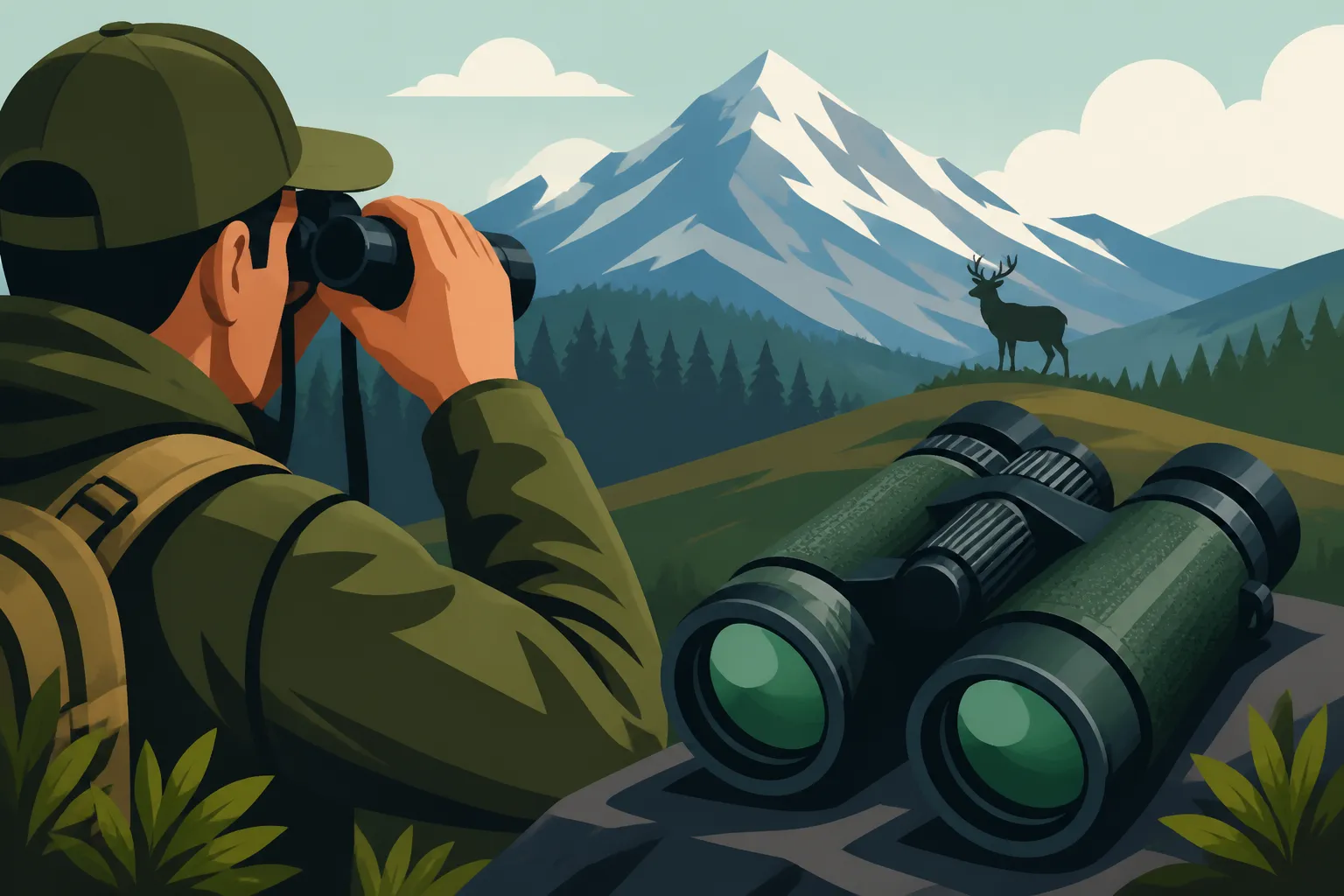
When you first look at binoculars, you’ll see two numbers, like 10×42 or 8×32. These aren't just arbitrary figures; they tell you the most fundamental aspects of the binocular’s performance. The first number, the "10x" or "8x", represents the magnification – how many times closer an object will appear. The second number, the "42" or "32", indicates the diameter of the objective lens in millimeters, which is the front lens that gathers light. Getting these two numbers right for your primary hunting style and the terrain you frequent in Washington is paramount.
Understanding Magnification for Washington Hunts
The magnification you choose directly impacts how much detail you can see at a distance, but it comes with tradeoffs. Higher magnification, like 12x or 15x, is fantastic for breaking down vast, open country, like the sagebrush flats of Eastern Washington or the immense canyons of the Blue Mountains, where mule deer and Rocky Mountain elk can appear as tiny specks miles away. If you spend most of your time picking apart distant coulee breaks or large clearcuts, that extra power can be a game-changer, revealing tines or an ear twitch you'd never catch with lesser glass.
However, more magnification also means a smaller field of view, a shakier image if you’re hand-holding, and often a heavier, bulkier binocular. For those who still-hunt the thick, brushy timber of Western Washington for Roosevelt elk or blacktail deer, where shots are typically close and spotting game is often a fleeting glimpse in dense cover, a lower magnification like 8x or 10x is usually more practical. It provides a wider view, making it easier to scan tight spaces quickly and locate game without making yourself dizzy from a bouncing image. You'll want to balance that desire for detail with the practical realities of how and where you hunt.
The Role of the Objective Lens in Light Gathering
The objective lens diameter dictates how much light your binoculars can gather. A larger objective lens (e.g., 50mm or 56mm) lets in more light, resulting in a brighter, clearer image, especially during those critical low-light periods at dawn and dusk when game is most active. This is a huge advantage in Washington, where dense forest can make even midday feel like twilight, or when you’re trying to pick out an elk silhouette against a dark timberline as the sun dips below the horizon. The ability to distinguish antler from branch in those last few minutes of legal shooting light can be the difference between a successful hunt and heading home empty-handed.
Conversely, smaller objective lenses (e.g., 32mm or 28mm) make for lighter, more compact binoculars, which are easier to carry on long, steep hikes. If you’re a minimalist backpack hunter or primarily hunt during bright daylight hours, the weight savings might be more appealing than the low-light performance. It’s a trade-off: portability versus peak optical performance in challenging conditions. Most hunters find a 42mm objective lens to be a sweet spot, offering a good balance of light gathering and manageable size for all-around Washington hunting.
Field of View and Eye Relief: Comfort and Context
Beyond magnification and objective lens size, two other critical specifications often get overlooked: field of view and eye relief. These aren’t just technical specs; they directly impact your comfort, how quickly you can find game, and how long you can effectively glass without fatigue, especially when you’re spending hours trying to pick out a Blacktail Deer Hunting in Western Washington Timber or patiently Glassing Sage and Wheat Edges for Washington Mule Deer.
Maximizing Your Field of View
Field of view (FOV) refers to the width of the area you can see through your binoculars at a specific distance, usually measured in feet at 1,000 yards. A wider FOV is incredibly beneficial, particularly in Washington’s varied terrain. Imagine you're scanning a vast mountain basin for elk or quickly trying to locate a buck that just busted out of a patch of reprod. A wide FOV allows you to cover more ground with fewer movements, increasing your chances of spotting game that might otherwise slip through a narrow visual tunnel. It’s like having a broader brushstroke when painting, letting you capture more of the scene at once.
This is especially true in areas like the Olympic Peninsula or Gifford Pinchot National Forest, where you might be looking for a Roosevelt Bull Antler Shape in dense, tangled undergrowth. The quicker you can scan and acquire targets, the better. While higher magnification generally means a narrower FOV, some manufacturers do a better job than others at optimizing this, so comparing FOV specs is worthwhile. Don’t just assume more power is always better; sometimes seeing more in context is more effective than seeing further in a tunnel.
Finding the Right Eye Relief
Eye relief is the distance your eye can be from the ocular lens (the eyepiece) while still seeing the full, unobstructed field of view. This is a crucial comfort factor, especially for those of us who wear eyeglasses or sunglasses. Binoculars with short eye relief force you to jam your eyes right up against the eyepieces, which is uncomfortable and often impossible with glasses on. The result is a frustrating "tunnel vision" effect, where you can’t see the edges of the image.
Good eye relief – typically 15mm or more – allows spectacle wearers to comfortably use binoculars without removing their glasses, which is a major convenience in the field. Even without glasses, ample eye relief reduces eye strain during prolonged glassing sessions. If you're going to spend hours behind your glass, say, trying to pick apart a distant hillside on the Colockum or Naneum units, comfort is key to preventing fatigue and maintaining focus. Many binoculars feature adjustable eyecups that twist up and down, helping you customize the eye relief to your preference, whether you wear glasses or not.
Optical Coatings and Prism Types: Seeing Clearly in Washington's Elements
The clarity, brightness, and color fidelity you experience through your binoculars aren't just about glass size; they're heavily influenced by the internal construction, particularly the prism type and the quality of the optical coatings. In Washington’s often-challenging weather – from persistent coastal rain to crisp, bright high-desert sun – these features can make a significant difference in how effectively you can discern game.
The Magic of Lens Coatings
Optical coatings are thin layers applied to the lens surfaces to reduce glare, minimize light loss due to reflection, and improve contrast and color rendition. This is where budget binoculars often fall short, sacrificing performance for a lower price tag. In Washington, where you might be glassing into shaded timber, across a sun-drenched canyon, or through a misty drizzle, good coatings are essential. Less expensive binoculars might only have "coated" lenses, meaning a single layer on some surfaces. Better binoculars are "fully coated" (all air-to-glass surfaces have at least one layer) or, ideally, "fully multi-coated" (all air-to-glass surfaces have multiple layers).
Fully multi-coated lenses offer the best light transmission and image quality, translating to brighter images with truer colors and higher contrast. This means you’ll be able to better distinguish a faint antler tine from a tangle of branches, or pick out the subtle brown hide of an elk against a dark evergreen backdrop. When the light is fading fast or conditions are overcast, superior coatings can extract every last bit of available light, giving you precious extra minutes of effective glassing time.
Porro vs. Roof Prisms: Design and Performance
The prism system inside your binoculars is responsible for inverting the image so it appears correctly oriented to your eye. There are two primary types: Porro prisms and roof prisms. Each has distinct characteristics that affect the binocular's shape, weight, and optical performance.
Porro Prisms
Porro prism binoculars are easily recognizable by their traditional, staggered shape – the objective lenses are wider apart than the eyepieces. This design offers a few advantages:
- Cost-Effective: They are generally less expensive to manufacture, making them a great option for hunters on a tighter budget who still want good optical quality.
- Depth Perception: The wider separation of the objective lenses can sometimes provide a slightly better sense of depth, which can be helpful when judging distance in rolling terrain.
- Bright Images: Well-made Porro prisms typically deliver very bright, clear images.
The main downside is their bulkier, less streamlined shape, which can be a bit cumbersome to carry and handle, especially if you’re navigating dense brush or need compact gear for a spike camp.
Roof Prisms
Roof prism binoculars have a more compact, straight-through design, where the objective lenses and eyepieces are aligned. This is the more popular choice for modern hunting binoculars due to several benefits:
- Compactness and Ergonomics: Their sleek, narrow profile makes them easier to hold, carry, and pack. This is a huge plus when you’re busting through Washington’s steep, unforgiving terrain or trying to minimize bulk in your pack.
- Durability: The internal focusing mechanism of roof prisms often makes them more robust and better sealed against water and dust intrusion.
- Advanced Coatings: To achieve comparable image quality to Porro prisms, roof prisms require more complex and expensive phase-correction coatings. When these coatings are present, roof prisms can deliver exceptional clarity, contrast, and color fidelity.
While roof prism binoculars are generally more expensive, the compactness, durability, and high optical performance they offer, particularly with good coatings, often make them the preferred choice for serious Washington hunters. When you're glassing for hours, you'll appreciate a binocular that feels good in your hands and delivers a crisp, clear image consistently.
Ergonomics and Durability: Built for the Backcountry
Washington hunting is rarely a gentle affair. From the soaking rains on the Olympic Peninsula to the dusty, rocky scree slopes of the Okanogan, your gear takes a beating. That’s why ergonomics and durability are just as important as optical performance. A binocular that feels good in your hands and can withstand the rigors of the field will be a much better companion than one that constantly fogs up or becomes a burden.
Comfort in Hand and Eye
Ergonomics are about how well the binoculars fit and feel in your hands. This might seem minor, but it makes a huge difference over a long day of glassing. Do they have a comfortable grip, even when wet? Are they balanced, or do they feel front-heavy? Can you easily reach the focus wheel with one hand? Many binoculars are armored with rubber coatings, which not only provide a better grip but also offer a layer of protection against minor bumps and scrapes. Some brands put a lot of thought into the thumb indents and overall shape, making them feel like an extension of your hands.
The focus wheel itself should be smooth and precise, allowing for fine adjustments without being too loose or too stiff. Nothing is more frustrating than a sticky focus wheel when you're trying to quickly bring a distant animal into sharp relief. Also, consider the diopter adjustment – usually a small ring on one of the eyepieces – which allows you to compensate for differences in vision between your left and right eyes. It should be easy to set but firm enough not to accidentally move once adjusted. These small details contribute significantly to user comfort and ultimately, your effectiveness in the field.
Weather Sealing and Fog-Proofing: Non-Negotiables
Given Washington’s notorious weather, proper sealing and fog-proofing are absolute must-haves. Look for binoculars that are explicitly described as "waterproof" and "fog-proof." Waterproofing typically means the binoculars are O-ring sealed to prevent moisture from entering the housing, allowing them to withstand rain, splashes, or even a brief submersion (though you probably don't want to test that last one on purpose).
Fog-proofing is achieved by purging the internal air and filling the binocular tubes with an inert gas, like nitrogen or argon, which prevents internal lenses from fogging up due to rapid temperature changes. Imagine going from a cold, damp morning out on the Willapa Hills to a warm truck cab, or hiking hard and having your body heat cause condensation inside your optics. Fogged lenses are useless lenses, and you’ll miss critical moments. A good pair of sealed, gas-purged binoculars ensures a clear view regardless of the external conditions, allowing you to hunt confidently in typical Washington weather, whether it’s a misty drizzle or a sudden cold snap.
Beyond the Binoculars: Tripods and Harnesses
While a quality pair of binoculars is central to effective glassing, the tools you use to carry and stabilize them are just as crucial for maximizing their performance, especially when you step up to higher magnifications or plan for extended glassing sessions. Don't overlook these essential accessories; they can elevate your glassing game significantly.
The Power of a Tripod for Stable Glassing
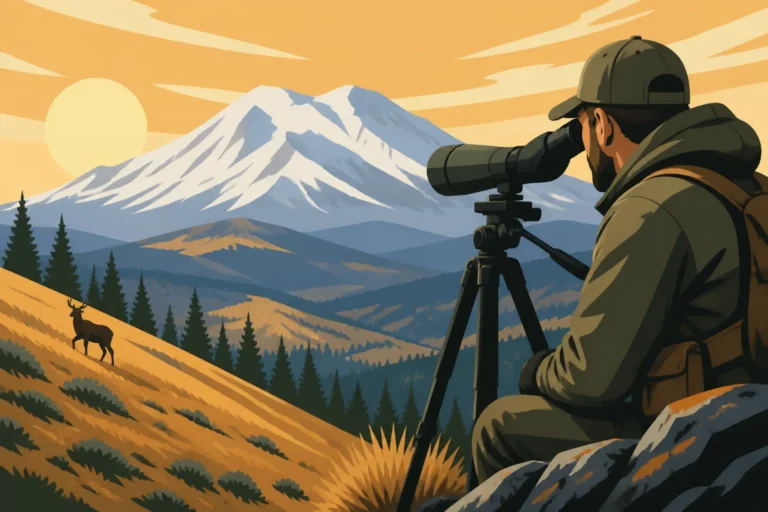
For any serious glassing, especially with 12x magnification or higher, a tripod is not optional – it's a necessity. Trying to hold powerful binoculars steady for more than a few minutes is an exercise in futility; the image will bounce and blur, making it impossible to pick out fine details. A sturdy tripod, paired with a binocular adapter, provides rock-solid stability, transforming your binoculars into a high-powered observation tool. This stability allows you to systematically pick apart distant hillsides, clearcuts, or canyons without eye strain, letting you truly examine every patch of cover.
Imagine you're Glassing Eastern Washington Breaks for Mule Deer and need to scrutinize a specific shadow line or patch of timber a mile away. With a tripod, you can lock onto that spot, relax, and patiently wait for movement or use your eyes to detect subtle anomalies. This level of detail and endurance is simply impossible when hand-holding. When selecting a tripod, prioritize stability, a smooth pan/tilt head, and reasonable weight for packing. A good tripod setup will change how you approach glassing forever, opening up a world of detail you never knew you were missing.
Binocular Harnesses: Comfort and Quick Access
A good binocular harness might seem like a small detail, but it’s a game-changer for comfort and efficiency in the field. Ditching the traditional neck strap is one of the best moves a hunter can make. A neck strap lets your binoculars swing freely, banging against your chest, and puts all the weight on your neck, leading to discomfort and fatigue.
A harness, however, distributes the weight across your shoulders and back, keeping your binoculars secure and close to your chest, yet easily accessible for quick deployment. This is invaluable when you’re negotiating blowdowns in the Gifford Pinchot or scrambling up a steep ridge in the Blue Mountains. Many harnesses also offer some level of protection for your objective lenses, guarding them from scratches and debris. Brands like FHF Gear or Kuiu offer excellent harness systems that are built tough and designed for active hunting, ensuring your optics are protected and always ready for action.
Matching Your Glass to Washington's Diverse Terrain
Washington is a state of incredible extremes when it comes to hunting landscapes. From the dense, rain-soaked rainforests of the west side to the arid, expansive sagebrush of the east, no single binocular is truly "perfect" for every scenario. Your ideal choice will heavily depend on where and how you typically hunt. Let’s break down the best choices for Washington's distinct regions.
Westside Timber and Coastal Hunting
Hunting the west side of Washington for Roosevelt elk and blacktail deer means dealing with thick timber, dense underbrush, and a lot of rain. Visibility is often limited, and most encounters happen at closer ranges, sometimes less than 100 yards. In these conditions, a wide field of view and excellent low-light performance are generally more valuable than extreme magnification.
For this type of hunting, an 8×42 or 10×42 binocular is often the sweet spot. The 8x magnification provides a very wide field of view, making it easier to scan quickly through tight windows in the trees and pick up movement in the shadows. The 10x offers a bit more reach for those slightly longer clearcut edges or open patches, without being overly powerful for the close quarters. The 42mm objective lens ensures good light gathering in the perpetual dimness of the deep woods. Durability and waterproofing are paramount here; your optics will get wet, bumped, and potentially dropped. Look for robust, well-sealed roof prism designs that can handle the abuse of the wet, rugged Pacific Northwest. You might also want to read up on Archery Practice for Wet Coastal Conditions to ensure your shooting matches your glassing skills.
Eastside Open Country and Mountain Hunting
Shift to Eastern Washington, and the game changes completely. Here, you'll find vast sagebrush flats, rolling wheat fields, deep canyons, and towering mountain ranges in areas like the Okanogan or the Blue Mountains. Mule deer and Rocky Mountain elk often hold at great distances, and spotting them before they spot you is key. This is where higher magnification truly shines.
Many Eastside hunters gravitate towards 10×42, 12×50, or even 15×56 binoculars. The 10×42 is a good all-around choice, but if you're seriously dedicated to long-range glassing, stepping up to a 12x or 15x will give you the power to pick apart distant coulees, analyze antlers, and spot bedded animals that would be invisible with lesser magnification. The larger objective lenses (50mm, 56mm) are a huge asset here, ensuring excellent light transmission during early morning and late evening glassing when you're targeting animals at the very edges of legal light. A tripod is an absolute must with these higher magnifications; without it, you're only getting a fraction of their potential. Resources like GoHunt are fantastic for researching these vast units and understanding the topography, which directly impacts your glassing strategy and binocular choice.
All-Around Versatility for Crossover Hunters
Many Washington hunters pursue game on both sides of the Cascades or hunt varied terrain within a single season. For those seeking a versatile do-it-all option, a high-quality 10×42 binocular is often the best compromise. It offers enough magnification to be effective in many open country situations, especially when paired with a tripod, while still being manageable for scanning timber and moving through denser cover. The 42mm objective lens provides good light gathering without adding excessive bulk or weight.
This combination strikes a balance that allows you to confidently hunt for Columbian Blacktail Deer in Western Washington in September and then chase Mule Deer of Eastern Washington in October with the same reliable optics. While it won't be the absolute best for extreme long-range glassing or the darkest timber, a top-tier 10×42 will perform admirably across the vast majority of Washington's diverse hunting landscapes. When considering a choice, review your personal hunting style and budget, and you'll find the right glass that serves you well season after season.
| Binocular Specification | Best for Westside Timber / Close Quarters | Best for Eastside Open Country / Long Range | All-Around Versatility | Key Benefit |
|---|---|---|---|---|
| Magnification | 8x or 10x | 12x or 15x | 10x | Seeing detail (higher magn.) vs. wider FOV & steadiness (lower magn.) |
| Objective Lens | 42mm | 50mm or 56mm | 42mm | Light gathering for brightness, especially low light (larger lens) |
| Field of View | Wide | Moderate to Narrow (offset by magnification) | Moderate to Wide | Scanning quickly and finding game in dense cover (wide FOV) |
| Eye Relief | 15mm+ | 15mm+ | 15mm+ | Comfort, especially for glasses wearers; reduced eye strain |
| Prism Type | Roof Prism (for durability/compactness) | Roof Prism (for durability/compactness) | Roof Prism | Compactness, durability, and image quality (Roof) vs. cost/depth (Porro) |
| Coatings | Fully Multi-Coated | Fully Multi-Coated | Fully Multi-Coated | Max light transmission, contrast, and color fidelity |
| Water/Fog Proof | Essential | Essential | Essential | Reliability in Washington's varied and often harsh weather conditions |
| Tripod Use | Optional (for 10x) | Highly Recommended / Essential | Recommended (for 10x) | Stability for prolonged, detailed glassing and higher magnifications |
Disclaimer
This article is for general informational purposes only and does not constitute professional advice. Laws, prices and regulations vary by location and change over time. Consult a qualified professional for guidance on your specific situation.