Arrow Spine and Front of Center
It’s a scenario every archer has faced: you’ve practiced for months, your form is dialed in, but when you let that arrow fly, it just doesn’t hit where you’re looking. Or worse, you see it porpoising and wobbling downrange, looking more like a dying bird than a precision projectile. This frustration is incredibly common, especially when preparing for big game seasons here in Washington, where conditions can range from tight timber to open sage. This guide is going to strip away the mystery surrounding two critical components of arrow flight – arrow spine and Front of Center (FOC) – and show you how understanding and optimizing them can transform your accuracy and penetration, giving you the confidence you need when that shot opportunity finally arises.
Understanding Arrow Spine and Why it Matters
When you pick up an arrow, it might look like a simple, rigid stick, but it's anything but. That shaft is designed to flex and recover in a very specific way when launched from your bow. This flexing, known as "spine," is paramount to accurate arrow flight and can make or break your hunt, whether you're chasing a Blacktail in the wet brush of the Olympic Peninsula or a mule deer across the open plains of Eastern Washington.
What Exactly is Arrow Spine?
At its core, arrow spine refers to the stiffness of the arrow shaft. Imagine a broomstick versus a thin dowel rod – one is stiff, the other is flexible. Arrows are somewhere in between, engineered to bend when the bowstring pushes the nock end forward, and then straighten out mid-flight. This controlled flex is crucial because as the arrow leaves the bow, the string actually pushes it around the bow riser. If the arrow is too stiff or too weak, it won't clear the riser cleanly, leading to erratic flight.
We talk about two types of spine: static spine and dynamic spine. Static spine is what you see on the arrow's packaging, usually a number like 300, 340, or 400. This number indicates how much the arrow deflects when a specific weight is hung from its center. A lower number (e.g., 300) means a stiffer arrow, while a higher number (e.g., 400) means a weaker, more flexible arrow. Dynamic spine, on the other hand, is the actual flex of the arrow as it leaves the bow. It's influenced by your static spine, but also by your bow's draw weight, draw length, arrow length, and even the weight of your broadhead or field point. It’s the dynamic spine that ultimately dictates how your arrow truly flies.
The Dangers of Incorrect Spine
Using an arrow with the wrong spine is like putting undersized tires on a powerful truck – it just won't perform as intended and can even be dangerous. If your arrow is too weak (too flexible), it will flex too much when shot. This can cause the fletching to hit the bow riser or rest, leading to a "kick" or "porpoising" flight path. You'll see the arrow flying up and down, or wiggling uncontrollably. This isn't just an accuracy problem; a weak-spined arrow can shatter or splinter upon release, potentially causing injury to the shooter. Imagine that happening during a crucial moment on a backcountry hunt!
Conversely, an arrow that is too stiff (not flexible enough) will also fly inconsistently, often pushing the nock end left or right. It won't have enough "give" to clear the riser properly, causing a similar collision and resulting in erratic flight and poor grouping. This is particularly frustrating when you’re trying to dial in your broadheads for a demanding Archery Elk Hunting in Washington's September Season. An improperly spined arrow will simply never tune correctly, no matter how much you adjust your rest or form. Both scenarios lead to decreased accuracy, reduced penetration, and a profound lack of confidence when you’re staring down a bull elk in the thick timber of the Cascades.
Matching Spine to Your Setup
Finding the correct spine is a careful balance. It’s not just about matching the arrow manufacturer's chart to your draw weight. Those charts are a great starting point, but they are generalized. You need to consider several factors that influence the dynamic spine:
- Bow Draw Weight: A heavier draw weight (e.g., 70 lbs) demands a stiffer arrow than a lighter draw weight (e.g., 50 lbs) because it imparts more energy and causes more flex.
- Draw Length: Longer draw lengths mean the arrow is pushed for a longer duration and extends further past the riser, requiring a stiffer spine.
- Arrow Length: Longer arrows are inherently more flexible. If you’re shooting a 30-inch arrow, it will flex more than a 28-inch arrow of the same static spine.
- Point Weight: This is a big one often overlooked! Adding heavier broadheads (e.g., 150 grains instead of 100 grains) effectively weakens the dynamic spine of the arrow. That extra weight at the front acts like a longer lever, causing the shaft to bend more aggressively upon launch. This means if you switch to a heavier broadhead, you might need to go to a stiffer spined arrow to maintain optimal flight.
When you’re preparing for a Washington hunting season, especially if you’re trying out a new Bow Choice for Wet Coastal Hunting or a different broadhead, it's vital to reassess your spine. Small changes can have big impacts.
Decoding Front of Center (FOC)
Once you've got your arrow spine dialed in, the next crucial piece of the puzzle is Front of Center, or FOC. This often misunderstood concept plays a massive role in arrow stability, accuracy, and critically, penetration. You can have a perfectly spined arrow, but if your FOC is off, you’ll still struggle with inconsistent flight and energy transfer, particularly important for achieving deep penetration on tough game like a mature Roosevelt elk.
What is Front of Center (FOC)?
Front of Center (FOC) refers to how far forward the balance point of your arrow is, expressed as a percentage of the total arrow length. Think of it like a dart: the weight is concentrated at the front, which helps it fly straight and stable. An arrow behaves similarly. A higher FOC means more of the arrow's weight is towards the front, making the arrow more "nose-heavy." A lower FOC means the weight is more evenly distributed or even slightly biased towards the back, making the arrow more "tail-heavy."
Why does this matter? As an arrow flies, especially at longer distances or in windy conditions common in places like Eastern Washington's open mule deer country, aerodynamic forces act on it. If the weight is primarily at the front, the fletching at the back acts more effectively like the tail of a kite, steering and stabilizing the arrow. It's a fundamental principle of flight dynamics: for stability, the center of gravity must be ahead of the center of pressure (the point where aerodynamic forces act). A proper FOC ensures that your arrow recovers quickly from any initial wobbles and maintains a stable trajectory throughout its flight.
Calculating Your FOC
While specific formulas exist, the easiest way to understand and roughly calculate FOC is through a simple process:
- Find the Physical Center: Measure the total length of your arrow from the throat of the nock to the end of the shaft (not including the broadhead tip). Divide this number by two to find the physical center.
- Find the Balance Point: With your broadhead or field point installed, balance the arrow on your finger or a knife edge. Mark this balance point.
- Measure the Distance: Measure the distance from the throat of the nock to your marked balance point.
- Calculate FOC:
- Subtract the physical center measurement (from step 1) from the balance point measurement (from step 3). This tells you how far forward your balance point is from the arrow's midpoint.
- Divide that result by the total arrow length (from step 1).
- Multiply by 100 to get a percentage.
For example: If your arrow is 29 inches long, the physical center is 14.5 inches. If it balances at 17 inches from the nock, then 17 – 14.5 = 2.5 inches forward. (2.5 / 29) * 100 = approximately 8.6% FOC. Many online calculators and apps, sometimes integrated into hunting platforms like GoHunt, can do this for you quickly, but understanding the basics helps you troubleshoot.
Low vs. High FOC and Their Impact
Both low and high FOC have distinct effects on arrow flight and terminal performance, and finding the right balance is key for Washington hunting.
Low FOC (typically below 8-10%):
Arrows with low FOC are more "tail-heavy." This can make them more susceptible to wind drift because the fletching has less "weight" to push around, and any instability is exacerbated. They tend to plane more, meaning they might wander off course, especially in a crosswind or when shooting at longer ranges. Penetration can also be reduced because the arrow might not maintain a straight path through the target as effectively, leading to glancing blows or less efficient energy transfer. For small game or target shooting, low FOC might not be a huge issue, but for big game hunting, especially for tough animals like elk, it can be a significant detriment to Shot Placement on a Quartering Elk.
High FOC (typically 12-18% for hunting, some push even higher):
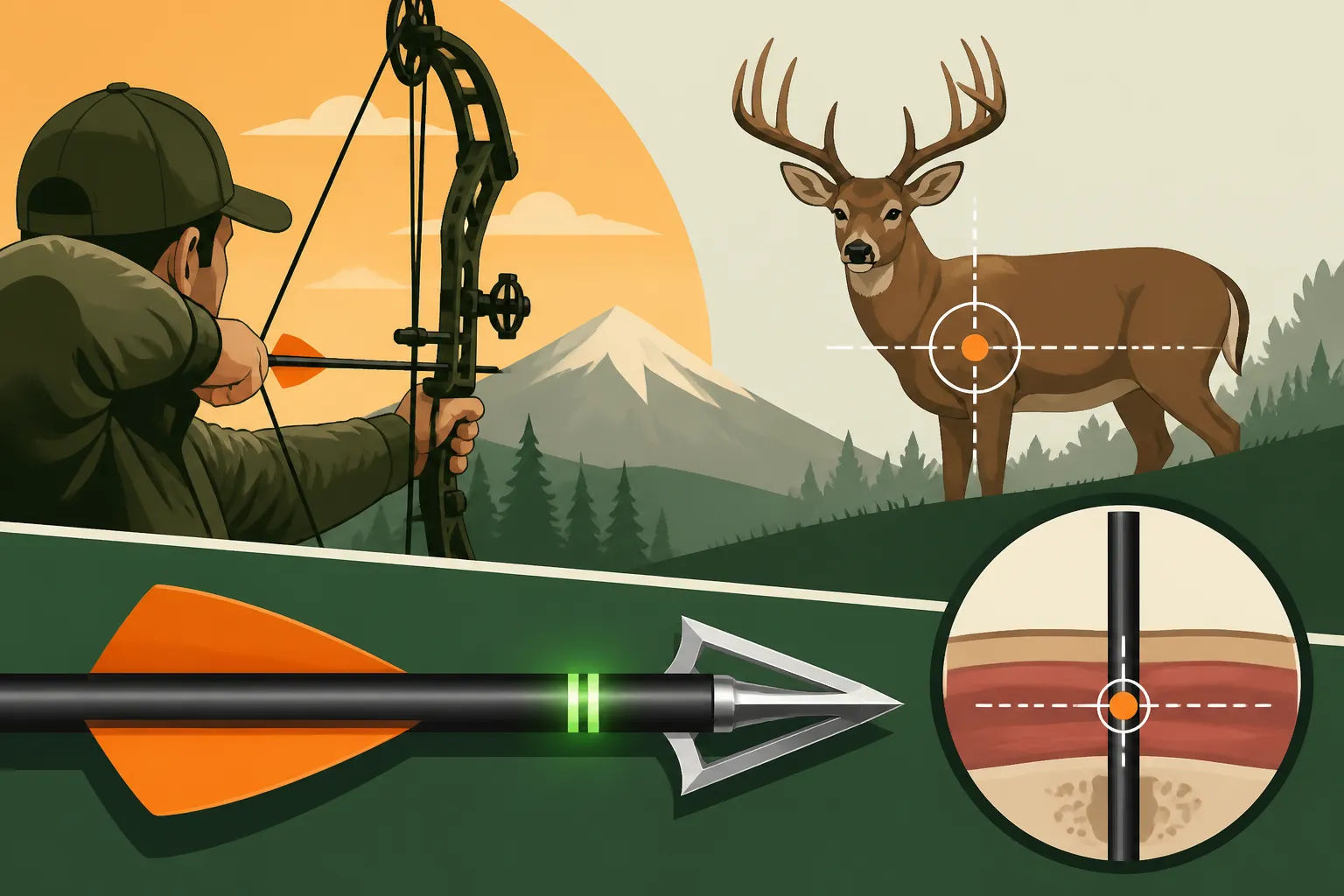
Arrows with higher FOC are more "nose-heavy" and are generally favored by serious hunters. The increased weight at the front makes the arrow incredibly stable in flight, much less affected by wind, and more forgiving of minor form imperfections. This translates to tighter groups, especially with broadheads. Crucially for hunting, higher FOC significantly improves penetration. The forward momentum carries the arrow through hide, muscle, and bone more effectively, reducing deflection and increasing the chances of a pass-through. This is incredibly important when you're dealing with the dense bone and muscle of a mature deer or elk here in Washington. While some archers push FOC above 20%, finding the sweet spot usually means balancing the benefits of stability and penetration without making the arrow so heavy that trajectory becomes overly rainbow-like at longer ranges.
The Synergistic Relationship: Spine and FOC Working Together
You can't talk about arrow performance without discussing spine and FOC in the same breath. They are two sides of the same coin, each influencing the other and dictating the ultimate flight characteristics and terminal performance of your arrow. An arrow with perfect spine but poor FOC will still underperform, and vice-versa. The magic happens when you get them both working in harmony.
Finding the Sweet Spot
The ideal arrow setup is a balance where your arrow's dynamic spine is perfectly matched to your bow's energy output, and your FOC provides optimal flight stability and penetration. When these elements align, your arrow will leave the bow with minimal oscillation, recover quickly, fly true to the target, and carry maximum kinetic energy for effective penetration.
For example, if you increase your FOC by adding a heavier broadhead or weight inserts to the front of your arrow, you are effectively "weakening" the dynamic spine. This means you might need to start with an arrow shaft that has a slightly stiffer static spine to compensate. Conversely, if you want a lighter arrow with higher FOC, you might use a shorter, stiffer shaft, which helps maintain spine integrity while allowing you to add more weight up front. This is why seasoned hunters spend so much time tinkering with their arrow build – it’s about creating a perfectly balanced system. When you're trying to dial in your setup for a tough Washington elk hunt, understanding these interactions is crucial.
Tuning Your Arrows for Washington Conditions
Once you've calculated your spine and FOC, the real-world testing begins. This is where the rubber meets the road, or more accurately, the broadhead meets the target.
- Paper Tuning: This is a fundamental step to confirm your spine. Shoot an arrow through a piece of paper held a few feet in front of your bow. The tear pattern in the paper will tell you if your arrow is flying perfectly straight, or if it's kicking left, right, up, or down. Adjustments to your arrow rest, nocking point, or even slight tweaks to your draw weight can resolve minor tears. If you have a severe tear, it's often an indicator that your spine is too weak or too stiff for your setup.
- Broadhead Tuning: This is the ultimate test for hunters. Once your field points are grouping tightly, screw on your hunting broadheads. They should group with your field points at all relevant hunting distances. If your broadheads are consistently hitting differently than your field points, it's a sign that your FOC might be off, your spine is incorrect, or your broadheads themselves aren't perfectly aligned. This is a crucial step for Washington hunters, as you need absolute confidence in your gear before heading into the backcountry. A slightly misaligned broadhead or an FOC that causes planing can easily cause you to miss a vital shot on a wary deer or elk. Bow Tuning Before the Season should always include extensive broadhead tuning.
- Considering Weather: Washington weather is famously unpredictable. A well-tuned arrow with proper spine and FOC will be much more forgiving in the face of wind, rain, or snow. A high FOC arrow, in particular, will slice through a crosswind with less deviation than a tail-heavy arrow, making it invaluable for those blustery late-season hunts. This also applies to the potential for wet conditions, as moisture can slightly alter flight dynamics.
When to Re-evaluate Your Arrow Setup
Your arrow setup isn't a "set it and forget it" kind of deal. Several scenarios should prompt you to re-evaluate your spine and FOC:
- New Bow or Bow Adjustments: If you get a new bow, change your draw weight, or significantly alter your draw length, your arrow's dynamic spine will change. You must re-tune and potentially buy new arrows.
- New Broadheads or Point Weight: As discussed, even a 25-grain change in point weight can impact dynamic spine and FOC. If you switch from 100-grain to 125-grain broadheads, for example, be prepared to re-evaluate.
- Different Arrow Lengths: If you decide to go with a shorter or longer arrow shaft, this changes the static spine and thus the dynamic spine and FOC.
- Inconsistent Accuracy: If you suddenly notice your groups opening up or arrows flying erratically, and you've ruled out form issues, your arrow setup is the next place to look. Often, this is a subtle shift in spine or FOC over time due to component changes or even string stretch.
- Planning a Specific Hunt: For a particularly challenging hunt, say for a big bull in the Blue Mountains Elk Herd where longer shots might be possible, you might specifically optimize your FOC for maximum penetration and stability at range.
Practical Tips for Arrow Selection and Tuning
Getting your arrow spine and FOC dialed in can feel like a deep dive, but it's an investment that pays off immensely in the field. Don't let the technical jargon scare you away. With a few practical steps and resources, you can gain confidence in every shot.
Starting with Manufacturer Charts
Every major arrow manufacturer, like Easton, Gold Tip, or Carbon Express, provides spine charts. These charts are your essential starting point. They typically list recommended spine values based on your bow's peak draw weight, your draw length, and the estimated total arrow length (including broadhead). Always consult these charts first. They provide a foundational understanding of what static spine you should be looking for. Remember, these are guidelines, not absolute rules, but they give you a solid baseline to avoid being wildly off. When looking at something like Arrow Weight Minimum for Washington Big Game, ensure your chosen arrow falls within legal parameters while also fitting the spine chart.
It's also worth noting that some charts will specify different recommendations for different arrow series, as construction and materials can vary the stiffness significantly. Don't just grab any 340-spine arrow; ensure it's from a reputable brand and series designed for hunting.
Utilizing Online Tools and Professional Help
In today's digital age, there are fantastic resources at your fingertips. Many online arrow spine calculators take your specific bow and arrow parameters and recommend a more precise spine. Some comprehensive hunting platforms, such as GoHunt, offer detailed resources, articles, and even calculators to help you plan out every aspect of your gear, including arrow selection. These tools can save you a lot of guesswork and potential headaches, especially if you're experimenting with different setups.
However, nothing beats the expertise of a good pro shop. If you're feeling overwhelmed, or if you just can't get your arrows to tune, head to a reputable archery pro shop. They have experienced technicians who can not only guide you through spine charts and FOC calculations but can also observe your shooting form, use specialized equipment to measure actual arrow speeds and flight, and help you fine-tune your bow and arrows. They can often catch subtle issues you might miss and provide hands-on advice for broadhead tuning, which is invaluable. Don't be shy about asking for help; a well-tuned arrow is a safe and effective arrow.
Fine-Tuning for Broadhead Accuracy
Ultimately, the goal of optimizing spine and FOC is to achieve pinpoint broadhead accuracy. A broadhead-tipped arrow behaves differently than a field point due to its larger surface area and cutting edges. If your spine or FOC is off, those broadheads will act like little rudders, magnifying any inconsistencies in flight.
After confirming your field points are grouping perfectly, move to your broadheads. Start close, around 20 yards, and ensure they hit precisely where your field points did. Gradually move back to 30, 40, and 50 yards (or your maximum ethical hunting range). Any deviation in broadhead flight needs to be addressed. Often, minor nock rotations, slight adjustments to your arrow rest, or even trying different brands of broadheads can make a huge difference. For mechanical broadheads, ensure they are deploying consistently and not causing erratic flight. For fixed blades, verify they spin perfectly true on the arrow shaft. Remember, a well-tuned arrow system, thanks to correctly matched spine and FOC, provides the platform for broadheads to fly as intended, ensuring maximum effectiveness on your Washington big game hunt.
| Arrow Setup Element | Key Impact on Flight | How to Adjust/Optimize | Washington Hunting Relevance |
|---|---|---|---|
| Arrow Spine | Controls arrow flex upon release, dictates clean riser clearance and straight flight. | Match to draw weight, draw length, arrow length, point weight; use manufacturer charts. | Prevents erratic flight in timber, improves broadhead accuracy for vital shots. |
| Front of Center (FOC) | Determines arrow stability, wind resistance, and penetration capabilities. | Adjust by changing broadhead weight, adding front inserts, or varying arrow length. | Essential for stability in crosswinds (Eastside), maximizes penetration on tough game like elk. |
| Broadhead Type | Can amplify flight issues if spine/FOC is off; affects wound channel. | Choose fixed or mechanical based on preference; ensure they spin true and group with field points. | Crucial for clean kills; legal Broadhead Width Rules in Washington apply. |
| Arrow Weight | Influences speed, kinetic energy, and momentum; heavier arrows generally penetrate better. | Select shafts with desired GPI (grains per inch); adjust point weight for FOC. | Balance trajectory for range with momentum for penetration on larger animals. |
| Arrow Length | Affects static and dynamic spine, and influences FOC by changing balance point. | Cut to fit draw length; ensures safety and optimal spine. | Critical for safely clearing riser and maintaining consistent spine. |
Disclaimer
This article is for general informational purposes only and does not constitute professional advice. Laws, prices and regulations vary by location and change over time. Consult a qualified professional for guidance on your specific situation.