Blacktail Versus Mule Deer Differences
It's a common dilemma for hunters hitting Washington's diverse landscapes: did I just see a blacktail or a mule deer? For those new to the state, or even seasoned veterans crossing from one side of the Cascades to the other, distinguishing between these two iconic deer species can be surprisingly tough. This guide is here to unravel the mystery, diving deep into the physical characteristics, behaviors, and habitat preferences that set Columbian blacktail deer and mule deer apart, giving you the knowledge you need for a more successful and informed hunt.
Understanding Washington's Deer Diversity
Washington State is unique in that it offers hunting opportunities for three distinct deer species: mule deer, white-tailed deer (primarily in the northeast), and the often-misunderstood Columbian blacktail deer. While whitetails are generally easier to identify, the overlap in appearance and sometimes even habitat between blacktails and mule deer can cause real head-scratching moments. Getting it right is crucial, not just for identification, but for understanding where and how to hunt effectively.
The Distinct Habitats of Blacktails and Mule Deer
One of the most immediate indicators of which deer you're looking at is where you're standing. The towering Cascade Mountains act as a natural, albeit not entirely impermeable, boundary for these species.
On the west side of the Cascades, stretching all the way to the Pacific Ocean, you're squarely in blacktail country. This region is characterized by dense, often wet, conifer forests, thick underbrush like salal and devil's club, and rugged, steep terrain. Think of the Olympic Peninsula, the Willapa Hills, or the timbered slopes around Mount St. Helens. Blacktails thrive in this heavy cover, using it to their advantage to vanish almost instantly. They are masters of concealment, preferring to live out their lives within the confines of dense timber, rarely venturing far into truly open spaces. Hunting these areas requires a different approach than the wide-open spaces of the east side, often involving a lot of still-hunting. If you're looking to understand the nuances of this environment, check out our guide on Blacktail Deer Hunting in Western Washington Timber.
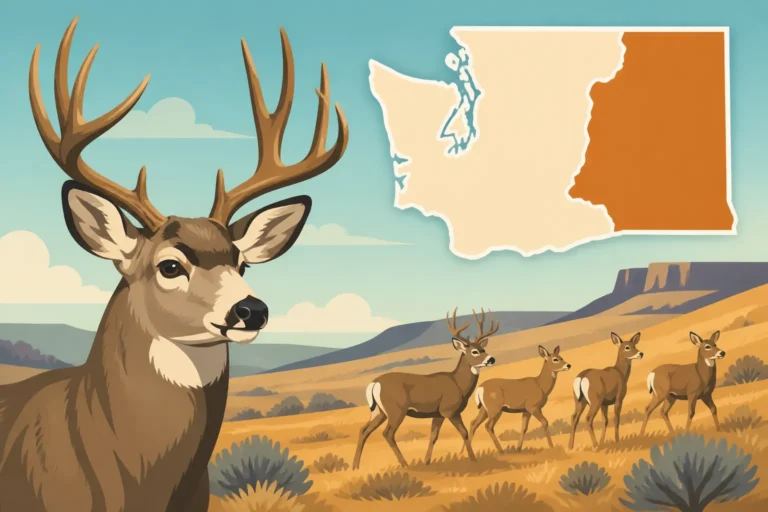
Cross over the Cascades to the drier, more open eastern Washington, and you're entering mule deer territory. Here, the landscape transforms into expansive sagebrush flats, ponderosa pine forests, wheat fields, and steep, broken coulees and canyons. The Okanogan, the Blue Mountains, and the Columbia Basin are prime mule deer haunts. These deer are built for this country, often seen feeding in open fields or traversing vast distances across exposed slopes. Their reliance on visibility means they're often spotted at much greater distances, making glassing a critical skill. For more on this, our post on Glassing Eastern Washington Breaks for Mule Deer offers deeper insights. While there can be some overlap, particularly in the foothills of the Cascades where both might be present, knowing the general geographic distribution is your first and most powerful clue.
Why the Distinction Matters for Hunters
Beyond simply identifying what you're seeing, recognizing the differences between blacktails and mule deer has direct implications for your hunting strategy, success, and even legal compliance. Each species requires a fundamentally different approach.
Hunting blacktails often means embracing the rain, the thick brush, and the close-quarters encounter. You're thinking about scent control in humid conditions, understanding how deer move through dense clearcuts, and relying on your tracking and still-hunting skills. You'll spend more time looking for subtle signs, fresh tracks, or a flicker of an ear in heavy cover. The game changes entirely when you're after mule deer. Here, you're probably ranging out with a good set of binoculars and a spotting scope, picking apart distant hillsides. Your shot opportunities are often longer, demanding a different level of marksmanship and understanding of external ballistics. The challenge shifts from finding deer in the green jungle to locating a camouflaged buck in a vast, open landscape.
Furthermore, legal regulations can sometimes vary slightly by species or general management unit (GMU) that defines their habitat. While many regulations are universal for "deer," specific GMUs might have antler point restrictions or season dates tailored to the predominant species. For example, some GMUs on the east side might have different antler point rules than those on the west. Understanding which deer you're pursuing ensures you're hunting ethically and legally. Always double-check the current WDFW regulations for your specific GMU and season. The rules around Washington's Three-Point Rule and What Counts can be particularly relevant in many areas.
Key Physical Characteristics and Identification
When you're out in the field, identifying whether you're looking at a blacktail or a mule deer comes down to a few key physical features. These aren't always immediately obvious, especially at a distance or in challenging light, but with practice, they become telltale signs.
Antler Configuration: A Tale of Forks and Spikes
Perhaps the most talked-about difference, especially among hunters, is the antler structure. While individual antler growth can vary greatly due to age, nutrition, and genetics, there's a general pattern that helps distinguish the two.
Mule deer are famous for their "forked" antlers. This means that each main beam typically forks, and then each of those forks often forks again. So, a typical mule deer buck might have two points on one side coming off the main beam, which then fork again to create a four-point (Western count) side. It's a dichotomous branching pattern, creating a symmetrical, "Y-shaped" look. While you can certainly find mule deer with spike antlers or non-typical growth, the classic mule deer rack has this distinct, repeating fork. If you're unsure about counting points, our guide on Counting Points on a Live Buck might be helpful.
Blacktail deer, on the other hand, tend to have a more traditional, "main beam" style of antler growth. They typically have a main beam that grows upward and backward, with individual tines (points) growing off of it. Often, you'll see a "forked horn" blacktail with a single main beam that has one fork at the top, or a "two-point" with one primary tine and perhaps a smaller brow tine. They rarely exhibit the extensive, repeating forking pattern seen in mule deer. It's not uncommon to see a respectable blacktail with two or three points on a side, resembling a smaller version of an Eastern whitetail rack. The key is that the points come off a main beam, rather than the beam itself forking repeatedly.
Tail, Rump, and Ear Size: The Obvious Tells
If the antlers aren't definitive, or if you're looking at a doe or a spike, the tail, rump patch, and ear size are often the easiest and most reliable differentiators.
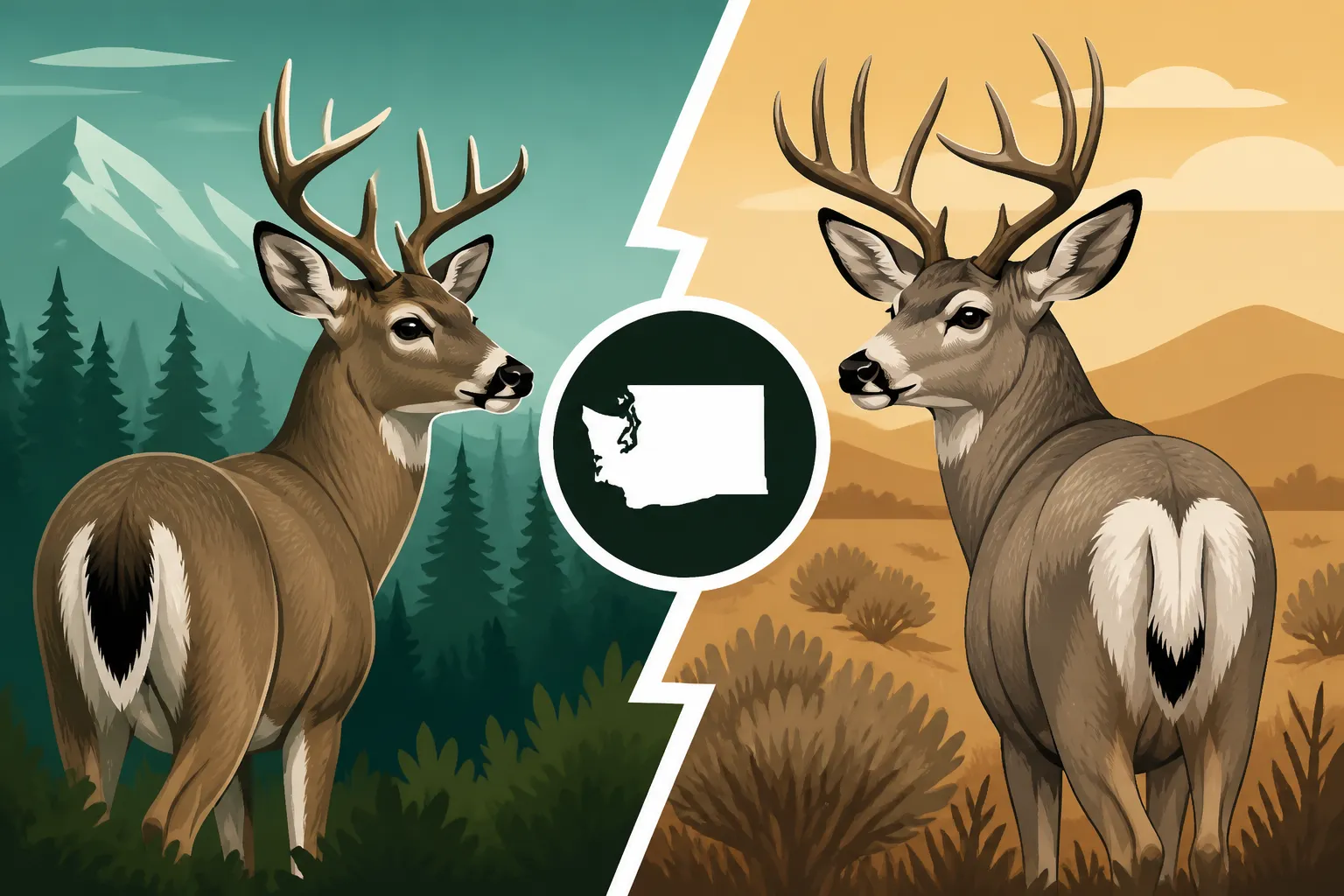
Mule deer get their name from their large, mule-like ears. These ears are noticeably larger than those of a blacktail, and are usually the first thing that strikes you when comparing the two side-by-side. Their tail is also very distinctive: it's typically a thin, rope-like tail, almost entirely white, often with a small, contrasting black tip. When a mule deer bounds away, this white "rope" tail is very prominent against its white rump patch. The entire rump is usually a bright, clean white, providing a stark contrast to its body color.
Blacktail deer have much smaller, more proportionate ears, closer in size to a whitetail. Their tail is the definitive characteristic: it's broad at the base and completely black or dark brown on top, often extending most of the way down. The underside might be white, but the top is distinctly dark. When a blacktail runs, you'll see this dark, flag-like tail, which is why they are sometimes confused with whitetails (though whitetails have a completely white tail that they hold straight up). The rump patch of a blacktail is generally grayish-brown, blending in with its body color, rather than the stark white found on a mule deer.
Coat Color and Body Build
While coloration can vary with season and individual deer, there are some general trends that can help you distinguish between the species.
Mule deer typically have a lighter, grayer-brown coat, especially in the winter, which helps them blend into the arid sagebrush and rocky terrain of eastern Washington. In summer, their coat can take on a more reddish-brown hue, but it generally remains lighter than a blacktail's. Their body build is often stockier and larger overall than a blacktail, with longer legs that are well-suited for covering ground in open, rugged country. A mature mule deer buck can be a truly impressive animal, carrying significant body weight.
Blacktail deer generally possess a darker, more reddish-brown coat, particularly pronounced in the summer months. This darker coloration serves as excellent camouflage in the shadows and dense foliage of western Washington's forests. Their body size tends to be smaller and more compact than mule deer, an adaptation that allows them to slip through dense undergrowth with greater ease. While a mature blacktail buck can still be a substantial animal, they typically don't reach the sheer bulk often seen in a large mule deer buck. Think of them as more streamlined, built for quick, quiet movement through tight spaces.
Behavioral Differences That Impact Your Hunt
It's not just how they look, but how they act that really sets blacktail and mule deer apart. Understanding these behavioral quirks is paramount for a successful hunt, dictating everything from how you approach a stalk to how you interpret their escape routes.
Movement and Gait: The "Mule Deer Bounce"
This is one of the most striking behavioral differences, and often the easiest to spot even at a great distance or in suboptimal light conditions.
Mule deer are famous for their unique bounding gait, often called "stotting" or the "mule deer bounce." When spooked or moving quickly across open terrain, all four of their hooves often hit the ground at the same time, giving them a distinctive, bouncy, almost spring-loaded look. They can cover an incredible amount of ground quickly with this efficient movement, especially uphill or across broken country. If you see a deer seemingly bouncing over the landscape, like a pogo stick, chances are very high it's a mule deer. This gait also allows them to maintain a higher vantage point for scanning their surroundings as they move.
Blacktail deer, by contrast, exhibit a more conventional running or trotting gait, much like a whitetail. When they move quickly, they run with their front and hind legs moving independently, covering ground in a more fluid, low-to-the-ground manner. They aren't built for the long, open-country bounds of a mule deer; instead, their movement is optimized for weaving through thick timber and heavy undergrowth, often staying low and using the cover to their advantage. They aim to disappear, not to show off a bouncy sprint. Observe how the deer moves, and you'll often have your answer.
Temperament and Reaction to Pressure
How these deer react to perceived threats, including hunters, is deeply ingrained in their species-specific evolutionary history and habitat.
Mule deer, accustomed to more open landscapes, often rely on their keen eyesight and the ability to cover vast distances quickly. When spooked, they might run a considerable distance, but they frequently pause, often on a ridge or saddle, to look back at what alarmed them. This "look-back" tendency is a classic mule deer behavior that many experienced hunters capitalize on. They might seem curious, or perhaps just trying to get a better read on the situation before making a final escape. This gives patient hunters a second chance, sometimes even a third, to make a shot if they can anticipate the pause.
Blacktail deer, living in dense, close-quarters environments, tend to react with extreme stealth and a powerful urge to disappear into the thickest cover available. When spooked, they don't often stop to look back. Instead, they crash through the brush, using every bit of available cover to put distance and obstacles between themselves and the threat. Their goal is immediate concealment, making them notoriously difficult to relocate once they've busted out of an area. Hunting blacktails means being ready for that quick, fleeting opportunity, as they often won't grant you a second one. You'll hear them before you see them, and then often hear them disappearing before you get a clear view.
Rut Timing and Breeding Behavior
The breeding season, or rut, is a crucial time for hunters, and the timing can differ significantly between blacktails and mule deer in Washington. Understanding this can help you plan your hunt to coincide with peak activity.
Mule deer in eastern Washington typically enter their rut later in the fall, often peaking from mid-November into early December. During this period, bucks become much more active, covering extensive ground in search of does. They may become less cautious, more visible, and engage in sparring matches. This late rut timing often coincides with colder weather and sometimes even early snowfall, which can push deer into more predictable patterns or lower elevations, making them easier to locate for hunters pursuing late-season opportunities.
Blacktail deer, particularly the Columbian blacktails of western Washington, tend to have an earlier rut. While there's always variation, peak rut activity for blacktails often occurs from late October through mid-November. This means that by the time many rifle seasons for deer are in full swing, blacktail bucks might already be actively chasing does. The earlier rut in thick, wet conditions means hunters often need to contend with more challenging weather. Bucks might be found scent-checking scrapes, following doe trails, or engaging in quiet sparring within the dense timber. Knowing this timing is vital for planning your hunt for maximum buck activity, especially if you're targeting that crucial window when bucks are less focused on immediate threats and more on breeding.
Hunting Strategies Tailored to Each Species
Given their distinct habitats and behaviors, it's no surprise that successful hunting strategies for blacktails and mule deer are vastly different. Trying to hunt a blacktail like a mule deer, or vice versa, is a recipe for frustration.
Blacktail Tactics: Mastering the Wet Woods
Hunting blacktails in western Washington is an intimate, often grueling affair that demands patience, stealth, and a deep understanding of their dense habitat. You're not usually glassing vast open country; you're often getting within bow range or short rifle range.
Still-hunting is perhaps the most effective tactic for blacktails. This involves moving incredibly slowly and deliberately through the timber, taking one or two steps, then stopping for several minutes to scan, listen, and glass every patch of cover. You're looking for a horizontal line, a twitch of an ear, or a patch of hide that doesn't quite match the surrounding forest. The key is to melt into the environment, using the wind to your advantage, and moving only when the conditions (like a gust of wind or falling rain) mask your movement or sound. This slow pace allows you to pick apart the dense vegetation where blacktails love to hide.
Tracking can also be highly productive, especially after a fresh rain when the ground is soft. Finding a fresh set of blacktail tracks and meticulously following them, often for hours, requires intense focus and a willingness to move at the deer's pace. It's a skill that combines reading sign with predictive movement, anticipating where that deer might be feeding or bedding in the thick brush. Success often comes down to who spots whom first in the dense understory. For insights on navigating this terrain, consider reading about Still-Hunting Blacktails in Wet Washington Brush.
Mule Deer Tactics: Spotting in Open Country
Mule deer hunting in eastern Washington is often characterized by long-range observation and strategic, calculated movements. Your optics are your best friend here, and patience is a virtue.
Glassing is the cornerstone of mule deer hunting. This means spending hours, sometimes days, behind your binoculars or spotting scope, meticulously scanning every hillside, coulee, and patch of timber for deer. You're not just looking for a whole deer; you're looking for an antler tip, an ear, a patch of hide, or a movement that breaks the natural pattern of the landscape. Early mornings and late evenings are prime glassing times as deer move to and from feeding areas. A good tripod for your binoculars or scope is almost essential to reduce fatigue and stabilize your view. Tools like those on GoHunt can be invaluable for e-scouting and identifying prime glassing knobs and escape routes before you even step foot in the field.
Once you spot a buck, the real challenge begins: a strategic spot-and-stalk. This involves planning your approach to account for wind, terrain, and the deer's potential escape routes. It often means long, circuitous routes to get into position, using every fold in the land, every rock, and every bush for concealment. You might cover miles to get within shooting range of a buck you spotted two ridges away. Unlike blacktails, mule deer often offer longer shot opportunities, so practicing your long-range shooting and understanding trajectory in varying wind conditions is critical for success in this open country. For more in-depth knowledge on hunting this terrain, our piece on Glassing Sage and Wheat Edges for Washington Mule Deer is a great resource.
Key Differences Summary Table
To help consolidate these distinctions, here's a quick reference table highlighting the main differences between Washington's blacktail and mule deer.
| Feature | Columbian Blacktail Deer | Mule Deer |
|---|---|---|
| Primary Habitat | West of Cascades (dense forests, wet brush) | East of Cascades (open sagebrush, pines, canyons) |
| Antler Growth | Main beam with tines, often single or small forks | Dichotomous forking (Y-shaped forks) |
| Tail | Broad, dark brown/black on top, like a small flag | Rope-like, mostly white with small black tip |
| Rump Patch | Grayish-brown, blends with body | Bright white, stark contrast |
| Ear Size | Smaller, proportionate to head | Large, mule-like ears |
| Coat Color | Darker, more reddish-brown | Lighter, grayer-brown |
| Body Build | Smaller, more compact, built for thick cover | Larger, stockier, longer legs |
| Gait (Spooked) | Runs/trots, stays low, crashes through brush | Distinctive "stotting" or bounding (all 4 feet) |
| Reaction to Pressure | Disappears quickly into thickest cover, rarely stops | Often runs, then pauses to look back |
| Rut Timing (Peak) | Late October to mid-November | Mid-November to early December |
Understanding the subtle yet significant differences between blacktail and mule deer is more than just academic knowledge; it's a fundamental aspect of becoming a more effective and respectful hunter in Washington's diverse ecosystems. Each species presents its own unique challenges and rewards, and by learning to distinguish them, you unlock a deeper appreciation for their natural history and a more refined approach to your time in the field.
Disclaimer
This article is for general informational purposes only and does not constitute professional advice. Laws, prices and regulations vary by location and change over time. Consult a qualified professional for guidance on your specific situation.