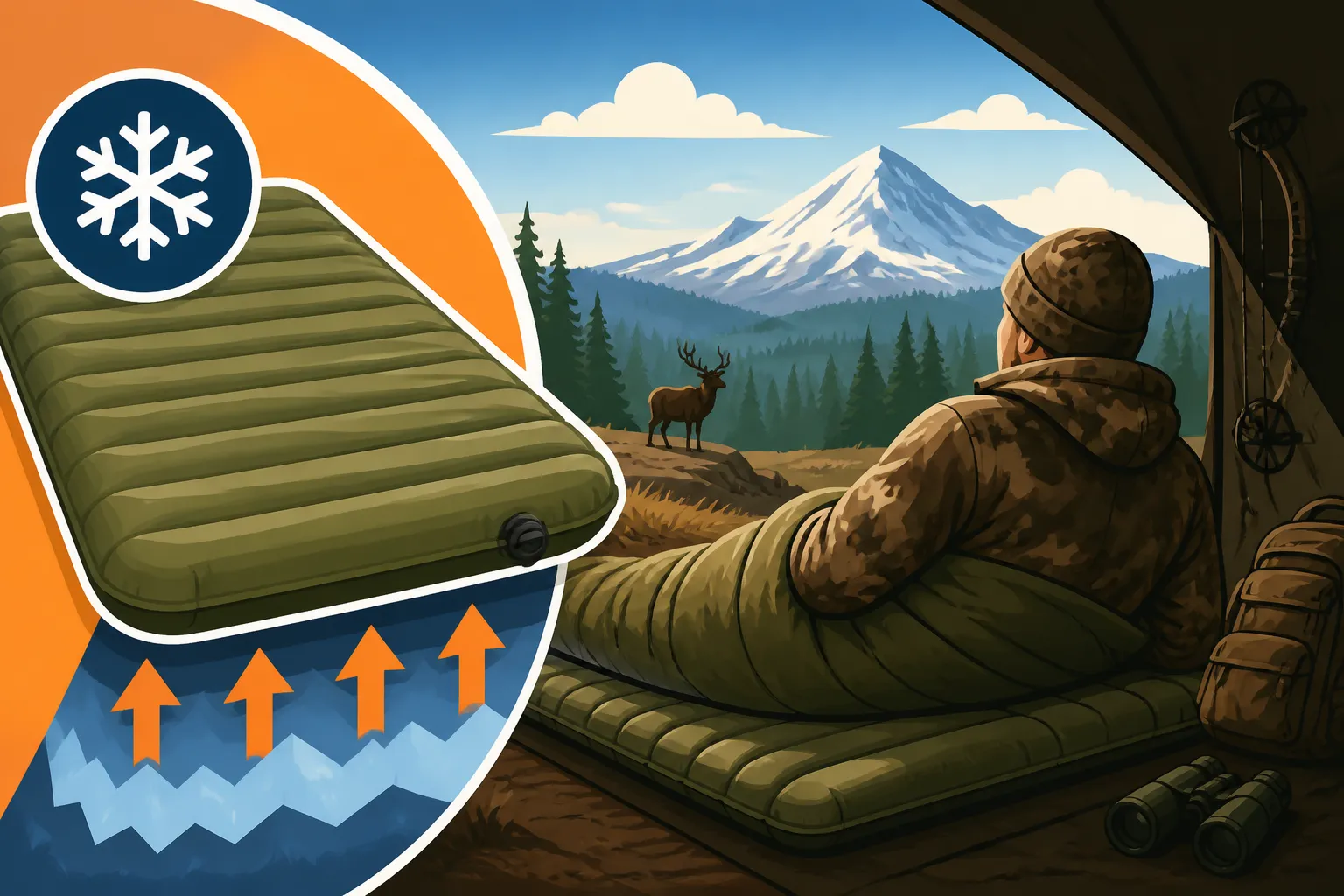
Sleeping Pads for Cold Ground
You've just spent a grueling day navigating the steep, rain-soaked timber of Western Washington or the rocky, windswept draws of the Eastside. All you want is a warm, restorative night's sleep to prepare for tomorrow's hunt. But often, hunters overlook one of the most critical pieces of backcountry gear: the sleeping pad. That cold, unforgiving ground can leach precious body heat away, turning a well-earned rest into a shiver-fest and leaving you exhausted, affecting your focus and performance in the field. This guide is dedicated to helping you understand how to choose and use the right sleeping pad to insulate you from Washington's frigid earth, ensuring you stay warm, comfortable, and ready for whatever the hunt throws at you.
The Silent Energy Drain: Why Cold Ground is Your Biggest Enemy in a Washington Spike Camp
It's easy to focus on your sleeping bag's temperature rating, but many hunters completely underestimate the amount of heat lost to the ground beneath them. When you lay down, your body compresses the insulation in your sleeping bag, especially on the underside. This compression drastically reduces its ability to trap air, which is what actually keeps you warm. The cold, hard ground then acts like a giant heat sink, relentlessly pulling warmth from your body through direct conduction. This isn't just uncomfortable; it's a significant drain on your energy reserves, leaving you fatigued and less effective when it matters most.
Imagine setting up a Backcountry Camps in Washington Wilderness when the mercury dips near freezing, or even below. Your sleeping bag might be rated for 0 degrees Fahrenheit, but if you're lying directly on cold earth with inadequate ground insulation, you'll still feel chilled to the bone. Your body constantly works to maintain its core temperature, and if it's losing heat faster than it can produce it, you're in for a miserable night. This constant battle for warmth burns calories, depletes your energy, and can even compromise your immune system, which is the last thing you want deep in the Washington backcountry.
This phenomenon is particularly pronounced in Washington, where even early-season hunts can encounter surprising cold snaps at higher elevations or persistent dampness in coastal regions. Think about those chilly September nights in the high Cascades, or a late October deer hunt in the Okanogan where the ground freezes solid. A sleeping pad is not just about comfort; it's a critical component of your survival system, acting as a crucial barrier between your body and the heat-sucking earth. Overlooking its importance is a common mistake that can cost you dearly in terms of comfort, safety, and hunting success.
Understanding R-Values: The Science Behind Staying Warm on Cold Washington Earth
When you start looking at sleeping pads, you'll quickly encounter the term "R-value." This isn't some marketing gimmick; it's a scientific measurement of a material's thermal resistance, or how well it insulates. The higher the R-value, the better the pad will prevent heat transfer from your warm body to the cold ground. This is the single most important factor to consider when choosing a sleeping pad for cold weather.
The R-value scale is linear, meaning an R-value of 4 is twice as insulating as an R-value of 2. It’s not subjective like a sleeping bag’s comfort rating; it’s a standardized test. For Washington hunting, where conditions can range from mild shoulder seasons to genuinely frigid late-season scenarios, understanding R-values is paramount. A pad with an R-value between 1.0 and 2.0 might be fine for summer camping, but it's utterly insufficient for a crisp fall elk hunt in the Colockum or a late-season blacktail hunt in the Willapa Hills.
Matching R-Values to Washington's Diverse Seasons
To help you get a handle on what R-value you might need, consider these general guidelines, always erring on the side of warmer if you tend to sleep cold or if your hunt takes you into unpredictable high country:
- Summer/Early Fall (above 40°F / 4°C): R-value of 1.0 – 2.0. Think August bear hunts at lower elevations or early September deer in warmer areas.
- 3-Season (20°F – 40°F / -7°C – 4°C): R-value of 2.0 – 4.0. This is the sweet spot for many general season deer and elk hunts in Washington, covering most of September and October.
- Cold Weather (0°F – 20°F / -18°C – -7°C): R-value of 4.0 – 6.0. Essential for those late-season hunts when temperatures consistently drop below freezing, or if you're in exposed, high-altitude camps.
- Extreme Cold (below 0°F / -18°C): R-value of 6.0+. If you're planning a serious Late-Season Hunting in Washington Snow in areas like the Blue Mountains or the Okanogan high country, this is where you need to be.
Remember, these are starting points. Personal physiology plays a huge role; some people are "cold sleepers" and need more insulation than others. Also, consider that the air temperature might be 30°F, but the ground could be much colder, especially if there's snow or frozen soil. Always factor in the coldest potential ground temperature, not just the air temperature predicted by the forecast you're checking on GoHunt.
Types of Sleeping Pads: Navigating Your Options for Washington's Diverse Terrain
The world of sleeping pads offers a variety of technologies, each with its own benefits and drawbacks for the Washington hunter. Understanding these differences will help you make an informed choice that balances warmth, weight, durability, and cost.
Closed-Cell Foam Pads
These are the simplest and often the most budget-friendly option. They consist of a dense foam material filled with tiny, sealed air pockets that provide insulation. Think of the classic blue or grey accordion-style pads you've seen.
- Pros: Extremely durable (you can't pop them!), lightweight, impervious to punctures, and they retain their insulation even if wet. They also provide a firm, stable sleeping surface. They're excellent as a secondary pad for layering.
- Cons: Not very comfortable compared to inflatable options, bulky to pack (they strap to the outside of your pack), and their R-values are generally lower, typically ranging from 1.0 to 2.5. This means they are often not sufficient on their own for cold Washington nights.
- Best for Washington: A great supplemental layer under an inflatable pad for extra warmth and ground protection in rugged terrain, or as a lightweight, indestructible option for shoulder-season day hunts where an unplanned overnight might occur. They also provide a convenient sitting pad around camp.
Self-Inflating Pads
These pads combine foam insulation with air chambers. When you unroll them and open the valve, the foam expands and draws air into the pad. A few breaths might be needed to top them off for firmness.
- Pros: Offer a good balance of comfort and warmth, and they are generally more durable than pure air pads because the foam provides some structural integrity. Their R-values can range from 2.0 to 5.0, making many suitable for 3-season Washington hunting.
- Cons: Tend to be heavier and bulkier than modern air pads, and while more puncture-resistant than air pads, they can still be deflated if punctured.
- Best for Washington: A solid choice for hunters who prioritize comfort and don't mind a little extra weight, especially if they're not pushing into extreme cold or ultralight backpacking. They work well for truck camps or shorter, less demanding hikes into a spike camp where the extra bulk isn't a deal-breaker.
Insulated Air Pads
These are the darlings of the ultralight backcountry hunting world. They rely entirely on trapped air for cushioning and often incorporate synthetic insulation or reflective baffles internally to boost their R-value without adding significant weight. You inflate them manually, usually with an included pump sack.
- Pros: Exceptionally lightweight and packable, often rolling down to the size of a water bottle. They offer superior comfort and warmth-to-weight ratios, with R-values ranging from 2.0 all the way up to 7.0+. This makes them ideal for serious cold-weather expeditions.
- Cons: More susceptible to punctures than other types (a stray thorn or sharp rock can ruin your night). They require manual inflation, which can be tiring after a long day, though pump sacks mitigate this. They can be noisy as you shift around, which might bother some sleepers. Their cost is often higher.
- Best for Washington: The go-to for serious backcountry elk hunters or those tackling late-season high-country mule deer. If you're Packing an Elk Out of Washington's Backcountry and every ounce counts, an insulated air pad is probably your best friend. Just be sure to carry a patch kit!
Building Your Sleep System: Combining Pads and Strategies for Ultimate Warmth
Choosing a single sleeping pad is a good start, but for ultimate warmth and versatility in Washington's unpredictable conditions, many experienced hunters embrace a "sleep system" approach, often involving layering pads. This strategy not only boosts your R-value but also adds a layer of redundancy, which is invaluable deep in the wilderness.
The Power of Layering Sleeping Pads
Layering typically involves placing a closed-cell foam (CCF) pad directly on the ground, and then putting your inflatable or self-inflating pad on top of it. This combination provides several key benefits:
- Boosted R-Value: You simply add the R-values of the two pads together. For example, a CCF pad with an R-value of 2.0 combined with an insulated air pad of 4.0 gives you a combined R-value of 6.0 – easily enough for truly cold conditions.
- Puncture Protection: The CCF pad acts as a tough, sacrificial barrier, protecting your more fragile inflatable pad from sharp objects on the ground. This peace of mind is huge when you're miles from the trailhead.
- Emergency Backup: If your inflatable pad does get a catastrophic puncture that can't be fixed, you still have the CCF pad to provide some insulation and keep you off the bare ground, preventing a potentially dangerous situation.
- Comfort and Stability: The CCF pad can add a bit more structure and prevent your inflatable pad from shifting around on uneven ground.
Many hunters use this strategy for hunts that might involve colder nights, especially if they are using a lower-rated Sleeping Bag Temperature Ratings. It's a highly effective way to fine-tune your insulation for specific conditions without having to buy multiple high-R-value inflatable pads. When planning your Washington hunt, whether you're looking up GMU data on GoHunt or scouting a new basin, think about the likely temperatures you'll encounter and build your sleep system accordingly.
Beyond the Pad: Other Considerations for Ground Warmth
Your sleeping pad is just one piece of the puzzle. The effectiveness of your entire sleep system also depends on how you use your gear and other environmental factors.
- Tent Selection: A good quality tent, especially one with a durable floor and a full rainfly, will offer more protection from the elements and a bit more insulation from the wind and ground. Look for a Tent Choice for Wet Washington Camps if you're frequently in the western part of the state.
- Sleeping Bag Rating: Ensure your sleeping bag's comfort rating aligns with the lowest temperatures you expect. Remember, the pad supports the bag's warmth; they work together.
- Site Selection: Always choose your camp spot wisely. Avoid depressions where cold air settles, and steer clear of rocky areas or spots with standing water that will conduct cold more efficiently. A bed of pine needles or dry leaves can add a tiny bit of natural insulation.
- Nutrition and Hydration: Eating a good, calorie-rich meal before bed helps your body generate heat overnight. Staying well-hydrated throughout the day is also crucial for overall body function and warmth.
- Layering for Sleep: Don't wear all your sweaty hunting clothes to bed. Put on clean, dry base layers. Layering for Wet Cold Weather principles apply even in your sleeping bag. A dry wool or synthetic base layer will trap air and help retain body heat. Consider a dry hat and warm socks.
- Ground Moisture: Washington is notoriously wet. Even if the air is dry, ground moisture can seep up. A ground cloth or footprint under your tent, combined with a good sleeping pad, creates multiple barriers against dampness and cold.
| Pad Type | R-Value Range | Weight/Bulk | Comfort | Durability | Washington Scenario |
|---|---|---|---|---|---|
| Closed-Cell Foam | 1.0 – 2.5 | Lightweight/Bulky | Low | Excellent | Emergency backup, layering, sitting pad for any hunt. |
| Self-Inflating | 2.0 – 5.0 | Mid-range | Medium-High | Good | Truck camping, shorter hikes, 3-season general hunts. |
| Insulated Air Pad | 2.0 – 7.0+ | Ultralight/Compact | High | Fair-Good | Backcountry elk, late-season high country, ultralight. |
Ultimately, investing in a high-quality sleeping pad or a versatile layering system is an investment in your comfort, safety, and success as a Washington hunter. Don't let a chilly night rob you of the energy you need to pursue that trophy animal the next morning. Make sure your Washington Backcountry Camp Gear includes a sleep system that will keep you toasty warm, no matter how cold the ground gets.
Disclaimer
This article is for general informational purposes only and does not constitute professional advice. Laws, prices and regulations vary by location and change over time. Consult a qualified professional for guidance on your specific situation.