When 15×56 Binoculars Beat a Spotter
Choosing the right optics for hunting in Washington can feel like a never-ending debate, especially when you're trying to decide between the sheer magnification of a spotting scope and the comfort of a high-powered set of binoculars. Many hunters assume a spotting scope is always the go-to for long-range glassing, but I'm here to tell you that in a lot of Washington's diverse and often challenging terrain, a good pair of 15×56 binoculars can actually be your secret weapon, outperforming a spotter in critical ways. This guide will dive deep into why these powerful binos might just be the perfect tool for your next hunt, helping you spot game more effectively and with less fatigue.
Understanding the Optics Divide: 15×56 Binoculars Versus Spotting Scopes
Before we dive into the nitty-gritty of why 15×56 binoculars can be superior, let's briefly unpack the fundamental differences between them and a typical spotting scope. It's not just about one being "better" than the other; it's about understanding their design intent and where each truly excels. Many hunters get caught up in the "more power is always better" mindset, but that's a trap, especially when you're dealing with the dynamic and often visually complex landscapes of Washington State.
Magnification, Field of View, and Light Gathering
A spotting scope, with its common magnification range of 20-60x or even higher, is designed for extreme detail at long distances. You can pick out the tiny characteristics of an elk's antler tine or verify a three-point mule deer across an enormous canyon. However, this high magnification comes at a significant cost: a much narrower field of view (FOV). Imagine looking through a soda straw compared to a wide-angle window. With a spotter, you're seeing a tiny slice of the landscape, making it difficult to scan for movement or locate game that isn't already in your crosshairs.
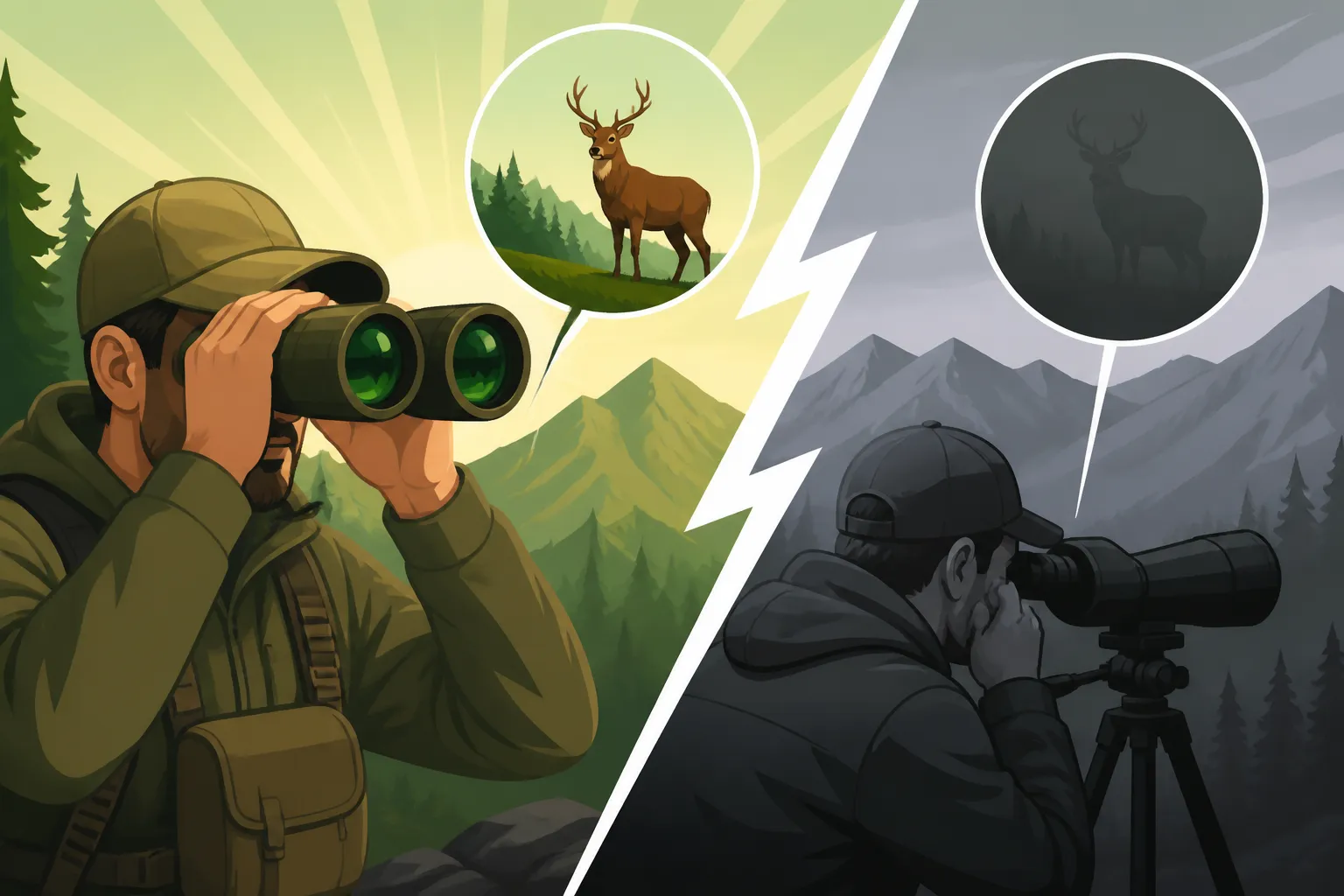
Now, consider a 15×56 binocular. While 15x might seem modest next to a 60x spotter, it offers a crucial advantage: two eyes, and a significantly wider field of view. This means you're taking in a broader swath of terrain simultaneously, which is incredibly efficient when you're trying to find an animal in a vast landscape. The 56mm objective lenses are also key here; they gather a substantial amount of light, giving you a bright image even in challenging conditions like Glassing Breaks at First Light or when the clouds roll in on the Westside. Two eyes also mean better depth perception, which can be surprisingly helpful in judging distances and terrain features.
Weight, Portability, and Set-Up Time
Let's be real: hunting in Washington often means covering ground. Steep hills, dense timber, and remote backcountry are the norm, not the exception. Every ounce in your pack counts, and every minute spent setting up gear is a minute not spent hunting or observing. A spotting scope requires not only the scope itself but also a sturdy tripod, adding considerable bulk and weight to your load. Deploying a spotter means finding a stable spot, extending the tripod, leveling it, and then carefully adjusting the scope. This whole process takes time, and sometimes, precious seconds.
The 15×56 binocular setup, on the other hand, is much more streamlined. While a tripod is still highly recommended for stable viewing with 15x magnification (we'll get to that!), the binoculars themselves are lighter and more compact than a scope. You can often carry them comfortably in a chest harness, ready for instant use. This quick-draw capability is invaluable when you're still-hunting through thick brush or need to rapidly confirm a distant movement. When you're trying to get a clear view of Blacktail Deer Density in Washington Timber and every rustle could be a buck, the speed of access with binos is a game-changer. Plus, if you're Packing an Elk Out of Washington's Backcountry, you'll appreciate any weight savings you can get.
Washington Scenarios Where 15×56 Binoculars Outshine a Spotter
Washington's hunting grounds are incredibly varied, from the dense, dark timber of the west side to the expansive sagebrush country of the east. Each environment presents its own optical challenges, and it's in many of these unique Washington settings that 15×56 binoculars truly come into their own.
Dense Timber, Brushy Valleys, and Broken Terrain
Picture this: you're working your way through a clearcut grown up in thick reprod on the west side, or slowly still-hunting a timbered ridge for Roosevelt Bulls and Why They Bugle Less. Your goal isn't to pick out a specific antler tine at a mile, it's to find any part of an animal hidden in the shadows, or to spot movement in the chaotic jumble of trees and brush. A narrow field of view from a spotter here is a huge disadvantage; you'd spend all your time trying to scan tiny patches, likely missing the bigger picture.
This is where the wider field of view of 15×56 binoculars shines. You're able to observe a much larger area, making it easier to pick up the subtle glint of an antler, a patch of hide, or the flick of an ear. The dual-eye viewing also helps immensely with perceiving depth in this cluttered environment. You can more quickly distinguish between a shadow and an animal, or a downed log and a bedded deer. For hunters focused on Still-Hunting Blacktails in Wet Washington Brush, these binoculars offer the perfect blend of magnification to reach out and see detail, with enough field of view to search effectively in challenging cover.
Mobile and Fast-Paced Hunting Strategies
Some hunts are about settling in and glassing for hours, but many in Washington demand mobility. Think about trying to intercept migrating elk during a late-season snow hunt, or working ridge lines in eastern Washington trying to find a fresh track. If you're constantly moving, covering ground, and only stopping for relatively brief glassing sessions, the faff of setting up a spotting scope repeatedly becomes a major hindrance.
With 15×56 binoculars, you can quickly post up against a tree, brace yourself, and scan an entire hillside or basin in minutes. If nothing's there, you're back on the move. There's no cumbersome setup, no packing away a delicate scope and tripod. This agility is priceless when you're trying to cover a lot of country, especially in Washington's more rugged areas, or when you're trying to relocate a herd that just disappeared over a ridge. This fast-paced approach is often necessary for pursuing Washington Elk Herds and Where They Live that might be on the move.
All-Day Glassing Comfort and Reduced Eye Fatigue
If you've ever spent hours behind a spotting scope, squinting with one eye, you know the fatigue is real. Your eye waters, your head aches, and eventually, you just want to put the thing away. This isn't just uncomfortable; it reduces your effectiveness as a hunter. Tired eyes miss details.
The beauty of 15×56 binoculars is that you're using both eyes. This natural way of seeing significantly reduces eye strain, even during extended glassing sessions. You can comfortably spend much longer scrutinizing a distant hillside or scanning a vast landscape without feeling drained. This is especially beneficial when you're trying to pick apart large areas for Mule Deer Numbers in Washington or patiently waiting for an animal to move out of cover. When you're trying to cover large expanses of terrain, especially in open eastern Washington country, this comfort factor allows you to stay in the game longer. This prolonged, comfortable viewing is a huge advantage for effective scouting and hunting.
Scouting and Broad Area Searches
When you're trying to figure out new ground, perhaps in a unit you've only seen on a map, or you're trying to locate a general area where game might be holding, a spotting scope is often overkill. You're not trying to score a ram; you're trying to locate any animal, or even just promising habitat. This is precisely where the wider field of view and dual-eye experience of 15×56 binoculars excel. You can sweep entire mountainsides, clearcuts, or drainages much more efficiently than with a spotter.
For initial scouting, whether it's before the season or on opening day, these binoculars allow you to take in more information at once. You can quickly identify travel corridors, bedding areas, or feeding zones. Many hunters, myself included, will use powerful tools like GoHunt to do their initial E-scouting from home, identifying potential areas of interest. Once in the field, these 15×56 binoculars become the perfect follow-up tool, allowing you to quickly confirm or dismiss those areas with boots on the ground, without the cumbersome setup of a spotter. You can identify patterns in Elk Behavior in Deep Snow across a broad area rather than focusing on a single small patch.
Maximizing Your 15×56 Binocular Performance in the Field
Just owning a pair of powerful binoculars isn't enough; knowing how to use them effectively is what truly unlocks their potential. With 15x56s, a few simple techniques and complementary gear choices can turn them into an incredibly potent glassing machine, often surpassing the practical utility of a spotting scope in Washington's varied hunting conditions.
The Indispensable Role of a Tripod
Let's be unequivocally clear: while you can handhold 15×56 binoculars, you're severely limiting their performance. The slightest tremor in your hands, the natural sway of your body, or even a brisk wind will cause the image to jump and blur, negating much of the magnification's benefit. To truly unlock the crisp, steady image and fine detail resolution that 15x56s offer, a lightweight, sturdy tripod is absolutely essential.
Mounting your binoculars on a tripod transforms them from a shaky handheld device into a stable, high-powered viewing station. This allows your eyes to relax and absorb detail without constantly trying to stabilize the image. You'll be amazed at the difference it makes, letting you pick out faint movements or small details that would be utterly missed otherwise. This is the difference between merely scanning a hillside and truly Glassing From a Tripod All Day, patiently waiting for an animal to reveal itself. Invest in a good tripod adapter for your binos, and you'll immediately elevate your glassing game.
Capitalizing on Low-Light Performance
The "56" in 15×56 refers to the diameter of the objective lens in millimeters. Larger objective lenses gather more light. This is a critical factor, especially when you consider that big game animals are most active during the low-light periods of dawn and dusk. This is often when you're trying to catch them moving from bedding to feeding areas, or vice-versa.
The generous 56mm objective lenses of these binoculars allow them to perform exceptionally well in dim conditions, often providing a brighter, clearer image than a spotting scope with smaller objective lenses. While some high-end spotters can rival this, the ability to gather light with both eyes simultaneously gives 15x56s an edge in perceived brightness and comfort during those crucial twilight hours. If you're trying to pick out an animal's silhouette against a dark timberline or find them feeding in a shaded draw as the sun dips below the horizon, these binoculars will give you a distinct advantage.
Pairing with Lower Magnification and Leveraging Digital Tools
While 15×56 binoculars are fantastic for detailed scrutiny and covering broad areas, sometimes you still need a lower-power optic for quick, general scanning, especially in very close quarters or extremely dense cover. Many experienced hunters will carry a smaller, lighter pair of 8x or 10x binoculars for general navigation and initial sweeps, then switch to their tripod-mounted 15x56s when they want to really pick apart a distant slope or verify a specific detail. This "two-binocular" approach offers the best of both worlds.
Furthermore, integrating your glassing strategy with modern digital tools can amplify your success. Before you even head into the field, using applications like GoHunt can help you pinpoint areas that are worth spending dedicated glassing time. You can analyze terrain, identify potential game corridors, and mark waypoints, all of which guide your in-field glassing efforts. When you know where to focus your 15×56 binoculars, you make every minute behind the glass more efficient. Imagine using GoHunt to identify key south-facing slopes, then using your 15x56s on a tripod to meticulously scan those slopes for elk.
Environmental Considerations and Robustness
Washington's weather is notoriously unpredictable. From driving rain on the Olympic Peninsula to dusty winds in the Columbia Basin, your optics need to withstand the elements. When investing in 15×56 binoculars, prioritize models that are fully waterproof, fog-proof, and built to take a beating. Rubber armor, rugged construction, and purged optics are key features to look for.
A high-quality pair of 15×56 binoculars is often more robust and less prone to delicate adjustments than a spotting scope. This means less worry about them getting knocked around in your pack while traversing rugged terrain or being exposed to an unexpected downpour. This durability ensures your vital glassing tool is ready to perform when you need it most, even if you're out there in Layering for Wet Cold Weather conditions. Good gear choices here can make or break your hunt, especially when you're miles into the backcountry.
When a Spotter Might Still Be the Better Choice
While 15×56 binoculars are incredibly versatile and often superior for many Washington hunting scenarios, it's important to be realistic about their limitations. There are specific situations where the sheer magnification of a spotting scope simply cannot be beaten. Understanding these situations helps you make an informed decision about your optics kit.
Extreme Long-Range Identification
If your primary hunting strategy involves glassing vast, open landscapes—think the sweeping coulees of Eastern Washington, or the enormous basins of some high-country mule deer units—and you need to consistently judge fine details at distances exceeding a mile, a spotting scope might still be your preferred tool. For example, if you need to meticulously count points on a deer to determine if it meets Washington's Three-Point Rule and What Counts from a ridgeline far, far away, a 60x spotter will undeniably give you more definitive detail.
Similarly, if you're on a trophy hunt where distinguishing between a legal branch-antlered bull and a smaller spike is critical at extreme ranges, a spotter provides that extra magnification to avoid mistakes. The ability to zoom in and resolve very small features, even if the field of view is narrow, is where a dedicated spotting scope still holds a distinct advantage. However, even in these scenarios, many hunters will use their 15×56 binoculars to find the animal, then switch to the spotter for the final, detailed identification.
Digital Adapters and Recording Your Hunt
Another niche where spotting scopes sometimes shine is in digiscoping – attaching your smartphone or a camera to the eyepiece to capture photos or videos of distant game. While adapters exist for binoculars, the single, larger exit pupil of a spotting scope often makes it easier to align a camera lens for higher quality, magnified images. If documenting your hunts with high-zoom photos or videos is a priority, a spotter might offer a more user-friendly and higher-resolution solution for that specific task. This isn't necessarily about hunting effectiveness, but about the auxiliary benefits.
Ultimately, the choice comes down to your primary hunting style, the terrain you frequent, and your personal preferences. However, for a vast majority of Washington hunting, especially when considering comfort, speed, and overall effectiveness in diverse environments, a quality pair of 15×56 binoculars, especially when tripod-mounted, offers an incredibly compelling argument for being the most valuable piece of glass in your pack.
| Feature | 15×56 Binoculars | Typical Spotting Scope (e.g., 20-60x) |
|---|---|---|
| Primary Use Case | Scouting, scanning, finding game, sustained viewing | Detailed identification, extreme long-range focus |
| Magnification Range | Fixed 15x | Variable (e.g., 20-60x) |
| Field of View | Wider, excellent for scanning and finding | Narrower, excellent for precise examination |
| Light Gathering | Excellent (56mm objective), good in low light | Varies by objective size, often good but one-eyed |
| Eye Fatigue | Low (two-eye viewing), comfortable for long periods | Higher (one-eye viewing), can cause strain quickly |
| Portability | Moderate weight, can be chest-harnessed for quick use | Heavier (scope + tripod), requires more setup |
| Tripod Requirement | Highly recommended for stable viewing | Essential for any practical use |
| Depth Perception | Good (two eyes) | Limited (one eye) |
| Speed of Deployment | Fast, quick on/off target | Slower, requires setup and adjustment |
| Weather Resistance | Generally very robust and sealed | Can be more delicate, requires careful handling |
Disclaimer
This article is for general informational purposes only and does not constitute professional advice. Laws, prices and regulations vary by location and change over time. Consult a qualified professional for guidance on your specific situation.