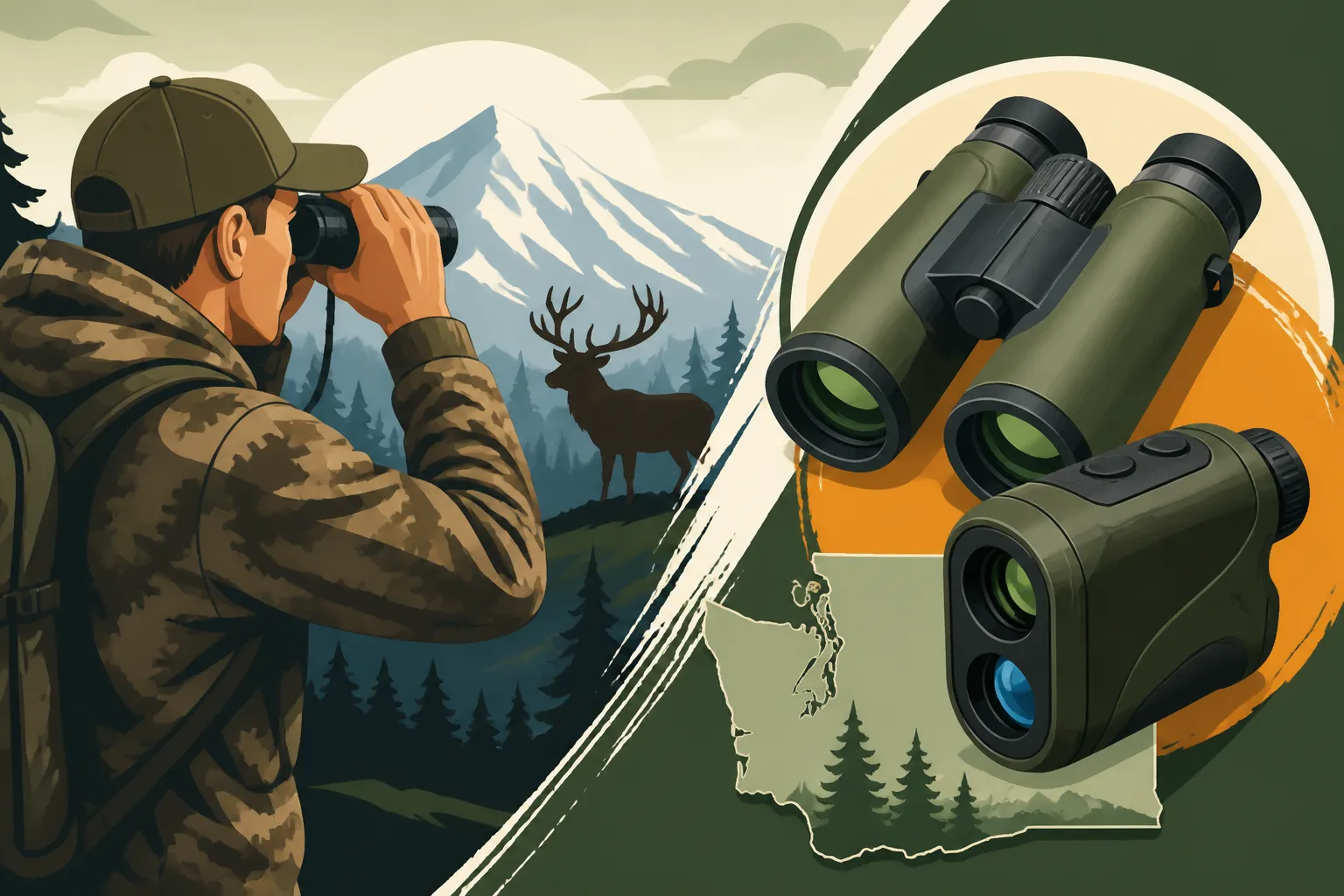
Rangefinder Binocular Combos
There’s a common frustration many of us face out in the Washington wilds: you spot a magnificent bull elk or a cagey blacktail buck, grab your binoculars for a better look, and then fumble for your rangefinder to get a yardage reading. In those crucial seconds, the animal might have moved, or worse, vanished into the timber. This guide is all about streamlining that process by diving deep into the world of rangefinder binocular combos, helping you understand how these integrated tools can give you a significant advantage in the field.
Understanding the Appeal of Rangefinder Binocular Combos
We’ve all been there: a moment of truth unfolds in front of you, and you’re trying to juggle multiple pieces of gear. Whether you're peering into the deep canyons of the Blue Mountains for a Rocky Mountain elk or navigating the dense reprod of the Willapa Hills for a Roosevelt, speed and efficiency can make all the difference. Rangefinder binocular combos offer a compelling solution to this age-old problem, merging two essential tools into one powerful optic.
Streamlined Efficiency in the Field
The primary draw of a rangefinder binocular combo is the sheer efficiency it brings to your hunting setup. Instead of having to transition from glassing with your binoculars to then grabbing a separate rangefinder, acquiring the target again, and then getting a reading, you do it all with one instrument. Imagine spotting a spike elk on a distant ridge while Glassing Eastern Washington Breaks for Mule Deer, instantly pressing a button, and getting an accurate distance without ever taking your eyes off the animal. This quick, seamless operation is invaluable, especially when elk or deer are on the move or when you're hunting in tight, fast-paced environments where every second counts. It reduces movement, minimizes noise, and keeps you focused on your target, increasing your chances of making an ethical shot.
This integrated approach also helps when you're making quick decisions in dynamic scenarios, like a bull elk responding to your calls during Bugling and Cow Calling in Washington's Archery Elk Season. You might be scanning the treeline for movement, and as soon as you pick up antlers, you can range them without breaking your glassing rhythm. This efficiency translates directly into more successful and less stressful hunting encounters. For serious hunters who spend countless hours scouting and practicing, optimizing every step of the in-field process is a game-changer. It’s not just about convenience; it’s about improving your actual effectiveness when it matters most.
Weight and Bulk Reduction
Another significant benefit that often goes overlooked is the reduction in weight and bulk you carry. While a single rangefinder and a single binocular might not seem heavy individually, when combined with your pack, rifle, water, and other essentials, every ounce adds up, especially on a multi-day backcountry hunt in Washington's rugged terrain. A combo unit eliminates the need for a second piece of glass, freeing up valuable space in your bino harness or pack and lightening your overall load. This is particularly noticeable when you're scrambling up a steep incline in the Okanogan or pushing through thick brush in the Gifford Pinchot National Forest.
Consider a scenario where you're packing in for an archery hunt. Every bit of gear is carefully selected for its utility and weight. Carrying separate binoculars and a rangefinder means two cases, two sets of straps (or a harness for one and a pocket for the other), and two distinct items that can get snagged or lost. A combo unit consolidates this, often fitting perfectly into a standard bino harness designed for its size. This not only makes your setup lighter but also less cumbersome. For those long days in the field, particularly when you’re already carrying heavy loads, even a few ounces saved can make a difference in your stamina and comfort. When you’re trying to keep things minimal and efficient, like during a Packing an Elk Out of Washington's Backcountry situation, having one less item to manage is a definite plus.
Key Features and Considerations When Choosing a Combo
Selecting the right rangefinder binocular combo isn't just about picking the first one you see. There's a lot to consider, from the quality of the glass to how well it holds up to Washington's notoriously wet weather. You’re making an investment, and you want to ensure it pays off in performance and durability. This isn't a purchase you want to rush, especially given the demands of hunting everything from Columbian Blacktail Deer in Western Washington to Rocky Mountain Elk East of the Washington Cascades.
Optical Performance and Ranging Capabilities
At the heart of any good binocular, combo or not, is its optical performance. You need crisp, clear images that allow you to pick apart distant hillsides, identify game, and judge antler size accurately. Look for terms like "ED glass" or "HD glass" as indicators of higher quality lenses that reduce chromatic aberration and provide excellent light transmission, which is crucial in the dim light of dawn and dusk. The magnification (e.g., 10x) and objective lens diameter (e.g., 42mm) are also important, dictating how much light the binoculars gather and how stable the image will be. For serious western hunting, a 10×42 or 10×50 is often considered a great balance. You'll want to carefully compare these specs, perhaps using resources like GoHunt to understand different models.
Equally important are the ranging capabilities. Consider the maximum reflective range – how far can it accurately range a highly reflective target? More practical for hunters is the range on deer or elk, which is usually significantly less. Look for models that offer angle compensation, often called "true ballistic range" or "horizontal distance." This is essential in Washington's steep, mountainous terrain, as the actual distance an arrow or bullet travels is different from the straight-line distance to a target on an incline. A rangefinder that only gives you line-of-sight distance can lead to significant misjudgments on steep shots. A good combo will have a fast and consistent ranging engine, allowing for multiple readings quickly. You need to be confident in that number when a trophy animal is in your crosshairs, so researching how different brands perform in varying light and atmospheric conditions is key.
Ergonomics, Durability, and Weather Resistance
Hunting in Washington means dealing with everything from driving rain to heavy snow and dense fog. Your gear needs to withstand these elements without fail. Durability and weather resistance are paramount. Look for units that are fully waterproof and fogproof, often indicated by nitrogen or argon purging. The housing material also matters; rubber armoring provides a good grip, protects against drops, and helps dampen sound. Ergonomics are also critical for extended periods of glassing. How does the combo feel in your hands? Is it balanced? Are the buttons easily accessible and intuitive to operate, even with gloves on? A poorly designed combo can be a major frustration in the field, making it difficult to operate quickly and efficiently.
The focus wheel and diopter adjustments should be smooth but firm enough to hold their setting. Many high-end combos offer customizable settings, such as different ranging modes (scan, brush, long-range) or the ability to store multiple ballistic profiles for your specific rifle or bow. While these features might seem advanced, they add a layer of functionality that can be incredibly useful. Imagine trying to get a range through a thick patch of salal in western Washington – a "brush" mode can help filter out foreground obstructions. A comfortable grip and well-placed buttons mean less fatigue and faster target acquisition when you need it most. This is especially true when you're trying to stay quiet and subtle, maybe during Still-Hunting Blacktails in Wet Washington Brush, where every movement and sound matters.
Battery Life and Power Management
One of the most common complaints about electronic devices in the backcountry is inadequate battery life. You don't want your rangefinding capabilities to die on day three of a five-day hunt. When evaluating rangefinder binocular combos, pay close attention to the advertised battery life and the type of battery required. Most units use common CR2 batteries, which are relatively easy to find, but some might use less common types. It’s always a good idea to carry spare batteries, regardless, but a combo with efficient power management will mean fewer swaps.
Beyond just the raw battery life, consider how the unit manages power. Does it have an auto-off feature to conserve battery if you forget to turn it off? How quickly does it power up when you need it? Some units have power-saving modes that might reduce the display brightness or limit certain features to extend life. For extended trips into remote Washington wilderness areas, reliable power management is critical. Imagine packing into the Pasayten Wilderness Hunting Access for a week – you can't just pop into a store for new batteries. Many hunters use external power banks for charging phones and other devices, but a combo that sips power means one less thing to worry about. Planning for your hunt also involves planning for your gear’s power needs, and a combination unit should make that easier, not harder.
Real-World Application in Washington's Diverse Terrain
Washington's hunting landscape is incredibly diverse, offering everything from the dense, wet forests of the Olympic Peninsula to the sage-studded coulees of the Columbia Basin. A rangefinder binocular combo needs to perform reliably and effectively across these varied environments. Understanding how specific features translate to real-world hunting scenarios is key to maximizing your investment and improving your chances of success.
Western Washington Timber and Brush
Hunting in Western Washington is often a game of close quarters, quick reactions, and navigating thick cover. The dense timber, clearcuts, and brushy drainages demand optics that are rugged, quick to deploy, and can cut through dim light and moisture. In these conditions, a rangefinder binocular combo shines by offering instant ranging. When a Roosevelt elk ghosts through a patch of devil's club, you need to react fast. Fumbling with separate optics can mean the difference between a shot opportunity and a missed chance.
In areas like the Coweeman Unit or the Olympic Unit, where visibility can be limited to less than 100 yards, the compact nature and rapid ranging of a combo are invaluable. While you might not be ranging thousands of yards, accurately knowing the distance to a bull that steps out at 60 yards or a blacktail buck at 35 yards in a tight window is paramount. The angle compensation feature is also crucial here, as Western Washington terrain often involves steep hillsides and deep ravines, even in the timber. Knowing the "shoot-at" distance on a steep downhill shot can prevent a miss or, worse, a wounded animal. The ability to range quickly and consistently, even when rain is falling or fog is settling in, is why many Westside hunters consider these combos a significant advantage. This quick assessment is vital when practicing Shot Placement on a Quartering Elk in a limited window of opportunity.
Eastern Washington Open Country
Contrast that with Eastern Washington's expansive landscapes, from the wide-open sagebrush flats of the Beezley Unit to the vast wheat fields and rolling hills of the Okanogan. Here, long-range glassing is the name of the game, and spotting a mule deer or Rocky Mountain elk at over a mile is not uncommon. A high-quality rangefinder binocular combo truly comes into its own in these environments. You'll spend hours behind the glass, picking apart distant features, and when you finally spot an animal, being able to instantly get a preliminary range is incredibly efficient.
The quality of the optics – the clarity, light transmission, and edge-to-edge sharpness – becomes even more critical when trying to discern a deer from a rock at 800 yards. When combined with a good tripod, a combo unit allows you to settle in for serious glassing, and as soon as you identify an animal, you can range it without shifting your position or your focus. This is invaluable when planning your stalk on a wary mule deer buck in the Columbia Basin. Having reliable angle compensation is equally important here, as many shots in Eastern Washington can involve significant elevation changes, whether you're shooting across a canyon or down into a draw. Brands like GoHunt often offer mapping tools that, when combined with accurate rangefinding, help you plan your approach and identify potential ambush points, truly maximizing your scouting and hunting efforts.
Making the Investment: Pros, Cons, and Value
Rangefinder binocular combos are often seen as a premium piece of hunting gear, and rightfully so. They integrate complex optics and electronics into a single, robust unit, which comes with certain implications regarding cost, performance, and overall utility. Understanding these factors will help you decide if a combo is the right choice for your Washington hunting adventures.
The Cost Factor and Long-Term Value
Let's be upfront: rangefinder binocular combos are an investment. They typically cost more than buying a decent pair of binoculars and a separate rangefinder of comparable quality. This higher upfront cost can be a barrier for many hunters, and it’s a valid consideration. However, it's essential to look beyond the initial price tag and consider the long-term value and benefits these units provide. When you combine two high-performance tools into one, you're paying for convenience, efficiency, and often, superior integrated performance.
The argument for long-term value often comes down to performance and durability. A good combo is built to withstand the rigors of the field, offering a robust, all-in-one solution that reduces the number of items that can break, get lost, or be forgotten. While you might pay more now, you're potentially saving yourself from future frustrations or even missed opportunities. Think about the cumulative benefit over multiple seasons of hunting Washington Elk Herds and Where They Live or chasing Blacktail Deer Hunting in Western Washington Timber. The enhanced speed and simplicity could translate into more successful hunts over time. Plus, many top-tier optics brands back their products with excellent warranties, further extending their perceived value over the life of the product. When considering the overall expense of hunting, from licenses and tags to travel and other gear, the investment in a quality combo can be justified by its direct contribution to your success and enjoyment in the field.
Potential Downsides and Alternatives
While rangefinder binocular combos offer significant advantages, they aren't without their potential downsides. The most commonly cited con, as mentioned, is the price. For hunters on a tighter budget, purchasing separate, entry-level to mid-range binoculars and a dedicated rangefinder might be a more financially accessible option that still gets the job done. Another potential drawback can be the repair factor: if one component (either the optics or the rangefinder) fails in a combo unit, the entire unit needs to be sent in for repair, leaving you without both functions. With separate units, if your rangefinder breaks, you still have your binoculars, and vice-versa.
Weight, ironically, can also be a double-edged sword. While it’s often touted as a weight reduction over carrying two quality pieces of gear, a combo unit will almost always be heavier than a stand-alone binocular of the same optical quality. If ultralight backpacking is your absolute priority, and you only need basic ranging occasionally, a super-light bino paired with a micro-rangefinder might be slightly lighter. Furthermore, if you prefer using a Spotting Scope Magnification Range for extended glassing from a tripod, then the integrated rangefinding might be less crucial as you're already committed to a more stationary, deliberate setup. Ultimately, the decision comes down to your personal hunting style, budget, and the specific demands of the Washington units you plan to hunt. Carefully weighing these pros and cons will help you make the best choice for your gear locker.
| Feature | Entry-Level Combo | Mid-Range Combo | Premium Combo |
|---|---|---|---|
| Optical Quality | Good, coated lenses | Very Good, ED glass | Excellent, HD/APO glass |
| Ranging Range (Deer) | 600-800 yards | 800-1200 yards | 1200-1800+ yards |
| Angle Compensation | Basic or None | Standard, reliable | Advanced, true ballistic |
| Durability | Weather-resistant | Fully waterproof/fogproof | Rugged, armored, fully sealed |
| Ergonomics | Functional, sometimes bulky | Comfortable, balanced | Lightweight, superior feel |
| Battery Life | Moderate | Good, efficient | Excellent, long-lasting |
| Price Point | Accessible | Moderate investment | Significant investment |
| Ideal For | Casual hunting, shorter ranges | Versatile, most hunting | Dedicated, backcountry, long-range |
Disclaimer
This article is for general informational purposes only and does not constitute professional advice. Laws, prices and regulations vary by location and change over time. Consult a qualified professional for guidance on your specific situation.