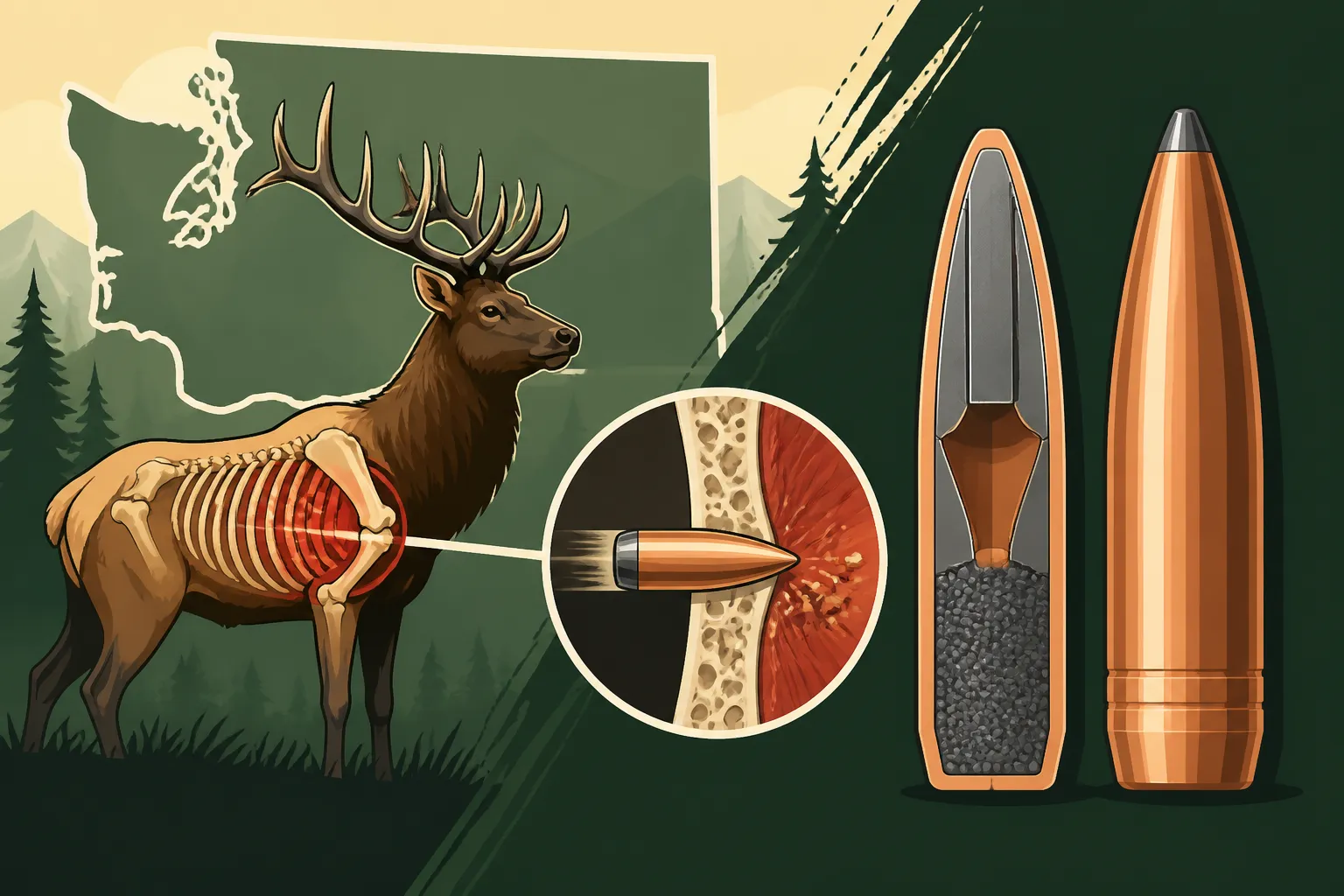
Bullet Construction for Heavy Bone
Hitting heavy bone on a big game animal in Washington can be a hunter's worst nightmare if your bullet isn't up to the task. Nothing is more frustrating, or ethically concerning, than a shot that doesn't penetrate or fragments on impact, leaving you with a wounded animal and a potentially difficult or impossible recovery. This guide will dive deep into the world of bullet construction, helping you understand how different designs perform when encountering the dense skeletal structure of a bull elk or a mature mule deer, and ultimately aiding you in choosing a bullet that will perform reliably when it matters most.
The Anatomy of a Hunting Bullet and Why It Matters
Before we can talk about how a bullet interacts with bone, it's crucial to understand what goes into making one. Modern hunting bullets are sophisticated pieces of engineering, far removed from simple lead projectiles. Their design, from the tip to the base and everything in between, is precisely calibrated to achieve specific terminal performance on game. When you're facing down a big Roosevelt elk in the thick timber of Western Washington, you need to know your bullet has the internal structure to hold together and drive deep.
Core and Jacket Materials
The heart of any hunting bullet is its core, typically made of lead, and the jacket that encases it, usually a copper alloy like gilding metal. But within this basic framework, there's a world of variation.
- Traditional Lead-Core, Non-Bonded: These are your classic cup-and-core bullets. A lead core is simply pressed into a copper jacket. When they hit something dense, the lead can separate from the jacket, leading to rapid expansion and fragmentation, but often at the cost of penetration, especially on heavy bone. They might dump a lot of energy quickly, but if that energy is spent on the surface, it doesn't reach vital organs deep inside.
- Bonded Cores: This is a significant step up. In bonded bullets, the lead core is chemically or thermally fused to the copper jacket. This bonding prevents the core and jacket from separating, even under extreme impact stresses. The result is superior weight retention and controlled expansion, which translates directly into deeper penetration through tough hide, muscle, and, critically, heavy bone. For a quartering-away shot on a bull elk where you expect to encounter a shoulder blade or spine, a bonded bullet offers a much higher probability of reaching the vitals.
- Monolithic Copper or Copper Alloy: These bullets are different entirely. Instead of a lead core and a separate jacket, they are machined from a single piece of copper or a copper alloy. They contain no lead, making them an excellent choice in areas with lead restrictions or for hunters concerned about lead in their game meat. Monolithic bullets are renowned for their incredible weight retention—often 95% or more—and their ability to penetrate deep with minimal fragmentation. They expand reliably, often peeling back into "petals," creating a devastating wound channel while staying intact to keep driving forward.
Bullet Design and Tip Types
Beyond the core and jacket, the external and internal design features of a bullet play a huge role in how it behaves on impact.
- Soft Points: These bullets have an exposed lead tip, designed to initiate rapid expansion. They're often found in traditional cup-and-core designs and can be effective on lighter game or for broadside shots. However, on heavy bone, that exposed lead tip can deform too quickly, leading to shallow penetration or even bullet breakup.
- Hollow Points: While many pistol bullets are hollow points, some rifle bullets, especially monolithic designs, incorporate a hollow cavity in the nose. This cavity is designed to catch fluid and force expansion. When engineered correctly for hunting, these can provide excellent expansion and penetration, particularly in monolithic forms where the robust copper structure maintains integrity.
- Polymer Tips: Many modern hunting bullets feature a polymer (plastic) tip. This tip serves several purposes: it improves ballistic coefficient for flatter trajectories and better accuracy at long range, and it also helps initiate expansion reliably by being driven back into the bullet's core on impact. Bullets like the Nosler AccuBond or Hornady ELD-X use polymer tips to great effect, combining accuracy with controlled expansion.
- Boattail vs. Flat Base: This refers to the rear of the bullet. A boattail design tapers at the base, reducing drag and improving long-range accuracy. A flat base can be simpler to manufacture and sometimes offers excellent accuracy at shorter ranges. While not directly related to bone performance, accuracy is paramount, and a bullet that consistently hits its mark is always preferred.
Weight Retention vs. Energy Transfer
This is the crux of bullet performance on heavy bone. Imagine your bullet as a tiny battering ram.
- Energy Transfer: A bullet that expands rapidly and fragments, like a traditional cup-and-core, might dump a lot of its energy very quickly within the first few inches of tissue. This creates a massive hydrostatic shock and a large wound cavity near the entry point. While this can be lethal, if it occurs primarily on the outside of the animal, it doesn't guarantee penetration to vital organs. Think of hitting a thick elk shoulder bone; if the bullet expands too violently and breaks apart, it might not even get through that bone, let alone into the chest cavity.
- Weight Retention: This is where bullets designed for heavy bone truly shine. A bullet with high weight retention—meaning it loses very little of its original mass upon impact—will continue to penetrate deep, even after hitting tough structures. Bonded bullets and monolithic solids are engineered precisely for this. They expand in a controlled manner, retaining most of their mass, allowing them to punch through bone and muscle to reach the vitals. This trade-off between rapid energy dump and deep penetration is critical for larger, tougher animals like Washington's elk. While a fast energy dump can be effective on a whitetail, it's often insufficient for an elk.
For hunters who rely on accurate shots and reliable terminal performance, understanding these material and design choices is paramount. It allows you to select a bullet that truly fits the challenge of the game you pursue, whether it's the Rocky Mountain Elk East of the Washington Cascades or the dense musculature of a Roosevelt Elk of Western Washington.
What Happens When a Bullet Hits Heavy Bone?
It's one thing to understand bullet construction in theory, and another to grasp the violent reality of a bullet striking the dense bone of a large animal. When a projectile traveling at thousands of feet per second collides with an unyielding object like a scapula or humerus, physics gets messy, and bullet performance is truly tested.
The Challenge of Bone Impact
Imagine the shoulder blade of a mature bull elk. It's not just a thin plate; it's a thick, tough, irregularly shaped bone designed to protect vital organs and provide attachment points for powerful muscles. This isn't like hitting soft tissue. When your bullet connects with this kind of structure, several things can happen, none of them good if your bullet isn't designed for it:
- Deflection: A bullet can glance off or be significantly redirected by a hard bone. This is particularly true if the bullet hits at an oblique angle or if it starts to deform prematurely. Instead of continuing its path toward the heart and lungs, it might follow the contour of the bone, or even exit at an unexpected point, causing a superficial wound.
- Fragmentation: Many traditional bullets, especially those with non-bonded lead cores, are prone to fragmenting violently when they hit heavy bone. The lead core can separate from the jacket, or the entire bullet can break into many smaller pieces. While these fragments can cause damage, they lack the mass and momentum to penetrate deeply into the animal's vitals. It creates a horrific wound, but one that might not be instantly lethal.
- Stopping/Slowing: In the worst-case scenario, a bullet that hits heavy bone can be completely stopped or significantly slowed down, preventing it from reaching the intended target. This often happens with lighter, fast-expanding bullets that expend all their energy on the bone itself. The animal is wounded, but not effectively taken down, leading to a potentially long and difficult tracking job. Blood Trailing in Salal and Devil's Club can be tough enough on a good hit, let alone a poor one.
Deformation, Fragmentation, and Penetration
These three concepts are intertwined when a bullet impacts bone.
- Deformation: All hunting bullets are designed to deform (expand) to create a larger wound channel and transfer energy. The key is controlled deformation. A bullet designed for heavy bone will deform to a certain diameter, mushrooming into a larger, more blunt profile, but it will maintain its structural integrity. This allows it to push tissue aside and continue forward, rather than breaking apart.
- Fragmentation: As mentioned, excessive fragmentation on bone is usually a sign of a bullet that's not robust enough for the task. While some controlled shedding of small lead petals can contribute to the wound channel, a bullet that disintegrates into many tiny pieces loses its penetrating power. Imagine trying to hammer a nail with a handful of sand versus a solid hammer. The solid hammer (weight-retaining bullet) will drive deeper.
- Penetration: This is the ultimate goal when hitting bone. You want the bullet to penetrate through the bone and continue into the vitals. A bullet that deforms in a controlled manner and retains its weight is far more likely to achieve adequate penetration. This is crucial for achieving a quick, humane kill, especially on animals with thick hides and robust bone structures. Even if you're aiming for a lung shot, a shoulder blade or rib cage might be in the way.
Common Bullet Failures on Bone
Hunters often encounter specific types of bullet failures when their projectile meets heavy bone.
- "Blow-ups": This term describes bullets that expand too rapidly and violently on impact with bone, often fragmenting extensively and failing to penetrate deeply. The bullet might essentially "explode" on the surface, leaving a nasty but superficial wound. This is particularly common with older, thin-jacketed cup-and-core bullets driven at high velocities. The energy is expended in a spectacular but ultimately ineffective manner.
- Shallow Penetration: Even if a bullet doesn't completely blow up, it might expand so aggressively that it expends all its energy within the first few inches of tissue and bone, resulting in very shallow penetration. This leaves the animal wounded, but often capable of escaping and surviving for a significant period. This is why selecting the right bullet, considering factors like Bullet Weight for Elk Versus Deer, is so important.
Understanding these failure modes helps emphasize why robust bullet construction is not just a preference, but an ethical imperative when hunting tough game. You need a bullet that you can trust to perform, even when the shot isn't perfectly clear of bone.
Bullet Constructions Engineered for Heavy Bone
When hunting large game like Washington elk or the bigger mule deer of the eastern plains, you need a bullet that's specifically designed to punch through heavy bone without compromising its ability to reach vital organs. Fortunately, bullet manufacturers have developed several effective constructions to meet this challenge. These designs prioritize weight retention and controlled expansion, ensuring deep penetration even after a bone strike.
Bonded Core Bullets
Bonded bullets are a popular and highly effective choice for heavy bone. As discussed, the key here is the fusion of the lead core to the copper jacket. This mechanical and chemical bond prevents separation, which is the primary cause of fragmentation and shallow penetration in traditional bullets.
- How they work: When a bonded bullet hits bone, the jacket and core expand together. The expansion is controlled, often mushrooming to about 1.5 to 2 times its original diameter, but the bullet holds together as a single, expanded unit. This means it retains a high percentage of its original weight, typically 70-95%, allowing it to maintain momentum and drive through tough tissue and bone.
- Examples: Popular bonded bullet lines include the Nosler AccuBond, Hornady InterBond, Swift A-Frame, and Federal Trophy Bonded Tip. Many hunters swear by these for elk, especially in challenging situations like those found in the Blue Mountains Elk Herd or the dense forests of the Willapa Hills Elk Herd. When you're packing an elk out of Washington's Backcountry, you want to know it went down clean.
- Benefits: Excellent balance of expansion and deep penetration. Reliable performance even on bone hits. Good ballistic coefficients for longer shots.
Monolithic Copper or Copper Alloy Bullets
These lead-free projectiles are an outstanding choice for tackling heavy bone, and they are gaining significant popularity, especially in areas where environmental concerns about lead are prevalent.
- How they work: Monolithic bullets are solid copper or copper alloy. They don't have a separate core and jacket to separate. Instead, they are typically designed with a hollow point or a polymer tip that initiates expansion by forcing the copper forward into pre-cut petals. These petals peel back but remain attached to the main body of the bullet, creating a wide, sharp cutting surface that continues to drive deep. Because they are a single, solid piece, their weight retention is exceptionally high—often upwards of 95%—which is critical for punching through bone.
- Examples: Barnes TSX, TTSX (Tipped Triple-Shock X-Bullet), LRX, Hornady GMX, Federal Terminal Ascent, and Nosler E-Tip are prime examples. These bullets are favorites among hunters pursuing Washington Elk Hunting Tactics by Weapon Season and offer reliable performance regardless of whether they encounter soft tissue or dense bone.
- Benefits: Near-perfect weight retention. Extremely deep penetration. Lead-free. Excellent expansion in a wide velocity range. Less prone to deflection than lead-core bullets due to their rigidity.
Partitioned or Dual-Core Designs
Partitioned bullets represent another innovative approach to achieving deep penetration with good expansion. The original design, the Nosler Partition, has been a benchmark for heavy game hunting for decades.
- How they work: These bullets feature two separate lead cores divided by a thick copper wall or "partition" within the bullet's jacket. The front core is designed for rapid, controlled expansion upon impact, creating a wide wound channel. The rear core, protected by the partition, remains intact, retaining its mass and driving the expanded front section for deep penetration. It's essentially two bullets in one: one for immediate damage, one for deep reach.
- Examples: The Nosler Partition is the quintessential example. Other manufacturers have adopted similar principles in some of their designs.
- Benefits: Guaranteed penetration due to the protected rear core. Good expansion in the front section. Proven performance on very large, tough animals like moose and large elk. They offer a great combination of energy transfer and penetration power.
Choosing the Right Bullet for Washington Species
When you're sifting through your options at the local sporting goods store or browsing online (perhaps doing some research on GoHunt for ballistics data), it's important to consider your target species and your hunting conditions in Washington.
- For Elk: Whether you're chasing Roosevelt Bulls and Why They Bugle Less on the Olympic Peninsula or Tracking a Buck After a Fresh Snow in the Blues, elk demand a robust bullet. Bonded, monolithic, and partitioned bullets are your best friends here. They will reliably break down bone and still deliver lethal force to the vitals. Consider a heavier bullet weight for your chosen caliber to maximize kinetic energy and momentum for deep penetration.
- For Mule Deer: Eastern Washington mule deer can be surprisingly robust, especially the bigger bucks found in the Okanogan Unit Mule Deer Country. While a lighter-constructed bullet might work on a broadside shot in open country, if you anticipate quartering shots or hitting shoulder bone, stepping up to a bonded or monolithic design is wise. They often feature good ballistic coefficients, which is a plus for longer shots common in open sagebrush or wheat stubble.
- For Blacktail Deer: Western Washington blacktails are generally smaller than mule deer, but they often inhabit thick cover, meaning shots can be close, fast, and sometimes through brush or angled, where hitting bone is a possibility. While many conventional bullets work well, a bonded or monolithic bullet provides an extra margin of error, ensuring consistent performance even if you hit a shoulder blade on a close-range animal.
| Bullet Construction Type | Primary Advantage | Ideal Use Case | Common Trade-off | Weight Retention | Bone Performance |
|---|---|---|---|---|---|
| Traditional Lead-Core | Rapid energy transfer, often good initial shock | Lighter game, broadside shots, shorter ranges | Can fragment, shallow penetration on heavy bone | Low to Medium | Poor to Fair |
| Bonded Core | Controlled expansion, high weight retention | All big game, especially elk and larger deer, quartering shots | Slightly less initial expansion than traditional | High | Good to Excellent |
| Monolithic Copper | Extreme penetration, near-perfect weight retention | All big game, any angle, lead-free areas | Can require higher impact velocity for optimal expansion | Very High | Excellent |
| Partitioned/Dual-Core | Guaranteed deep penetration, good expansion | Very large/tough game (elk, moose), any shot angle | More complex design, sometimes higher cost | High | Excellent |
This table should give you a quick reference when considering your options. Ultimately, the best bullet is one that you trust, that shoots accurately from your rifle, and that is appropriately constructed for the animals you hunt and the conditions you expect to encounter.
Practical Considerations for Washington Hunters
Choosing the right bullet construction isn't just about reading a ballistic chart; it's about integrating that knowledge into your overall hunting strategy for Washington's diverse terrain and species. From selecting your caliber to rigorous practice, every step contributes to ethical and successful hunting.
Caliber and Bullet Weight
While bullet construction is paramount, it works in concert with your chosen caliber and bullet weight. A larger caliber generally allows for heavier bullets, which inherently carry more momentum and energy, aiding in penetration. However, even a smaller caliber, when paired with a premium, well-constructed bullet, can be surprisingly effective on heavy game.
- Bigger is not always better: A .30-06 Springfield with a 180-grain bonded bullet will often outperform a .338 Win Mag with a poorly constructed 200-grain bullet on heavy bone. The construction determines how well that weight and energy are utilized.
- Bullet Weight for Species: For elk, most experienced Washington hunters lean towards bullet weights at the heavier end of the spectrum for their chosen caliber (e.g., 180-200 grains in a .30 caliber, 160-180 grains in a .270 or 7mm). This extra mass aids in maintaining momentum through tough hide, muscle, and bone. For deer, especially the smaller Blacktail Deer Density in Washington Timber, you might opt for a slightly lighter bullet if you prefer, but a well-constructed bullet of moderate weight will still provide excellent performance without excessive damage. Consider Bullet Weight for Elk Versus Deer carefully for your specific hunt.
Shot Placement and Angle
No matter how good your bullet construction, nothing replaces proper shot placement. Even the toughest bullet can't overcome a poorly aimed shot. However, premium bullet construction provides an invaluable margin of error when bone is unexpectedly encountered.
- Aim for the Vitals: Always aim for the animal's vitals—the heart and lungs. These are large targets, and a well-placed shot here with a good bullet will result in a quick, humane kill.
- Anticipate Bone: When taking a quartering-away shot on an elk, you might aim for the far shoulder to break it and ensure the bullet passes through the vitals. This is exactly where a bonded or monolithic bullet shines, as it can punch through that far shoulder blade. If you were using a frangible bullet, that bone could stop or deflect it.
- Ethical Limits: Know your limitations and the limitations of your equipment. Don't take risky shots through heavy bone at extreme angles if you're not confident in your rifle's accuracy and your bullet's performance. Sometimes the most ethical decision is to wait for a better shot or pass entirely.
Testing Your Chosen Load
You wouldn't head out for Sighting In Before the Opener without knowing your rifle's zero, and you shouldn't head into the field without knowing how your chosen bullet performs.
- Range Time: Spend ample time at the shooting range, not just confirming your zero, but also practicing shooting from field positions. Understand how your bullet flies at various ranges. This also helps you become intimately familiar with your rifle's recoil and handling characteristics.
- Impact on Media: While not strictly necessary, some hunters like to test their chosen loads into various media (wet newspaper, ballistic gel, even water jugs) to visually observe expansion and penetration characteristics. This can be a fascinating way to gain confidence in your bullet's design.
- Accuracy First: The most robust bullet in the world is useless if it doesn't shoot accurately from your rifle. Always prioritize accuracy. If a particular premium bullet doesn't group well in your rifle, it's better to choose a different, accurate load, even if its construction is slightly less "premium," and then stick to broadside, bone-free shots.
Researching Performance
Don't just take a manufacturer's word for it. There's a wealth of information available to help you make an informed decision.
- Hunter Forums and Reviews: Read reviews and experiences from other hunters who have used specific bullets on similar game. Many online hunting communities, like those found on GoHunt, have extensive discussions about terminal performance on various species. You can find real-world accounts that complement manufacturer data.
- Ballistic Calculators: Use online ballistic calculators (many bullet manufacturers and third-party sites offer these) to understand your bullet's trajectory, energy, and velocity at different ranges. While these won't tell you how a bullet performs on bone, they confirm if your bullet retains enough energy for reliable expansion at your maximum ethical shooting distance.
- Manufacturer Data: Reputable bullet manufacturers provide detailed information on their bullet designs, intended use, and often provide gelatin test results or cross-section images. This helps you understand the engineering behind the bullet. When considering Washington's diverse hunting opportunities, from Glassing Eastern Washington Breaks for Mule Deer to Still-Hunting Blacktails in Wet Washington Brush, having a bullet that performs predictably across conditions is invaluable.
By carefully considering caliber, practicing religiously, and researching your options, you'll be well-prepared to make an ethical shot with a bullet that will perform reliably, even when encountering the heavy bone of Washington's big game.
Disclaimer
This article is for general informational purposes only and does not constitute professional advice. Laws, prices and regulations vary by location and change over time. Consult a qualified professional for guidance on your specific situation.