Two-Way Radios and Legal Channels
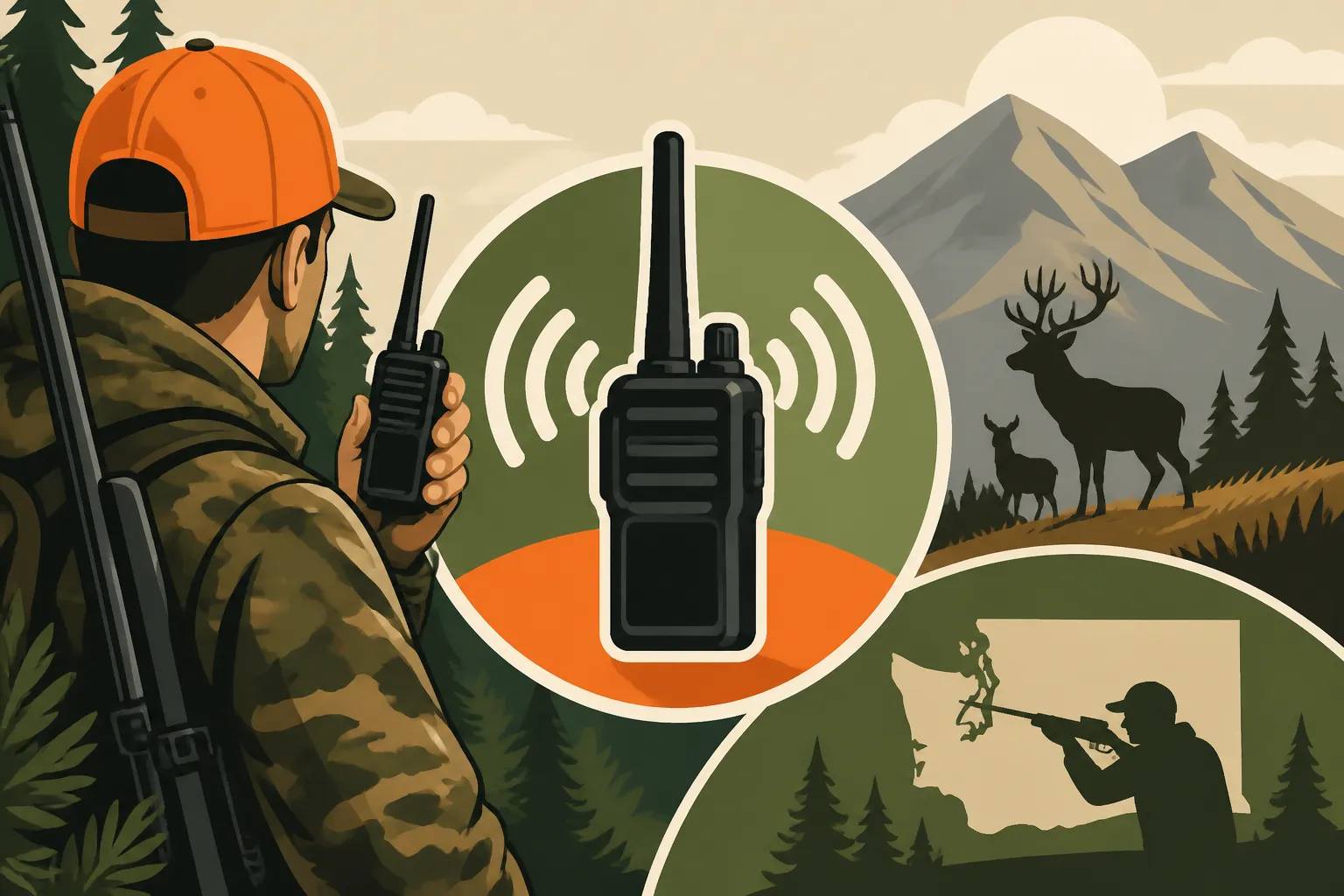
Picture this: you're deep in the Washington backcountry, miles from a trailhead, with patchy-to-nonexistent cell service. You're hunting with a buddy, maybe trying to coordinate a push through some dense timber or a long-range glassing effort across a canyon. Suddenly, you hear a crash, or you spot a bull, but your phone is a useless brick. How do you communicate? This guide is all about cutting through that frustration, making sure you and your hunting partners stay connected and safe in Washington’s diverse and often challenging terrain, specifically focusing on two-way radios and the legal channels you need to understand.
Why Two-Way Radios Are Essential for Washington Hunters
Washington state offers some incredible hunting opportunities, from the dense, wet forests of the Olympic Peninsula to the vast, open expanses of the Columbia Basin. But with that beauty comes a significant challenge: reliable communication. Cell service is often a pipe dream once you leave the main highways, leaving hunters isolated and vulnerable if something goes wrong. This is where two-way radios become more than just a convenience; they become an indispensable piece of safety gear.
Communication in Remote Areas
Let's be real, how many times have you been out scouting a new Washington Game Management Units Explained or tracking a blacktail through thick westside reprod, only to see "No Service" on your phone? It's practically a given. Washington's topography, with its dramatic mountain ranges, deep river valleys, and vast timberlands, creates countless dead zones for cellular signals. Relying on a cell phone for communication in these areas is akin to relying on a bicycle for an elk pack-out – it's just not going to cut it.
Radios, on the other hand, operate on line-of-sight or ground-wave principles, meaning they don't need cell towers. While their range can still be impacted by terrain, a well-chosen radio system can maintain communication where phones fail. This is especially crucial if you're out in a remote area for a multi-day hunt, maybe even trying Washington Backcountry Camp Gear. You need a reliable way to check in, share updates, or call for help.
Safety and Coordination for Your Group
Hunting with partners is safer and often more effective, but only if you can communicate. Imagine one hunter spots a bear on an avalanche chute while another is working their way up the drainage. Or, worse, someone takes a fall, twists an ankle, and can't move. In these scenarios, a two-way radio can be the difference between a minor inconvenience and a serious emergency.
Radios allow for real-time coordination, whether you're planning a complex drive for deer, trying to pinpoint the location of a bugling bull during Archery Elk Hunting in Washington's September Season, or simply letting your group know you've decided to head back to camp. This isn't just about tactical hunting advantages; it's about peace of mind. Knowing you can reach your partners at any moment, even if you’re miles apart, drastically increases the safety margin for everyone in your hunting party.
Different Radio Types and Their Roles
When you start looking at two-way radios, you'll quickly encounter an alphabet soup of acronyms: FRS, GMRS, and even HAM. Each type has its own set of rules, power limits, and capabilities, making them suitable for different hunting scenarios. Understanding these differences is the first step in choosing the right tool for your Washington adventures. FRS radios are generally simple, low-power devices, perfect for short-range communication among a small group. GMRS radios offer more power and range but require a license. HAM radios are the most powerful and versatile, demanding a more in-depth understanding and a specialized license. We'll dive into the specifics of each and their legal channels next.
Navigating the Airwaves: Legal Channels for Washington Hunting
Understanding the legalities of two-way radio use is just as important as knowing how to operate the device itself. You don't want to inadvertently break a rule or, worse, interfere with emergency communications. In Washington, like the rest of the US, radio frequencies are regulated. For hunters, the primary concern will be FRS and GMRS, with HAM radio being a more niche, advanced option.
FRS Radios: Simple and License-Free
FRS, or Family Radio Service, radios are what most people think of when they imagine walkie-talkies. They are readily available at most sporting goods stores and electronics retailers. The biggest advantage of FRS radios is that no license is required to operate them. This makes them incredibly popular for casual use and for hunting groups where everyone just wants to grab a radio and go.
However, this ease of use comes with limitations. FRS radios are restricted to low power output (typically 0.5 to 2 watts) and operate on shared, public channels. This means their effective range in Washington's rugged terrain can be quite limited, often only a mile or two, sometimes even less in dense timber or deep valleys. While they're great for close-range communication – say, between two hunters still-hunting a clearcut, or when setting up a Two-Man Calling Setups on Elk – don't expect them to reach across a major canyon.
GMRS Radios: More Power, More Range, Licensing Required
GMRS, or General Mobile Radio Service, radios are a step up from FRS. They operate on similar frequencies but are allowed to transmit at much higher power levels (up to 50 watts for mobile units, though handhelds are usually 5 watts or less), significantly increasing their potential range. This extra power can make a huge difference when you're trying to communicate across open ridges while Glassing Eastern Washington Breaks for Mule Deer or coordinating multiple groups across a wider area.
The catch? GMRS radios require a license from the Federal Communications Commission (FCC). Don't let that intimidate you; it's not like getting your pilot's license. The GMRS license covers you and your immediate family for a period of years, and it's a relatively straightforward online application process. There's a fee involved, but for many serious hunters, the increased range and reliability are well worth the investment. Think of it like investing in your Rifle Setup for Washington Elk and Deer – it's a tool that enhances your effectiveness and safety. If you're using detailed mapping tools like GoHunt to plan your hunts, coordinating with more powerful GMRS radios becomes a logical extension of that strategic effort.
HAM Radios: The Advanced Option
Amateur Radio, or HAM radio, is another league entirely. These radios offer the most power and flexibility, with capabilities for extremely long-range communication, even across states or continents under the right conditions. However, HAM radio operators must pass an exam to get a license, demonstrating a solid understanding of radio theory and operating procedures.
For most Washington hunters, HAM radios are overkill. They involve more complex equipment, often requiring external antennas and a deeper knowledge base than is necessary for typical hunting communications. While a HAM license is valuable for emergency preparedness and can certainly be used for hunting, the barrier to entry is higher. Unless you're planning ultra-remote, multi-week expeditions where communication is absolutely critical over vast distances, or you're already an avid HAM enthusiast, FRS or GMRS will likely meet your needs. Still, if you're deeply into detailed planning and scouting using platforms like GoHunt, and you value redundant communication, a HAM setup might appeal to your comprehensive approach.
The Importance of Channel Etiquette
Regardless of the radio type you choose, remember that these are shared frequencies. Practicing good radio etiquette is crucial. Keep your transmissions brief, clear, and to the point. Avoid hogging a channel or engaging in lengthy, unnecessary chatter. If you hear others using a channel, try to move to another one if possible, especially if you're just chatting. Using privacy codes (sometimes called sub-channels or CTCSS/DCS tones) can help filter out unwanted chatter, but remember they don't make your conversation private; they just mute your radio unless it detects the same code. Always assume others can hear you.
Here's a quick comparison of the common radio types for hunters:
| Feature | FRS (Family Radio Service) | GMRS (General Mobile Radio Service) | HAM (Amateur Radio) |
|---|---|---|---|
| License | None required | Required (covers family) | Required (individual, exam-based) |
| Power Output | Low (0.5-2 watts) | Medium to High (up to 50 watts) | High (up to 1500 watts, usually less for handhelds) |
| Range | Short (1-5 miles line-of-sight) | Medium (5-25+ miles line-of-sight) | Long (regional to worldwide) |
| Complexity | Very simple, plug-and-play | Simple to moderate | Moderate to high |
| Cost | Low | Low to moderate | Moderate to high |
| Typical Use | Close-range, small groups | Mid-range, larger groups, safety | Enthusiasts, emergency comms, very remote |
| Encryption | None | None | Some digital modes offer privacy |
Choosing the Right Two-Way Radio for Your Washington Hunt
Selecting the best two-way radio isn't a one-size-fits-all decision. What works for a couple of buddies still-hunting Blacktail Deer Hunting in Western Washington Timber might be totally inadequate for a larger group chasing elk in the Blue Mountains Hunting in Southeast Washington. You need to consider the specific conditions of your hunt and your priorities.
Key Features to Look For
When you're sifting through the countless radio models, keep these features in mind:
- Range and Power Output: This is often overstated on packaging. A radio claiming "36-mile range" is usually referring to optimal, line-of-sight conditions (like mountain peak to mountain peak with nothing in between). In Washington's real-world hunting environments, expect significantly less. For thick timber, you'll be lucky to get a mile or two. For more open country, GMRS radios with higher wattage will give you more reliable reach.
- Battery Life: You're not going to find an outlet out in the wilderness. Look for radios with long battery life, preferably those that use rechargeable battery packs and have the option to run on standard AA/AAA batteries as a backup. Carrying extra battery packs or a portable charger is always a smart move. When you're Packing an Elk Out of Washington's Backcountry, the last thing you want is your radio dying when you need to coordinate.
- Durability and Weather Resistance: Washington weather is notoriously unpredictable. Your radio needs to withstand rain, snow, dust, and the occasional drop. Look for radios rated IPX4 or higher for water resistance. Robust construction and durable buttons are also a plus when you're wearing gloves or operating in adverse conditions.
- Ease of Use: In a high-stress situation, you don't want to be fumbling with complicated menus. Simple, intuitive controls are best. Features like hands-free operation (VOX) can be useful, though sometimes they pick up too much ambient noise.
- NOAA Weather Alerts: Many radios include a feature to tune into NOAA weather radio alerts. This can be a lifesaver, giving you advance warning of incoming storms or other hazardous conditions, especially if you're Late-Season Hunting in Washington Snow.
Specific Scenarios and Radio Choices
- Short-Range, Dense Cover (Western Washington Timber): For two or three hunters working closely in dense timber or thick brush, basic FRS radios might suffice. Their low power is less of a hindrance when line-of-sight is minimal anyway. They are lightweight and inexpensive.
- Mid-Range, Varied Terrain (Eastside Breaks or Larger Groups): If you're hunting more open country on the east side, or if your group tends to spread out a bit, a GMRS system is a much better choice. The increased power will allow you to communicate more reliably over longer distances, like across a couple of canyons. This is also ideal for larger groups needing better coordination. When you're E-Scouting Washington GMUs Before the Draw with a tool like GoHunt, you can identify potential communication dead zones and plan around them, making a GMRS system even more valuable for bridging those gaps.
- Ultimate Range and Reliability (Extreme Backcountry): For those undertaking truly remote, multi-day excursions far from any semblance of civilization, a HAM radio might be considered, though it requires significant commitment to licensing and equipment. Satellite communicators (like those from Garmin inReach or Zoleo) are also excellent options for true emergency communication and check-ins, often providing text messaging and SOS capabilities independently of radio frequencies.
Considerations for GoHunt Users
If you're already using advanced tools like GoHunt for detailed mapping and planning your Washington hunts, think about how your communication strategy integrates. GoHunt helps you understand terrain, access points, and game movement. Knowing the topography of your hunting area can help you predict where radio signals might be blocked. For instance, if your GoHunt map shows a deep canyon between you and your partner, you'll know that even a powerful GMRS radio might struggle without a relay point.
Consider using GoHunt's mapping features to mark potential high points that could serve as relay locations for your radio communication, or to anticipate areas where comms will be completely cut off. A strong communication plan, whether with FRS or GMRS, complements the detailed scouting and planning you put into your hunt through GoHunt, ensuring you have the best possible chance of success and safety.
Mastering Your Radio: Tips for Effective Field Communication
Having the right radio is only half the battle; knowing how to use it effectively in the field is just as crucial. Poor radio habits can lead to misunderstandings, missed opportunities, and even unsafe situations.
Clear and Concise Language
When communicating over a two-way radio, think brevity and clarity. Static, distance, and even background noise (like wind or rushing water) can obscure messages. Adopt a clear, concise way of speaking:
- Identify Yourself: Start by identifying who you are and who you're calling. "John to Mike, over."
- Keep it Short: Don't ramble. Get to the point quickly.
- Use Standard Phrases: "Copy" means you understand. "Say again" means you need them to repeat. "Over" indicates you've finished speaking and are awaiting a response. "Clear" or "out" means you're finished with the conversation.
- Use Cardinal Directions and Landmarks: Instead of "he's over there," say "he's moving northwest, toward the big fir tree at the edge of the clearcut." Referencing a known landmark or a waypoint on your GPS (which GoHunt can provide) is incredibly helpful.
- Spell Out Ambiguous Words: If a word might be unclear, spell it out using the phonetic alphabet (Alpha, Bravo, Charlie, etc.). For example, "I'm at waypoint Delta-Two-Zero."
Battery Management in the Field
Radios are useless with dead batteries. This is particularly true in Washington's often cold and wet environments, where battery performance can degrade rapidly.
- Start with Full Charge: Always start your hunt with fully charged batteries.
- Carry Spares: Bring extra battery packs or a supply of standard AA/AAA batteries if your radio uses them.
- Power Off When Not in Use: If you don't anticipate needing communication for a while (e.g., during a long trek or while glassing silently), turn your radio off to conserve power.
- Keep Batteries Warm: In cold weather, keep spare batteries in an inside pocket close to your body to preserve their charge.
- Consider a Power Bank: A small, rugged power bank designed for outdoor use can recharge USB-chargeable radios or battery packs.
Antenna Optimization and Terrain
Your radio's antenna is vital for signal transmission and reception. Maximizing its effectiveness is key, especially in challenging terrain.
- Line of Sight is King: The more direct the line of sight between your radio and your partner's, the better your communication will be. Get to high ground whenever possible – a ridge, a knoll, even standing on a stump can make a difference.
- Vertical Antenna: Hold your radio with the antenna pointed straight up, not horizontally or at an angle.
- Avoid Obstructions: Try not to transmit from inside a vehicle, a deep ravine, or directly behind a large hill or mountain. These will block or severely degrade your signal.
- Relay Points: If you're in a deep canyon or behind a mountain, designate a third person to act as a "relay." This person positions themselves on high ground with a clear line of sight to both communicating parties, repeating messages back and forth. This strategy is especially useful in dense areas like those described in Still-Hunting Blacktails in Wet Washington Brush.
Testing Before You Go
Never wait until opening morning to test your radios. Take them out on a practice run in terrain similar to what you'll be hunting. Confirm that everyone understands how to operate them, which channels to use, and what the range limitations are. A small dry run can iron out many potential communication issues before they become critical problems on your actual hunt. This kind of preparation is as important as sighting in your rifle or practicing with your bow, ensuring that every piece of your gear, including your communication tools, is ready for the demands of a Washington hunt. Knowing how to use these tools effectively is a major component of Solo Hunting Safety Precautions too, even if you're just using them to check in with someone back at camp or in the truck.
Disclaimer
This article is for general informational purposes only and does not constitute professional advice. Laws, prices and regulations vary by location and change over time. Consult a qualified professional for guidance on your specific situation.