Turret Dialling Versus Holdover
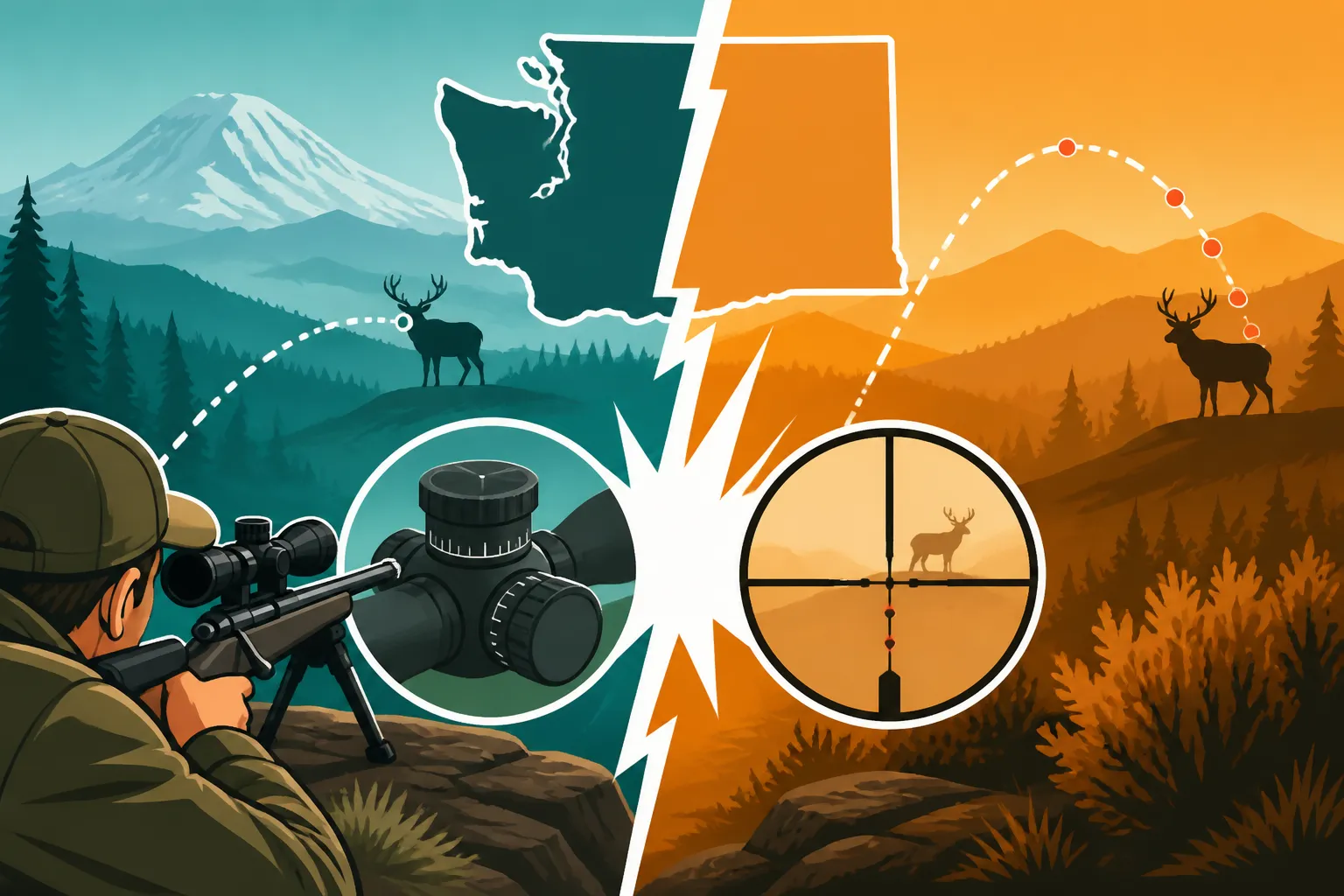
One of the most intense moments in hunting is when an animal steps out, and you have to make a quick, accurate shot at an unfamiliar distance. Many Washington hunters grapple with whether to carefully dial their scope's elevation turret or rely on a faster, instinctual holdover using their reticle. This guide will help you understand the pros and cons of each method, giving you the clarity and confidence to make the right call when it truly matters, whether you're staring across an eastern Washington coulee or peering into a western Washington clearcut.
Understanding the Fundamentals: Bullet Trajectory and External Factors
Before we dive into how to compensate for bullet drop, it's crucial to understand why your bullet drops in the first place and what other factors play a role. Gravity, as we all know, is constantly pulling your bullet towards the earth from the moment it leaves the barrel. This downward pull creates a parabolic arc, meaning your bullet rises slightly above your line of sight before falling back through and then below it. Your scope's zero is simply the point where this arc intersects your line of sight at a predetermined distance, usually 100 or 200 yards.
Beyond gravity, several external factors dramatically influence your bullet's flight path. Wind is perhaps the most challenging. Even a slight crosswind can push your bullet off course significantly at longer distances, turning a perfect shot into a frustrating miss. Altitude and temperature also play a part; thinner air at higher elevations (like the high country of the Okanogan) or warmer temperatures can reduce air density, causing your bullet to experience less drag and therefore drop less. Humidity is another, albeit smaller, factor. All these variables mean that simply knowing your rifle is "zeroed" isn't enough for consistent accuracy beyond that zero distance.
This is why having a firm grasp of your rifle's capabilities and your cartridge's ballistic profile is so important. Modern ballistic calculators, often found in apps or on websites, can take all these variables into account and generate precise data for your specific setup. Whether you're chasing mule deer across the vast plains of eastern Washington or stalking a Roosevelt elk in the thick timber of the Olympics, understanding these foundational principles will empower you to make more informed decisions when it comes to shot placement, no matter your chosen compensation method.
Turret Dialing: Precision for Known Distances
Turret dialing is a method where you physically adjust your scope's elevation turret to compensate for bullet drop at a specific distance. Once you've ranged your target, you consult a ballistic chart or calculator, determine the necessary upward adjustment (measured in Minutes of Angle – MOA, or milliradians – MILs), and then "dial" those clicks into your scope. This moves your reticle precisely to account for the bullet's drop at that exact range.
The Appeal of Pinpoint Accuracy
The primary advantage of turret dialing is its unparalleled precision. When you dial, your reticle becomes a true aiming point for that specific distance, effectively re-zeroing your scope for the shot. This eliminates the guesswork involved in holdover and allows for extremely accurate shot placement, especially at extended ranges. Imagine you're set up on a ridge overlooking a distant basin in the Blue Mountains, and a nice bull steps out at 450 yards. With enough time, ranging the animal, pulling out your rangefinder with Rangefinder Angle Compensation, checking your data, and dialing the correct elevation ensures that when you put the crosshairs on the bull's vitals, that's exactly where the bullet should go, provided you've managed the wind.
This method shines in scenarios where you have ample time to prepare your shot, such as open-country hunting for mule deer or a patiently set ambush for elk. It's often favored by hunters who prioritize tight groups and repeatable accuracy, especially when hunting in terrain that allows for longer shots. Having a clear, uncluttered reticle with a single aiming point can also reduce mental clutter and increase confidence in the shot. Many hunters use sophisticated tools, like those found on the GoHunt platform, to generate and manage their specific ballistic data, which is crucial for reliable dialing.
The Downside of Time and Complexity
While highly precise, turret dialing isn't without its drawbacks. The most significant is the time it takes. Ranging, consulting data, and dialing clicks takes precious seconds, which you might not have if an animal is on the move or about to disappear into cover. This can be a real issue when hunting active animals or in dynamic environments, like trying to get on a bull elk that's bugling and moving through timber. Fumbling with turrets under pressure can lead to missed opportunities or, worse, poorly placed shots.
Another challenge is the potential for mechanical failure or user error. Turrets can get bumped, inadvertently dialed, or simply misread in the heat of the moment. Cold, wet fingers can make delicate adjustments difficult, especially in the soggy conditions often found during late-season hunts in Washington. Losing your ballistic data card or having your app crash in the field can also leave you scrambling. For these reasons, many hunters meticulously practice their dialing routine, ensuring it becomes second nature before heading into the field. This also highlights the importance of keeping your rifle simple and robust for Rifle Setup for Washington Elk and Deer.
Holdover: Speed and Simplicity in the Field
Holdover is the art of using your scope's reticle to estimate and compensate for bullet drop without physically adjusting the turrets. Instead, you use various marks, dots, or lines within your reticle—known as subtensions—to "hold over" the target by the appropriate amount. For example, if your rifle is zeroed at 200 yards, and you estimate a 300-yard shot requires 10 inches of holdover, you might use a specific dot or line in your reticle that corresponds to that drop, aiming that mark directly at the target.
When Every Second Counts
The undeniable advantage of holdover is speed. When an animal appears unexpectedly or is moving quickly, you often don't have time to mess with turrets. Think about a blacktail buck crashing through thick Blacktail Deer Hunting in Western Washington Timber or an elk herd suddenly busting out of dark timber at 250 yards. In these situations, quickly ranging (or even estimating) the distance and instantly placing the correct holdover mark on the animal can be the difference between filling your tag and going home empty-handed.
Holdover is particularly effective at close to mid-ranges where bullet drop is less extreme and can be easily managed by a few common reticle marks. Many modern hunting scopes feature reticles specifically designed for holdover, often with a series of dots or hash marks calibrated in MOA or MILs. This allows for rapid compensation without breaking your shooting position or shifting your focus from the target. This immediate response makes holdover an invaluable skill for hunters who prioritize quick target acquisition and decisive action, especially in the more dynamic and close-quarters hunting environments found in much of Washington. Hunters should research Riflescope Magnification for Timber for different reticle options.
The Trade-offs of Estimation and Range
While fast, holdover does come with its limitations, primarily in terms of precision and effective range. Relying on an estimated holdover mark in your reticle is inherently less precise than dialing a specific number of clicks. At longer distances, where bullet drop becomes significant and external factors like wind have a greater impact, the small lines or dots in your reticle might not offer the fine adjustments needed for truly ethical shot placement. If your target is at 475 yards and your reticle has marks for 400 and 500, you're left guessing for that in-between distance, which can lead to errors.
Furthermore, different reticle designs offer varying levels of utility for holdover. A simple duplex reticle might only be useful for very close-range holdover, while a more complex Christmas tree reticle can provide many more aiming points. However, overly complex reticles can also become distracting or confusing under pressure, especially in low light or against busy backgrounds. Wind compensation, too, is often more challenging with holdover; while some reticles have wind dots, they are typically less precise than dialing for elevation and holding for wind, or using a combination of both for a Shot Placement on a Quartering Elk. It's crucial for hunters to understand their own reticle and its limitations through extensive practice, both at the range and with a Spotting Scope Magnification Range to confirm hits at distance.
Choosing Your Method: When to Dial, When to Hold
Deciding between turret dialing and holdover isn't about one being inherently "better" than the other. It's about knowing when to apply each method based on the specific hunting situation, your equipment, and your personal skill set. Many experienced Washington hunters utilize a hybrid approach, leveraging the strengths of both.
Situational Awareness and Terrain
The type of terrain you're hunting in Washington often dictates which method will be more practical. For example, if you're hunting the wide-open, rolling hills and agricultural edges of eastern Washington for mule deer or even Rocky Mountain Elk East of the Washington Cascades, where shots can frequently stretch beyond 300 yards, turret dialing often makes the most sense. You're more likely to have the time to range, consult your E-Scouting a Washington GMU From Home data, and make precise adjustments, especially if you've spotted your animal from a distance. The extra seconds spent dialing can significantly increase your chances of a clean kill at those extended ranges.
Conversely, if you're navigating the dense, tangled clearcuts and dark timber of western Washington chasing a Roosevelt Elk of Western Washington, where most shots are under 200 yards and opportunities can arise and disappear in an instant, holdover is often the preferred choice. There's simply no time to dial when an elk ghosts through the trees at 80 yards. The ability to quickly snap the rifle up, find the appropriate holdover point in your reticle, and take the shot is paramount. Even when still-hunting blacktails in wet Washington brush, a quick holdover might be the only option for a successful shot.
The Hybrid Approach and Practice
For many hunters, a hybrid approach offers the best of both worlds. This might involve dialing for elevation adjustments on longer shots, but then using holdover for wind compensation, or for quick follow-up shots if the animal moves after the first shot. Some hunters might dial their primary zero to 200 yards and then use holdover for anything within 300-350 yards, reserving dialing for anything beyond that. This allows for both speed at common hunting ranges and precision at longer distances.
Ultimately, proficiency in both methods comes down to rigorous practice. Don't just practice at the bench; practice shooting from various field positions, simulating real hunting scenarios. Time yourself ranging and dialing, and practice quickly acquiring targets and using your reticle for holdover. Know your rifle's capabilities, your cartridge's ballistics, and your scope's reticle inside and out. Use tools like GoHunt's mapping and research features to understand the typical shot distances in your chosen GMU, allowing you to tailor your practice. Familiarize yourself with your Gear to Skip on Your First Elk Hunt and focus on essentials first. Only through consistent, realistic practice will you build the muscle memory and confidence to make the right decision in the moment of truth.
Comparison: Turret Dialing vs. Holdover
To help you visualize the key differences, here's a quick comparison:
| Feature | Turret Dialing | Holdover |
|---|---|---|
| Precision | High (exact adjustment for specific range) | Moderate (relies on reticle marks/estimation) |
| Speed | Slower (requires ranging, calculation, dialing) | Faster (instant compensation) |
| Best Use | Long-range shots, static targets, ample time | Close-to-mid range, quick shots, dynamic targets |
| Complexity | Higher (requires ballistic data, turret manipulation) | Lower (uses intuitive reticle marks) |
| Risk Factors | User error in dialing, bumped turrets | Estimation errors, less precise at extreme range |
| Equipment Need | Scope with clear, tactile turrets, ballistic data | Scope with appropriate reticle subtensions |
Disclaimer
This article is for general informational purposes only and does not constitute professional advice. Laws, prices and regulations vary by location and change over time. Consult a qualified professional for guidance on your specific situation.