How Far a Cougar Travels
If you've ever spent time hunting in Washington's vast and wild landscapes, you've probably felt that chilling sense of being watched. Cougars are masters of stealth, often unseen, yet they are a significant part of our state's ecosystem. One question that haunts many hunters and wildlife enthusiasts is just how far these elusive predators truly travel. It's a mystery that can feel impenetrable, but understanding their movement patterns is crucial for appreciating their role and for those who seek to interact with them in the field. This guide aims to pull back the curtain on the average cougar's travel distances, diving into the myriad factors that influence their daily and seasonal wanderings across the Evergreen State.
Unpacking the Nuances of Cougar Movement
When we talk about how far a cougar travels, it's not a simple answer. We're not just looking for a single number. Instead, it's a dynamic range influenced by a host of environmental and individual factors. Understanding the difference between a "home range" and "daily travel" is key to grasping the full picture of cougar movement. These aren't just academic distinctions; they have real-world implications for how we perceive and potentially encounter these incredible animals.
Defining Home Range Versus Daily Travel
A cougar's home range is essentially its established territory, the larger area where it lives, hunts, and raises its young. Think of it like your entire neighborhood, including your house, your favorite grocery store, and the park you frequent. This area can be quite expansive, especially in less productive habitats or for dominant males. Within this home range, a cougar has a variety of preferred bedding sites, travel corridors, and hunting grounds. It knows this territory intimately, using it repeatedly over weeks, months, or even years. The size of this overall territory can tell us a lot about the health of the habitat and the availability of prey. Cougar Territory and Movement is a fascinating topic to dive deeper into if you want to understand the spatial dynamics.
In contrast, daily travel refers to the actual distance a cougar might cover on any given day. This is akin to the specific route you take from your house to work, or your loop around the park. It's the immediate, day-to-day movement driven by hunting for food, checking scent markers, or looking for a mate. While a cougar's home range might span tens or even hundreds of square miles, its daily travel might be a fraction of that, depending on whether it's just finishing a kill, searching for a new one, or simply resting. These shorter movements are often opportunistic and directly tied to immediate needs, making them incredibly unpredictable for an observer.
Factors Defining Home Range Size
The size of a cougar's home range isn't fixed; it's a flexible boundary that expands or contracts based on several critical factors. Imagine if your grocery store moved further away, or your favorite park became overgrown and unusable – you'd naturally adjust your routine. Cougars do the same, but with much higher stakes.
Firstly, prey availability is arguably the most dominant factor. If there's an abundance of deer, elk, or other prey animals within a smaller area, a cougar doesn't need to travel as far to find its next meal. This often leads to smaller, more concentrated home ranges. Conversely, in areas with sparse prey populations, cougars must patrol larger territories to secure enough food, leading to expanded home ranges. This is particularly noticeable in certain arid regions of Eastern Washington compared to the more productive forests of the west. Understanding Cougar Predation on Washington Deer Herds can provide more insight into this delicate balance.
Secondly, habitat quality and cover play a significant role. Dense forests, rugged mountains, and thick brush provide excellent cover for cougars to ambush prey and remain hidden from other predators or human disturbance. Areas with good thermal cover and secure den sites also reduce the need for extensive travel to find suitable resting places. If the habitat is fragmented, open, or disturbed, a cougar may need a larger area to find enough suitable hunting and bedding locations.
Lastly, cougar population density and individual characteristics matter. In areas with a high density of cougars, individual home ranges tend to be smaller as they try to avoid conflicts with neighboring cats. Dominant males often have larger home ranges that overlap with multiple females, but these boundaries are constantly being negotiated through scent marking and occasional confrontations. Females with cubs also tend to have smaller, more secure home ranges, especially when their young are very small and vulnerable. Juvenile cougars, once dispersed, will often travel significant distances to establish their own, potentially new, home range, sometimes crossing territories of many other cougars in the process.
Key Influencers on Cougar Travel Distances
So, what makes a cougar decide to take a long stroll versus hunkering down? It's a complex interplay of environmental cues, biological drives, and individual circumstances. Hunters often wonder if a cougar they spotted in one drainage today will still be there tomorrow, or if it's already miles away. The truth is, it could be either, and these next factors help explain why.
Prey Abundance and Distribution
As mentioned, prey is king. A cougar's primary driver for movement is finding food. If a cougar has recently made a kill, especially a large one like an elk or a mature deer, it might stay near that carcass for several days, feeding and defending it. During this time, its daily travel distance might be very short, perhaps only a few hundred yards from the kill site to a nearby bedding area. This is a period of relative inactivity, conserving energy. What a Cougar Kills in a Year highlights the impact these kills have.
However, once that kill is consumed or if a cougar is actively hunting, its travel patterns change dramatically. If deer or elk herds are widely dispersed, or if local populations are low, the cougar will expand its search, covering much greater distances. They might follow traditional migration routes of their prey species, moving seasonally from high country summer range down to lower elevation wintering grounds, always shadowing their food source. This can lead to impressive linear travel, sometimes several miles in a single night. This is where an e-scouting tool like GoHunt can be invaluable, allowing hunters to study historical game movements and understand how cougar territories might align with these patterns.
Terrain and Habitat Accessibility
Washington is a state of incredible topographical diversity, and cougars thrive in it all, from the dense, wet rainforests of the Olympic Peninsula to the rugged, sage-covered breaks of Eastern Washington. The type of terrain and habitat directly impacts how far and how easily a cougar can travel.
In steep, broken country with thick timber, travel can be more arduous but also offers more cover. A cougar might move through such areas more slowly but perhaps more consistently, utilizing game trails, ridge lines, and creek bottoms. Dense vegetation, like the salal and devil's club common in Western Washington, can create natural barriers, forcing cougars to take specific routes or to expend more energy to push through. Conversely, in more open country, a cougar might cover ground more quickly, especially during nocturnal movements, but might also stick to draws and shadowed areas for concealment. Old logging roads, even overgrown ones, can act as highways for cougars, allowing them to move efficiently across their territory. When hunters are Finding Old Logging Roads on Satellite, they might inadvertently be mapping out cougar highways too.
Age, Sex, and Reproductive Status
Individual cougars also exhibit different travel behaviors based on their life stage and biological needs. These differences are quite pronounced and often dictate the scale of their movements.
Young, dispersing cougars (typically 1.5 to 3 years old) are often the ones undertaking the longest journeys. Once they leave their mother's care, they must find and establish their own territory, which can mean traveling dozens, even hundreds, of miles through unfamiliar and often dangerous landscapes where they risk encountering established, dominant cougars. These movements are critical for the genetic health of the overall population, connecting different sub-populations.
Adult males generally maintain larger home ranges than females, often overlapping with the territories of several females. Their travel is driven by patrolling their extensive boundaries, scent marking to warn off rival males, and seeking out females in estrus. A dominant male might cover significant ground daily to maintain its status and reproductive opportunities.
Adult females, particularly those with cubs, tend to have more restricted movements. Their focus is on providing food and safety for their young, which usually means concentrating their activities within a smaller, more secure part of their home range. As cubs grow older and start accompanying their mother on hunts, the female's daily travel distance will increase, but still remain within that core area. Once the cubs are nearly grown, the female might start pushing them towards independence, preparing them for their own dispersal.
Here's a quick overview of how these factors typically influence cougar travel:
| Factor | Impact on Travel Distance (General Tendency) | Notes |
|---|---|---|
| Prey Abundance | High Prey = Shorter Travel | Abundant food allows cougar to stay in a smaller area. |
| Prey Scarcity | Low Prey = Longer Travel | Cougar must range widely to find sustenance. |
| Habitat Type (Dense Cover) | Shorter Daily, Consistent Movement | Good ambush cover, but travel can be slower. |
| Habitat Type (Open Country) | Longer Daily, Faster Movement | Less cover, but quicker to cover ground, often at night. |
| Adult Male | Longest Daily & Home Range | Patrolling vast territories, seeking mates. |
| Adult Female w/ Cubs | Shortest Daily & Home Range | Focused on protection and localized hunting. |
| Dispersing Juvenile | Longest Overall, Single Journey | Actively seeking a new, unoccupied territory. |
| Cougar Density (High) | Smaller Home Ranges | More competition, less individual territory available. |
| Cougar Density (Low) | Larger Home Ranges | More space available, less conflict. |
Typical Daily and Seasonal Cougar Movements
So, what does this all boil down to in terms of actual numbers? While generalizations are tough because every cougar is an individual, research and field observations give us a good idea of their typical daily and seasonal patterns. These are the patterns that hunters might inadvertently cross paths with or track when they are Reading Cougar Sign in the Snow.
Average Daily Distances Covered
On any given day, a cougar might travel anywhere from 2 to 10 miles (3 to 16 kilometers). This isn't a straight line, mind you. It's often a circuitous route, winding through timber, along ridges, and down drainages as the cat hunts. If a cougar has recently killed a large animal and is feeding on it, its travel might be minimal, perhaps less than a mile, as it rests nearby.
However, when a cougar is actively hunting or searching for a new territory, these distances can increase dramatically. During a hunting foray, especially if prey is scarce, a cougar might cover 5 to 7 miles in a single night. A male cougar patrolling his territory for scent marks or seeking a female can easily put on 8 to 10 miles. These nocturnal wanderings are part of what makes them so elusive; they're most active when we're typically asleep. This means that a track you find in the morning could be from an animal that has already traveled a good distance since it laid that print.
Seasonal Shifts and Dispersal Movements
Cougars aren't static residents; their movements are often influenced by the seasons, particularly how they affect prey distribution. For hunters keen on E-Scouting Washington GMUs Before the Draw, understanding these seasonal shifts in both prey and predator movement can offer a significant advantage.
In spring and summer, cougars often follow deer and elk to higher elevations as the snow melts and new forage emerges. Their movements might be tied to these migrating herds, ensuring they stay close to a food source. In fall, as big game animals begin their descent from high country to winter range, cougars often follow suit. This can lead to concentrated cougar activity in specific drainages or transition zones. This natural migration also means that a cougar seen in a particular area in July might be miles away in a different elevation band by November.
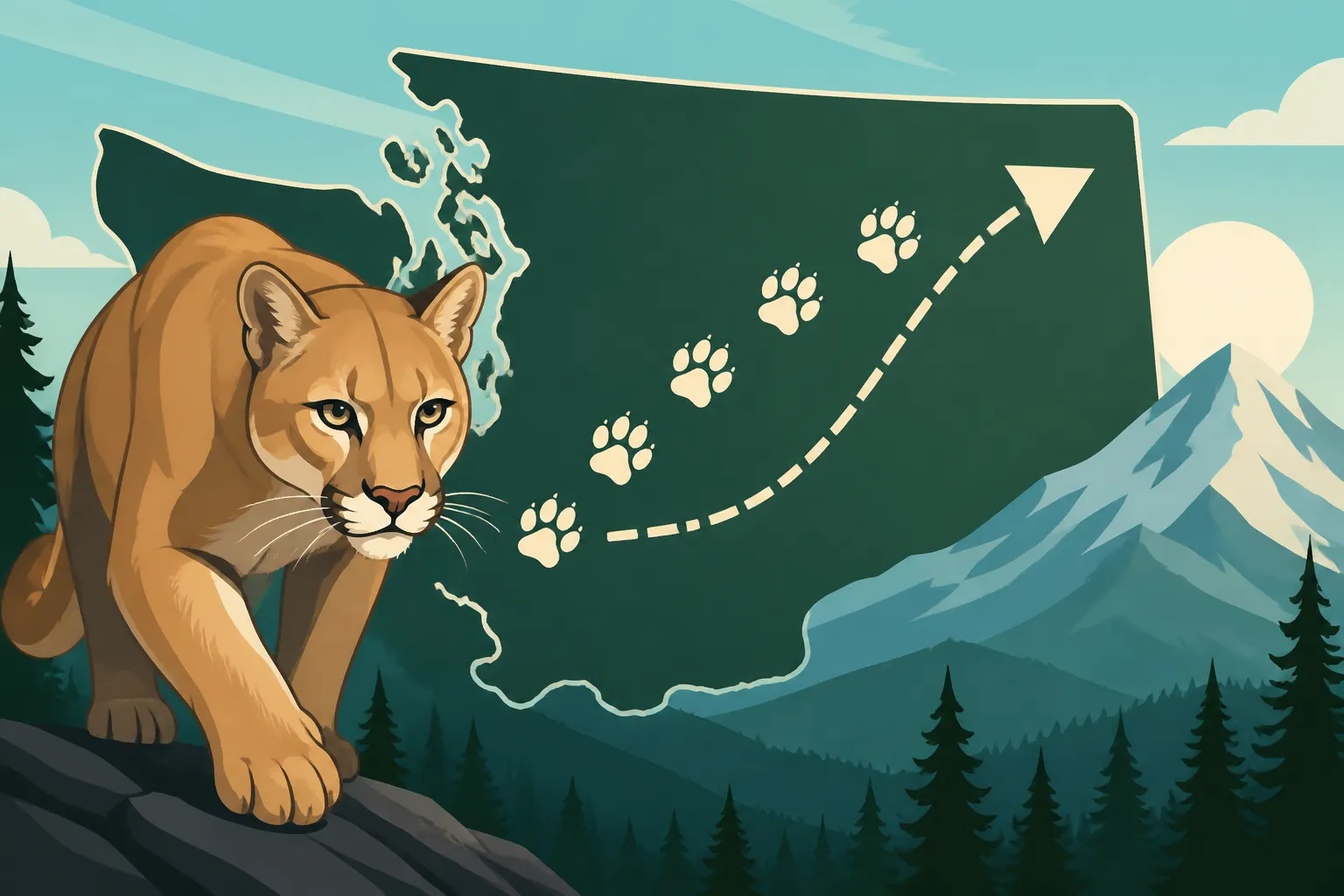
The most extensive movements are the dispersal events of young cougars. These can be truly astonishing. A juvenile male cougar, pushed out by its mother or an aggressive resident male, might travel over 100 miles (160 kilometers) in a relatively straight line as it seeks its own unoccupied home range. There have been documented cases of cougars crossing major highways, rivers, and even urban fringes during these dispersal phases. These long-distance journeys are high-risk but necessary for the health and expansion of the overall cougar population. It's during these times that cougars might be observed in unexpected places, far from their typical "wild" habitat.
Applying This Knowledge for Washington Hunters
Understanding cougar travel isn't just for academic interest; it's genuinely useful for hunters in Washington. Whether you're hunting deer, elk, or specifically pursuing cougar, knowing how these animals move can help you be safer, more successful, and more observant in the field.
Interpreting Cougar Sign
When you're out in the Washington woods, you're constantly looking for clues: tracks, scat, rub marks, and kill sites. Knowing how far a cougar typically travels helps you interpret these signs more effectively.
For instance, finding fresh cougar tracks in a snow-covered drainage might mean the cat is still in the immediate vicinity, especially if you also find signs of a fresh kill. A cougar won't move far from a food source until it's finished. However, if you find tracks but no other signs, that cat could be several miles away by now, continuing its patrol. This helps you decide whether to slow down and meticulously still-hunt the area or pick up the pace, knowing the cat is likely long gone. Finding Cougar Tracks Without Hounds becomes a more insightful exercise when you understand the context of their movement.
Look for consistency in tracks. Are they following a particular ridge line or crossing a series of saddles? Cougars often use predictable travel corridors, especially where terrain funnels game or provides good cover. If you identify a regular travel route, such as an old logging road that traverses a basin, you can infer that a cougar might use it repeatedly. Tools within GoHunt or similar mapping apps allow you to mark these potential travel corridors and analyze the terrain for optimal ambush points, should you ever find yourself in a pursuit situation.
Strategic Hunting and Scouting
Armed with knowledge about cougar movement, you can make smarter decisions about where and when to hunt. This applies whether you're actively hunting cougar or simply want to be aware of their presence while pursuing other big game.
When scouting for elk or deer, always keep cougars in mind. Areas with high deer or elk densities are also prime cougar territory. If you find a fresh cougar kill, especially one that looks like it's being actively fed upon, it's a good bet the cougar is nearby. You might choose to leave the area to avoid disturbing the predator or to return to it later if you're targeting cougar. Understanding Cougar Hunting in Washington After the Hound Ban involves a lot more tracking and knowing these movement patterns is critical.
For cougar hunters, understanding dispersal movements is vital. Young, dispersing males often get into trouble near human habitation or are seen crossing unfamiliar landscapes. These are often the cats that present unique opportunities, as they haven't established a fixed, secure home range yet and might be more vulnerable to detection. Focusing your scouting efforts on areas where young males might be moving through, such as river corridors or the fringes of known cougar territories, can increase your odds. Knowing that a cougar might cover significant ground in a night also means that cutting a fresh track early in the morning can lead to a long day of tracking, but potentially a rewarding one.
Remember, cougars are incredibly efficient and adaptable predators. Their travel distances are a reflection of their drive to survive, reproduce, and thrive in Washington's diverse ecosystems. By respecting their movements and understanding the reasons behind them, we become better hunters and more informed conservationists.
Disclaimer
This article is for general informational purposes only and does not constitute professional advice. Laws, prices and regulations vary by location and change over time. Consult a qualified professional for guidance on your specific situation.