Blowdown After a Windstorm
There's nothing quite like the crushing disappointment of planning a hunt in your favorite Washington GMU, only to arrive and find that a recent windstorm has laid waste to the forest, turning your familiar hunting grounds into an impenetrable labyrinth of tangled timber. It's frustrating, dangerous, and can completely derail your plans. But don't despair! This guide is here to walk you through exactly how to adapt, strategize, and even thrive when hunting in areas ravaged by blowdown.
Understanding Blowdown's Impact on Washington Hunting
When a powerful windstorm sweeps through Washington's forests, it doesn't just knock down a few trees; it can create vast, impassable zones of timber, often referred to as "blowdown" or "jackstrawed" timber. This isn't just an inconvenience; it fundamentally alters the landscape for both hunter and hunted.
Why Windstorms Create Hunting Challenges
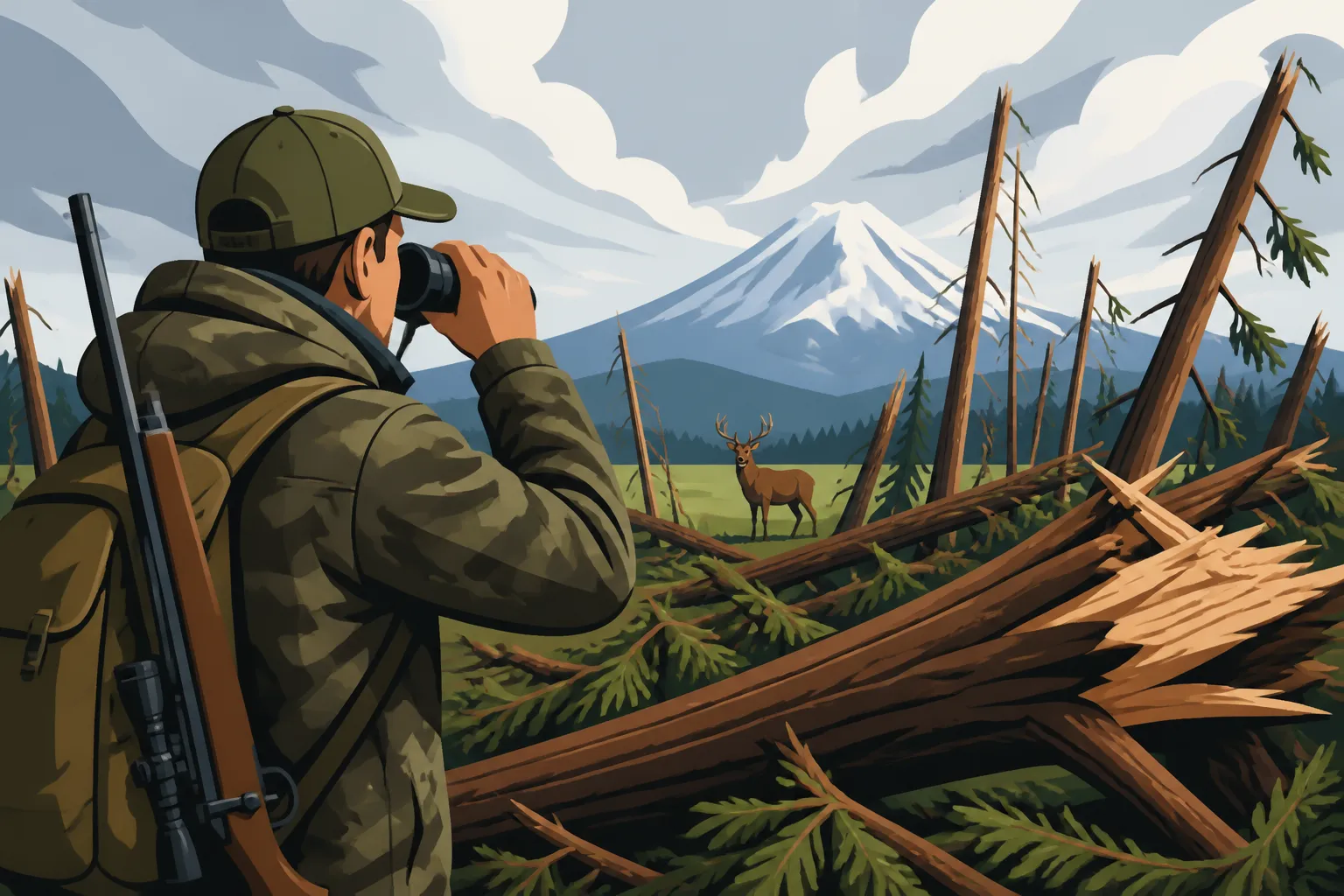
We've all experienced that moment when you crest a ridge, binoculars in hand, ready to glass a familiar basin, only to find it looks like a giant picked up a box of Lincoln Logs and dumped them haphazardly. It's truly disheartening, and the challenges are immediate and severe. First and foremost, navigation becomes a brutal exercise. What was once a subtle game trail or a relatively clear old logging spur can become a chest-high barricade of interwoven trunks and branches. Every step is a calculated risk, a potential trip or fall over unseen hazards. The sheer physical effort required to traverse even short distances skyrockets, draining energy that should be reserved for the hunt itself.
Beyond the physical toll, the noise you make trying to push through a blowdown area is significant. Every snapped branch, every rustle of dry needles, and every groan of shifting timber broadcasts your presence far and wide. This makes it incredibly difficult to approach game stealthily, turning what should be a quiet stalk into a noisy procession. Roads and trails, especially in less-maintained public lands like parts of the Olympic National Forest or Gifford Pinchot National Forest, can become completely impassable, blocking vehicle access and forcing you to either hike significantly farther or abandon your intended approach altogether. It can feel like the forest itself is conspiring against you, creating an almost impenetrable barrier that isolates entire sections of a unit you once knew intimately.
How Blowdown Changes Game Movement and Habits
While it might seem like blowdown makes hunting impossible, it's crucial to understand that game animals, particularly elk and deer, are masters of adaptation. For them, a fresh blowdown isn't just an obstacle; it's a new feature of their habitat, often providing both challenges and opportunities. One of the most significant changes is in how they use the blowdown for cover and bedding. That jumbled mess of fallen trees that's a nightmare for you to walk through? For a big bull elk or a wary blacktail buck, it can be the perfect sanctuary. The dense, interwoven branches offer incredible visual cover, making animals nearly impossible to spot from any distance. The tangle also makes it difficult for predators, including hunters, to move through silently, giving game a distinct advantage.
Animals might also utilize the complex structure of blowdown for thermal cover, especially during cold, wet Washington winters. The piled logs can create insulated pockets, shielding them from wind and snow. While blowdown might initially disrupt existing migration routes, game animals are quick to find new paths of least resistance, often creating new, subtle trails around or through the edges of the worst areas. Furthermore, the disturbance itself can create new forage opportunities. When trees fall, they often open up the canopy, allowing sunlight to reach the forest floor, which can spur the growth of new shrubs, grasses, and forbs that are highly palatable to deer and elk. Suddenly, a previously shaded and less productive area might become a hotspot of new growth, drawing animals in. Understanding these shifts is key to turning a frustrating situation into a potential advantage.
Essential Strategies for Hunting Through Blowdown
Successfully hunting in blowdown isn't about brute force; it's about smart tactics, heightened awareness, and a willingness to slow down and adapt. You can't just barge through like you would clear timber.
Navigation and Safety in Treacherous Terrain
Moving through severe blowdown is inherently risky. You're constantly climbing over, under, and around unstable logs, many of which can shift unexpectedly. The most crucial rule here is to slow down. Your pace will be a fraction of what it would be in open timber. Each step needs to be deliberate, testing the stability of logs and branches before committing your weight. Look for natural paths where logs cross each other lower to the ground, or where game animals have already pushed through, creating a faint tunnel. Often, a route that looks impossible from one angle might open up if you shift just a few yards to the left or right.
This is where modern technology truly shines. A reliable GPS unit or a robust mapping app on your phone, like GoHunt's mapping system or onX Hunt, becomes absolutely indispensable. Before you even set foot in the blowdown, take the time to mark your starting point, potential escape routes, and any significant landmarks. Use the satellite imagery layer to identify pockets of lighter blowdown or areas where the timber is less dense. Downloading offline maps is critical, as cell service is often non-existent in these remote, broken areas. Think about marking your path as you go, creating a digital breadcrumb trail that can guide you back out if you get disoriented. It's incredibly easy to lose your bearings when the landscape changes every few feet, making even a short loop feel like an endless maze. For more on navigating remote areas, consider checking out "Downloading Offline Maps for Washington".
Safety goes beyond just not twisting an ankle. You're moving through a complex environment where unseen hazards lurk. Always carry a comprehensive first-aid kit; a serious cut or sprain deep in a blowdown area can quickly become a life-threatening emergency. A two-way radio or a satellite messenger (like a Garmin InReach or Zoleo) is non-negotiable, especially if you're Solo Hunting Safety Precautions. Many seasoned Washington hunters will also bring a small, collapsible saw or even a hatchet. Not for clearing major paths, but for cutting through smaller, nuisance branches that impede your progress or create too much noise. Remember, getting in is only half the battle; you need to be able to get out, potentially in the dark and under duress.
Adapting Hunting Tactics to Blowdown Country
Your usual hunting tactics will likely need a significant overhaul in blowdown. Forget about covering vast expanses quickly. Instead, embrace the art of the still-hunt. This method, where you take a few slow, deliberate steps, then stop and carefully scan your surroundings, is perfectly suited for blowdown. The sheer density of cover means you'll likely be within spitting distance of an animal before you see it. Think of it less like hunting and more like an intense game of "I Spy" where you're both the seeker and the sought. Your goal isn't to walk quickly, but to move silently, inch by agonizing inch, constantly searching for horizontal lines (the back of an animal), contrasting colors (a patch of hide against dark timber), or the glint of an antler.
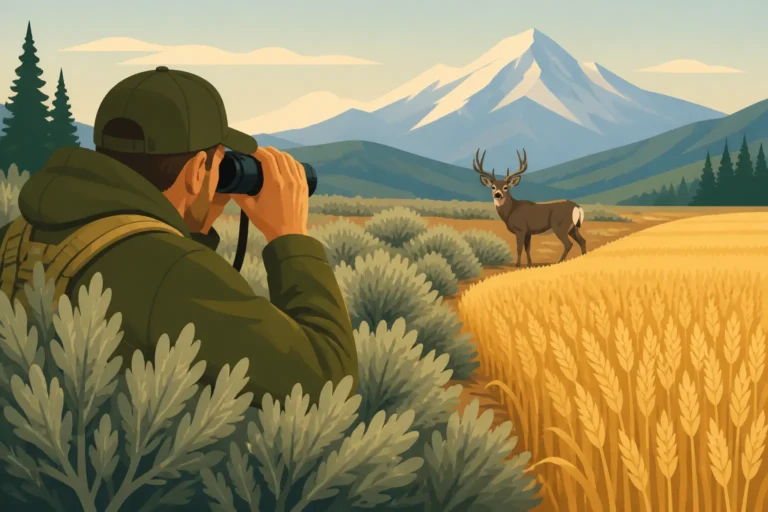
Glassing, while typically a pillar of Western hunting, becomes extremely challenging in heavy blowdown. However, if you can find any elevated point – a stable log pile, a small knoll, or even an intact standing tree with a safe perch – take the time to pull out your binoculars. Often, you'll be glassing into the blowdown, searching for those small openings or travel lanes animals might be using. For some general tips on Glassing Sage and Wheat Edges for Washington Mule Deer the principles can still apply, just on a much more microscopic scale.
Calling techniques can be particularly effective, but they require a different approach. Instead of trying to bugle an elk across a canyon, you're now trying to elicit a response from an animal bedded deep in the tangle, potentially just yards away. Soft cow calls or quiet glunking might be more effective than a full-blown challenge bugle, which could alert an animal to your precise location. The idea is to make them curious enough to stand up or take a few steps, revealing themselves. Because of the limited visibility, shot opportunities in blowdown country are almost always at closer ranges, and they often materialize quickly. You won't have time to ponder. Practicing quick, offhand shots at close distances before the season starts is invaluable. Always be ready, rifle shouldered or bow drawn, as you negotiate each barrier. For a deeper dive into how terrain affects target acquisition, read up on Shot Placement on a Quartering Elk.
Gear and Preparation for Blowdown Hunting
Being properly equipped and thoroughly prepared can make the difference between a successful, albeit tough, hunt and a miserable, potentially dangerous, experience in blowdown.
Recommended Gear for Navigating Obstacles
Your feet are your primary tool in blowdown, so investing in the right footwear is paramount. Forget flimsy hiking shoes; you need sturdy boots with excellent ankle support. Think stiff soles and high-cut uppers to protect against impacts and prevent rollovers on unstable surfaces. Brands like Kenetrek or Schnee's are popular for a reason—they're built for this kind of abuse. Good traction is also non-negotiable; you'll be scrambling over wet, slick logs. For more detailed advice on choosing footwear, refer to Boots for Steep Eastside Country.
Trekking poles, often overlooked by hunters, become your best friends in blowdown. They provide two extra points of contact, significantly enhancing your stability as you navigate uneven ground and fallen trees. They can help you probe for solid footing, balance on slick logs, and even push aside smaller branches. They're also a godsend when you're loaded down with an elk quarter, offering critical support. Your clothing needs to be durable, resisting tears and snags from sharp branches and bark. Avoid anything easily shredded. Layers are always key in Washington's unpredictable weather, so ensure your Layering for Wet Cold Weather system is robust.
A small, packable saw (like a Silky Gomboy or a folding pruning saw) is a game-changer. While you won't be clearing a road, being able to quickly saw through a stubborn branch that's blocking your path or making too much noise can save you a lot of time and frustration. Finally, your pack needs to be up to the task. A good internal or external frame pack that can handle heavy loads is essential, especially if you plan on packing out an animal through this challenging terrain. You might not carry a huge pack for still-hunting, but if you do harvest, you'll be grateful for a robust system designed for load distribution, as discussed in Packing an Elk Out of Washington's Backcountry.
Planning and Scouting for Blowdown Areas
Preparation is your secret weapon. Before you ever leave home, dedicate significant time to e-scouting your chosen GMU. Tools like GoHunt's 3D mapping and satellite imagery are incredibly powerful for this. Look for areas that appear abnormally jumbled or where the canopy seems to have significant gaps, especially if you know a major wind event recently occurred. Compare current satellite images with older ones to identify changes. Pay attention to ridge lines and saddles, as these areas are often hit hardest by strong winds. E-Scouting Washington GMUs Before the Draw offers excellent general advice that is even more critical when anticipating blowdown.
Beyond digital scouting, if time and access allow, physical scouting before the season is invaluable. A pre-season trip into a suspected blowdown area, even if you're not hunting, allows you to assess the extent of the damage, identify potential travel corridors that animals are using, and pinpoint less severe routes for your actual hunt. You can mark these on your GPS or mapping app. Look for animal sign around the periphery of the blowdown – fresh tracks entering or exiting the tangled mess can give you clues about how game is adapting. Even observing areas that are not blown down but are adjacent can tell you where animals might be pushed to.
Consider potential escape routes if you do harvest an animal. It's one thing to push through with a daypack, another entirely to try and haul hundreds of pounds of meat back out. Think about water sources, safe spots to set up a quick camp if you're delayed, and areas where visibility might improve even slightly. Knowledge is power, and when facing blowdown, the more you know about the terrain, the better equipped you'll be.
Ethical Considerations and WDFW Regulations
Hunting in blowdown isn't just about physical prowess and good gear; it also involves a heightened awareness of ethical responsibilities and adherence to WDFW regulations, which can be particularly tricky in damaged areas.
Minimizing Impact and Respecting the Land
When you're fighting through a tangled mess, it's easy to focus solely on your immediate path, but it's important to remember that you're a guest in the forest. Strive to minimize your impact. This means not unnecessarily breaking more branches or further damaging the delicate ecosystem if there's a less destructive path available. Where possible, stick to existing game trails or areas that appear to be natural avenues of travel. If you do use a saw to clear a small obstruction, do so judiciously and only when necessary for safe passage.
The "pack it in, pack it out" principle is even more critical in blowdown areas. The last thing these already disturbed environments need is additional litter. Every wrapper, every spent shell casing, and every piece of tape needs to come out with you. Respect for the land is paramount, especially in areas that have been recently damaged by natural events. Your presence should ideally be undetectable after you've left.
Understanding WDFW Rules in Affected Areas
Washington Department of Fish and Wildlife (WDFW) regulations, along with Forest Service and DNR rules, remain in effect, and in some cases, new restrictions might be imposed due to blowdown. Always check for current updates before heading out. Large-scale blowdown can sometimes lead to temporary access restrictions or even area closures, especially if roads are completely impassable or if there are significant fire risks from dried debris. Always check the WDFW website or contact the local forest service office for the most up-to-date information on road closures and access points. For information on general public land access, you can look into "Public Land Hunting in Washington: Forest, DNR and BLM".
You might encounter "Green Dot" road systems in some areas, particularly in Eastern Washington. While these systems are designed to regulate vehicle access, a windstorm can render sections of them impassable, effectively turning open roads into walk-in only areas. Understanding "Washington Green Dot Road Systems" is key. Always be aware of property boundaries as well; blowdown can obscure fences or property markers, making it easier to inadvertently trespass. Rely on your mapping apps to stay on public land. Reporting large-scale blowdown that significantly impacts public access or wildlife movement to WDFW can also be helpful, as it provides them with valuable data to manage the land.
Here’s a quick overview of essential gear considerations when facing blowdown conditions:
| Gear Item | Blowdown Hunting Needs | Open Country Hunting Needs |
|---|---|---|
| Boots | Stiff sole, high ankle support, waterproof, aggressive tread for unstable surfaces. | Flexible sole, moderate ankle support, good for long walks, varying terrain. |
| Navigation | GPS/Mapping App (GoHunt, onX) with offline maps, marked waypoints, physical compass/map backup. | GPS/Mapping App, physical compass/map. Less reliance on micro-navigation. |
| Poles | Essential for stability, balance, probing for footing, pushing branches. | Optional, good for steep inclines or heavy loads, but not always necessary. |
| Outerwear | Highly durable, snag-resistant, waterproof/breathable, quiet fabric. | Durable, waterproof/breathable, quiet, focus on warmth and concealment. |
| Cutting Tool | Small folding saw or hatchet for clearing minor obstacles and field dressing. | Sharp knife for field dressing, possibly a small bone saw. Less need for clearing. |
| Communication | Satellite messenger (Garmin InReach), two-way radio, charged phone with offline maps. | Phone, two-way radio. Satellite messenger for remote areas. |
| First Aid | Comprehensive kit with trauma focus (sprains, cuts, impacts), extra bandages, pain relievers. | Standard kit for common hunting ailments. |
| Pack | Robust internal/external frame pack for heavy loads and durability, rain cover. | Daypack to frame pack depending on hunt length; focus on comfort and capacity for chosen gear. |
Remember, every piece of gear should contribute to safety, efficiency, and comfort when you're battling through the aftermath of a windstorm. It's not just about what you carry, but how well it performs under extremely challenging conditions.
Disclaimer
Please be aware that hunting regulations, seasons, and access rules can change frequently. Always consult the most current Washington Department of Fish and Wildlife (WDFW) regulations pamphlet and relevant land management agency websites before planning any hunting trip. The information provided here is for general guidance and educational purposes only.