Judging Antler Points Before the Shot
You've spent months scouting, endured countless cold mornings, and finally, a buck or bull steps out. Your heart pounds, the moment you've dreamed of is here – but then the internal debate starts: Is it legal? Does it have enough points? That split-second decision can be the difference between a successful, legal harvest and a significant violation. This guide is here to walk you through the critical skill of judging antler points before the shot, specifically within the unique regulations and challenges of Washington State.
Why Antler Point Judging Matters in Washington
In Washington, unlike many other states, hunter preference points for special draws aren't a factor. This means every hunter has an equal shot each year, but it also places a premium on understanding the rules of general seasons, especially when it comes to antler restrictions. Misidentifying legal game isn't just a simple mistake; it carries real consequences that can impact your hunting future and the reputation of hunters statewide.
Legal Ramifications and Ethical Hunting
Washington State has specific regulations regarding antlered deer and elk, particularly the "three-point minimum" rules in many areas. If you pull the trigger on an animal that doesn't meet the legal antler criteria for the unit you're hunting, you could face hefty fines, loss of hunting privileges, and even confiscation of your weapon and game. These aren't just minor infractions; they're serious violations of state wildlife laws. Beyond the legalities, there's a deep ethical responsibility that comes with hunting. Every hunter has a duty to correctly identify their target and ensure it's legal before taking a shot. This respect for wildlife and the regulations is fundamental to maintaining a healthy hunting tradition and ensuring sustainable populations for future generations. Rushing a shot or taking an animal that doesn't meet the criteria undermines these principles and can negatively affect how the public perceives hunting.
Impact on Herd Management
Antler restrictions are not arbitrary rules; they are carefully designed by wildlife biologists to achieve specific herd management goals. For deer, a three-point minimum, for example, is often implemented to protect younger bucks and allow them to mature, leading to an older age structure and potentially larger antlers in the population over time. For elk, spike-only hunts or specific branch-antlered bull requirements serve similar purposes, helping to manage herd ratios, reduce competition among bulls, and ensure a healthy breeding population. Understanding these goals helps us appreciate why these rules exist. When hunters fail to comply, it can skew the data WDFW collects, making it harder to accurately assess herd health and adjust future seasons. Every animal harvested illegally represents a loss to the management plan and the overall health of the herd. This is why tools and resources from platforms like GoHunt that help you research specific GMU regulations are invaluable.
Understanding Washington's Antler Point Rules
Washington's antler point rules can sometimes feel a bit like reading ancient hieroglyphics, especially for new hunters or those coming from states with different regulations. It's not always as straightforward as "if it has antlers, it's legal." The specifics of what constitutes a "legal" point are paramount to avoid unintended violations.
Defining a "Point" in Washington
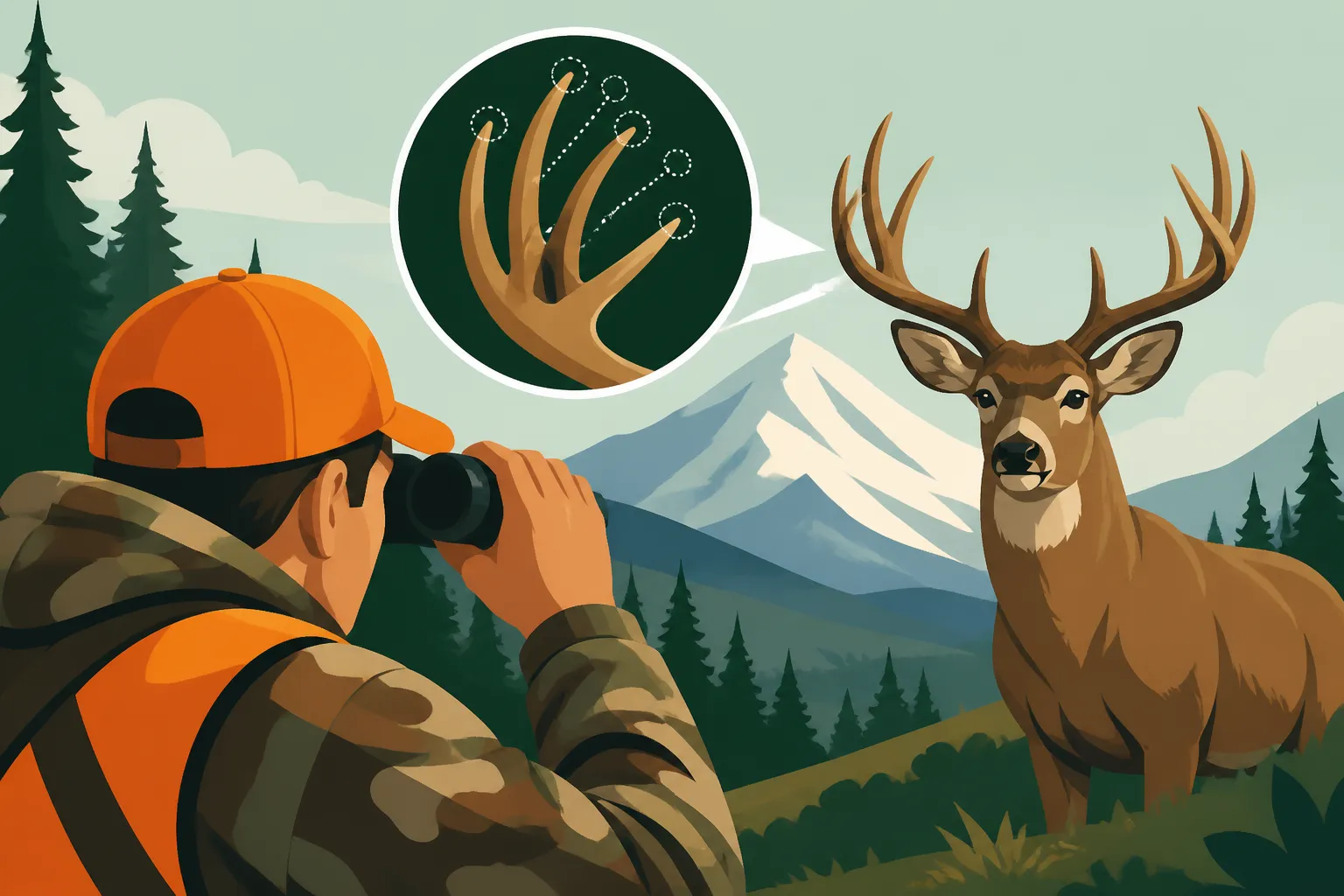
In Washington, a point is generally defined as a projection on an antler that is at least one inch long and longer than it is wide at its base. This is a crucial distinction. Many hunters mistakenly count small bumps, burrs, or eye guards that don't meet these specific dimensions. For example, a small, knobby growth near the base of the antler, often referred to as an "eye guard" or "brow tine," might not technically count as a point if it doesn't meet the length and width criteria. It's not about how many tines you think you see, but how many legal points are actually present. When you're in the field, under pressure, judging this can be incredibly difficult, which is why practice is so important. Getting familiar with Washington's Three-Point Rule and What Counts is the first step toward making confident, ethical decisions. Remember, if it's less than an inch or wider than it is long, it's not a legal point in Washington.
Units with Specific Antler Restrictions
Not all Game Management Units (GMUs) in Washington have the same antler restrictions. While many Western Washington GMUs implement the three-point minimum for deer (often Blacktails), some Eastern Washington units might have different rules for Mule Deer or Whitetails, or even no antler restrictions at all. For elk, you'll find units designated as "any elk," "spike only," or "branch-antlered bull only," often with specific definitions for what constitutes a "branch-antlered" animal. This patchwork of regulations means you must know the specific rules for the GMU you are hunting before you step foot in the woods. Resources like the WDFW hunting pamphlets and online platforms such as GoHunt's unit profiles are indispensable for this research. These tools allow you to pinpoint the exact regulations for your chosen unit, helping you avoid an unfortunate situation. Failing to verify the rules for Washington's Three-Point Minimum Units specifically can lead to a very bad day.
Let's look at a quick comparison of point definitions:
| Feature | Washington Legal Point Definition | Common Misconception |
|---|---|---|
| Minimum Length | At least 1 inch long | Any discernible projection, regardless of length |
| Width at Base | Longer than it is wide | Any width, as long as it protrudes |
| Brow Tines / Eye Guards | Count if they meet 1" length & longer than wide criteria | Always count, regardless of size |
| Stickers / Kobs | Only count if they meet 1" length & longer than wide criteria | Always count |
| Broken Points | Must still be 1" long and longer than wide after being broken | Count if it was once a full point |
| Antler Burr | Does not count | Sometimes mistaken for a point |
Visual Cues for Judging Points
The moment of truth can be a blur. An animal might be moving, the light could be fading, or the distance might be stretching. In these high-stakes situations, having a systematic approach to visually assessing antler points can make all the difference.
Estimating Length and Mass
When a legal buck or bull appears, the first thing many hunters do is try to count points. But before you even get to counting, take a moment to assess the overall length and mass of the antlers. Longer, thicker antlers generally mean more points, but not always. Think about the animal's ears: an antler point that extends past the ear length is usually a solid indicator of that one-inch minimum. Similarly, mass refers to the thickness of the antler beam. A thick, heavy beam is more likely to support substantial points that meet the legal criteria. Don't confuse beam circumference with points; a thick main beam with only two legal tines is still a two-point. However, animals with good mass often have more developed points, which can be a helpful heuristic. This initial assessment helps you decide if the animal even warrants a closer look at individual points or if it's clearly too small. It's a quick, high-level evaluation that can save you precious seconds.
Counting Points Under Field Conditions
This is where the rubber meets the road. Counting points in the field, especially on a moving animal or at a distance, is challenging. Here are some strategies:
- Use your optics: Always use your binoculars or spotting scope, even if the animal seems close. A good pair of 10×42 binoculars can make all the difference. Get a steady rest if possible.
- Focus on one side first: Don't try to count both sides simultaneously. Pick one antler, usually the one with the best light or clearest view, and count systematically from the base up.
- Identify the main beam: This is the primary antler growth. All other points will branch off it.
- Look for projections: Scan the main beam for any projections that are clearly longer than they are wide and appear to be at least an inch long. Mentally "tick" them off as you go.
- Ignore "trash" or "stickers" unless clear: Many deer and elk have small bumps or non-conforming projections. Unless they definitively meet Washington's one-inch length and greater-than-width rule, do not count them. This is often where hunters make mistakes, especially with Eye Guards and Point Counting Mistakes.
- Verify the other side: Once you've counted one side, quickly scan the other. Even if a GMU is "three-point minimum on one side," you still need to be sure. Most units imply "on one side" when they say "three-point minimum."
- Take your time: If the animal is calm, take a few extra seconds. Better to let a legal animal walk than shoot an illegal one. This skill is critical when you are Counting Points on a Live Buck that may only give you a brief window of opportunity.
Body Size and Antler Ratios
Beyond just the antlers themselves, consider the animal's overall body size. Younger bucks and bulls typically have smaller bodies and less developed antlers. While not an exact science, a very small-bodied deer is less likely to carry a significant number of legal points than a mature, robust animal. For example, a young spike or two-point buck will appear lanky and narrow, while a three- or four-point buck will often have a deeper chest and more muscular build. This "body-to-antler ratio" can be a quick sanity check. If the body looks tiny, it's highly improbable the antlers will meet a three-point minimum. Conversely, a large, mature body usually correlates with more developed antlers, increasing the odds that it's a legal animal. This isn't a substitute for actual point counting, but it can help you filter out clearly illegal animals more quickly, allowing you to focus your detailed attention on animals that show potential.
Common Mistakes and How to Avoid Them
Even seasoned hunters can make mistakes when judging antlers in the field. The combination of adrenaline, poor light, distance, and unfamiliar angles can play tricks on your eyes. Being aware of these common pitfalls is the first step to avoiding them.
The "Thumb" or "Palm" Mistake
One of the most frequent errors hunters make, especially with deer antlers, is mistaking the end of a main beam or a palmated section for multiple points. For example, a buck with a wide, shovel-like palm at the end of its main beam might appear to have several small points or "forks" when viewed quickly or from a distance. However, if those projections don't meet the one-inch length and longer-than-wide criteria, they are not legal points. Think of it like a hand: your palm is one big surface, not multiple fingers. The same goes for antlers. If the main beam just widens out into a flat, broad area, that's often just a palmation, not a collection of legal points. Similarly, a thick, rounded end of a main beam that lacks distinct, measurable tines is often miscounted. Always mentally trace each potential point, ensuring it clearly projects and meets the Washington WDFW definition before you finalize your count. This meticulous approach is key to staying legal and ethical.
Distance, Light, and Angle Distortions
These are the silent saboteurs of good judgment. What looks like a definite three-point at 100 yards in perfect morning light can become an ambiguous two-point at 250 yards in fading evening shadows.
- Distance: The farther the animal, the more difficult it is to accurately gauge point length and width. Parallax, heat shimmer, and the sheer challenge of resolving fine details all contribute. If there's any doubt due to distance, try to close the gap or simply pass on the shot. It's never worth risking a violation.
- Light: Low light conditions, whether at dawn, dusk, or in dense timber, can obscure details. Shadows can make small projections disappear or create false ones. Hunting in the deep timber of Western Washington, where Still-Hunting Blacktails in Wet Washington Brush is common, makes clear visibility a premium. Overcast days are generally better for clarity than harsh midday sun which can create glare and wash out details.
- Angle: The angle at which you view the animal profoundly affects how its antlers appear. A buck quartering away might hide a point on the far side, or a tine might appear shorter or longer than it actually is due to perspective. A bull looking directly at you will present a very different profile than one broadside. Always try to wait for the animal to turn to get a clear, broadside view of both antlers if possible. Sometimes, even a slight shift in the animal's head can reveal or conceal a critical point.
Rushing the Shot
This is perhaps the biggest and most preventable mistake. The surge of adrenaline when a big game animal appears can be overwhelming, leading to tunnel vision and a desperate urge to shoot immediately. However, rushing your shot is a recipe for disaster, both in terms of ethical shot placement and legal antler judging. Take a deep breath. Slow your heart rate. Verbally confirm your count if hunting with a partner, or mentally repeat it to yourself. "Okay, I see one… two… three clear points on the right, and four on the left. That's a legal bull." Allow yourself a few extra seconds to confirm your visual assessment through your optics. The animal may move, but you must prioritize accuracy and legality over speed. If you feel rushed, if your mind is racing, or if there's any doubt about the legality of the animal, it's always best to let it walk. There will be other opportunities. Making sure your Rifle Setup for Washington Elk and Deer is properly sighted in and familiar will also reduce the variables during these critical moments.
Practice Makes Perfect
Like any critical skill, antler point judging improves with consistent practice. You wouldn't expect to hit a bullseye on your first shot without range time, and you shouldn't expect to flawlessly judge antlers without dedicated effort.
In-Season Scouting and Observation
One of the best ways to hone your judging skills is to spend as much time as possible observing live animals, even outside of hunting season. During early scouting trips, use your binoculars and spotting scope to practice counting points on every legal-sized animal you see. Don't just glance; scrutinize them. Pay attention to how different lighting conditions and angles affect your perception of points. If you see a smaller buck or bull, try to determine why it doesn't meet the minimum. Is it lacking the third point? Is the second point too short? This type of deliberate practice during Public Land Scouting in Washington Before Opening Day or simply observing wildlife will build your confidence and refine your eye. Get familiar with the general antler growth patterns in your specific hunting unit, whether it's the distinctive characteristics of Roosevelt Elk of Western Washington or the sprawling racks of Mule Deer of Eastern Washington. The more you see, the better you'll become at quick and accurate identification under pressure.
Utilizing Trail Cameras and E-Scouting Tools
In today's hunting world, technology offers incredible advantages for pre-season preparation. Trail cameras, when legally placed and used according to Washington regulations, provide an invaluable, low-pressure way to study individual animals. You can review countless photos and videos from your trail cameras, pausing, zooming in, and counting points at your leisure. This takes the pressure off and allows for detailed analysis of various bucks and bulls in your hunting area. Pay close attention to how antlers grow and develop throughout the summer and fall.
E-scouting platforms like GoHunt, OnX Hunt, or BaseMap are also fantastic. They allow you to research specific GMUs, view aerial and topographical maps, and understand potential access points or terrain features. While not directly for antler judging, understanding the type of habitat and the general health of the local herd can give you clues about the typical antler quality you might expect. For instance, if you've done your E-Scouting Washington GMUs Before the Draw and seen through local hunting reports that a unit is known for older, larger deer, you might expect more mature antler growth. You can also analyze historical harvest data, if available, to get a sense of the success rates and antler criteria commonly met in that unit. By understanding these broader trends, you can temper your expectations and be better prepared for what you might encounter. Also, learn how to best implement Using Trail Cameras to Find Washington Bulls to gather intelligence without disturbing their natural patterns.
Post-Season Review and Learning
The learning shouldn't stop when the season ends. After your hunt, whether successful or not, take time to reflect on your experiences. If you harvested an animal, review your decision-making process. Was your initial count accurate? What challenges did you face? If you passed on animals, could you have judged them more accurately? Look at photos from your trail cameras or any other game camera pictures you come across. Discuss your observations with hunting buddies, sharing photos and debating counts.
Even watching hunting videos online can be a form of practice – pause the video when an animal appears and try to count its points before the hunter does. Compare your count to theirs. This continuous self-assessment and learning are vital. Every season presents new challenges and opportunities for growth. By consistently refining your ability to judge antler points, you not only increase your chances of a legal harvest but also become a more skilled, ethical, and responsible hunter. This ongoing process of learning helps solidify your understanding of rules like Washington's Three-Point Rule and What Counts into instinct.
Disclaimer
Please remember that hunting regulations, including those for antler point restrictions, can change from year to year. Always consult the most current Washington Department of Fish and Wildlife (WDFW) hunting regulations pamphlet for the season you are hunting in. This article is intended for informational purposes only and should not be considered a substitute for official WDFW regulations. It is your sole responsibility to know and understand all applicable laws and regulations before hunting.