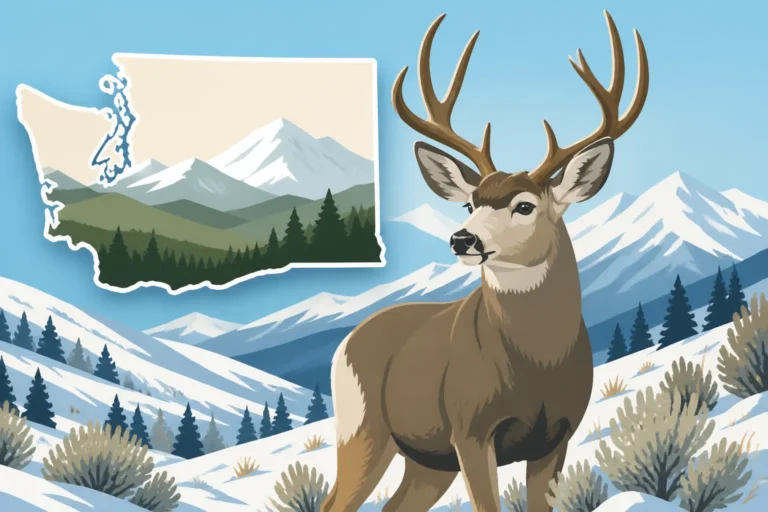
Mule Deer of Eastern Washington
Eastern Washington mule deer hunting can feel like trying to find a needle in a haystack that stretches for thousands of square miles. This vast, often unforgiving landscape presents unique challenges, from endless sagebrush flats to steep, timbered breaks and agricultural interfaces. This guide is designed to cut through the noise, offering a deep dive into understanding, finding, and ultimately pursuing the magnificent mule deer that call Eastern Washington home.
Understanding Eastern Washington Mule Deer
Mule deer are truly icons of the American West, and the populations inhabiting Eastern Washington embody all the classic traits that make them such a challenging and rewarding quarry. Unlike their blacktail cousins on the west side or even the more elusive whitetails in the northeast, these deer are built for big country and open spaces.
Physical Characteristics and Adaptations
When you spot a true Eastern Washington mule deer, you'll immediately notice their distinctive features. They get their name from those large, mule-like ears, which are incredibly efficient at picking up the slightest sounds across vast distances. Their coat color typically ranges from light brownish-gray in winter to a more reddish-brown in summer, providing excellent camouflage against the sagebrush, dirt, and rock of their habitat. What truly sets them apart is their bounding gait, known as a "stot." When alarmed, they can bound off four-legged, covering ground surprisingly fast over broken terrain, a crucial adaptation for surviving in open landscapes where cover can be sparse. Their antlers, particularly those of mature bucks, tend to be wide and fork multiple times, often forming deep, symmetrical "forks" rather than the typical main beam with tines seen on whitetails.
A mule deer's physical build is a testament to its environment. They're typically stockier than a whitetail, with heavier bones and a more robust frame, allowing them to traverse steep canyons, rocky outcrops, and deep draws with impressive agility. Their larger hooves provide better traction on loose rock and uneven ground, an absolute necessity when you consider the dramatic elevation changes and often treacherous footing found throughout areas like the Okanogan Highlands or the Blue Mountains. This robust build also allows them to carry significant fat reserves, critical for surviving the harsh Eastern Washington winters where food can be scarce and snow can pile deep.
Diet and Foraging Habits
The diet of Eastern Washington mule deer is heavily influenced by the arid and semi-arid conditions of their habitat. They are primarily browsers, meaning they prefer to eat leaves, twigs, and woody shrubs over grasses, though they will graze on succulent forbs and grasses, especially in the spring and early summer. Key forage plants include sagebrush, bitterbrush, serviceberry, and various types of browse found in riparian areas or timber edges. The availability and quality of these food sources dictate much of their movement and behavior throughout the year.
Think about it: in areas like the Columbia Basin, where agriculture meets native rangeland, mule deer will readily utilize alfalfa, corn, or wheat fields, especially during the colder months when native browse becomes less palatable or covered by snow. This adaptability to exploit different food sources is a significant factor in their survival. However, their reliance on specific types of browse also makes them vulnerable to habitat changes; clear-cutting or wildfire that removes preferred forage can have a significant impact on local mule deer populations. Understanding what they're eating and when they're eating it is paramount to finding them, particularly during the early archery or muzzleloader seasons when they might still be keyed into summer food sources.
Social Structure and Rut Behavior
Mule deer have a fascinating social structure that shifts throughout the year. For much of the spring and summer, bucks typically form bachelor groups, focusing on feeding and antler growth. These groups can range from a couple of young bucks to several mature animals, often found in higher elevations or remote areas where they can feed undisturbed. Does, on the other hand, form maternal groups with their fawns and yearling offspring, offering a collective defense against predators and a shared knowledge of prime feeding areas.
The most dramatic shift in their behavior occurs during the rut, or breeding season, which typically kicks off in November in Eastern Washington. This is when the bachelor groups disband, and bucks become singularly focused on finding receptive does. They will travel extensively, sparring with rival bucks, scent-checking does, and often becoming less cautious as their instincts take over. This period, often extending into early December, is a prime time for hunters to capitalize on their increased movement and distraction, although Washington's general seasons usually conclude before the peak rut. Special permit hunts, however, can sometimes coincide with the best of this activity.
Key Eastern Washington Mule Deer Habitat
Eastern Washington is a land of extremes, from rolling hills and vast plains to towering peaks and deep river canyons. This diverse landscape offers a variety of habitats for mule deer, each requiring a different approach for hunters.
Sagebrush Steppe and Coulee Country
This is the quintessential Eastern Washington mule deer habitat. Areas like the Beezley Hills, Saddle Mountains, and the coulee systems carved by ancient floods – think the Grand Coulee – are dominated by sagebrush, bitterbrush, and various grasses. The terrain here can be surprisingly rugged, with deep, steep-sided canyons, draws, and rock outcrops providing crucial escape cover and bedding areas. Visibility can be immense, stretching for miles, making glassing an essential skill.
Hunting in this open country requires patience and meticulous glassing. Deer here are often moving between feeding areas in the bottoms of draws and bedding sites on north-facing slopes or in dense patches of bitterbrush where they can catch a thermal updraft and escape the sun. The key frustration for many hunters is the sheer scale; a buck spotted a mile away can vanish into the folds of the land in moments. Learning to effectively glass these breaks at first light and understand the subtle contours that offer deer concealment is paramount. These landscapes also offer incredible opportunities for hunters willing to put in the miles on foot, exploring the myriad of smaller draws and hidden benches that never get glassed from the road.
Pine Forests and Timber Edges
While Eastern Washington is largely thought of as arid, it also boasts significant tracts of pine forest, particularly in areas like the Okanogan, Colville, and Blue Mountains. Here, mule deer utilize the timber for security, shade, and different forage types. They'll often be found along the edges of clearcuts, where new growth provides abundant food, or in the transition zones where the timber meets the sagebrush, allowing them easy access to both environments.
Hunting these timbered areas demands a different skill set. Instead of long-range glassing, you're often engaging in still-hunting or spot-and-stalk tactics within the trees. Deer will bed in thick stands of Ponderosa pine, Douglas fir, or even aspen groves, especially on cooler, north-facing slopes. The challenge is moving quietly enough to detect them before they detect you. Learning to interpret fresh tracks in the soft pine needles or reading rub lines and scrapes becomes far more important than scanning miles of open country. It's a game of inches and patience, often with much shorter shot opportunities.
Agricultural Lands and Transition Zones
Eastern Washington is a major agricultural hub, and where these vast fields of wheat, alfalfa, and potatoes meet native rangeland, you'll often find mule deer. These transition zones offer a smorgasbord of high-energy food sources, especially critical as winter approaches. Deer will often bed in the safety of the adjacent natural habitat and move into fields to feed during low light hours.
Access can be a primary concern when hunting agricultural lands, as much of it is private. However, understanding how deer utilize these areas can inform your strategy on nearby public land or land enrolled in programs like Washington's Register to Hunt Properties. Deer moving between their bedding cover and agricultural fields create distinct travel corridors. Finding these "pinch points" – a narrow draw, a fence line, or a small timbered finger extending into a field – can be incredibly productive. It's not uncommon to see large groups of deer, sometimes dozens, feeding in a single alfalfa field at dusk, making these areas incredibly tempting, but also demanding careful ethical consideration and respect for private property.
Seasonal Movements and Behavior
Mule deer in Eastern Washington are incredibly attuned to the changing seasons, with their movements and behavior dictated by food availability, weather patterns, and the onset of the rut. Understanding these annual cycles is key to consistent success.
Spring Green-Up and Summer Patterns
As winter snows begin to recede, typically around April and May, mule deer start their migration to higher elevation summer ranges or seek out areas where the "green-up" is occurring. This is a crucial period for does to recover from winter and nurse new fawns, and for bucks to begin growing their antlers. They're focused on consuming nutrient-rich forbs and grasses that are rapidly emerging. You'll often find them in riparian areas, along irrigated creek bottoms, or on south-facing slopes that warm up faster.
During the peak of summer, mule deer will often be found at higher elevations in the timbered mountains or in the cooler, deeper canyons of the steppe. Bucks, still in velvet, will often form bachelor groups, remaining somewhat secluded and focusing on maximum antler growth. Does will be raising their fawns, often keeping them hidden in thick cover. Glassing open basins and high mountain meadows at first and last light can reveal these summering deer. The challenge here is their limited movement during the heat of the day; they often bed down for long stretches, making them hard to find without covering extensive ground. As the season progresses towards early archery in September, these deer might still be in their summer patterns, requiring high-country efforts.
Early Fall and Pre-Rut Activity
With the arrival of cooler temperatures in September and October, mule deer behavior begins to shift dramatically. The lush green vegetation of summer starts to dry out, prompting deer to seek out remaining succulent forage and browse. Bucks will shed their velvet, becoming more active and starting to spar with each other, testing their strength and establishing dominance hierarchies in preparation for the rut. This is the pre-rut, a period of increased movement and territorial behavior.
Hunters often find this to be an excellent time to hunt, particularly for archery and muzzleloader seasons. Bucks are no longer tied as tightly to their summer bachelor groups and are starting to expand their home ranges. They're still feeding heavily but also beginning to cruise for does. This means they can be found in a wider variety of habitats, from timber edges to sagebrush draws. Understanding where Washington's mule deer migration corridors are and how to hunt them during this transitional phase is critical. They might be utilizing agricultural fields more consistently now, especially in the evening, but returning to secure cover during the day. This is also when hunters might start using tools like rattling or grunting, though it's typically more effective later in the rut.
The Rut and Winter Range Migration
The peak of the mule deer rut in Eastern Washington typically occurs in November, coinciding with most modern firearm general seasons. This is when bucks are at their most vulnerable, completely preoccupied with breeding. They will travel relentlessly, often covering vast distances in search of receptive does, sometimes abandoning their usual cautious behavior. Does also become more active, moving around more as they're pursued by bucks.
Following the rut, as temperatures drop further and snow begins to accumulate, mule deer begin their annual migration to lower elevation winter ranges. These areas, often on south-facing slopes, in sheltered river bottoms, or adjacent to agricultural fields, provide easier access to forage and less snow accumulation. This migration is vital for their survival through the harsh winter months. Hunters pursuing late-season opportunities, either through special permits or specific late general seasons, will focus on these wintering grounds. However, it's crucial to be aware of Washington Winter Range Closures That End Late Hunts to ensure you're not inadvertently trespassing or disturbing deer on critical habitat. The challenge during this period can be accessing these areas, as many winter ranges are on private land, and roads can be closed due to snow.
Hunting Strategies for Eastern Washington Mule Deer
Hunting Eastern Washington mule deer requires a flexible and adaptable approach, given the diverse terrain and changing seasonal behaviors. One strategy rarely works for all situations; often, success comes from blending several tactics.
Glassing Open Country Effectively
Glassing is, without a doubt, the most important skill for hunting mule deer in the vast open and broken country of Eastern Washington. You could hike all day and never see a deer if you're not using your optics effectively. This means more than just occasionally scanning the horizon; it means systematically breaking down large landscapes, often from a high vantage point, using quality optics mounted on a tripod. Many veteran hunters will spend hours, even days, behind their binoculars or spotting scope before ever putting a boot to the ground in a specific area.
Start by finding a vantage point that allows you to see into multiple draws, canyons, and hillsides. A good rangefinder with angle compensation is essential here. Set up your spotting scope or high-powered binoculars on a sturdy tripod. Begin by slowly scanning the closest terrain, working your way out. Look for anything that doesn't quite fit: a horizontal line in a vertical world (a deer's back), a patch of color, or the glint of an antler. Pay close attention to shaded north-facing slopes, the bottom of draws where deer might be feeding, and dense patches of bitterbrush or sage where they might be bedded. It's often the subtle flick of an ear or a movement that gives them away. Don't be afraid to sit and re-glass the same area repeatedly, especially at first light and last light when deer are most active. This is where tools like Optics for Washington Elk and Deer Hunting become indispensable, particularly quality binoculars and spotting scopes.
Still-Hunting Timber and Breaks
While Eastern Washington is known for its open spaces, many mule deer also inhabit the pine forests and timbered breaks, particularly in areas like the Okanogan and Blue Mountains. Here, still-hunting – moving slowly and deliberately, stopping frequently to observe – becomes a highly effective tactic. This is not a race; it's about stealth and patience.
When still-hunting, focus on moving into the wind or with a crosswind, always paying attention to your scent. Take two or three steps, then pause for several minutes, scanning every tree, every shadow, and every patch of brush with your naked eye and binoculars. Mule deer are masters of camouflage, and they will often stand perfectly still, allowing you to walk right by. Look for horizontal lines, patches of hair, or the tell-tale glint of an antler. Pay extra attention to transitions: where thick timber meets thinner stands, along game trails, or near water sources. Walking ridges and then slowly dropping down into drainages, or traversing sidehills through broken timber, can be highly effective. The key is to be prepared for close-range encounters and quick shots. Good rain gear that is quiet and durable, like that often used for Still-Hunting Blacktails in Wet Washington Brush, can be invaluable even in dryer Eastern Washington timber, especially on dewy mornings.
Hunting Agricultural Edges and Transition Areas
As mentioned, where agriculture meets natural habitat, mule deer often thrive, utilizing the abundant food sources. Hunting these areas requires careful planning, often involving permission on private land, or focusing on public land that borders these private agricultural zones.
The most common strategy in these areas is to intercept deer as they move between their bedding cover (often on adjacent public land, timber company land, or unhunted private parcels) and the agricultural fields where they feed. This means identifying key travel corridors – draws, treelines, brushy fence rows, or even narrow strips of timber – that connect these two environments. Setting up on a vantage point overlooking these corridors, especially during the early morning or late evening, can be highly productive. Ensure you have clear shooting lanes and that you are set up downwind of where you expect deer to travel. It's also critical to scout these areas extensively before the season to identify patterns of movement and secure any necessary permissions. Resources like Hunting Washington's Register to Hunt Properties can be a great way to find access to these productive transition zones.
| Hunting Method | Ideal Terrain | Best Season | Key Gear | Primary Challenge |
|---|---|---|---|---|
| Glassing Open Country | Sagebrush steppe, coulees, vast basins, high ridges | Early Fall (archery/muzzleloader), Late Fall (rifle) | High-quality 10x binos, spotting scope, tripod, rangefinder | Sheer size of landscape, deer disappearing in folds |
| Still-Hunting Timber | Pine forests, timbered breaks, dense draws | Early Fall (archery/muzzleloader), Mid-Fall (rifle) | Quiet clothing, good boots, low-power riflescope, light rifle | Detecting deer before they see/hear you, thick cover |
| Hunting Agricultural Edges | Fields bordering public land, transition zones | Late Fall (rifle), especially after harvest | Binoculars, camouflage, accurate rifle, private land permission | Access, deer nocturnal on fields, discerning travel routes |
Gear and Optics for Eastern Washington Mule Deer
Hunting Eastern Washington mule deer presents unique challenges that demand specific gear choices. From the vast distances you might glass to the rugged terrain you'll traverse, your equipment needs to be up to the task.
Optics for Long-Range Observation
In a landscape where you can see for miles, your optics are your primary hunting tool. Skimping here is a critical mistake. For general scanning, a good pair of 10×42 or 10×50 binoculars is the standard. However, for serious mule deer hunting in Eastern Washington's open country, you'll want to step up your game. Many successful mule deer hunters carry 15x binoculars, often mounted on a sturdy tripod, for extended glassing sessions. These allow you to pick apart distant hillsides and identify deer that smaller binos would miss entirely.
A high-quality spotting scope, typically 60-80mm objective with 20-60x magnification, is also a non-negotiable item. This allows you to confirm antler size, sex, and ensure it's a legal animal at extreme distances, saving you precious miles of walking only to find a spike or an illegal deer. Combine this with a lightweight yet robust tripod. Carbon fiber tripods are excellent for backpack hunting as they offer stability without excessive weight. Don't forget a dependable rangefinder, ideally with angle compensation, as you'll be ranging animals on steep slopes and across deep canyons. Brands like Vortex, Leupold, and Swarovski produce excellent optics that stand up to the rigors of Washington hunting.
Rifle and Cartridge Considerations
When it comes to your rifle, reliability and accuracy are paramount. Washington's minimum caliber for big game is .24 caliber (6mm), but for mule deer, especially if you anticipate long-range shots across expansive coulees, you'll want something with a bit more horsepower and flatter trajectory. Popular cartridge choices for Eastern Washington mule deer include the .270 Winchester, .30-06 Springfield, .300 Winchester Magnum, and various 6.5mm and 7mm magnum offerings. Many hunters also favor cartridges like the 28 Nosler or 7mm PRC for their exceptional long-range ballistics. The key is to choose a rifle and cartridge you can shoot accurately and confidently out to your maximum ethical range.
Beyond the cartridge, bullet choice is crucial. You need a well-constructed bullet that will expand reliably at various impact velocities, retaining enough weight to penetrate deep and anchor a mule deer effectively. Premium bonded or monolithic bullets are excellent choices. As for the rifle itself, a scope with a ballistic reticle or exposed turrets for dialing elevation can be a huge advantage for those longer shots. Ensure your Rifle Setup for Washington Elk and Deer is meticulously sighted in and that you've practiced shooting from various field positions, including prone, kneeling, and off a backpack.
Footwear and Layering for Varied Terrain
Eastern Washington terrain can be incredibly diverse, from soft sagebrush flats to steep, rocky slopes and abrasive shale. Your footwear needs to be robust, supportive, and comfortable. Sturdy leather or synthetic hiking boots with stiff soles are ideal, providing ankle support and protection against sharp rocks and thorny brush. Waterproofing is a must, even in drier Eastern Washington, as morning dew or unexpected rain can soak lesser boots. Look for models from brands like Kenetrek, Schnee's, or Lowa. Getting boots like those used for Boots for Steep Eastside Country broken in long before the season is absolutely critical to avoid blisters and discomfort that can ruin a hunt.
Layering is also essential, as temperature swings in Eastern Washington can be dramatic. You might start your day in freezing temperatures, only to be shedding layers by midday as the sun beats down in a south-facing canyon. Begin with a moisture-wicking base layer (merino wool or synthetic), add an insulating mid-layer (fleece or puff jacket), and top it off with a durable, breathable, and waterproof outer shell. This system allows you to adapt to changing conditions and maintain comfort throughout the day, whether you're hiking hard or sitting for hours glassing.
Washington's Mule Deer Management and Regulations
Navigating the rules and regulations set by the Washington Department of Fish and Wildlife (WDFW) is a critical part of ethical and successful mule deer hunting. These regulations are designed to manage deer populations, provide hunting opportunities, and ensure the long-term health of the herds.
General Season Versus Special Permits
For many hunters, pursuing Eastern Washington mule deer means participating in the general season hunts. These seasons are typically over-the-counter tags, available for specific GMUs (Game Management Units) and weapon types (archery, muzzleloader, modern firearm). The general seasons usually offer broad time frames, but often coincide with deer in their pre-rut phases, making for challenging but rewarding hunting. Success rates during general seasons can vary widely depending on the GMU, weather, and hunter effort.
However, Washington also offers a robust special permit system for mule deer. These permits, often referred to as "draw tags," allow access to specific GMUs during extended or earlier/later seasons, or for antlerless deer. They are highly sought after because they often provide access to higher quality hunts, better buck-to-doe ratios, or seasons that coincide with the peak rut. Applying for these permits requires careful research into draw odds and unit characteristics, and many hunters rely on resources from organizations like GoHunt to analyze data and make informed choices. While the odds can be long, drawing a special permit for a quality mule deer hunt can be a once-in-a-lifetime opportunity. You can learn more about how to apply through guides like Washington Special Hunt Permits and How to Apply.
Antler Point Restrictions and GMU Rules
Washington has various antler point restrictions (APRs) that apply to mule deer, particularly in Eastern Washington. The most common is the "three-point minimum," which means a buck must have at least three points on one antler to be legally harvested. These points must be at least one inch long and not include the eye guard. Understanding Washington's Three-Point Rule and What Counts is crucial to avoid a costly and illegal harvest. Some GMUs might have different restrictions, or even no antler restriction for a specific season, so always consult the current WDFW hunting regulations pamphlet for the specific GMU you plan to hunt.
Beyond antler restrictions, each GMU has its own specific rules, including season dates, legal weapons, and sometimes even specific access requirements or road closures. Ignoring these details can lead to fines, loss of hunting privileges, and even confiscation of your harvest. It's not enough to just know the general statewide rules; you must intimately understand the regulations for your chosen GMU. Many GMUs in Eastern Washington also have specific winter range closures to protect deer during critical periods, which hunters must respect.
Harvest Reporting and CWD Surveillance
Harvest reporting is a mandatory requirement for all big game hunters in Washington. After successfully taking a mule deer, you are required to report your harvest to WDFW within a specific timeframe, typically within 10 days of killing the animal and before any processing other than field dressing. This data is vital for wildlife managers to track population trends, monitor harvest rates, and set future season structures. Failing to report a harvest can result in penalties.
Currently, Washington has not detected Chronic Wasting Disease (CWD) in its deer or elk populations, which is fantastic news for hunters and wildlife enthusiasts. However, WDFW conducts ongoing surveillance for CWD, particularly through sampling harvested deer and elk. Hunters may be asked to provide lymph node samples from their harvested animal at designated check stations or drop-off locations, especially in areas bordering states where CWD has been detected. Understanding CWD Testing and Carcass Rules and cooperating with WDFW's surveillance efforts is important for protecting Washington's deer herds from this devastating disease.
Challenges and Conservation for Eastern Washington Mule Deer
While Eastern Washington mule deer populations generally remain strong, they face a variety of challenges that impact their numbers and distribution. Conservation efforts, often supported by hunters, are crucial for their long-term health.
Habitat Loss and Fragmentation
One of the most significant long-term threats to Eastern Washington mule deer is habitat loss and fragmentation. While vast tracts of public land remain, increasing human development, agricultural expansion, and changes in land use patterns can reduce the amount of quality habitat available to deer. Urban sprawl encroaching on winter ranges, vineyards replacing native sagebrush, and new roads dissecting traditional migration corridors all contribute to this problem.
This fragmentation means deer may have to travel further or cross more dangerous areas (like highways) to access food, water, and shelter. It can also isolate smaller populations, making them more vulnerable to disease or genetic issues. Conservation groups and WDFW work to acquire and protect critical habitats, particularly winter ranges and migration corridors. Hunters, through their license and tag fees, directly contribute to these efforts, funding land acquisitions and habitat improvement projects that benefit mule deer and other wildlife.
Severe Winters and Predation
Mule deer populations are naturally cyclical, and severe winters can have a profound impact, especially on fawns and older animals. Prolonged periods of deep snow and extreme cold can make forage inaccessible and deplete deer's fat reserves, leading to increased mortality. The severity of a winter, particularly when combined with an already stressed population, can dictate the health of the herd for several years to come.
Predation also plays a role. While mountain lions (cougars) and coyotes are natural predators of mule deer, their impact on a healthy population is usually balanced. However, in combination with harsh winters or habitat degradation, predation can exacerbate population declines. WDFW manages predator populations through various seasons and permits, aiming to maintain a healthy balance. Hunters also contribute to predator management, which can help alleviate pressure on deer populations during vulnerable times. Understanding Mule Deer Winter Range and Survival is key to appreciating these ecological challenges.
Conservation Efforts and Hunter Contributions
Numerous conservation efforts are underway to protect and enhance Eastern Washington mule deer populations. These include habitat restoration projects, such as planting bitterbrush and other key forage species, managing controlled burns to promote new growth, and improving water sources in arid regions. WDFW biologists continually monitor mule deer health, population numbers, and fawn recruitment rates to inform management decisions, including tag allocations and season structures.
Hunters are arguably the most significant contributors to mule deer conservation. The revenue generated from hunting licenses, tags, and excise taxes on firearms and ammunition (through the Pittman-Robertson Act) directly funds the vast majority of wildlife management and habitat conservation programs in Washington. Without this funding, many of the protections and improvements that benefit mule deer and countless other species simply wouldn't exist. Participating in WDFW surveys, reporting observations, and adhering to regulations are all ways hunters actively contribute to the future of mule deer in Eastern Washington.
Common Mistakes and How to Avoid Them
Hunting Eastern Washington mule deer can be a humbling experience, especially for those new to the region. Many common mistakes can be avoided with careful planning, realistic expectations, and a willingness to learn.
Underestimating Terrain and Distance
One of the biggest frustrations for new Eastern Washington hunters is underestimating the sheer scale and ruggedness of the terrain. A buck that looks "just over there" can easily be a mile or two away, separated by multiple deep draws and steep ridges. What looks flat on a map can be surprisingly broken and tiring to traverse. This leads to exhaustion, wasted time, and missed opportunities.
To avoid this, invest in good mapping software like OnX Hunt or GoHunt maps, and study the topography intimately before you ever set foot in the field. Use the elevation tools to gauge the true steepness of climbs and descents. When scouting or hunting, choose vantage points that offer a clear view of multiple drainages, not just one. Don't be afraid to take detours to find easier paths, and always carry more water than you think you'll need. Conditioning yourself for steep climbs and long walks is crucial; your physical fitness will often dictate your success more than any other factor. Remember, miles on the boots equal higher odds, but only if those miles are smart ones.
Ignoring Wind and Scent
Mule deer have an incredible sense of smell, arguably their primary defense mechanism. While they can be found in more open country, they almost always bed and move in ways that allow them to detect danger by scent. Ignoring wind direction, especially in the swirly thermal conditions common in Eastern Washington's canyons and breaks, is a surefire way to spook deer.
Always, and I mean always, be aware of the wind direction. Use a wind checker powder or an actual wind indicator to continuously monitor changes. When still-hunting or stalking, try to keep the wind in your face or on your crosswind. When setting up a glassing spot or an ambush point, position yourself so your scent is blowing away from where you expect deer to be. Thermals play a huge role: in the morning, thermals typically rise, carrying your scent uphill; in the evening, they fall, carrying your scent downhill. Plan your movements accordingly. There's nothing more frustrating than putting in hours of effort only to have a deer bolt because they smelled you a quarter-mile away.
Not Adapting to Deer Behavior
Mule deer are not static creatures; their behavior changes throughout the day, the season, and even depending on hunting pressure. A common mistake is to hunt them the same way day after day, expecting different results. If deer are going nocturnal due to pressure, or if they've shifted their feeding patterns due to a change in available forage, sticking to an outdated strategy will lead to an empty pack.
Be flexible and willing to adapt. If you're not seeing deer where you expect them, ask yourself why. Has the weather changed? Is there new hunting pressure? Has a different food source become available? For example, if you're hunting early season and deer are still high, adjust your focus to higher elevation draws and timber. If late season brings heavy snow, shift your efforts to lower elevation winter ranges. Pay attention to fresh tracks and sign; they tell a story about recent deer activity. Use your scouting, e-scouting, and observations to continually refine your strategy. The most successful mule deer hunters are those who can read the landscape and the deer, and adjust their plans on the fly.
Disclaimer
Please note that hunting regulations, seasons, and access rules can change frequently. Always consult the most current Washington Department of Fish and Wildlife (WDFW) hunting regulations pamphlet and relevant land management agency rules before planning and engaging in any hunting activities. This guide is for informational purposes only and does not supersede official regulations.