Public Land Scouting in Washington Before Opening Day
Showing up on opening day in Washington with nothing more than a hope and a prayer is a recipe for disappointment. We've all been there, stumbling through unfamiliar timber or sagebrush, wondering where the animals are while others are already filling their tags. This guide is all about equipping you with the knowledge and strategies to effectively scout public land in Washington before the season even begins, dramatically increasing your chances of a successful hunt.
Why Pre-Season Scouting is Non-Negotiable in Washington
Hunting in Washington's vast public lands—whether it's the dense rainforests of the Olympic Peninsula or the expansive sagebrush of the Columbia Basin—is incredibly challenging if you haven't done your homework. The sheer size and diversity of habitat mean that game animals aren't just everywhere; they're in specific places for specific reasons at specific times. Relying on luck or old tales from a buddy is a gamble most serious hunters aren't willing to take. Pre-season scouting isn't just an advantage; it's a fundamental requirement for consistent success.
Avoiding Opening Day Surprises
Imagine this: you've planned your hunt for months, driven hours to a new area you picked off a map, and on opening morning, you find a gate locked that was open last year, or a recent timber harvest has completely changed the landscape you studied. Maybe you find the perfect-looking ridge, only to realize it's a popular hiking trail buzzing with mountain bikers. These are the kinds of frustrating surprises that can absolutely derail a hunt before it even begins. Scouting ahead of time allows you to identify these access issues, understand current conditions, and adjust your plans accordingly. It also helps you spot potential pressure points from other hunters and find those hidden pockets of escape cover that the game will inevitably be pushed into.
Beyond access, knowing the terrain intimately before the pressure hits can be a game-changer. Is that seemingly easy ridge actually a tangled mess of blowdown? Is that lush basin a boggy swamp that's impossible to traverse quietly? Without putting boots on the ground, you just won't know until it's too late. Pre-scouting helps you identify these physical challenges, allowing you to prepare physically and mentally, or even pivot to a different part of your chosen Washington Game Management Units Explained. It's about turning unknowns into knowns, so your opening day isn't a chaotic scramble but a well-executed plan.
Understanding Game Movement Patterns
Animals, especially big game like elk and deer, are creatures of habit. They have preferred bedding areas, established travel corridors between food and water, and specific escape routes when pressured. These patterns aren't static; they shift with the seasons, feed availability, and even weather conditions. Scouting during the late summer and early fall allows you to observe these patterns firsthand or find fresh sign that indicates recent activity. You might discover a hidden spring that becomes a critical water source during a dry spell, or a bench where a bachelor group of bucks habitually beds down.
Understanding these patterns is particularly crucial for archery and muzzleloader seasons, where getting close is paramount. Knowing exactly where an elk might cross a creek or which thicket a deer prefers for a midday nap can mean the difference between an opportunity and an empty-handed walk back to the truck. When you combine your on-the-ground observations with digital tools like GoHunt that layer historical harvest data and public land boundaries, you start to paint a really clear picture of where animals are likely to be found, not just generally, but specifically within your chosen unit.
Building Confidence for the Hunt
There's an undeniable mental edge that comes from knowing you've done your homework. When you've hiked the ridges, climbed the steep slopes, and explored the drainages of your hunting area, you'll step into the woods on opening morning with a quiet confidence. This isn't just about finding game; it's about navigating the landscape efficiently and making informed decisions under pressure. You'll know where to expect a shot opportunity, where to set up for an ambush, and perhaps most importantly, where not to waste your time.
This confidence extends to recovery efforts as well. If you know the terrain, you'll have a much better idea of where an animal might run after the shot, and you'll be able to quickly navigate to that area for blood trailing. The familiarity gained through scouting significantly reduces stress and anxiety, allowing you to focus on the hunt itself rather than worrying about getting lost or making a wrong turn. It transforms the hunting experience from a shot in the dark to a strategic endeavor, making every moment in the field more enjoyable and potentially more fruitful.
Leveraging Digital Tools for E-Scouting Success
Before you even tie on your boots, your best friend in scouting is often your computer screen. E-scouting, or electronic scouting, allows you to cover vast amounts of terrain from the comfort of your home, identifying potential hotspots and access challenges. This initial phase of scouting is critical for narrowing down areas and making your physical scouting trips far more efficient. In Washington, with its complex mix of public and private lands and varied topography, digital tools are indispensable for any serious hunter.
The Power of Satellite Imagery and Topographic Maps
Modern satellite imagery and topographic maps are incredible resources for hunters. Programs like Google Earth, Gaia GPS, or specialized hunting apps such as GoHunt, let you zoom in on potential areas with incredible detail. You can identify changes in elevation, steepness of terrain, and areas of dense timber versus open clearcuts. Look for natural funnels, saddles, benches, and distinct changes in vegetation. Elk and deer love transition zones – where different types of habitat meet, like a dense forest edge bordering a new clearcut, or a brushy draw leading up to a more open ridge. These are prime areas to focus your attention.
Topographic maps, especially when layered with satellite imagery, reveal contours that indicate potential game trails, bedding areas on sheltered slopes, and natural travel corridors that might not be obvious from a flat map. For instance, a small bench halfway up a steep mountain can be an overlooked bedding area for a mature bull. Studying these maps thoroughly can help you predict where animals might move, bed, and feed, giving you a massive head start. Don't just look for obvious features; train your eye to spot subtle terrain changes that could offer an animal cover or an advantage. Consider how E-Scouting Washington GMUs Before the Draw can give you an early advantage in understanding these remote landscapes.
Utilizing WDFW and Third-Party Resources
The Washington Department of Fish and Wildlife (WDFW) website is an absolute treasure trove of information that far too many hunters overlook. Here you'll find GMU boundary maps, season dates, harvest reports, and often specific information about wildlife areas. Harvest reports, in particular, can be incredibly insightful, showing which units have higher success rates for specific species. While these don't pinpoint exact locations, they help you focus your efforts on areas with established animal populations. You should also check the Washington Big Game Pamphlet Release for the most current rules and regulations.
Beyond WDFW, third-party mapping apps provide even more advanced tools. Many, like GoHunt, overlay public land ownership, private timber lands, road systems (including "Green Dot" roads), and even historical fire data, giving you a complete picture. These apps often allow you to mark waypoints, measure distances, and track your movements, making them invaluable for both e-scouting and boots-on-the-ground navigation. Some even offer specific data layers that highlight past animal sightings or public water sources, further enhancing your research.
Identifying Key Habitat Features from Afar
When you're staring at your screen, train your eye to pick out specific features that scream "game habitat." For elk, look for north-facing slopes with dense cover for bedding, proximity to water, and areas with lush forage like clearcuts or old burns. Patches of dark timber adjacent to open areas are also prime. For deer, especially mule deer in Eastern Washington, focus on sagebrush flats, wheat field edges, and rocky outcroppings that offer both cover and vantage points. Blacktail deer in Western Washington will often be found in the thickest reprod and clearcuts.
Identifying potential pinch points or funnels is another e-scouting priority. These are natural constrictions in the landscape that force animals to travel through a smaller area, like a narrow ridge line, a saddle between two peaks, or a thick timbered draw leading to water. These are ideal locations for setting up an ambush or finding fresh sign. Look for areas with a mix of cover, food, and water, as these are the basic requirements for any big game animal. By doing this thorough armchair scouting, you can dramatically reduce the amount of unproductive walking you'll do once you hit the field.
Boots-on-the-Ground Scouting Strategies
While e-scouting is crucial for narrowing down your options, nothing beats actually getting into the woods and seeing the landscape firsthand. Boots-on-the-ground scouting provides invaluable details that satellite imagery can’t convey, such as the freshness of tracks, the density of undergrowth, or the actual steepness of a slope. This is where you confirm your e-scouting theories and discover the nuances of game movement that will be critical come opening day. Think of it as putting the final brushstrokes on the masterpiece you began digitally.
Reading Sign: Tracks, Scrapes, and Rubs
When you're walking your chosen areas, you're not just hiking; you're looking for a story written in the dirt and on the trees. Fresh tracks are gold, telling you not only that game is present but also indicating their size, direction of travel, and how recently they were there. Focus on muddy trails, creek crossings, and dusty roads. For deer, look for scrapes (where a buck clears a patch of ground and urinates over a gland) and rubs (where a buck scrapes his antlers on a tree), which are especially common as the rut approaches. These signs indicate a buck's presence and activity.
For elk, you'll be looking for larger tracks, fresh droppings, and wallows – muddy depressions where bulls roll to cool off and spread their scent. Rubs from elk are also common, often on larger trees, and indicate the presence of bulls. Pay attention to the concentration of sign. A single track might be a transient animal, but multiple tracks, rubs, and droppings in a relatively small area indicate a core use area. Learning to differentiate between fresh sign (wet mud, leaves still curled, sharp edges on tracks) and old sign (cracked mud, dry droppings, weathered rubs) is a skill that comes with practice and is vital for efficient scouting.
Locating Water Sources and Feeding Areas
Water is life, especially during hot, dry early seasons in Washington. Identifying reliable water sources like springs, creeks, and even stagnant pools can reveal critical pinch points where animals will frequently visit. In arid Eastern Washington, water holes can be absolute magnets for game. Note how much water is present and if it's likely to dry up. Fresh tracks and droppings around water sources are strong indicators of active use.
Feeding areas will vary greatly depending on the time of year and species. For elk and deer, early season might mean lush green clearcuts, old burns, or south-facing slopes with new growth. Later in the year, they might shift to acorns, berries, or specific browse plants. Look for clipped browse, disturbed earth where animals have rooted or pawed for food, and fresh droppings. If you find a promising feeding area, look for trails leading from it towards denser cover – these are likely routes to bedding areas. Knowing both food and water sources allows you to pattern animal movement between these two vital locations.
Finding Bedding Areas and Escape Routes
Bedding areas are where animals spend a significant portion of their day resting and staying hidden. For elk, these are often on north-facing slopes with thick timber, offering shade and thermal cover, or on benches with good visibility. Deer, particularly blacktails, might bed in incredibly dense reprod where they are nearly impossible to see, or on steep, brushy hillsides with good wind thermals. Look for flattened grass or depressions in the snow, often with fresh droppings nearby. These spots are usually chosen for good visibility, scent-checking capabilities, and quick escape.
Escape routes are the paths animals take when they feel threatened. These are often well-worn trails leading from bedding or feeding areas into thicker, more remote cover. They might follow a drainage, a hidden ridge line, or a dense band of timber. Identifying these routes is key for predicting how animals will react to hunting pressure and where they might flee. If you can position yourself along an escape route that animals are likely to use when pushed, your chances of success increase dramatically. Don't forget that terrain itself can be an escape route; a steep, nasty canyon might be avoided by hunters but seen as a safe haven by a savvy bull.
Timing Your Scouting Missions Effectively
Just like hunting itself, the timing of your scouting trips can have a huge impact on what you observe and how relevant that information will be for opening day. Washington’s diverse seasons, from early archery to late-season rifle, mean that game behavior and available forage change dramatically. Knowing when to scout for general patterns versus specific, fresh sign is a critical piece of the puzzle that often gets overlooked by eager hunters.
Spring and Early Summer for General Reconnaissance
While you won't find mature buck or bull sign during spring and early summer, these months are fantastic for general reconnaissance. This is when the leaves are typically greening up, visibility is good before the densest summer foliage, and the weather is often mild. Use this time to hike into new areas, learn the lay of the land, and get a feel for the accessibility of different drainages and ridges. You can identify potential water sources, trail systems, and key terrain features that might hold animals later in the year. It’s also a great time to evaluate access roads, noting any closures or new logging operations.
During this period, focus on mapping out the general "bones" of the landscape. Where are the steep canyons? What are the dominant timber types? Where are the old clearcuts that might be growing back with prime forage? You can even use this time to scout for shed antlers, which can give you clues about where bulls wintered and might move through in the fall. Don't worry about finding fresh tracks; instead, focus on understanding the habitat potential and getting physically familiar with the terrain. This foundational knowledge will make your later, more focused scouting trips much more productive.
Late Summer and Early Fall for Specific Game Sign
As late summer transitions into early fall, usually around August and September, is prime time for finding specific, fresh game sign. This is when bucks and bulls are finalizing their antler growth, establishing their territories, and beginning to transition into their fall patterns. You'll start seeing fresh rubs, scrapes, and more concentrated tracks as animals become more active. This is also when you might hear some early bugling from elk, giving you clues to their whereabouts.
This is the time to really put your e-scouting to the test. Head to those pinch points, saddles, and transition zones you identified digitally and look for proof of recent animal activity. Note the elevation and specific habitat types where you're finding the most sign. If you're looking for Blacktail Rut Timing in Western Washington, this is when you'll start to see those tell-tale scrapes and rubs. Pay attention to bedding areas and routes between them and feeding areas, as these patterns are often well-established before hunting pressure disrupts them. This is the crucial window for gathering current, actionable intelligence.
Avoiding Disturbing Animals Too Close to the Season
While scouting is essential, it's a delicate balance. The closer you get to opening day, the more cautious you need to be to avoid alerting or educating the animals you intend to hunt. Walking through a prime bedding area a week before the opener, leaving your scent and making noise, can push animals out of the area or make them nocturnal. The goal is to gather information, not to change animal behavior.
Many experienced hunters will make their final "check" scouting trips several weeks, or even a month, before the season. They might hike observation points, use powerful optics from a distance, or deploy trail cameras (where legal and ethical) to monitor activity without entering core areas. If you absolutely must go in closer to the season, do so sparingly, quietly, and use wind to your advantage. Treat these late scouting trips like a mini-hunt, practicing stealth and minimizing your presence. It's about gathering intelligence without leaving a trace.
What to Look For: Specific Game Species
Washington is home to a variety of big game species, each with its own preferred habitats and behavioral patterns. Effective scouting means knowing what specific signs to look for based on the animal you’re targeting. The tracks, rubs, and preferred cover of a Roosevelt elk in the dense Olympic rainforest will be vastly different from a mule deer in the high desert of Eastern Washington. Tailoring your scouting approach to the species is paramount.
Elk: Wallos, Rubs, and Migration Corridors
When scouting for elk, especially the magnificent Roosevelt Elk of Western Washington or the powerful Rocky Mountain Elk East of the Washington Cascades, you'll want to focus on several key indicators. Wallows are perhaps one of the most exciting finds for an elk hunter. These muddy depressions, often with nearby trees or brush that have been rubbed smooth or broken, indicate a bull's presence and desire to cool down and spread his scent. Fresh wallows, especially those still wet or with distinct tracks, are a sign of recent activity.
Elk rubs are another strong indicator. Bulls will rub their antlers on trees and saplings, especially during the late summer and early fall, to remove velvet and later to mark territory. These rubs are often higher on the tree than deer rubs and can be quite destructive to smaller trees. Look for them along ridges, near bedding areas, and along travel routes. Lastly, understanding migration corridors is crucial, particularly for herd animals like elk. These are the routes elk use to move between summer and winter ranges. While these migrations might not happen until later in the season, knowing these general pathways can help you predict movement, especially if an early snow pushes animals down. Use tools like GoHunt to visualize terrain that might serve as natural funnels for migrating herds.
Deer: Buck Beds, Scrapes, and Travel Routes
For deer, whether it's the elusive Columbian Blacktail Deer in Western Washington, the majestic Mule Deer of Eastern Washington, or the more secretive White-Tailed Deer in Northeast Washington, your scouting focus will shift slightly. Buck beds are key; these are often small depressions in thick cover, providing the buck with good visibility or scent-checking capabilities of the downwind side. Look for them on points, benches, or hidden pockets within dense brush or timber, often near escape routes.
Scrapes are another critical sign, particularly as the rut approaches. A scrape is a patch of disturbed earth where a buck has pawed away leaves, often urinated, and used an overhanging branch (a "licking branch") to deposit scent. These are essentially calling cards for other deer. Fresh scrapes are usually wet with urine and have distinct paw marks. Rubs, similar to elk, are also important, indicating a buck has been working his antlers. Deer rubs are typically lower on the tree than elk rubs and can range from small saplings to larger trees. Connect these scrapes and rubs with nearby bedding areas and feeding spots to identify key travel routes and predict deer movement.
Bear and Cougar: Scats, Tracks, and Kill Sites
Scouting for predators like Washington Black Bears Coast to Cascades and Cougars in Washington and How Many There Are requires a slightly different approach, as their sign can be more subtle or widely dispersed. For bears, focus on food sources. In spring and early summer, look for areas with emerging grasses and forbs, or berries later in the season. Bear scat is a strong indicator of their diet and presence. Look for claw marks on trees, especially berry bushes or older trees used as "bear trees" for rubbing. Spotting bears on avalanche chutes or clearcuts with good visibility can be done from a distance, making optics crucial.
Cougar sign is notoriously hard to find, but look for tracks, especially along old logging roads, game trails, or dusty areas. Their tracks are typically rounder and lack claw marks compared to dog tracks (unless running). Scat can also be found, often containing hair and bone fragments. The ultimate sign is a kill site – an animal carcass (often deer or elk) that has been partially consumed and often covered or "cached" with leaves, sticks, or dirt. This indicates a cougar actively hunting in the area. Be extremely cautious around kill sites, as the cougar may return. You might also find their tracks around water sources or along rocky ridges that provide good ambush points.
Essential Gear for Your Scouting Expeditions
Just like hunting, a successful scouting trip requires the right gear. Going unprepared can lead to discomfort, inefficiency, and even safety hazards, especially when exploring remote public lands in Washington. The gear you pack should prioritize navigation, observation, and personal comfort and safety, ensuring you can cover ground effectively and gather all the necessary information.
Navigation Tools and Communication Devices
In Washington's vast and often rugged public lands, reliable navigation is non-negotiable. Your primary navigation tool should be a high-quality GPS unit or a robust smartphone app like GoHunt or onX Hunt, loaded with offline maps of your chosen GMUs. Do not rely solely on cell service, as it's notoriously spotty in many prime hunting areas. A downloaded map allows you to pinpoint your exact location, mark waypoints for promising sign (tracks, rubs, water sources), and track your routes. Always carry a traditional compass and a physical map as a backup – batteries die, and electronics can fail. Learning to use them effectively is a crucial skill.
Communication devices are equally vital for safety, especially if you're scouting solo. A satellite messenger or personal locator beacon (PLB) like a Garmin inReach or a Zoleo can be a lifesaver, allowing you to send messages or an SOS signal even when out of cell range. A reliable two-way radio can be helpful if you're scouting with a partner, allowing you to communicate across drainages or around bends in a trail. Always let someone know your plans, your intended route, and your expected return time before heading out, especially into remote backcountry areas. Knowing Solo Hunting Safety Precautions is key.
Optics for Long-Range Observation
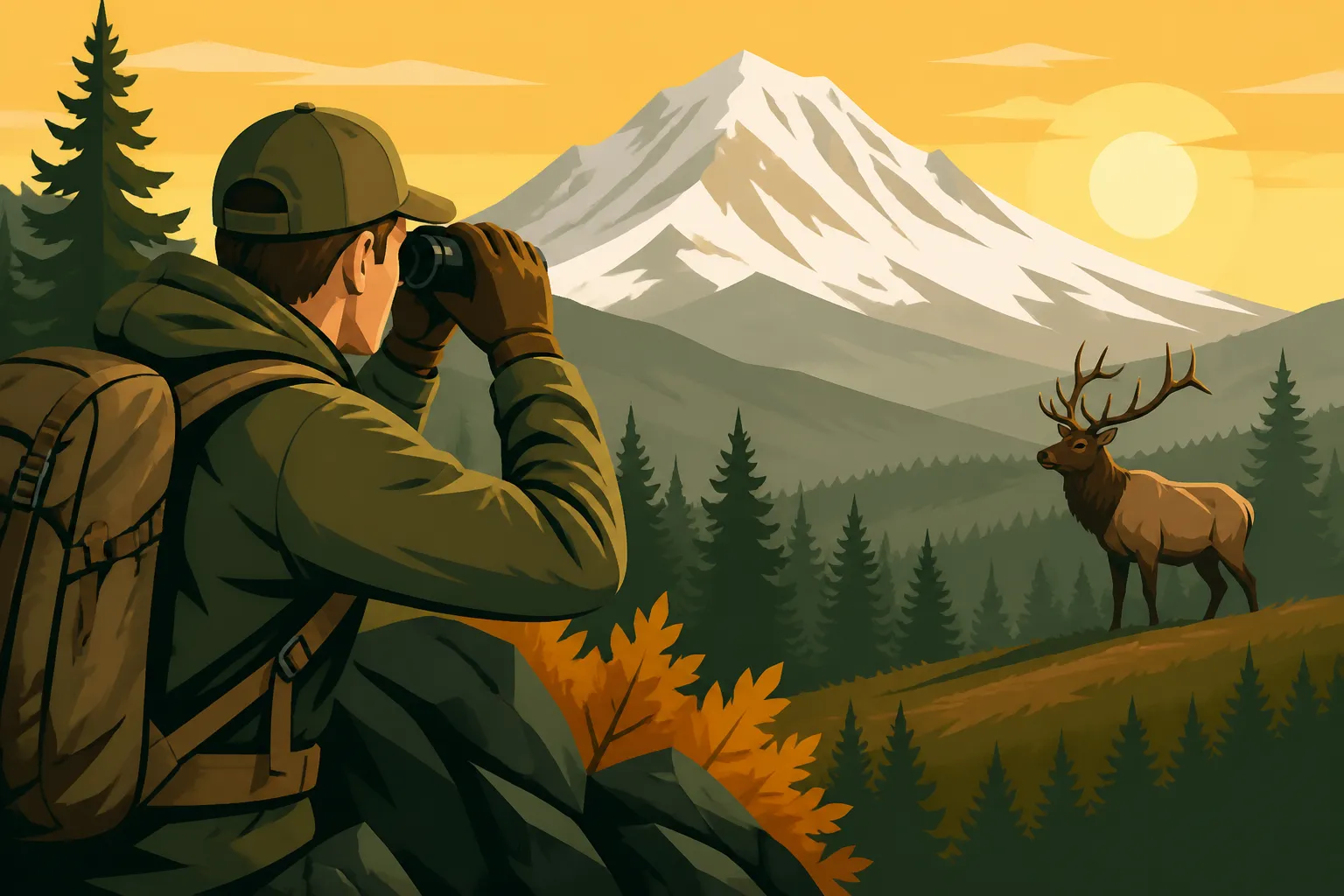
Good optics are as important for scouting as they are for hunting. A pair of quality binoculars, ideally 10×42 or 10×50, will allow you to scan distant hillsides, analyze habitat, and potentially spot animals without disturbing them. You can pick out clearcuts, old burns, and timber transitions from afar. For more open country in Eastern Washington, a spotting scope (15-45x or 20-60x) mounted on a tripod can be invaluable for picking apart distant hillsides and identifying subtle features or even individual animals. This allows you to "scout smart" by covering more ground visually without exhausting yourself physically.
Using optics for long-range observation helps you minimize your footprint and avoid bumping animals. You can sit on a vantage point for an hour or two, systematically glassing different areas, identifying potential bedding sites or feeding areas, and noting any game trails or pinch points. This is especially effective in terrain where direct access is difficult or where you want to minimize your scent disturbance in a core area. Learning Glassing Eastern Washington Breaks for Mule Deer with quality optics can dramatically improve your success.
Comfortable and Durable Footwear and Apparel
You'll be covering a lot of ground in varied terrain, so your footwear and apparel need to be up to the task. Invest in high-quality, broken-in hiking boots that provide good ankle support and are waterproof. Mud, steep slopes, and stream crossings are common in Washington. Blisters or wet feet can quickly turn a productive scouting trip into a miserable slog. Consider boots designed for Boots for Washington's Eastside Rock and Westside Mud, depending on your target GMU.
Your clothing should be comfortable, durable, and suitable for the weather. Layers are key in Washington, as temperatures can fluctuate widely, and rain is always a possibility, even in summer. Lightweight, breathable long-sleeve shirts and pants will protect you from sun, bugs, and brush. Always pack a lightweight rain jacket and pants, even if the forecast looks clear. A small backpack to carry water, snacks, a first-aid kit, and your navigation tools is also essential. Remember, scouting is training for the hunt, so wear gear that you'd be comfortable wearing for a full day of hunting.
Interpreting Public Land Regulations and Boundaries
Navigating Washington's public lands can feel like deciphering a complex puzzle, especially with the intricate mix of state, federal, and private land ownership. Understanding regulations and boundaries isn't just about avoiding a fine; it's about respecting the land, other users, and ensuring you have legal access to your hunting grounds. Proper interpretation of these rules is a critical part of pre-season scouting.
Understanding GMU Boundaries and Special Rules
Every hunter in Washington needs to be intimately familiar with the concept of Game Management Units (GMUs). These numbered geographical areas dictate which species you can hunt, during which seasons, and with what weapon. The boundaries of these GMUs are often defined by roads, rivers, ridge lines, or property lines, and they can be notoriously tricky to navigate in the field. What looks like a clear boundary on a map might be a subtle dip in the terrain or a small logging road that's hard to distinguish from others.
It’s your responsibility to know exactly which GMU you are in at all times. Use your GPS device or mapping app (like GoHunt) to ensure you stay within your legal hunting area. Furthermore, many GMUs have special rules, such as antler point restrictions (e.g., "three-point minimum"), spike-only elk seasons, or weapon restrictions. For instance, some areas may be shotgun or archery-only zones. Failing to understand these specific regulations can lead to a forfeited animal or a hefty fine. Always consult the most current WDFW hunting pamphlet for the GMU you plan to scout and hunt. For more details on this, check out Reading a Washington GMU Boundary.
Navigating Green Dot Roads and Restricted Access
Washington's public lands, particularly those managed by the Department of Natural Resources (DNR) and some National Forests, utilize "Green Dot" road systems. These systems are designed to manage vehicle access, often closing certain roads during specific times of the year to protect wildlife or reduce environmental impact. A green dot on a map or gate means the road is open for vehicle use, while a red dot or no dot often indicates a seasonal or permanent closure. During scouting, you need to pay close attention to these signs.
An access road that was open during your summer scouting trip might be closed by the time hunting season rolls around. This can completely change your entry and exit strategies, requiring you to hike much farther than anticipated. Always check the current Green Dot maps on the WDFW or DNR websites before each scouting trip and, more importantly, before your actual hunt. Also, be aware of other types of restricted access, such as walk-in-only areas, gated roads behind private timber company lands (which may require permits), or federal wilderness areas where motorized vehicles are prohibited. Understanding Washington's Green Dot Road Systems is vital for planning vehicle access and knowing where you can drive versus where you must walk.
Respecting Private Land Inholdings
One of the biggest challenges when hunting Washington's public lands is the checkerboard pattern of land ownership. Federal and state public lands are often interspersed with private parcels, some of which are timber company lands that require permits, and others that are private residences or farms. Trespassing, even accidentally, is a serious offense that can result in fines, loss of hunting privileges, and sour landowner relations for everyone.
During your e-scouting, clearly identify and mark all private land boundaries using your mapping app. When you're on the ground, be vigilant for "No Trespassing" signs, fences, or property line markers. If you're unsure about a boundary, err on the side of caution and avoid the area. Never assume that unposted land is open to hunting; in Washington, all private land is considered closed unless you have explicit permission. If you find a promising area on private land adjacent to public land, consider attempting to gain Getting Written Permission on Private Land well in advance of the season. Respecting private land is crucial for maintaining hunting access for everyone in the state.
Turning Scouting Data into a Hunt Plan
Scouting isn't just about finding game sign; it's about collecting data that you can then synthesize into a comprehensive hunt plan. This transformation from raw observations to a strategic roadmap is where the real value of your pre-season efforts comes to life. A well-developed hunt plan will guide your actions, provide alternatives, and ensure you're as prepared as possible for whatever Washington's unpredictable conditions throw at you.
Mapping Out Primary and Secondary Hunt Areas
Once you’ve completed your e-scouting and boots-on-the-ground recon, you should have a very clear picture of several promising areas. Now it’s time to define your primary and secondary hunt areas. Your primary area should be your absolute top choice, based on the most consistent and freshest game sign, ideal habitat, and favorable access. This is where you’ll focus your initial efforts on opening day.
However, never put all your eggs in one basket. Washington weather can be fickle, hunting pressure can be intense, and game can move unexpectedly. That’s where your secondary areas come in. These are backup spots that also show potential, perhaps with slightly less sign or a different access point, but still offer a good chance of success. Your secondary areas might include an escape route, a different drainage, or a higher elevation bench where animals might retreat under pressure. Having these contingencies mapped out prevents panic and allows you to pivot smoothly if your primary plan hits a snag. GoHunt is excellent for visualizing these different zones and marking them clearly.
Developing Entry and Exit Strategies
A crucial component of your hunt plan is developing detailed entry and exit strategies for each of your hunt areas. How will you get into your primary spot before first light without bumping animals? Where will you park? What route will you take to minimize noise and scent? Consider prevailing winds and thermal currents, especially in the early morning and late evening. You want to approach from a direction that puts the wind in your favor.
Equally important are your exit strategies. How will you get out safely, especially if you’re packing out an animal? Will you need to navigate difficult terrain in the dark? Are there any gates that might close behind you? Plan multiple exit routes, accounting for different scenarios, such as bad weather or a successful harvest. Knowing Packing an Elk Out of Washington's Backcountry requires forethought on the easiest routes. If you successfully harvest an animal, having a clear and safe way to Getting Meat Off the Mountain Before Dark is paramount. This detailed planning ensures you can execute your hunt efficiently and safely, regardless of the outcome.
Planning for Contingencies and Changing Conditions
Washington weather is notorious for being unpredictable. A beautiful, clear fall morning can quickly turn into a driving rainstorm or even an early snow. Your hunt plan must account for these contingencies. What will you do if a heavy rain moves in? Do you have an alternative, more sheltered hunting spot? What if a sudden cold snap pushes animals to lower elevations, or conversely, a warm spell keeps them high?
Consider planning for hunting pressure as well. If your primary spot is overrun with other hunters on opening day, do you have a more remote, difficult-to-access secondary area you can hike into? This might mean a longer, tougher pack-in, but it could also mean the difference between seeing animals or not. Having a flexible mindset and a well-thought-out plan for various conditions will keep you adaptable and increase your chances of success. Reviewing the Late-Season Hunting in Washington Snow guide could offer some valuable insights for planning for those unexpected weather shifts.
| Scouting Activity | Best Time to Conduct | Key Things to Look For | Relevant Species | Tools & Resources |
|---|---|---|---|---|
| E-Scouting | Year-round, especially winter/early spring | Terrain features, access roads, public/private boundaries, clearcuts, water sources | All Big Game | GoHunt, onX Hunt, Google Earth, WDFW maps |
| General Recon. | Spring/Early Summer (post-snow melt) | Overall layout, dense cover, pinch points, shed antlers, road conditions, general habitat | All Big Game | Binoculars, GPS/mapping app, comfortable boots |
| Specific Sign | Late Summer/Early Fall (pre-season) | Fresh tracks, rubs, scrapes, wallows, active feeding areas, bedding sites | Elk, Deer, Bear, Cougar | Binoculars, spotting scope, trail cameras, scent control |
| Access Checks | Weeks before season & day before hunt | Road closures (Green Dot), private gate status, trail conditions | All Big Game | WDFW/DNR websites, physical drive/walk-through |
| Patterning | Seasonally (adjust as needed) | Consistent movement between food/water/bedding, reaction to pressure | All Big Game | Trail cameras, long-range glassing, field observation |
Disclaimer
Please note that hunting regulations, seasons, and land access rules in Washington can change. Always consult the most current Washington Department of Fish and Wildlife (WDFW) regulations pamphlet and relevant land management agency websites (e.g., DNR, Forest Service) before planning or embarking on any hunting or scouting trip. This guide is for informational purposes only and does not supersede official regulations. It is your responsibility to know and follow all applicable laws.