Rangefinding Inside Bow Range
For any archer, that moment when a big bull elk or a cagey blacktail deer steps out inside your effective bow range is pure magic, often followed by an intense surge of adrenaline. While many focus on making long-range shots, the truth is that accurately and swiftly ranging a close-quarters target, especially when it’s moving or the terrain is tricky, can be deceptively challenging. This guide is all about mastering the art of rangefinding inside bow range, giving you the confidence and techniques to execute when those crucial seconds count in Washington's diverse and often unforgiving hunting grounds.
The Deceptive Challenge of Close-Range Ranging
It's easy to assume that because an animal is close, the shot is a gimme. But anyone who's been in the moment knows better. The closer the animal, the more intense the pressure, and the faster things can unfold. This isn't just about drawing your bow; it's about making a quick, precise decision on yardage when every second matters.
Why Short Distances Feel Tricky
When a magnificent bull suddenly appears at 28 yards in the dark timber, or a blacktail buck materializes at 17 yards in dense western Washington brush, your body floods with adrenaline. This "fight or flight" response, while natural, can make complex motor skills and quick mental calculations surprisingly difficult. Your heart is pounding, your hands might feel shaky, and your mind is racing. In this state, a distance that would be simple to judge in your backyard can suddenly feel like guesswork. Furthermore, animals at close range are often moving quickly, quartering, or even looking your way, demanding an almost instantaneous read on the yardage. There's also the mental trap of thinking "it's so close, I don't really need to range it," which can lead to costly assumptions. Washington's varying topography, from the steep, broken country of the Blue Mountains to the thick, tangled clearcuts of the Olympic Peninsula, means visual estimation is often unreliable, even at short distances.
The Critical Seconds
In bowhunting, time is a luxury you rarely have. An elk can cover 20 yards in a blink, and a blacktail can melt into the shadows before you even finish ranging. The difference between a 20-yard shot and a 25-yard shot, especially if you're not perfectly anchored, can mean the difference between a clean pass-through and a gut shot. This urgency is compounded by the fact that you often need to range, draw, find your anchor, and settle your pin, all while the animal might be shifting its position or angling away. Every fraction of a second you spend fumbling with your rangefinder or second-guessing your yardage is a lost opportunity. This is why a smooth, intuitive process for ranging is just as important as the rangefinder itself.
Your Ranging Toolkit and Techniques
Becoming proficient at close-range ranging isn't about one magic bullet; it's about combining technology with honed intuition and practice. Your goal should be to make ranging an instinctual, fluid part of your shot process, not a frantic last-minute scramble.
The Modern Rangefinder: Speed and Precision
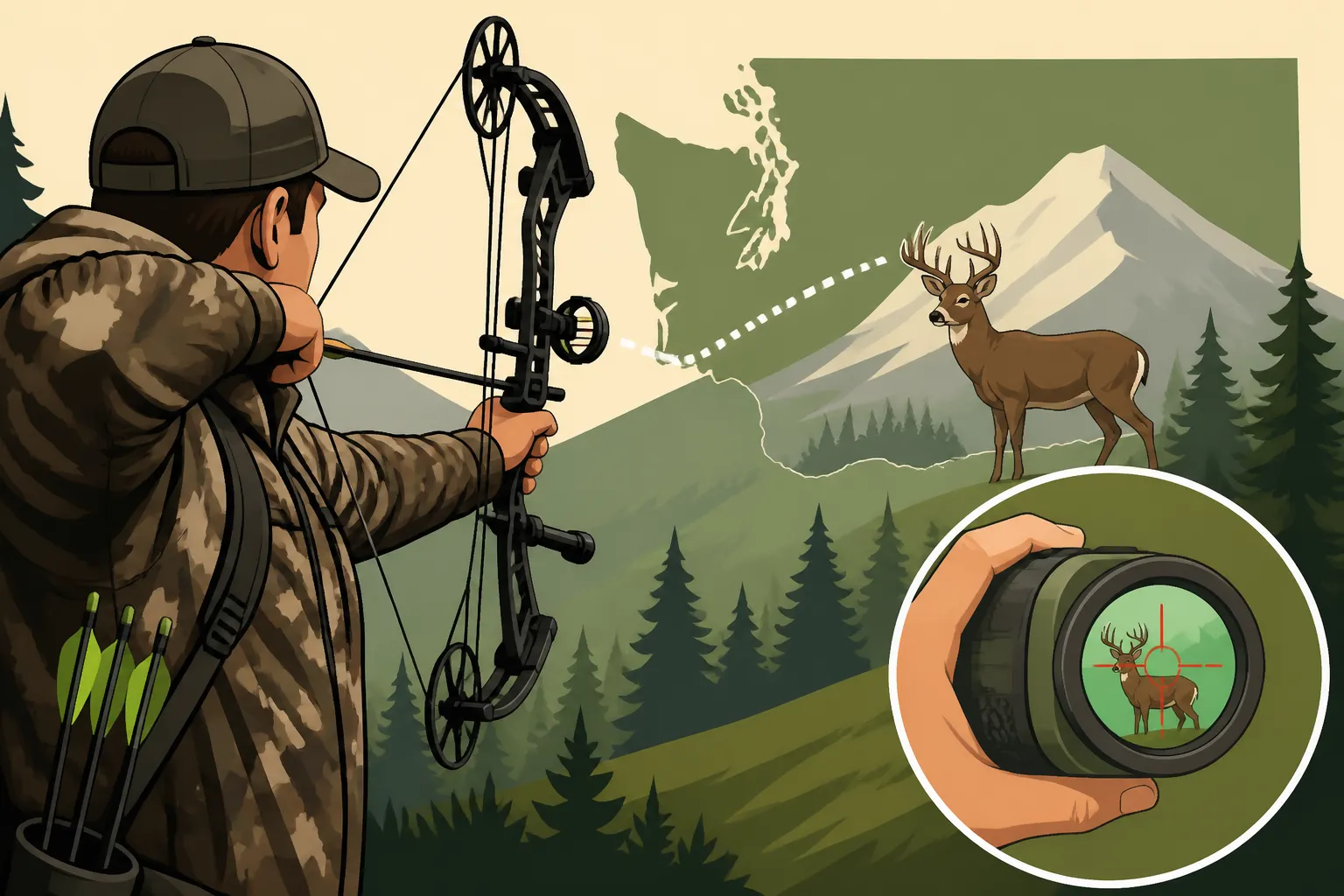
Your laser rangefinder is your most reliable tool, but only if you know how to use it under pressure. Modern rangefinders are incredibly fast, but "buttonology" – knowing exactly where the button is, how many times to press it, and which mode you're in – needs to be second nature. Practice pulling your rangefinder out, ranging, and putting it away without looking, just by feel. Many rangefinders offer angle compensation, which is absolutely critical in Washington's steep terrain. What looks like a 30-yard shot might actually be an "equivalent horizontal distance" of 25 yards when shooting sharply uphill or downhill. Failing to account for this angle can cause your arrow to sail high or drop low. Make sure your rangefinder is always on a quiet lanyard or in an easily accessible pouch that won't clang against your bow or buckle. The "scan mode" on many rangefinders can be a huge asset, allowing you to quickly pan across an area and get continuous readings, which is invaluable when an animal is moving.
The Lost Art of Visual Estimation
While your rangefinder is king, visual estimation is the loyal subject that steps in when speed or silence is paramount. Training your eye to accurately judge distances without technology is a powerful backup skill. Start by picking out objects at known distances and mentally logging them. "That stump is 20 yards. That big fir tree is 35. The edge of that clearcut is 50." Over time, your brain will start to build a reference library. Use terrain features as natural markers. If you're set up on a game trail, note a prominent rock at 20 yards, a particular bush at 30, and a fallen log at 40. Then, if an animal steps between these points, you have a much narrower margin of error for your estimation. Many hunters find the "halving" or "doubling" method helpful: "It's about half the distance to that 50-yard tree, so 25 yards." Before you even head into the field, tools like GoHunt or other mapping applications can help immensely. By studying topo maps and satellite imagery, you can "e-scout" potential ambush points and pre-range key landmarks from those spots. Knowing the general layout of your hunting area and anticipating where an animal might appear can give you a head start on mental bracketing. This ties in well with E-Scouting Washington GMUs Before the Draw.
Pin Gaps and Mental Anchors
Your sight pins aren't just for aiming; they're also excellent visual aids for close-range estimation. Knowing the precise gap between your 20-yard and 30-yard pin, or your 30-yard and 40-yard pin, is incredibly valuable. If an animal is standing in that gap, you can make an educated hold. For example, if it looks like it's exactly halfway between your 20 and 30, you know it's 25 yards. Practice shooting at those "in-between" yardages too, so you understand how your arrow performs. Develop "mental anchors" – visual cues that correspond to certain distances. Perhaps a deer that fills a certain amount of your sight housing at 20 yards, or one that looks a certain size when standing at 30. Combine these with your visual estimation and pin gaps, and you create a robust system for quick, confident yardage calls. This close range precision is critical for good Shot Placement on a Bull at Twenty Yards.
Mastering Pressure and Proficiency
True mastery of close-range ranging comes not from theoretical knowledge, but from consistent practice that simulates the stress and unpredictability of a real hunting scenario. Getting good on the static range is one thing; performing when your heart is pounding is another.
Practice Scenarios That Mimic Reality
To really dial in your ranging skills, you need to go beyond simply shooting at known distances. Incorporate movement into your practice. Have a friend move a target to unexpected spots, forcing you to draw and range quickly. Practice ranging and drawing from different shooting positions – kneeling, sitting, even awkwardly behind a tree, just like you might experience in real Washington hunting situations. To simulate the adrenaline of the moment, try doing a set of jumping jacks or a quick sprint before picking up your bow and ranging a target. This elevates your heart rate and forces you to focus through the physical stress. Setting up a "pressure course" in your backyard or at a safe archery range, with targets appearing at various short distances and angles, is an excellent way to prepare. Think about the specific environments you hunt. If you're chasing blacktails in the dense coastal forests, practice Archery Practice for Wet Coastal Conditions and ranging in thick cover where laser beams can get confused. If you're in the steep terrain of eastern Washington, practice with significant uphill and downhill angles to ingrain that angle compensation. Don't forget to practice Practicing Offhand and Kneeling Shots which often go hand-in-hand with quick ranging when an animal busts out close.
Gear Setup and Accessibility
The most advanced rangefinder in the world is useless if you can't get to it quickly and quietly. Think critically about your rangefinder's carry system. Many hunters prefer a chest harness that keeps it front and center, protected, and easily deployable with one hand. Others use a secure lanyard that allows it to hang quietly when not in use. Some even experiment with bow-mounted rangefinders, though these have their own set of pros and cons, often coming down to personal preference for weight distribution and field of view. The key is that your system allows for lightning-fast access without fumbling, noise, or having to look down at your hands. Just as with Rifle Setup for Washington Elk and Deer, knowing your gear inside and out means your rangefinder becomes an extension of your body, not an obstacle. Make sure batteries are fresh before every hunt and carry spares. You don't want a dead battery costing you a shot at a once-in-a-lifetime animal. Consider how Bow Choice for Wet Coastal Hunting might affect how you carry your rangefinder too, as rain can affect accessibility and electronics.
Avoiding Common Pitfalls and Ensuring Success
Even seasoned archers can fall prey to simple mistakes when ranging inside bow range. Being aware of these common traps is the first step toward avoiding them and ensuring you make the most of every opportunity.
Target Fixation and Over-Ranging
One of the most common mistakes is ranging the wrong thing. In thick brush or timber, it's incredibly easy for your rangefinder's beam to hit a branch, a clump of grass, or a tree behind the animal, giving you an inaccurate reading. Always try to range a clear, distinct spot on the animal itself, or directly in front of it. Another pitfall is "over-ranging" – ranging the animal multiple times when one quick, solid read would have sufficed. This wastes precious seconds, increases your movement, and can alert the animal. Trust your first good reading, especially when the animal is calm and you've had time to get a clear line of sight. If possible, range before the shot opportunity fully materializes. If you see an animal approaching a specific opening, range that opening. If a bull is feeding away from you, quickly range a tree he might walk past. Being proactive is always better than being reactive.
The "Too Close to Range" Trap
This is arguably the most dangerous mistake. Many archers assume that anything under 20 yards doesn't need to be ranged, or that "it's just 10 yards" is good enough. But consider this: a 5-yard error at 15 yards is a 33% error. A 5-yard error at 50 yards is only a 10% error. At close range, small mistakes in yardage have a much larger impact on percentage of error and thus, your point of impact. Arrows drop dramatically, even at short distances, and even a slight error can lead to a missed or poorly placed shot. Always range, even if it feels "too close." Your 10-yard pin is specifically for 10 yards, not 12 or 8. Precision here is paramount to hitting the vitals. Ensure your arrow weight, which is covered in Arrow Weight Minimum for Washington Big Game, is consistent to prevent unexpected drops at close range.
Utilizing E-Scouting for Advantage
The work you do at home, long before the season opens, can significantly improve your close-range ranging skills in the field. Using satellite imagery and mapping apps is a game-changer. Platforms like GoHunt allow you to virtually scout potential stand locations, mark natural travel corridors, and even identify key landmarks like large rocks, downed timber, or prominent trees. You can then use the mapping tools to pre-range distances from your anticipated ambush point to these landmarks. This allows you to walk into your hunting area with a mental map of known distances. If an elk steps out at that specific downed log you marked, you already know it's 32 yards, saving you critical time in the moment. Remember to Downloading Offline Maps for Washington before heading into areas with no cell service, so your pre-scouted information is always available. Understanding terrain and planning for angle compensation is also much easier from the comfort of your home using detailed topographic maps. This foresight reduces mental load and ensures you’re ready for the shot when it happens.
Disclaimer
This article is for general informational purposes only and does not constitute professional advice. Laws, prices and regulations vary by location and change over time. Consult a qualified professional for guidance on your specific situation.