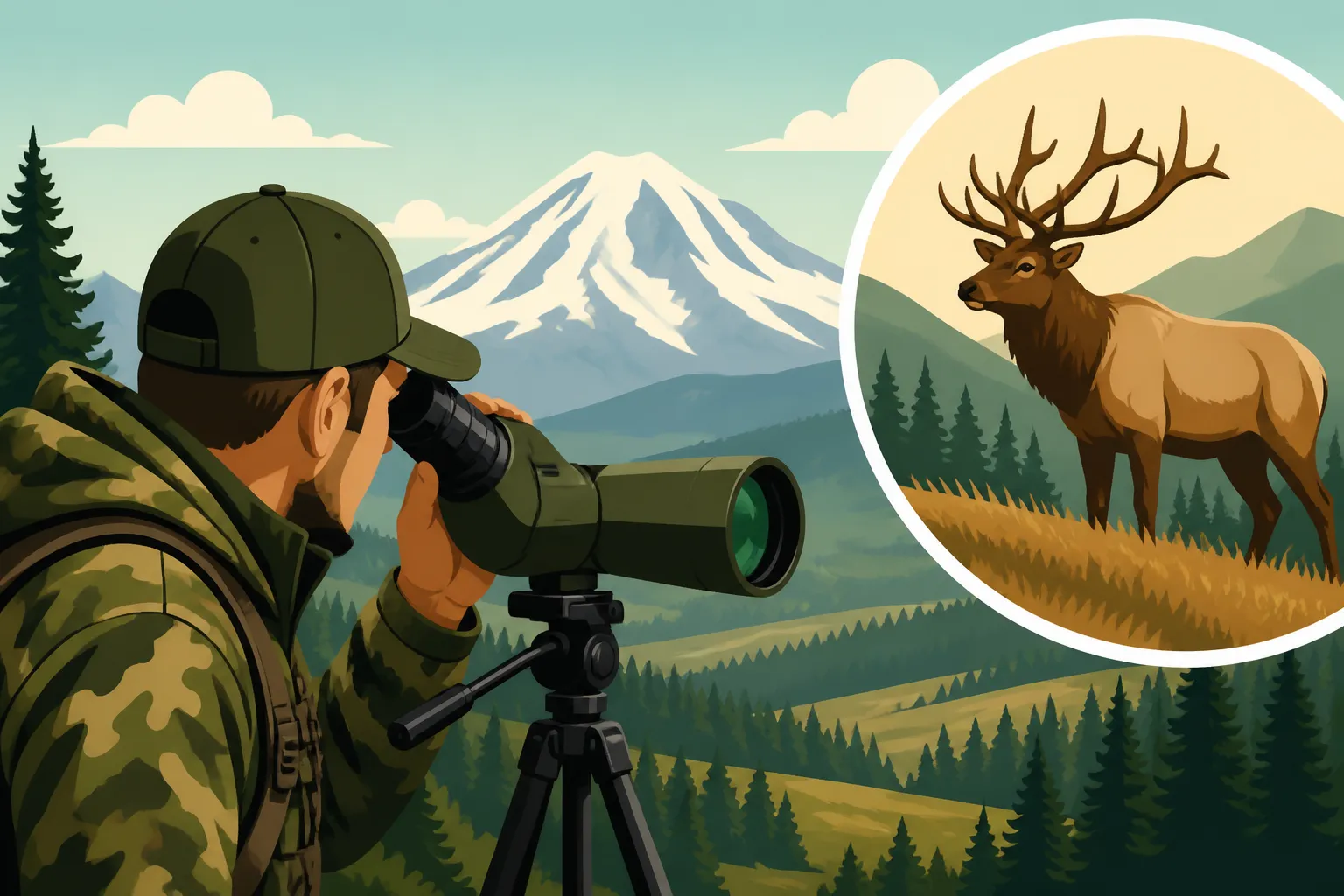
Spotting Scopes and When You Need One
There’s nothing quite like spending hours behind your binoculars, meticulously picking apart a distant hillside or canyon rim in Washington, only to catch a flicker of movement or a tell-tale antler tine. But often, those tantalizing glimpses leave you wanting more. You're left squinting, questioning whether that faint speck is a branch or a legitimate bull, and that's exactly where a good spotting scope becomes less of a luxury and more of an indispensable tool for serious Washington hunters. This guide is all about helping you understand when and why you need a spotting scope to elevate your glassing game and confirm those crucial details.
The Role of Spotting Scopes in Washington Hunting
When you're out in the vast, wild landscapes of Washington, whether it's the sprawling breaks of the eastside or the occasional open clearcut on the west, the ability to observe game from a distance without disturbing them is paramount. Binoculars are your workhorse, no doubt, but there comes a point where their capabilities max out. That's when a spotting scope truly earns its place in your gear list, allowing you to not just see, but interpret what's happening miles away.
When Binos Just Aren't Enough
You’ve been there: sitting on a ridge, glassing a distant timber patch or a sagebrush flat, and your 10x42s just aren’t cutting it. You see something – maybe a faint shape, a glint of antler, or a patch of hide that doesn't quite look like a rock. With your trusty binoculars, you can confirm it’s an animal, but you can’t tell if it’s a spike, a decent bull, or merely a cow. Is it even legal in a Washington's Three-Point Minimum Units? That’s the classic moment when you wish you had more magnification.
In Washington’s diverse terrain, from the vast open country of the Okanogan to the more broken, but still expansive, eastern slopes of the Cascades, a spotting scope bridges that critical gap. It allows you to transform a distant blur into a recognizable animal, letting you pick out specific features. Imagine you're patiently working a large basin, methodically sweeping the distant hillsides. Your binoculars show you some deer, but you can't tell if that one on the far ridge is a buck or a doe, let alone how many points it has. A spotting scope lets you zoom in, resolve those details, and make an informed decision without having to burn boot leather on a speculative stalk. This saves precious time and energy, especially on multi-day hunts where every step counts. For more on general optics, check out Optics for Washington Elk and Deer Hunting.
Identifying Game at Extreme Distances
The ability to identify game at extreme distances isn’t just about seeing more; it’s about making smart hunting decisions. In areas like eastern Washington, where the landscape can stretch for miles, a spotting scope becomes your best friend for evaluating an animal before committing to a stalk. Think about chasing mule deer in the wide-open wheat fields and coulee country. You might spot a group of deer a mile or two away. With a spotting scope, you can sit back, analyze the herd, locate the bucks, and Counting Points on a Live Buck. You can watch their movement patterns, see if they’re feeding, bedding, or moving to water.
This level of detail is critical for mature bulls and bucks, especially when dealing with specific antler restrictions. You might see a distant bull with a heavy frame through your binoculars, but is it a 6×6 or a branch-antlered bull that meets the legal requirements for a special permit unit? A spotting scope allows you to count points, check brow tines, and confirm legality before you ever take a step. This is also invaluable for confirming that what you’re seeing isn't a sow with cubs when you're targeting bear, or identifying a legal ram in a bighorn unit where only certain curl criteria are permitted. When you're spending countless hours glassing, like for Glassing Eastern Washington Breaks for Mule Deer, this precision is gold.
Understanding Spotting Scope Magnification and Objective Lens
Just like binoculars, spotting scopes come with a range of specifications, and understanding what those numbers mean is crucial to choosing the right tool for your specific Washington hunting needs. It's not just about cranking up the zoom; it's about balancing magnification with field of view, light gathering, and overall image quality.
Variable vs. Fixed Power Scopes
Most modern spotting scopes are variable power, meaning they offer a range of magnifications. You'll often see them listed with a range like 20-60x or 25-50x. This flexibility is incredibly valuable in the field. You can start at a lower magnification to quickly locate an animal or sweep a large area, then zoom in to maximum power to study the details. Imagine you're scanning a distant ridge for a bedded elk. You might start at 20x to cover ground quickly. Once you spot a hint of an ear or a patch of brown that seems out of place, you can smoothly dial up to 60x to confirm it's a bull and even get a good look at its antlers. This versatility is what makes variable power scopes so popular and effective for hunters across Washington.
Fixed power scopes, while less common today, offer a simpler, often more robust design with fewer moving parts. They might be slightly brighter or sharper at their single magnification than a variable scope set to that same power, simply because there's less glass and fewer optical compromises. However, they lack the adaptability that hunters often need when facing varied distances and conditions. For the vast majority of Washington big game hunters, the flexibility of a variable power scope outweighs the minor optical edge a fixed power might offer. The ability to tailor your magnification to the situation is a huge asset.
Objective Lens Size and Light Gathering
The objective lens is the large lens at the front of the spotting scope, and its diameter (measured in millimeters) directly impacts how much light the scope can gather. Common objective lens sizes range from 60mm to 95mm, or even larger. A larger objective lens means more light transmission, which translates to a brighter, clearer image, especially in low-light conditions like dawn and dusk, or when looking into deep shadows.
Consider hunting during the crucial first and last hours of light, when animals are most active. A scope with a 80mm or 95mm objective will gather significantly more light than a 65mm scope, providing a brighter image that allows you to see more detail when light is fading fast. This can be the difference between confirming a legal bull and letting him walk because you couldn't resolve his antlers in the shadows. The downside, of course, is that larger objective lenses mean heavier, bulkier scopes. For backpack hunters covering serious mileage in units like the Pasayten Wilderness, every ounce counts. You have to balance the desire for maximum light gathering with the practical realities of carrying your gear into remote areas. For instance, when you're Packing an Elk Out of Washington's Backcountry, you want every piece of gear to justify its weight. Therefore, choosing the right objective lens size involves a careful consideration of your hunting style, target species, and the terrain you typically cover.
| Feature | Smaller Objective (e.g., 65mm) | Larger Objective (e.g., 85mm+) |
|---|---|---|
| Light Gathering | Good in daylight, struggles in low light | Excellent, performs well in low light |
| Brightness | Adequate | Superior |
| Weight | Lighter, more packable | Heavier, bulkier |
| Size | Compact | Larger, takes up more pack space |
| Cost | Generally lower | Generally higher |
| Ideal Use | Mobile hunters, daylight scouting | Static glassing, critical low light ID |
Angled Versus Straight Spotting Scopes
One of the first decisions you'll face when picking a spotting scope is whether to go with an angled or straight eyepiece. This might seem like a minor detail, but it profoundly impacts how you use the scope in the field, affecting comfort, versatility, and even how quickly you can get on target. Both configurations have their dedicated proponents among Washington hunters, and understanding their pros and cons is key to making the right choice for your specific hunting style.
Pros and Cons of Angled Eyepiece
An angled spotting scope, as the name suggests, has the eyepiece set at an angle, usually around 45 degrees, relative to the main body of the scope. This design offers significant comfort advantages, especially during prolonged glassing sessions. When you're spending hours hunkered down on a ridge in the Blue Mountains Hunting in Southeast Washington, meticulously picking apart distant terrain, the angled eyepiece allows for a more relaxed head and neck position, as you look down into the scope rather than straight through it. This is a huge benefit if you find yourself sitting for long stretches, as many trophy hunters do when trying to Judging Antler Points Before the Shot.
Furthermore, an angled scope can be more versatile in varying terrain and for hunters of different heights. You can often use a shorter tripod, making the setup more stable and lighter to pack. If you're sharing the scope with a partner who is taller or shorter, or if you're glassing from a steep incline or decline, the angled eyepiece can be rotated, making it easier for anyone to get comfortable. For digiscoping – attaching your phone to the eyepiece to take photos or videos through the scope – the angled setup is generally preferred as it’s easier to view the screen.
However, there are some downsides. Finding your target can sometimes be a bit slower with an angled scope because you can't just sight down the barrel like you can with a straight scope. It takes a little more practice to acquire a distant animal quickly, especially if it's moving. Some hunters also find the angled view less intuitive for tracking a moving animal. It's a trade-off: greater comfort and versatility once you're set up, but potentially a slightly steeper learning curve for target acquisition.
Pros and Cons of Straight Eyepiece
A straight spotting scope has the eyepiece aligned directly with the objective lens, much like a rifle scope. This design makes target acquisition incredibly fast and intuitive. If you spot something interesting with your binoculars, you can often transition directly to the straight scope, aligning your eye with the scope and getting on target almost instantly. This rapid acquisition can be a game-changer when an animal is on the move or when you need to confirm a shot placement quickly if you are hunting with a partner. For hunters who value speed and simplicity above all else, the straight scope is often the preferred choice.
Additionally, a straight scope can be easier to use from certain positions, particularly when glassing from inside a vehicle or a ground blind, where space might be limited and an angled eyepiece might bump against the roof or window frame. It can also be more natural for packing flat against a backpack, potentially reducing snag points compared to an angled design where the eyepiece might protrude more.
The main drawback of a straight scope is ergonomics during extended glassing. You often have to crane your neck or adjust your tripod to a higher, less stable position, especially if you're looking significantly uphill or if the scope is mounted high. This can lead to neck strain and fatigue after long hours. If you're frequently glassing from a seated or prone position for extended periods, an angled scope will likely offer more comfort. Ultimately, the choice between angled and straight comes down to personal preference, your typical hunting scenarios, and what feels most natural and comfortable to you after spending time behind both.
Tripods and Adapters: The Unsung Heroes
Having a top-notch spotting scope is only half the battle. Without a stable foundation, even the best optics will be frustrating to use. The tripod is the unsung hero of any serious glassing setup, providing the stability needed to maximize the clarity and resolution of your scope. And sometimes, you can even leverage your tripod to boost your binocular game, which is a great way to extend your glassing capability without carrying an extra spotting scope, especially when using tools like GoHunt to scout new areas.
Why a Solid Tripod is Non-Negotiable
A wobbly tripod is worse than no tripod at all. Even the slightest vibration or movement will render your high-magnification spotting scope unusable, turning a clear image into a frustrating blur. Imagine you've just spotted a monster bull way out across a canyon in the Colockum or Yakima unit. You zoom in, heart pounding, only for the image to dance and shake every time a breeze blows or you accidentally bump the leg. It's enough to make you pull your hair out. A good tripod provides the rock-solid platform necessary to hold your scope steady, allowing you to patiently study animals, count points, and observe their behavior without strain or frustration.
When choosing a tripod for hunting in Washington, especially if you're packing into the backcountry, you need to balance stability with weight. Carbon fiber tripods are generally lighter and often absorb vibrations better than aluminum, but they come at a higher cost. Look for features like sturdy leg locks (lever locks are often faster than twist locks in cold weather or with gloves), a wide leg stance for stability, and a reliable head that allows for smooth panning and tilting. A fluid head, often used for video, offers incredibly smooth movement, which is fantastic for tracking animals. A ball head is quicker to adjust and lighter, but might not be as smooth for tracking. Don't skimp on the tripod; it's an investment that will make every minute behind your scope more productive and enjoyable. For tips on packing light, consider Backcountry Camps in Washington Wilderness.
Adapting Binoculars for Extended Glassing
While a spotting scope offers superior magnification, sometimes you just need to get your binoculars on a stable platform for prolonged observation. This is where binocular adapters come in. A simple L-shaped adapter can attach most binoculars with a threaded front hinge to any standard tripod head. This allows you to mount your 10x or 12x binoculars onto your tripod, offering a much more stable image than holding them freehand.
Why would you do this? Extended glassing with handheld binoculars leads to fatigue, eye strain, and a shaky image, making it easy to miss subtle details. Mounting your binoculars on a tripod eliminates the shake, making a 10x binocular feel more like a 15x or even 20x for clarity and resolution. This is especially useful if you're primarily hunting in areas that don't always demand extreme magnification, but still require long periods of meticulous glassing, such as picking apart timber edges for Blacktail Deer Hunting in Western Washington Timber or patiently waiting for movement in a clearcut. It can also be a fantastic technique for initial broad area sweeps before you even consider pulling out the spotting scope. Many hunters utilize this strategy for Glassing Sage and Wheat Edges for Washington Mule Deer, covering vast areas systematically. When you combine this grounded approach with e-scouting tools like GoHunt, you can really pinpoint potential areas, then use your tripod-mounted binoculars to confirm initial observations.
Scenarios Where a Spotting Scope Shines in Washington
Not every hunting scenario in Washington absolutely requires a spotting scope, but there are definite situations where having one in your pack can be the difference between a successful hunt and a missed opportunity. Its strength lies in providing unparalleled detail at distances where binoculars simply can't compete. Knowing when to rely on your scope is as important as knowing how to use it.
Eastside Mule Deer and Rocky Mountain Elk
The expansive, broken country of Eastern Washington is where a spotting scope truly comes into its own. Imagine hunting mule deer in the Beezley Unit or the Okanogan, where draws, coulees, and sagebrush flats stretch for miles. You can often sit on a high point and have visibility for several square miles. While your binoculars are great for initial sweeps, to really pick apart a distant feeding herd, count points on a potential buck, or confirm a bedded deer's legality, a spotting scope is essential. It lets you analyze every nook and cranny, looking for shed antlers, ear tags, or the subtle twitch of a deer's tail. You're trying to find that specific buck you saw on a trail camera during your E-Scouting Washington GMUs Before the Draw.
Similarly, for Rocky Mountain elk in the Colockum, Blue Mountains, or Yakima herds, the terrain can be vast and steep. Elk often feed in open areas at dawn and dusk before bedding down in timber. A spotting scope allows you to watch those timber edges for hours, patiently waiting for a bull to step out, or to meticulously examine distant bands of timber for a flicker of movement. You might spot a small group of elk a mile and a half away. With a spotting scope, you can sit there, enjoy the show, and confirm if that's a legal bull before you ever begin the arduous climb or descent. This is especially critical during general seasons when you're often looking for specific antler configurations. For more specific elk tactics, explore Washington Elk Hunting Tactics by Weapon Season.
Alpine Hunts and Scouting
Washington’s high country, particularly in units bordering the North Cascades or in the deeper reaches of the Okanogan-Wenatchee National Forest, presents some of the most challenging but rewarding hunting experiences. This is often steep, open, rocky country with scattered timber, where visibility can extend for incredible distances. For high-alpine mule deer, mountain goats, or bighorn sheep, a spotting scope is not just an advantage; it’s often a necessity. These animals are masters of camouflage in their rocky domains, and picking them out at a mile or more against a mottled background requires serious optical power.
When scouting these areas, a spotting scope allows you to identify game trails, observe bedding areas, and understand migration patterns without having to put immense physical effort into traversing every ridge. You can spend a full day on one vantage point, systematically breaking down several square miles of terrain. This strategic approach is also incredibly useful for Public Land Scouting in Washington Before Opening Day in general, allowing you to maximize your time in the field before the season even begins. Using tools like GoHunt, you might identify potential alpine basins from home, then confirm them with your scope from a distant peak. Even for less extreme backcountry hunts, say for Roosevelt elk in the Gifford Pinchot National Forest where you might encounter larger clearcuts or avalanche chutes, a spotting scope can help you confirm distant animals that would be mere specks through binoculars. It turns a hopeful guess into a confident identification, letting you save your energy for the actual stalk.
Budgeting for a Spotting Scope: What to Expect
Let's be real, hunting gear can get expensive, and spotting scopes are no exception. Just like rifles, bows, or even your boots, there's a wide range of price points, and understanding what you get for your money is crucial. It's not about spending the most, but spending wisely for your specific hunting style and needs in Washington.
Entry-Level Options and Their Limitations
If you're just starting out or working with a tighter budget, there are definitely entry-level spotting scopes available. These scopes can typically offer magnifications in the 20-60x range and usually feature objective lenses around 60-65mm. You can expect a decent image in good light, and they will certainly provide more detail than your binoculars at longer ranges. For identifying a distant animal as "deer" or "elk" and perhaps getting a general idea of size, they do the job.
However, the limitations become apparent when conditions aren't ideal. In low light, such as early morning or late evening, or when looking into shadows, the image will likely be dimmer and less clear. Chromatic aberration (color fringing around high-contrast objects) might be noticeable, and the edge-to-edge clarity might not be as sharp as higher-end models. Durability can also be a concern with some budget options, meaning they might not stand up to the rigors of Washington's wet, rugged terrain as well as more robust models. Think of it this way: an entry-level scope will get you on target, but it might not let you confirm the exact number of points on a bull in deep timber at dusk. It's a great starting point, but understand that there are trade-offs in optical performance, especially in challenging conditions.
Mid-Range and High-End Performance
Stepping into the mid-range category (and certainly the high-end) is where you start to see significant improvements in optical quality, durability, and overall user experience. Mid-range scopes often boast larger objective lenses (70-85mm), better glass (like ED or HD glass), and advanced lens coatings that drastically improve light transmission, color fidelity, and edge-to-edge sharpness. These scopes perform much better in low-light conditions, allowing you to glass effectively during the critical twilight hours. The image will be brighter, clearer, and more vibrant, with less distortion or fringing.
High-end spotting scopes are the pinnacle of optical engineering. They use the absolute best glass (often fluorite-containing elements), proprietary coatings, and precision manufacturing. This results in an incredibly bright, razor-sharp image across the entire field of view, even at maximum magnification and in the dimmest light. The resolution is so fine that you can pick out incredible detail, like the texture of an elk's hide or the minute tines on a distant buck's antlers. They are built like tanks, often nitrogen-purged and O-ring sealed for waterproof and fog-proof performance, capable of shrugging off the worst weather Washington can throw at them. While the cost is substantial, for serious hunters who demand the absolute best and often hunt once-in-a-lifetime tags like Washington Moose Permit Applications, the investment in a top-tier scope is often justified. The clarity and reliability they offer can genuinely improve your odds of success and make the entire glassing experience more rewarding.
Disclaimer
This article is for general informational purposes only and does not constitute professional advice. Laws, prices and regulations vary by location and change over time. Consult a qualified professional for guidance on your specific situation.