Still-Hunting Blacktails in Wet Washington Brush
The relentless drizzle and saturated undergrowth of Western Washington can feel like an impossible challenge for still-hunting blacktails. The constant rustle of wet leaves, snapping twigs underfoot, and the general dampness make every step a potential alarm bell for a wary buck. This guide will meticulously break down how to adapt your tactics, gear, and mindset to effectively still-hunt blacktail deer in this challenging, yet incredibly rewarding, environment.
Understanding the Blacktail's World in Wet Weather
Hunting blacktail deer in Western Washington often means embracing the rain, fog, and pervasive dampness that characterize much of the season. These conditions, while frustrating to us, are simply part of a blacktail's everyday life, and understanding how they react to and utilize this environment is key to successful still-hunting.
How Rain and Fog Affect Blacktail Behavior
When the skies open up or a thick fog rolls in, blacktails don't just disappear; they adapt. Often, a steady rain can work to your advantage, dampening the forest floor and masking your movements. Think of a light, consistent rainfall: it softens the crunch of leaves and needles, allowing you to move with greater stealth. Deer, in turn, might move less, hunkering down in thick cover, but their senses are still razor-sharp. During a heavy downpour, deer are more likely to seek dense cover, often in the thickest reprod or under large, mature conifers that offer some reprieve from the elements. This is where your still-hunting patience will truly be tested, as they might be bedded in spots you'd typically walk past.
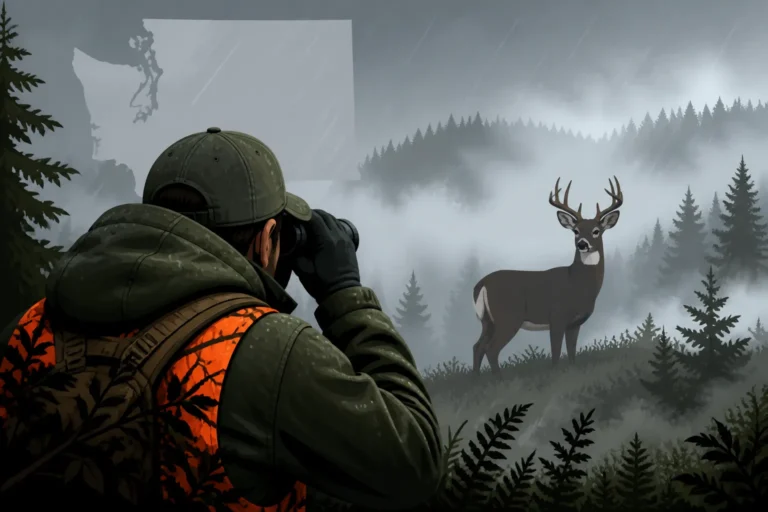
Fog is another game-changer. While it reduces visibility for both you and the deer, it often makes them feel more secure, sometimes causing them to move later in the morning or earlier in the evening. They might feel more comfortable venturing into openings or along clearcut edges they'd usually avoid in clear daylight. Your focus shifts from long-range glassing to a much more intimate, close-quarters hunt, relying on brief glimpses and subtle movements. Remember, a blacktail will hear you long before it sees you, especially in a dense fog, so meticulous movement is paramount.
Reading the Brush: Where Blacktails Hide
Western Washington brush is famously thick, a tangled maze of salal, huckleberry, sword ferns, and devil's club. For blacktails, this isn't an obstacle; it's home, sanctuary, and dinner table all rolled into one. When you're still-hunting, you're essentially walking through their living room. In wet conditions, they’ll often be bedded down in the densest part of this cover, seeking shelter from the rain and wind. Look for areas where the brush forms natural overhangs or thick pockets, especially those near food sources like clearcut edges with young browse, or areas with recent logging activity that disturb the canopy and allow new growth.
They'll often utilize small depressions, benches, or even just a slight rise in terrain that offers a good vantage point downwind. Don't be fooled by seemingly impenetrable tangles; a blacktail can melt into cover that looks barely sufficient to hide a rabbit. Pay close attention to subtle breaks in the brush, game trails, and any areas where the canopy provides natural overhead cover. Often, a mature conifer with low-hanging branches can create a dry, secluded pocket underneath that a blacktail will readily use as a bed during a wet day. This is particularly true if it's near a south-facing slope that gets a bit more warmth.
The Advantage of Noise: Rain as a Cloak
While the wet environment poses challenges, it also offers a significant advantage: natural sound dampening. The constant drip, drop, and rustle of rain on leaves and branches, combined with the general ambient noise of a damp forest, creates a cloak that can mask your movements. Instead of seeing every snapped twig as a disaster, learn to embrace the rain as your ally. A gentle rain reduces the crispness of dry leaves and needles underfoot, making your steps significantly quieter. The overall background noise makes it harder for deer to pinpoint the exact location of any sounds you might make.
This doesn't mean you can stomp around, but it does mean you have a bit more margin for error than on a crisp, dry day. Use these moments of increased ambient noise—a gust of wind, a sudden downpour—to move a few extra steps. The blacktail's hyper-alert senses are still active, but the deluge of auditory information makes it harder for them to distinguish a subtle human sound from the myriad of natural forest noises. This allows you to close distances in ways that would be impossible in drier, quieter conditions, offering a crucial edge when Still-Hunting Pace in Wet Brush is the name of the game.
Gear Up for Silence and Comfort
Still-hunting in wet Washington brush demands very specific gear choices. Your comfort and stealth directly correlate with your success, and being cold, wet, or noisy will quickly end your hunt. Investing in the right equipment is not just about staying dry; it's about being effective.
Quiet, Waterproof Outerwear is Non-Negotiable
Forget the noisy crinkle of cheap rain gear. In the dense, close quarters of blacktail country, every sound you make is amplified. Your outer layers must be genuinely waterproof, but equally important, they must be quiet. Many companies now produce brushed polyester or softshell fabrics that are treated with durable water repellent (DWR) coatings or feature waterproof/breathable membranes like Gore-Tex or similar technologies. Look for materials that don't rustle or make a swishing sound as you move your arms or walk. A quiet face fabric is essential, especially when pushing through thick brush.
Consider a layering system. A good base layer wicks moisture, a mid-layer provides insulation, and a quiet, waterproof outer layer sheds the rain and blocks the wind. Brands like Sitka, Kuiu, and even some offerings from Cabelas' hunting lines often prioritize quiet fabrics in their rain gear. Remember, you'll be exerting yourself, so breathability is also key to prevent getting soaked from the inside by your own sweat. There's an excellent discussion on Rain Gear That Survives a Washington Westside Season that details what works in these conditions.
Footwear for Stealth and Grip
Your boots are your foundation when still-hunting wet brush. They need to provide exceptional grip on slippery roots, moss-covered logs, and slick mud, while also being completely waterproof. A tall boot, at least 8-10 inches, is highly recommended to prevent water and debris from entering when you're wading through knee-high ferns or crossing shallow puddles. Look for aggressive outsoles with deep lugs that can shed mud easily. Vibram soles are a common and reliable choice.
Beyond waterproofing, consider flexibility. A stiff mountaineering boot might be great for side-hilling, but for silent movement, a boot with a bit more give in the ankle and sole can help you "feel" the ground and place your feet more deliberately. Pay attention to how your boots fit and break them in thoroughly before the season. Blisters in wet conditions can quickly turn a productive hunt into a miserable march back to the truck. Rubber boots, like those from Muck Boot Company or LaCrosse, can be surprisingly effective for still-hunting in extremely wet, swampy areas, offering unparalleled waterproofing and decent stealth if you choose a flexible model. For more options, explore the advice on Boots for Washington's Eastside Rock and Westside Mud.
Essential Tools for the Wet Woods
Beyond your weapon and basic clothing, a few key items will significantly enhance your still-hunting experience in wet brush. A good pair of waterproof binoculars (10×42 is often ideal) is crucial for picking apart dense cover, even in low light or fog. You’ll be constantly scanning for flicking ears, a horizontal backline, or a patch of contrasting color against the monotonous green. A rangefinder is also invaluable for quickly assessing shot distances, especially when visibility might be limited by fog or rain.
Navigation is paramount. A reliable GPS unit or a smartphone app like onX Hunt, loaded with offline maps, is critical for staying found in the maze of logging roads and dense timber. With limited visibility, it's incredibly easy to get turned around. Ensure you have extra batteries or a power bank for electronic devices. Lastly, a sharp knife, a small first-aid kit, and a headlamp are non-negotiables for any hunt, especially when pushing deep into wet, unforgiving terrain.
Mastering the Art of Silent Movement
Still-hunting is a blend of extreme patience, acute observation, and deliberate, silent movement. In wet Washington brush, this art is taken to another level, demanding even more focus and control. It's about becoming part of the forest, not an intruder.
The "Stop and Go" Rhythm
The fundamental principle of still-hunting is the "stop and go" rhythm. This isn't just about pausing; it's about pausing and observing. You might take one or two slow, deliberate steps, then freeze for one, five, or even ten minutes. During these pauses, your eyes should be constantly scanning every shadow, every cluster of brush, every tree trunk. Look for unnatural lines, horizontal shapes, or subtle movements that indicate a deer. Many hunters make the mistake of moving too fast, only stopping when they think they've heard something or seen movement. The best still-hunters stop before they've seen anything, allowing their eyes to detect what their moving body would have missed.
In wet brush, this rhythm is even more crucial. The damp conditions might muffle your sound, but they don't erase it. Every single step must be planned. Before you lift a foot, visually clear your landing zone of any crunchy debris, loose rocks, or standing water that might cause a splash. Place your foot down slowly, heel first, then roll to your toe, distributing your weight. If a twig snaps, freeze immediately and wait. Often, the deer will hear it but won't bolt if you don't follow it up with more movement. This methodical, almost meditative approach is the core of effective still-hunting, as detailed in Still-Hunting Pace in Wet Brush.
Using Terrain and Cover to Your Advantage
The broken topography of Western Washington offers numerous opportunities to use the land itself to your advantage. Ridges, creek bottoms, and dense pockets of cover can all provide natural pathways for stealthy movement. When moving along a ridge, try to stay just below the crest, out of sight from deer on either side, using the rise as a natural screen. If you're moving across a slope, consider moving uphill slightly to approach deer from above, as their eyes are generally trained downhill.
Use the thick brush itself as cover. Rather than trying to navigate around every patch of dense salal or huckleberry, sometimes it's best to move through it, using the vegetation to break up your silhouette. Move slowly, parting branches gently rather than crashing through. Focus on looking into the cover, not just past it. Blacktails are masters of concealment, and they'll often be standing or bedded just a few feet inside what looks like an impenetrable wall of green. When the fog rolls in, your ability to utilize subtle terrain features and dense vegetation becomes even more critical, as explored in Hunting Blacktails in Fog and Rain.
Navigating Blowdowns and Water Features
Wet Washington forests are often littered with blowdowns—fallen trees and tangled debris from windstorms. These can be incredibly noisy to navigate and seem like insurmountable obstacles. However, they can also be prime bedding areas or travel corridors for deer. Approach blowdowns slowly, scouting for natural openings or game trails that weave through them. Sometimes, it's best to go around a large blowdown, using its mass as a sound barrier. Other times, you might have to climb over, taking extreme care to avoid snapping dead branches.
Water features, like small creeks or marshy areas, can present similar challenges. While crossing a stream might seem noisy, the running water can actually mask your sounds. Look for natural crossings, or consider using the stream bed itself as a silent pathway if the water is shallow enough and the banks aren't too steep or muddy. Deer often travel along creek bottoms, using them as natural highways through the dense forest. Be especially vigilant when approaching these areas; a blacktail might be bedded just on the other side.
Locating and Closing the Distance
Finding a blacktail in wet, dense cover is like searching for a needle in a haystack, but with diligent scouting and sharp senses, you can significantly improve your odds. Once you've spotted one, the true test of your still-hunting prowess begins: closing the distance for a shot.
Scouting for Sign in a Downpour
Effective still-hunting starts long before you ever step foot in the woods with your weapon. Pre-season scouting, even in wet weather, is invaluable. Look for fresh tracks in soft, damp earth near creek beds, logging roads, or trails. Fresh droppings, especially those that appear wet or shiny, indicate recent deer activity. Pay attention to rubs on small trees or saplings and fresh scrapes, which signal bucks in the area, particularly as the rut approaches.
During your hunt, don't just walk; constantly interpret the landscape. Fresh browse on huckleberry, salal, or vine maple can tell you what deer are feeding on and how recently. Look for areas where the ground cover is disturbed or flattened, indicating a recent bed. In the rain, these signs can be fleeting, so train your eyes to catch the subtle details. A small clump of matted grass under a conifer, or a fresh, dark track in the mud, can be the clue that leads you to your quarry. Utilizing online mapping tools like GoHunt can help you identify potential feeding and bedding areas before you even get boots on the ground, allowing you to focus your efforts.
Visual Cues and Listening for Subtle Sounds
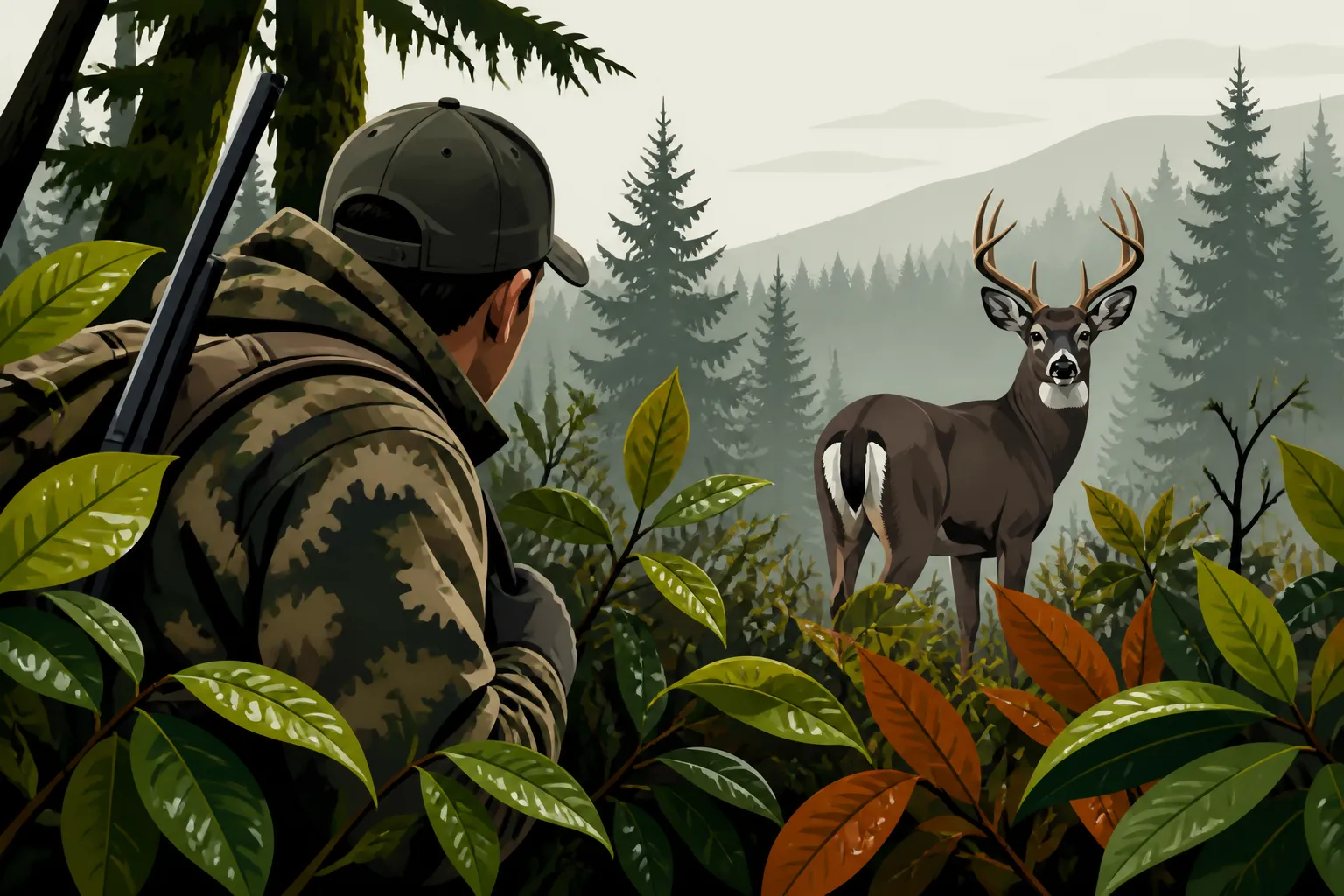
In the close confines of wet brush, you're looking for pieces of a deer, not a whole animal. Train your eyes to pick up horizontal lines (a deer's back), the vertical lines of legs, or the subtle curve of an antler against the vertical trunks and brush. Focus on patches of color that seem out of place—a warm brown or grey amongst the green, or a patch of white on the throat or rump. Often, you'll see a flick of an ear, a slight shift in weight, or the glint of an eye before you ever recognize the full form of a deer. Use your binoculars to methodically dissect every suspicious patch of cover.
While rain muffles sound, it doesn't eliminate it. Listen for subtle sounds: the almost imperceptible thump-thump of hooves on soft ground, the soft snort of a deer blowing, or the rustle of an animal getting up from its bed. In a downpour, even the sound of a deer chewing can sometimes carry through the damp air. If you're hunting during the rut, listen for the soft grunts or the distinctive sounds of bucks sparring. Your ears are almost as important as your eyes in this environment, so periodically stop and just listen, letting your eyes continue to scan.
Executing a Stalk in the Rain
Once you've spotted a blacktail, the real chess match begins. Your goal is to get into a shooting position without being detected. First, assess the wind. This is paramount. Always try to keep the wind in your favor, blowing from the deer towards you. If the wind is wrong, you might have to make a wide loop or abandon the stalk altogether. Next, identify your path, planning each step. Look for natural lanes in the brush, depressions, or larger trees that can break up your silhouette.
Move painfully slowly, even slower than your still-hunting pace. Take one step, then pause for several seconds, or even a full minute, to observe the deer's reaction. If it looks up or seems agitated, freeze completely until it settles down. Use any available cover—a downed log, a thick fir sapling, a dense cluster of salal—to screen your approach. In the rain, the deer might be slightly less prone to spooking from subtle sounds, but any sudden movement or strong scent will still give you away. The dense cover means shot opportunities will be fleeting and close-range, so be ready to shoot as soon as a clear lane opens up. This is where solid archery practice for wet coastal conditions pays off, or knowing your rifle setup for Washington elk and deer inside typical timber ranges.
Adapting Your Strategy to Different Habitat Types
Western Washington isn't a monolithic forest; it's a diverse landscape of clearcuts, mature timber, and riparian zones. Each habitat presents unique challenges and opportunities for the still-hunter in wet conditions.
Hunting Clearcuts and Reprod in the Wet
Clearcuts, especially those that are a few years old and growing into dense "reprod" (reproduction timber), are blacktail magnets. They offer abundant browse and thick cover. Still-hunting these areas in the wet demands a different approach. Instead of trying to push through the densest reprod, focus on the edges where the new growth meets older timber, or along logging roads and skid trails that cut through the clearcut. Deer will often utilize these travel corridors, especially during a rain, as they offer slightly easier movement.
When the rain is falling, deer in clearcuts might feel more secure browsing out in the open, as their keen senses are slightly dulled. Move slowly along the perimeter, stopping often to glass into the clearcut, picking apart the brush for any sign of deer. Focus on the low spots, draws, and shaded areas where deer might bed down to escape the weather. Sometimes, just walking parallel to a clearcut, fifty yards in the mature timber, can give you a better vantage point without spooking deer out of the thicker stuff. For a deeper dive, check out Reading Clearcuts and Reprod for Blacktail Bucks and even Reading a Three-Year-Old Clearcut for Bucks. Understanding Where Blacktails Bed in Reprod is key to success in these areas.
Still-Hunting Old Growth and Mature Timber
While blacktails thrive in disturbed areas, they also utilize old growth and mature timber, especially for bedding and travel between feeding areas. Still-hunting here in the wet means navigating a quieter, often darker, environment. The forest floor tends to be less cluttered with crunchy leaves, but mossy logs and slippery roots become more prevalent. The canopy of large trees offers more shelter from heavy rain, and deer will often gravitate towards these areas to escape the downpour.
Focus your efforts on natural benches, saddles between ridges, and the fringes of thick timber patches. Deer will often follow subtle game trails through the big timber, especially those leading to or from water sources. Pay attention to changes in elevation, as deer will often bed on small rises or knolls that offer a slight advantage for spotting approaching predators. The "stop and go" method is paramount here, as the longer sightlines mean a deer might spot you from further away if you're not meticulous. Look for patches of light filtering through the canopy, as these can highlight a deer or an area where browse is growing.
Creek Bottoms and River Drainages
Riparian zones—creek bottoms, river drainages, and marshy areas—are often overlooked but can be incredibly productive for still-hunting blacktails in wet conditions. These areas typically have a unique microclimate, often warmer and wetter, with a different mix of vegetation that can provide excellent forage and cover. Deer frequently use these drainages as travel corridors, moving between bedding and feeding areas, often protected by the dense growth along the banks.
Approach these areas slowly and cautiously. The sound of running water in a creek can both mask your approach and make it harder to hear deer. Focus on the benches above the water, the thick tangles of alder and willow, and any small openings where deer might be feeding. In very wet conditions, deer might seek higher, drier ground on the slopes immediately adjacent to these drainages. Be aware of your scent, as thermals can be tricky in these bottom areas, often swirling and pulling your scent into unexpected directions. Knowing Blood Trailing in Salal and Devil's Club will be critical if you are successful near these thick areas.
Disclaimer
Hunting is an inherently dangerous activity. Always prioritize safety, understand and follow all Washington hunting regulations, and ensure you have proper training and equipment. The information provided in this guide is for educational purposes only and should not replace professional instruction or local regulations. Always be aware of your surroundings, know your target and what is beyond, and hunt ethically and responsibly.