Washington Archery Equipment Rules
It's incredibly frustrating to spend countless hours scouting, practicing, and preparing for an archery hunt in Washington, only to worry if your equipment actually meets the legal requirements. The rules can feel like a maze, full of specific measurements and nuanced interpretations that can change season to season. This guide is here to untangle those regulations, helping you confidently choose and prepare your archery gear so you can focus on the hunt itself, not on whether your broadhead is legal.
Understanding Washington's Fundamental Archery Regulations
Hunting with a bow and arrow in Washington is a deeply rewarding experience, but it comes with a strict set of rules designed to ensure fair chase and humane harvest. It's not enough to simply own a bow; your entire setup, from the string to the broadhead, must comply with the Washington Department of Fish and Wildlife (WDFW) regulations. Ignoring these rules, even accidentally, can lead to fines, loss of hunting privileges, and even confiscation of your equipment.
The Definition of Legal Archery Equipment
When the WDFW refers to legal archery equipment for big game, they're talking about very specific tools. This isn't the kind of general archery you might see at a backyard target range. For starters, you're looking at a bow (compound, recurve, or longbow) that delivers a certain amount of power, coupled with an arrow that meets minimum weight and length requirements, tipped with a very particular type of broadhead. We'll delve into the specifics of broadhead design and cutting diameter in a later section, but for now, understand that a field point or a small game head is never going to be legal for deer or elk.
The underlying principle here is penetration and ethical harvest. A hunting arrow needs to be capable of cleanly passing through the vitals of an animal like a deer or elk, creating a lethal wound channel that leads to a quick recovery. This is why there are minimum draw weights and arrow weights. It’s about ensuring the projectile carries enough kinetic energy to do its job. Anything less risks wounding an animal without recovering it, which is the last thing any ethical hunter wants.
General Prohibitions to Be Aware Of
Washington has a few absolute "no-go" items when it comes to archery hunting. First and foremost, you cannot use any bow or arrow that is propelled by any other means than string tension directly from the archer. This means no pneumatic or hydraulic bows, no devices that store energy by means other than the flex of the bow limbs and string. While these might seem like obvious exclusions, it’s worth noting explicitly. Similarly, you cannot use any electronic devices attached to the bow or arrow that aid in target acquisition, except for lighted nocks. This means no laser sights that project a dot onto the animal, no rangefinding binoculars attached to the bow, and certainly no thermal or night vision scopes on your bow.
Another common misunderstanding revolves around poison or explosives. It should go without saying, but no arrow can be tipped with any substance that is toxic or explosive. This is a basic safety and ethical rule across all hunting, not just archery. Finally, any arrow that is not tipped with a legal broadhead designed for big game, as we'll discuss, is also prohibited. Your practice arrows with blunt tips or small game heads are fine for target practice, but they have no place in the field during big game season. Understanding these fundamental prohibitions upfront saves a lot of heartache and potential legal trouble.
Deep Dive into Bow Specifications and Accessories
Your bow is the heart of your archery setup, and Washington's regulations ensure that it's up to the task of ethical big game hunting. These rules are in place to make sure that the equipment has enough power to achieve a humane harvest, while also maintaining the spirit of archery hunting.
Draw Weight Requirements and Considerations
For any bow (compound, recurve, or longbow) used for big game in Washington, there's a minimum draw weight requirement. Specifically, it must be capable of casting a legal hunting arrow 125 yards. While the WDFW doesn't typically list a specific poundage number in the regulations, this "125-yard rule" is the guiding principle. For most archers, this translates to a minimum of about 40 pounds of draw weight for compounds, and often a bit more for recurves or longbows to achieve that distance with a hunting arrow. It’s not just about reaching the target, but about maintaining enough kinetic energy at various ranges.
Think about it from a practical standpoint: if your bow can only lob an arrow 50 yards, it's not going to have the necessary penetration for an ethical shot on an elk or even a large deer. This rule pushes hunters to use equipment that is truly designed for hunting, rather than just recreational shooting. When you're selecting a new bow, or even re-evaluating your current setup, it’s worth checking your bow's capabilities. A good pro shop can help you confirm that your bow meets this standard, especially with your chosen arrow and broadhead combination. Remember, just because you can draw a heavy bow doesn't mean you should if you can't do it smoothly and accurately, especially if you plan on pursuing animals like the Roosevelt Elk of Western Washington.
Legal Release Aids and Peep Sights
Good news for modern archers: mechanical release aids are perfectly legal for archery hunting in Washington. Whether you prefer a wrist-strap release, a thumb button, or a hinge release, you're good to go. These aids help achieve a more consistent and precise release, which translates to better accuracy in the field. Similarly, peep sights, which are small apertures threaded into your bowstring to aid in aiming by creating an additional alignment point with your sight pins, are also legal. These are standard equipment for many compound bow hunters and are fully permissible.
The key here is that these devices aid in accuracy but do not project light or use electronics to locate the target. They are mechanical or passive visual aids. As long as they don't fall into the category of "electronic devices attached to the bow or arrow that aid in target acquisition" (aside from lighted nocks), you're usually on solid ground. So, feel free to use your favorite release and a well-tuned peep to boost your confidence in hitting your mark when that buck or bull steps out. Consistent practice with your chosen release and peep sight is crucial for success, whether you're targeting Columbian Blacktail Deer in Western Washington or Rocky Mountain Elk East of the Washington Cascades.
The Scoop on Illuminated Nocks and Sights
This is one area where technology is allowed to a limited degree. Lighted nocks, which illuminate after the shot to help you track your arrow's flight and locate it after it hits the ground or the animal, are explicitly legal in Washington. These are a fantastic tool, especially when hunting in low light conditions or thick cover, as they can significantly improve your chances of finding your arrow and beginning a blood trail. They don't aid in the actual aiming process before the shot, but rather assist in post-shot recovery.
When it comes to sights, traditional pin sights are the norm, and they can be fiber optic for brightness in low light. However, the rule gets a bit tighter when we talk about projecting light onto the target. Any sight that actively projects a beam, dot, or image onto the animal itself is generally illegal. This means no laser sights. However, sights that have internal illumination for the pins themselves, allowing you to see your aiming point in dim conditions, are usually fine. The distinction is subtle but important: the illumination must be within the sight, helping you see your pins, not projecting outwards onto the animal. Always double-check the latest WDFW regulations if you're considering a sight with advanced features, as interpretations can sometimes shift. For more advanced planning and understanding these rules, tools like those offered by GoHunt can be invaluable in keeping up with the latest information.
Navigating Broadhead and Arrow Rules for Big Game
The arrow and broadhead are your primary tools for humane harvest. Washington has very specific rules about what you can launch at a big game animal, focusing on maximizing lethal penetration and creating a sufficient wound channel. These aren't suggestions; they are hard and fast requirements.
Minimum Broadhead Cutting Diameter
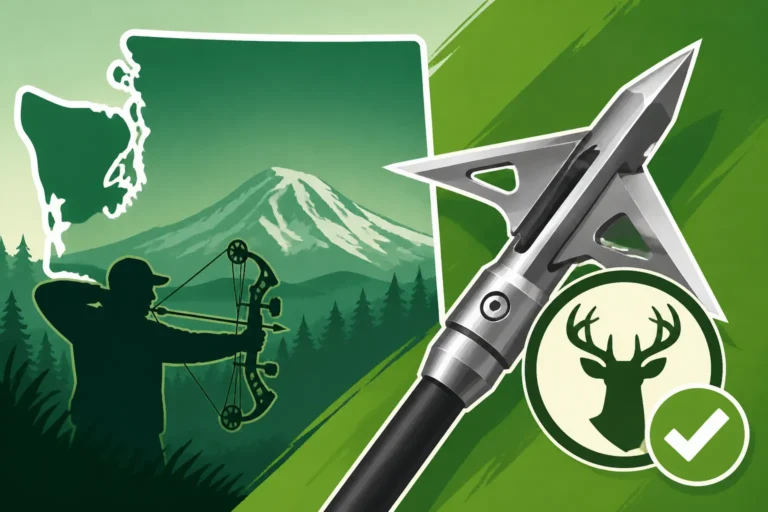
This is a critical rule that many new archers sometimes overlook. For big game in Washington, your broadhead must have at least a 7/8 inch minimum cutting diameter. This measurement refers to the width of the cutting edge. This rule applies whether you're using a fixed blade or a mechanical broadhead. The purpose of this minimum is to ensure that the broadhead creates a large enough wound channel to cause significant blood loss and a quick, ethical death. A small broadhead might penetrate deeply, but if it doesn't sever enough vital tissue, the animal could suffer unnecessarily and be difficult to recover.
To visualize this, imagine taking a caliper and measuring the widest point of your broadhead's cutting surface. It needs to be at least 0.875 inches. If you're using a mechanical broadhead, this measurement is taken when the blades are fully deployed. It's vital to check the manufacturer's specifications on your broadheads and, if possible, even measure them yourself. Don't assume all "hunting broadheads" meet this rule. Some older designs or specialized heads might not. Choosing broadheads that explicitly state they meet Washington's requirements is always a good idea. This rule is discussed in more detail in Washington's Seven-Eighths Inch Broadhead Rule.
Fixed Blade Versus Mechanical Broadheads
Washington permits both fixed-blade and mechanical (expandable) broadheads, provided they meet the minimum cutting diameter and other general rules. This gives archers a good range of options to suit their preferences and equipment.
Fixed-Blade Broadheads: These heads have blades that are rigidly attached to the ferrule and do not move. They are known for their strength, reliability, and consistent flight, especially in windy conditions. Many traditional archers and those who prioritize maximum penetration often favor fixed blades. They are generally simpler in design, less prone to mechanical failure, and can be easier to sharpen. When choosing a fixed blade, ensure those 7/8 inch blades are actually cutting blades, not just barbs or blunt edges. Some hunters prefer fixed blades for the added assurance of no moving parts, especially when pursuing tougher animals like elk.
Mechanical Broadheads: Also known as expandable broadheads, these heads feature blades that are retracted during flight and deploy upon impact with the target. Their main advantage is often better flight characteristics, mimicking field points more closely, which can simplify tuning. When deployed, many mechanicals offer a significantly larger cutting diameter than fixed blades, theoretically creating a larger wound. However, they introduce moving parts and the potential for blades not deploying fully or breaking upon impact with bone. For Are Mechanical Broadheads Legal in Washington?, yes, they generally are, but you must ensure they deploy to the minimum 7/8 inch cutting diameter upon impact. When selecting mechanicals, always test them to ensure consistent deployment and choose reputable brands known for their reliability.
Arrow and Bolt Weight Minimums
Just like broadhead size, arrow and crossbow bolt weight is also regulated to ensure sufficient kinetic energy and penetration. Washington requires that arrows and bolts for big game must weigh a minimum of 350 grains. This measurement includes the shaft, fletchings, nock, and broadhead. Again, this rule is about energy. A very light arrow might fly fast, but it will shed energy quickly and may not penetrate adequately on a large animal, especially if it hits bone.
A typical hunting arrow for a compound bow often falls between 400 and 550 grains, depending on the archer's setup and preference. For recurves and longbows, arrows can sometimes be heavier to compensate for lower arrow speeds. You'll need to know the total weight of your hunting arrows, which you can usually find by weighing a fully assembled arrow on a grain scale. Most archery shops can help you do this. This rule ensures that hunters aren't using ultra-light target arrows for big game, which simply lack the punch needed for an ethical kill. The 350-grain rule applies equally to crossbow bolts. If you are preparing for a hunt, ensure you meet Arrow Weight Minimum for Washington Big Game and Washington Bolt Weight Minimum for Crossbows. This information is crucial for hunters who want to be sure their equipment is compliant and effective.
Washington's Specific Crossbow Regulations
Crossbows are a unique category within archery equipment, offering a distinct set of advantages and requiring their own specific set of rules. While some states have very open crossbow seasons, Washington State maintains more restrictive regulations, often tying their use to specific conditions or permits.
When is a Crossbow Legal for Big Game?
This is perhaps the most important distinction for crossbow hunters in Washington: you cannot simply use a crossbow during any general archery season. Crossbows are not legal for general archery seasons for deer or elk unless the hunter possesses a specific disabled hunter permit or a special "Master Hunter" permit that allows it. This means for most hunters, you cannot buy an archery tag and then decide to use a crossbow. You must either qualify as a disabled hunter and obtain the appropriate endorsement on your license, or be an approved participant in the state's Master Hunter program with a crossbow authorization. Washington Crossbow Rules for Big Game outlines these limitations very clearly.
For the general hunter, if you want to use a crossbow, you must typically hunt during a modern firearm season, provided the unit and season allow it, and you possess a modern firearm tag. Essentially, if you're not a disabled hunter or Master Hunter, your crossbow is treated like a firearm for legal hunting purposes, not an archery device in the traditional archery seasons. This can be a source of confusion for hunters coming from states with more liberal crossbow rules, so it’s absolutely critical to understand this distinction before heading afield.
Crossbow Draw Weight and Safety Features
Just like traditional bows, crossbows have minimum performance requirements. Washington regulations stipulate a minimum draw weight of 125 pounds for crossbows used on big game. This ensures the crossbow has enough power to launch a legal bolt with sufficient force for an ethical harvest. Many modern crossbows easily exceed this minimum, but it's important to verify your crossbow's specifications. If your crossbow has an adjustable draw weight, make sure it's set to at least 125 pounds for big game hunting. This minimum draw weight is a key part of Washington Crossbow Draw Weight Minimum guidelines.
Beyond draw weight, crossbows must also incorporate a mechanical safety device. This is a crucial safety feature that prevents accidental discharge. All commercially produced crossbows typically come with an integrated safety, but it's vital to ensure it's functioning correctly before you hunt. It’s also good practice to never rely solely on a mechanical safety; always handle your crossbow with the same care and attention as you would a loaded firearm. Furthermore, the bolt must be retained on the string by a mechanism that prevents it from falling off, even when pointed downwards. This ensures reliable and consistent loading and shooting.
Legal Bolts and Broadheads for Crossbows
The rules for bolts (crossbow arrows) and broadheads used with crossbows largely mirror those for traditional bows, with a few nuances. As discussed, crossbow bolts must meet the same 350-grain minimum total weight, including the broadhead. This is outlined in The 350-Grain Rule for Arrows and Bolts. This ensures that the projectile carries enough momentum for deep penetration on big game animals.
For broadheads, the same 7/8 inch minimum cutting diameter applies. Whether you use fixed-blade or mechanical broadheads on your crossbow, they must expand or be designed to achieve that minimum width upon impact. All broadheads must also be sharp and free of any toxic or explosive substances. Given the higher speeds that many crossbows generate, some hunters choose fixed-blade broadheads for their increased durability and reliability, while others prefer the larger cutting diameters offered by mechanicals. Regardless of your choice, ensure it's legal and that you've practiced extensively with it to understand its flight characteristics and deployment reliability.
| Equipment Type | Minimum Requirement (Washington Big Game) | Notes |
|---|---|---|
| Traditional Bow | Cast arrow 125 yards | Typically means 40 lbs+ draw weight for compounds, more for recurves/longbows. |
| Crossbow | 125 lbs draw weight | Requires disabled or Master Hunter permit for general archery seasons; otherwise, legal only during modern firearm seasons. |
| Arrow/Bolt Weight | 350 grains (total weight) | Includes shaft, fletchings, nock, and broadhead. |
| Broadhead | 7/8 inch minimum cutting diameter | Applies to both fixed and mechanical (when deployed). Must be sharp. |
| Release Aids | Legal | Mechanical release aids are permitted. |
| Peep Sights | Legal | Permitted to aid in aiming. |
| Illuminated Nocks | Legal | Permitted to aid in arrow recovery after the shot. |
| Laser Sights | Illegal | Any device that projects light onto the target is prohibited. Sights with internal illumination for pins are generally okay. |
| Poison/Explosives | Illegal | Broadheads or arrows tipped with toxic or explosive substances are strictly prohibited. |
Ethical Considerations and Best Practices Beyond the Rules
Meeting the minimum legal requirements is just the starting point for responsible archery hunting. To truly be an ethical and effective hunter, you need to go beyond the letter of the law and embrace best practices that ensure a clean kill and respect for the animal. This often comes down to intimate knowledge of your gear and your own capabilities.
Practicing with Your Legal Setup
Just because your bow and broadheads are legal doesn't mean you're ready to hunt. Consistent and dedicated practice with your actual hunting setup is paramount. This means shooting your bow with the broadheads you intend to use, not just field points. Broadheads, especially fixed blades, can fly differently than field points, and you need to ensure your bow is tuned to shoot them accurately at all reasonable hunting distances. This often requires careful bow tuning, adjusting sights, and sometimes even fletching adjustments.
You should practice from various positions – standing, kneeling, sitting, and even mimicking shots you might take from a tree stand or ground blind. Practice in different weather conditions, too. If you plan on Archery Elk Hunting in Washington's September Season, you might encounter rain, so practicing Archery Practice for Wet Coastal Conditions is vital. Understanding how your arrow behaves in wind or through light brush can be the difference between a clean miss and a wounded animal. The goal is to build muscle memory and confidence, so that when the moment of truth arrives, your shot execution is flawless, even under pressure. This commitment to practice is what elevates a hunter beyond just being legal, to being truly ethical.
Knowing Your Equipment's Limitations
Every piece of equipment has its limits, and so do you as an archer. It's crucial to understand the effective range of your bow and broadhead combination, and more importantly, your personal effective range. For some, this might be 30 yards, for others 60 yards, but it is rarely the maximum distance your bow can physically shoot an arrow. Your effective range is the distance at which you can consistently place an arrow into a six-inch circle (representing an animal's vital zone) 100% of the time, from a hunting position, under pressure.
Don't let the adrenaline of the moment push you beyond that range. Taking a shot that is too far or too difficult, even with legal equipment, is an unethical act. For example, Shot Placement on a Quartering Elk is precise, and if you can't guarantee that placement at a given distance, you need to pass on the shot. Similarly, understanding how your Bow Choice for Wet Coastal Hunting performs in damp conditions, or the limitations of your Mechanical Versus Fixed Broadheads in Washington when encountering bone, will inform your shot selection. Tools like those from GoHunt can help you research different gear options and understand what might best suit the challenging conditions you find in Washington. Always err on the side of caution. A passed shot is never a failed hunt; it's a responsible decision that ensures the well-being of the game and the integrity of the hunting experience.
Disclaimer
This article is for general informational purposes only and does not constitute professional advice. Laws, prices and regulations vary by location and change over time. Consult a qualified professional for guidance on your specific situation.