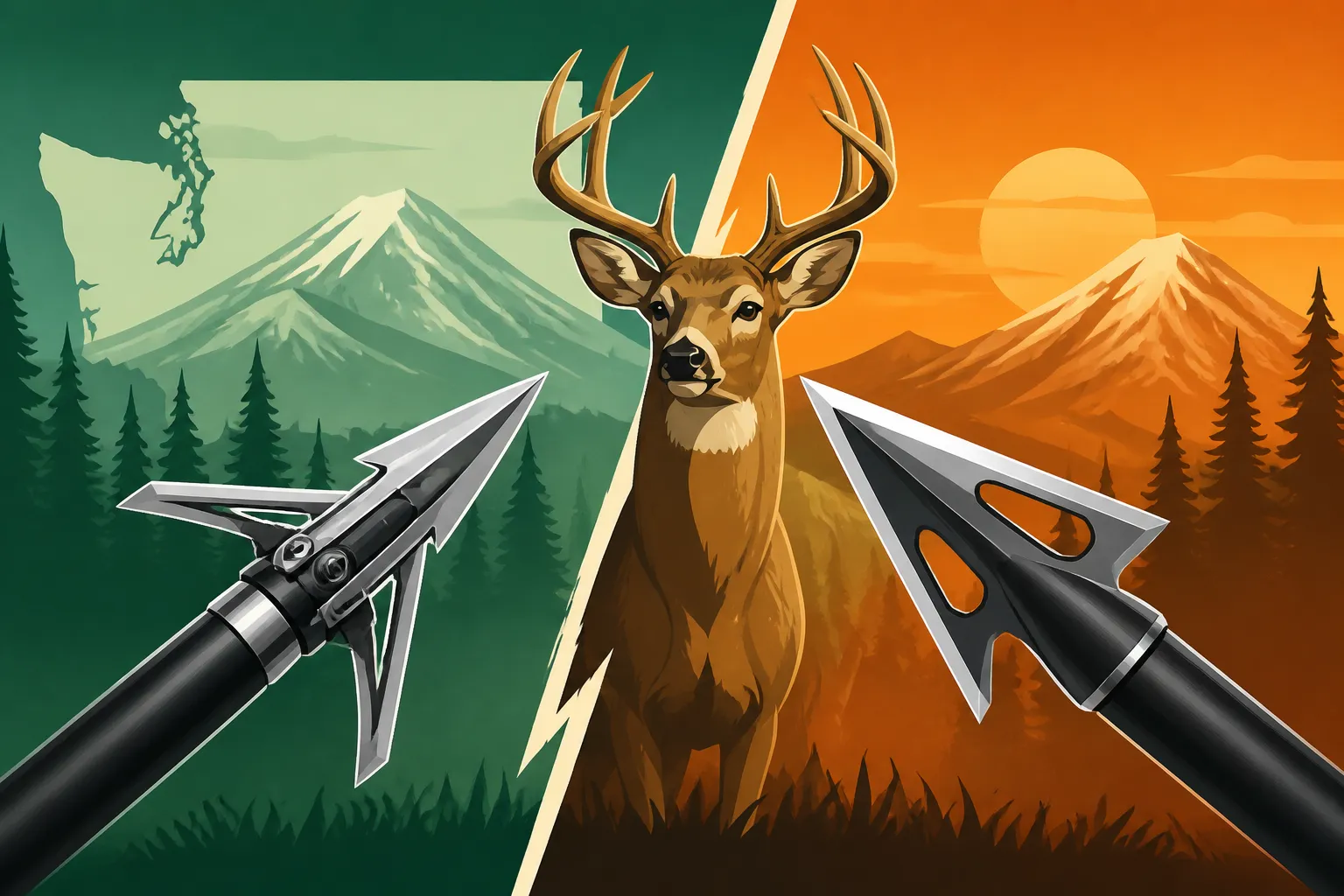
Mechanical Versus Fixed Broadheads in Washington
There's a constant debate among Washington bowhunters, a question that probably causes more head-scratching than anything else once you've picked out your bow: "Which broadhead should I shoot?" It's not just a matter of personal preference; it’s a critical decision that impacts your accuracy, the animal’s welfare, and your overall success in the field, especially with Washington's diverse terrain and species. This guide is here to untangle the complexities of fixed-blade versus mechanical broadheads, helping you understand the regulations, performance characteristics, and real-world implications so you can make an informed choice for your next hunt.
Understanding Broadhead Types: Fixed Blade Versus Mechanical
When you walk into an archery shop or browse online for broadheads, you’ll quickly notice there are two main categories staring back at you. Each type has its devoted followers and its fair share of detractors. Understanding the fundamental design and purpose of each is the first step in deciding what’s right for your Washington hunting adventures.
Fixed Blade Broadheads: The Traditional Choice
Fixed blade broadheads are the original workhorses of archery hunting. Their design is straightforward: multiple blades, typically two, three, or four, are permanently affixed to the ferrule, forming a single, solid unit. There are no moving parts. This simplicity is often cited as their greatest strength. They are inherently strong and reliable because there's nothing to deploy or fail upon impact. When you shoot a fixed blade, it's going to hit the target looking exactly as it did on your arrow rest.
Historically, fixed blades have been the standard for good reason. They're built tough. Imagine sending an arrow through the thick hide and bone of a Washington Roosevelt elk in a dense cedar swamp; a well-designed fixed blade is less likely to break or deflect. They excel at deep penetration, often creating a consistent wound channel as long as the blades are sharp and the shot is well-placed. However, that robust design can come with a trade-off: aerodynamics. The blades create drag, which can affect arrow flight, especially at higher speeds or longer distances. This means more time spent tuning your bow and practicing to ensure your broadheads hit the same spot as your field points.
Mechanical Broadheads: The Expanding Edge
Mechanical broadheads, sometimes called expandable broadheads, represent a more modern approach to hunting arrowheads. Their defining characteristic is that their blades are retracted or folded against the ferrule during flight, only to deploy and expand upon impact with the target. This design aims to achieve two primary benefits. First, with the blades tucked away, the broadhead presents a smaller profile in flight, which significantly improves aerodynamic efficiency. This often translates to field-point accuracy, meaning your mechanical broadheads should theoretically fly very similarly to your practice points, reducing the need for extensive broadhead tuning.
The second major benefit is the creation of a much larger wound channel upon deployment. Where a fixed blade might cut a consistent 1-inch diameter hole, a mechanical broadhead could open up to 2 inches or more, creating a larger entry and exit wound, theoretically increasing blood loss and leading to quicker, more humane kills. However, mechanical broadheads introduce complexity. They have moving parts, and with moving parts comes the potential for mechanical failure. Blades might not deploy fully, or they might deploy prematurely. Their ability to penetrate can also be a concern, especially on tougher hides, bone, or at lower bow kinetic energies, as the act of deployment requires energy that might otherwise contribute to penetration.
The Legal Landscape in Washington State
Before you even start thinking about the perfect flight or wound channel, you absolutely have to know what's legal in Washington State. Hunting regulations are there for a reason, and not knowing them isn't an excuse. The Washington Department of Fish and Wildlife (WDFW) has specific rules governing broadheads and arrow setups, and understanding these nuances is critical for staying within the law and ensuring a successful, legal hunt. It’s one of those things you want to square away long before opening day.
Washington's Specific Broadhead Regulations
Washington State's regulations on broadheads are quite clear, though sometimes a little bit open to interpretation if you're not paying close attention. The WDFW states that broadheads used for big game animals must have at least two sharp cutting edges, and the minimum cutting width must be seven-eighths of an inch. This rule applies equally to both fixed blade and mechanical broadheads. The "sharp cutting edge" part is pretty self-explanatory – dull blades are not only illegal but deeply unethical.
The "minimum cutting width" is where some confusion can arise, especially with mechanicals. For fixed blades, it's simple: measure the width of the blades from tip to tip or edge to edge. If it's 7/8 inch or more, you're good. For mechanical broadheads, the WDFW rule effectively means that the broadhead must be at least 7/8 of an inch in its closed, in-flight position. This is crucial because it prevents hunters from using mechanicals that are essentially field points in flight and only open up to a legal width. Most mechanical broadheads on the market are designed with this in mind, but it's your responsibility to check. Don't assume. Measure it yourself or consult the manufacturer's specs carefully to ensure compliance before you head out, especially if you're buying a new model you haven't used before.
Interpreting the "Seven-Eighths Inch" Rule
Let's dive a little deeper into that seven-eighths inch rule because it’s a point of contention and confusion for many new and even experienced bowhunters. When the WDFW specifies "minimum cutting width," it's referring to the diameter of the hole the broadhead would cut if the blades were fully closed, or in the case of a fixed blade, its inherent cutting width. For a fixed blade, it's pretty straightforward: if your broadhead has a two-inch cutting diameter, it easily meets the 7/8 inch minimum. No problem there.
With mechanical broadheads, this means that even when the blades are folded back, the actual body of the broadhead, or the portion that would make initial contact, must be at least 7/8 of an inch wide. This is why you won't see mechanicals that are super thin in flight, like a field point, and then expand to a massive cutting diameter. The intent is to ensure that even if a mechanical broadhead fails to deploy, it still creates a substantial wound channel, improving the chances of a clean kill and ethical hunting. Always double-check this specification on the packaging or manufacturer's website for any mechanical broadhead you consider. It's an easy thing to overlook, but a costly mistake if you're found in violation in the field.
The 350-Grain Rule for Arrows and Bolts
Beyond the broadhead itself, Washington also has regulations concerning the overall weight of your arrow or bolt. For big game animals, your arrow or bolt must weigh a minimum of 350 grains. This rule is in place to ensure that your projectile carries enough kinetic energy to achieve sufficient penetration for a humane kill. A lightweight arrow, while potentially faster, might not deliver the necessary force, especially on larger, tougher animals like elk or bear.
This 350-grain minimum includes everything: the shaft, the fletching, the insert, and yes, the broadhead itself. So, while a lighter broadhead might seem appealing for speed, you need to make sure your total arrow weight still meets that 350-grain threshold. Many archers achieve this by using heavier arrows, heavier inserts, or a combination. When you're building or selecting your arrows, make sure to weigh a fully fletched arrow with your chosen broadhead installed. A simple digital grain scale is an essential tool for any serious bowhunter. It's another layer of regulation designed to promote ethical hunting and ensure that the equipment used is capable of performing its intended task effectively. For more details on arrow and bolt requirements, check out Washington Archery Equipment Rules and Washington Bolt Weight Minimum for Crossbows.
Performance in the Field: Pros and Cons
Choosing a broadhead isn't just about legality; it's about what performs best when it truly matters – in the field. Washington presents a huge variety of hunting scenarios, from tight timber to wide-open sagebrush, and understanding how fixed and mechanical broadheads react in these environments can make or break your hunt. Both types have distinct advantages and disadvantages that can become very apparent when you’re facing a shot opportunity on a wary animal.
Accuracy and Flight Characteristics
This is often the primary reason hunters lean one way or the other. Mechanical broadheads are generally heralded for their superior accuracy and field-point-like flight. Because their blades are tucked away during flight, they create less drag and are less susceptible to wind drift or planning. This means that an arrow tipped with a mechanical broadhead will often fly almost identically to an arrow tipped with a field point of the same weight. This can be a huge confidence booster, especially when practicing for longer shots or in variable wind conditions. For hunters who struggle with getting fixed blades to group with their field points, mechanicals can be a game-changer, allowing them to focus more on shot execution and less on broadhead tuning.
Fixed blade broadheads, on the other hand, are often more finicky to tune. The exposed blades catch air, which can cause the arrow to steer or "plane" off-target, especially if your bow isn't perfectly tuned or if your form isn't consistent. Achieving consistent groups with fixed blades often requires meticulous bow tuning – adjusting arrow rest position, cam timing, and fletching angle. However, once a fixed blade broadhead is properly tuned, it can be incredibly accurate. The key difference is the effort required to get there. For some, the peace of mind of a simple, rugged design outweighs the tuning hassle, especially for shorter-range timber hunting typical of the Westside. Archery Practice for Wet Coastal Conditions highlights how critical tuning and practice are.
Penetration and Wound Channels
When it comes to putting an animal down quickly and humanely, penetration and the size of the wound channel are paramount. Here, the broadhead types diverge significantly in their approach. Fixed blade broadheads are generally superior in terms of penetration. With no moving parts, all of the arrow's kinetic energy is focused on driving the blades forward through tissue and bone. Their sturdy construction means they are less likely to deflect or break upon impact with heavy bone, such as a shoulder blade or rib. This deep, consistent penetration is especially critical for tough animals like a Washington bull elk, where every inch of penetration counts towards reaching vital organs. The wound channel is typically narrower but often deeper and more consistent, creating a clean cutting path through the animal.
Mechanical broadheads aim to create a wider wound channel by deploying their blades on impact. When they work as designed, they can create devastatingly large entry and exit holes, which theoretically leads to more rapid blood loss and a quicker kill. This wider cut can also be beneficial for blood trailing, leaving a more substantial blood trail. However, the act of deploying the blades consumes kinetic energy. If your bow setup is on the lighter side (lower draw weight, shorter draw length, lighter arrow), or if the broadhead hits heavy bone or tough hide (like the gristle plate on a bear), the deployment might be compromised, or the penetration might be significantly reduced. A partial deployment or insufficient penetration can lead to a wounded animal and a difficult, if not impossible, recovery. This is a primary concern for hunters pursuing large game.
Durability and Reliability in Tough Situations
Hunting in Washington often means dealing with rugged terrain and challenging conditions. Whether you're navigating the thick brush of the Olympic Peninsula or the rocky slopes of the Blue Mountains, your gear needs to be tough. Durability and reliability are key factors in broadhead selection.
Fixed blade broadheads generally shine in this department. Their solid, unmoving construction means there are fewer points of failure. The blades are typically thicker and less prone to bending or breaking than the thinner, hinged blades of some mechanical designs. This inherent toughness makes them a favorite for hunters who prioritize bomb-proof reliability, especially when there's a chance of hitting bone or encountering obstacles like small twigs or brush before the target. You can usually inspect a fixed blade, sharpen it, and trust it to perform the same way every time.
Mechanical broadheads, by their very nature, are more complex and thus can be more susceptible to issues. Blades can sometimes be damaged in the quiver, or the deployment mechanism can be fouled by dirt, moisture, or even premature deployment if bumped. While many modern mechanical designs are incredibly robust, the risk of a blade not deploying fully, or deploying prematurely in flight (though rare with quality broadheads), is always present. This concern often leads hunters to question their reliability when the stakes are highest. For those using resources like GoHunt to research gear for specific GMUs in Washington, balancing the flight advantage of mechanicals against the raw durability of fixed blades is a common contemplation.
Matching Broadheads to Game and Conditions
Washington State offers an incredible diversity of big game animals and hunting environments. What works perfectly for a blacktail deer in a clearcut might not be the ideal choice for a Rocky Mountain elk in the high country. Your broadhead selection should always be a thoughtful process, tailored to the specific game you're pursuing and the conditions you expect to encounter.
Elk, Deer, and Bear: Different Needs
Each species you pursue in Washington presents unique challenges, and your broadhead choice should reflect that.
- Elk: These are robust animals with thick hides, heavy bone structures, and dense muscle. When hunting Roosevelt Elk of Western Washington or Rocky Mountain elk, maximum penetration is absolutely critical. Many experienced elk hunters lean towards durable, fixed blade broadheads, often with a two-blade design, to ensure deep penetration even on marginal hits or when encountering bone. The larger cutting diameter of mechanicals is appealing, but the potential for reduced penetration due to deployment energy is a serious consideration. You want a broadhead that can punch through and create an exit wound for a good blood trail.
- Deer: Washington offers both Columbian Blacktail Deer in Western Washington and Mule Deer of Eastern Washington, as well as some whitetails. Deer are generally less physically tough than elk, with thinner hides and less bone mass. For deer, both fixed blade and mechanical broadheads can be highly effective. The field-point accuracy of mechanicals is a major advantage for hunters taking longer shots on mule deer in open sagebrush country. For blacktails in dense timber, a durable fixed blade is still an excellent choice, as shots are typically shorter and often involve navigating through brush.
- Bear: Washington Black Bears Coast to Cascades can vary significantly in size and fat content. Their thick, often greasy hide and dense fat layers can make penetration challenging. Like elk, deep penetration is key. While some mechanicals are designed for bear hunting, many prefer stout fixed blades to ensure consistent penetration through that tough hide and fat to reach the vitals. Shot placement on bears is also critical, as their vitals can be tucked in a bit differently than deer or elk. Spot-and-Stalk Bear Hunting in Washington Without Bait often means close quarters and tricky shot angles, where reliability is paramount.
Western Washington's Wet, Brushy Terrain
Hunting on the west side of the Cascades means contending with dense forests, thick underbrush, and persistent rain. Think salal, devil's club, and downed timber, often found in blacktail and Roosevelt elk country. In these environments, shots are typically close-range, often under 40 yards, and frequently involve navigating brush.
Fixed blade broadheads tend to be favored here. Their robust design makes them less susceptible to deflection if they clip a small branch or twig on the way to the target. A mechanical broadhead, especially one with a wider open diameter, could potentially deploy prematurely if it snags on heavy brush, leading to a missed shot or a poorly placed one. Furthermore, the limited visibility and shorter shot distances mean that the aerodynamic advantages of mechanicals are less pronounced. Durability, penetration through dense hide and bone, and resistance to environmental factors like moisture (which could potentially affect mechanical mechanisms, though this is rare with modern designs) are highly valued. Still-Hunting Blacktails in Wet Washington Brush or Setting Up on a Herd Bull in Dark Timber are classic examples where reliability over distance is key.
Eastern Washington's Open Country and Longer Shots
Contrast the Westside with Eastern Washington's vast, open landscapes – rolling hills, sagebrush flats, and expansive wheat fields. This is mule deer country and often home to Rocky Mountain elk herds. Here, shot distances can be significantly longer, sometimes stretching past 60 yards, and wind can be a constant factor.
In these conditions, the aerodynamic advantages of mechanical broadheads become much more appealing. Their field-point-like flight allows for greater accuracy at longer distances and reduces the impact of crosswinds. For hunters who practice extensively at these ranges and are confident in their bow's kinetic energy, mechanicals can offer an edge in hitting a precise spot on an animal that might be further away. However, the caveat about penetration remains; for elk in Eastern Washington, especially those big Rocky Mountain bulls, a highly durable, well-designed mechanical or a deeply penetrating fixed blade is still essential. It's a balance between accuracy at range and terminal performance. If you're Glassing Eastern Washington Breaks for Mule Deer, you might be taking a longer shot, making precise flight a higher priority. Many hunters use tools like GoHunt's mapping and unit analysis to plan hunts in these specific terrains, often considering how their broadhead choice aligns with the likely shot distances and conditions of a particular GMU.
Maintenance, Practice, and Ethical Considerations
Regardless of which broadhead type you choose, your responsibility as an ethical hunter extends beyond just legality. Proper maintenance of your equipment and dedicated practice are paramount. A broadhead is only as effective as the hunter wielding it, and a well-placed, sharp broadhead is the cornerstone of a quick, humane kill. Neglecting these aspects can lead to tragic outcomes and reflect poorly on all hunters.
Sharpening and Inspection for Fixed Blades
Fixed blade broadheads, with their exposed cutting edges, demand regular attention. Firstly, they must be razor sharp. Many fixed blades come sharp out of the package, but they can dull quickly from handling, being in a quiver, or even just sitting for a while. You should always inspect and sharpen them before the season and re-sharpen them after any practice shots (if you're using dedicated practice broadheads or the actual hunting ones). There are various sharpening systems available, from traditional stones to specialized broadhead sharpeners, and finding one that works for you is important. Washington Broadhead Sharpness Requirements isn't just a rule; it's an ethical imperative.
Beyond sharpness, routinely inspect your fixed blades for any damage. Check for bent tips, dinged blades, or looseness where the blades attach to the ferrule. A damaged broadhead can lead to erratic flight, poor penetration, and potential failure on impact. If you use removable blade fixed broadheads, ensure all screws are tight and that the blades are properly seated. This vigilance ensures that when you draw back on an animal, your broadhead is in perfect working order, ready to perform its job flawlessly.
Testing and Confidence with Mechanicals
Mechanical broadheads, while often flying like field points, still require diligent testing and confidence building. The primary concern with mechanicals is their deployment and durability. Before hunting, you absolutely must shoot at least one of your actual hunting mechanical broadheads into a suitable broadhead target. This confirms that they fly true with your setup and that the blades deploy as intended. Many mechanicals come with a practice head that mirrors the flight characteristics without deploying, which is great for tuning, but a live test of a hunting head is irreplaceable.
Beyond initial testing, inspect your mechanical broadheads meticulously. Check for any bent blades, malfunctioning deployment mechanisms, or issues with the O-rings or retention bands that hold the blades in place. Any sign of damage or malfunction means that broadhead should not be used for hunting. Confidence in your equipment is crucial, and knowing that your mechanical broadhead will deploy perfectly every time is a big part of that. Many hunters using GoHunt for strategic hunt planning also factor in gear performance and reliability testing into their pre-season routine.
Ethical Shot Placement and Tracking
No matter if you choose a fixed blade or a mechanical, nothing – and I mean nothing – is more important than ethical shot placement. A perfectly performing broadhead on a poorly placed shot is still a poor outcome. Conversely, a good shot with either broadhead type vastly increases your chances of a quick, humane kill and a successful recovery.
Understanding animal anatomy, practicing diligently at various distances and angles, and knowing your personal limits are vital. Aim for the vital triangle (heart and lungs) on all big game. When that arrow flies, track its impact and the animal's reaction. If you suspect anything other than a clean pass-through, give the animal time before beginning your blood trail. Knowing Blood Trailing in Salal and Devil's Club or Blood Trailing in Thick Understory can be the difference between recovery and a lost animal. Ethical hunting means doing everything in your power to make a clean kill and recover your animal, and that starts long before you step into the woods.
Making Your Choice: A Washington Hunter's Perspective
Ultimately, the choice between mechanical and fixed broadheads comes down to a blend of personal preference, hunting style, and the specific conditions you'll face in Washington. There's no single "best" broadhead for everyone, and what works for your hunting buddy might not be the right fit for you. It’s about evaluating all the factors we’ve discussed and finding the combination that gives you the most confidence and results in the most ethical outcomes.
Evaluating Your Hunting Style and Preferences
Consider how you hunt in Washington. Are you primarily still-hunting through dense Westside timber, where shots are typically close and fast, and reliability through brush is a concern? Or are you spot-and-stalk hunting in Eastern Washington's open country, where longer shots across windy fields are more common? Your hunting methodology plays a huge role.
- For the "set it and forget it" hunter: If you prefer simple, robust gear and don't mind the extra bow tuning effort required to get fixed blades flying perfectly, then fixed blades might be your choice. Their inherent reliability and deep penetration are undeniable.
- For the "accuracy-first" hunter: If you prioritize field-point accuracy, struggle with tuning fixed blades, or anticipate longer shots where every bit of aerodynamic efficiency counts, mechanical broadheads might give you the edge. Just be sure to choose a robust model with a proven track record.
Your confidence in your equipment is also a massive factor. If you don't trust your broadheads to perform, that hesitation can affect your shot. Pick the type that makes you feel most confident in your setup and your ability to make a clean kill.
Balancing Durability, Accuracy, and Impact
Let's summarize the trade-offs:
| Feature | Fixed Blade Broadheads | Mechanical Broadheads |
|---|---|---|
| Accuracy/Flight | Can be harder to tune, prone to planing; excellent once tuned | Generally field-point accurate, less tuning needed |
| Penetration | Excellent, all energy focused on cutting, good for bone | Good, but some energy used for deployment; can struggle with heavy bone/low energy bows |
| Wound Channel | Consistent, often narrower (e.g., 1-1.25 inches) | Often wider on deployment (e.g., 1.5-2+ inches) |
| Durability | Very high, few moving parts, robust | Good, but some risk of damage/malfunction with moving parts |
| Reliability | Extremely high, simple design | High, but depends on deployment mechanism |
| Washington Legal | Easy to meet 7/8" minimum | Must be 7/8" in closed position |
| Best For | Tough animals (elk, bear), dense brush, close shots | Deer, longer shots, hunters prioritizing flight |
It's a continuous balancing act. For elk, many hunters will lean towards the reliability and penetration of a fixed blade. For a blacktail hunt where longer shots aren't expected, but a clear flight path is desired, either could work. Think about the specific game animal and the conditions of the GMU you're hunting in. The GoHunt platform is great for scouting these details, helping you predict shot scenarios and thus broadhead needs.
Final Decision: Personal Preference Meets Washington Realities
Ultimately, the best broadhead is the one you have practiced with extensively, that flies true from your bow, is legal in Washington, and gives you the utmost confidence to make an ethical shot. There are outstanding products in both categories from reputable manufacturers. Don't fall for marketing hype; instead, look for real-world performance data and honest reviews.
My advice for any Washington bowhunter is to spend time researching, practicing, and honestly evaluating your own shooting abilities and hunting situations. If you're new to bowhunting, perhaps start with a well-designed fixed blade that's known for its robust construction and reliability, while meticulously tuning your bow. As you gain experience, you might explore the benefits of mechanicals for specific scenarios. Whatever you choose, make sure it’s sharp, legal, and that you can place it precisely where it needs to go every single time. Happy hunting, and may your arrows fly true!
Disclaimer
This article is for general informational purposes only and does not constitute professional advice. Laws, prices and regulations vary by location and change over time. Consult a qualified professional for guidance on your specific situation.