Spot-and-Stalk Bear on Washington Green-Up Slopes
Many Washington hunters feel a distinct sense of frustration when it comes to pursuing black bears, especially with the unique challenges of dense timber and the state's longstanding ban on spring baiting. It can feel like you're trying to find a needle in a haystack. But there's an incredibly effective and rewarding method that focuses on glassing expansive green-up slopes in the early fall: spot-and-stalk bear hunting. This comprehensive guide will walk you through everything you need to know to successfully locate, identify, and ethically pursue black bears as they feast on accessible forage.
Understanding Washington's Bear Hunting Landscape
Hunting black bears in Washington requires a different approach than many other states, primarily due to the specific regulations and the diverse habitats. We don't have a spring bear season for general hunters, and baiting is prohibited. This means our fall seasons, often starting in August and running into November, are when hunters get their opportunities, and understanding bear behavior during this time is paramount.
The Shift to Fall Seasons and Finding Bears
For many years, Washington offered a general spring bear season, giving hunters an exciting opportunity to pursue bears as they emerged from their dens, often focusing on lush, green valley bottoms and south-facing slopes. However, those general spring seasons were discontinued, which for many, felt like losing a prime opportunity. This shift means that all general season black bear hunting now occurs in the fall. This change doesn't mean bears are harder to find; it just means we need to adapt our tactics to their fall behaviors.
During late summer and early fall, black bears in Washington enter a critical phase called hyperphagia. This is a period of intense feeding, where they consume enormous amounts of calories to build up fat reserves for hibernation. While they might still be in dense timber, seeking out cooler temperatures or security cover, their primary drive is food. This is why focusing on natural food sources, rather than relying on bait, becomes the ultimate strategy. Without baiting, like other states might allow, hunters in Washington must become experts at reading the landscape for where bears are naturally compelled to feed. This requires more effort in scouting and understanding their diet through the different seasons. For a deeper dive into the specific reasons behind this, you might explore topics like Why Washington Bans Bear Bait.
Why Green-Up Slopes are Bear Magnets
The term "green-up" might sound like a spring phenomenon, but it’s just as relevant, if not more so, for early fall bear hunting in Washington. As summer heat gives way to cooler temperatures and potentially earlier rains, certain areas can experience a secondary flush of growth. These "green-up" slopes become highly attractive to bears looking to pack on pounds. They often consist of open hillsides, old clearcuts, powerline corridors, or natural avalanche chutes where sunlight penetrates, promoting lush vegetation.
Bears are intelligent and efficient foragers. They gravitate towards areas where high-calorie foods are abundant and easy to access. On these open slopes, a variety of palatable plants — grasses, clovers, forbs, and late-season berries — can offer a buffet. Unlike the thick, dark timber where a bear can disappear into the shadows, these more open areas provide both food and the advantage of visibility for hunters. A south-facing slope, bathed in morning or evening sun, can hold succulent plants longer, drawing bears out into the open to feed. They might spend hours methodically grazing, offering a prime opportunity for a hunter to spot them from a distance.
Washington Bear Season Timing and Regulations
Washington's black bear hunting seasons typically kick off in early August and can run through late November, depending on the specific Game Management Unit (GMU) you’re hunting. Always consult the current Washington Department of Fish and Wildlife (WDFW) hunting pamphlet for precise dates, bag limits, and any GMU-specific restrictions. Generally, you'll need a valid Washington hunting license and a separate bear tag to pursue them. The bag limit is typically one bear per license year.
A critical regulation to remember, and one that highlights the ethical responsibility of bear hunters, is the prohibition against harvesting a sow with cubs. This rule is absolute and requires positive identification before taking a shot. During the early fall, cubs can still be quite small and might be hidden by vegetation, making identification challenging. This is why meticulous glassing and extreme patience are not just good hunting practices, but legal necessities. After a successful harvest, reporting your bear to WDFW is mandatory. Failure to do so can result in penalties, so always make sure to follow the harvest reporting requirements diligently. Knowing these foundational rules is the first step in a responsible and successful bear hunt.
Identifying Prime Green-Up Slopes and Forage
The secret to spot-and-stalk bear hunting often boils down to finding where the bears are eating. In Washington's diverse terrain, this means understanding the forage cycle and how different landscapes offer up a buffet for hungry bears. You need to become a detective of diet and terrain.
Early Season Forage: Grasses, Clovers, and Fresh Growth
While bears are known for their love of berries in late summer, early fall "green-up" isn't solely about fruit. As the seasons transition, bears will aggressively seek out a wide variety of succulent, high-energy plants. This includes new growth of grasses, sedges, clovers, and other forbs that might have sprung up after summer dormancy or early seasonal rains. These plants offer vital carbohydrates and moisture.
Specific plants like huckleberries, which can still be found producing in higher elevations or cooler, shadier spots well into early fall, are huge attractants. Salal and thimbleberry patches, common in Western Washington, also provide fruits and tender leaves. In recently logged areas or burns, the vigorous new growth of various opportunistic plants becomes a bear magnet. You'll want to scout for areas where these food sources are abundant. Look for areas with fresh bear scat—the contents will tell you exactly what they’re currently feasting on. Finding good concentrations of their preferred foods, like those discussed in Where Bears Feed in Early Fall, is the most reliable way to find bears themselves.
Reading Terrain for Optimal Bear Habitat
Beyond just identifying specific plants, understanding how terrain influences their growth and bear movement is crucial. Aspect (which direction a slope faces), elevation, and proximity to water all play significant roles in creating a "green-up" hotspot. South-facing slopes, for instance, capture more sunlight and tend to warm up earlier and stay warmer longer, often promoting lusher, more persistent forage growth.
Using modern mapping tools like those offered by GoHunt, you can analyze satellite imagery and topographic maps to identify promising areas. Look for expansive clearcuts, old logging roads, natural avalanche chutes, or power line corridors that cut through otherwise dense timber. These areas are typically more open, allowing sunlight to reach the forest floor, stimulating fresh growth. In Western Washington, you might focus on DNR lands or portions of the Gifford Pinchot National Forest with extensive logging activity. In Eastern Washington, specific drainages within the Colville National Forest or Okanogan-Wenatchee National Forest might offer similar opportunities. Bears will also use natural funnels, saddles, and benches as travel corridors between feeding and bedding areas, making these excellent points to observe. Exploring areas known for active bear sign, such as those mentioned in Spotting Bears on Avalanche Chutes, can significantly increase your odds.
Understanding Bear Diet Through the Washington Seasons
Black bears are true opportunivores, meaning their diet shifts dramatically depending on what's available throughout the year. In spring, they emerge from dens hungry, often seeking out protein from winter-killed animals or the first flush of green vegetation. As summer progresses, their diet shifts towards berries and other fruits. But in early fall, as they prepare for hibernation, their focus becomes almost exclusively on high-calorie, easily digestible foods.
This means that while they might eat some grasses, their preference shifts rapidly to a combination of late-season berries, nuts, acorns, and any remaining succulent vegetation that is still rich in energy. Understanding this dietary transition is key to locating them. If you're hunting in August, huckleberry patches at higher elevations might be the ticket. By late September or October, they might be moving lower, looking for oak thickets, or areas where early rains have stimulated new green shoots. Pre-season scouting, both digitally and on foot, is essential to identify which food sources are currently abundant in your chosen Washington GMU. If you can locate the current menu, you're halfway to finding the diner.
Essential Gear and Optics for Spot-and-Stalk Bear
Spot-and-stalk hunting for bears in Washington's varied terrain demands specific gear, with optics leading the charge. You'll be spending a lot of time behind glass, and your ability to see and analyze distant landscapes will directly impact your success.
High-Quality Optics for Long-Range Glassing
For spot-and-stalk bear hunting, your optics are arguably more important than your weapon. You will spend hours, if not days, meticulously scanning distant hillsides. A good pair of 10×42 binoculars is the baseline for general glassing, offering a wide field of view and sufficient magnification to pick out subtle movement or dark shapes against a varied background. However, for dissecting far-off slopes, a higher magnification like 15×56 binoculars or a dedicated spotting scope (20-60x or even 80x) becomes invaluable. These allow you to pick apart shadows, distinguish between a rock and a bear, and, most critically, confirm if a bear is a sow with cubs—a non-negotiable step.
A sturdy tripod is non-negotiable for both binoculars and spotting scopes. Trying to handhold high-power optics for extended periods is a recipe for fatigue and missed details. A quality tripod will stabilize your image, allowing you to pick out the smallest clues. Couple this with a rangefinder that features angle compensation, as you'll often be ranging targets on steep, uneven terrain. This will give you true ballistic distance, a crucial factor for accurate shooting. Many of the principles discussed in Optics for Washington Elk and Deer Hunting apply directly to bear hunting, emphasizing clarity, light gathering, and durability in tough conditions.
Rifle or Archery Setup for Bear Hunting
Once you've spotted a bear, your weapon needs to be up to the task. For rifle hunters, adequate stopping power is paramount. Black bears, though not as large as grizzlies, are incredibly tough, muscled animals with dense bone structure. Common Washington deer calibers like a .270 or .30-06 are certainly capable, but many bear hunters prefer a slightly heavier hitting cartridge such as a .300 Win Mag or .338 Win Mag, especially if longer shots across open slopes are expected. The key is bullet construction: choose tough, controlled-expansion bullets designed for deep penetration, not rapid fragmentation. Premium bullets from manufacturers like Nosler, Hornady, or Barnes are excellent choices.
Archers pursuing black bears need a setup that prioritizes penetration. A compound bow with a sufficient draw weight (typically 60-70 lbs) and a heavy, well-spined arrow (at least 450-500 grains) will deliver the kinetic energy needed. Fixed-blade broadheads are often preferred for their reliability and superior penetration compared to some mechanical designs, especially when dealing with thick hide and bone. Ensure your broadheads meet Washington's minimum width requirements. Regardless of your weapon choice, extensive practice is crucial. Practice shooting from various field positions—standing, kneeling, prone—and simulate uphill and downhill shots, as these are common scenarios in Washington's rugged bear country. Understanding your weapon's capabilities and practicing in varied conditions is as vital as the gear itself, echoing sentiments found in Rifle Setup for Washington Elk and Deer and Archery Gear for Washington's Wet Westside.
Layering and Weather Protection for Early Fall Conditions
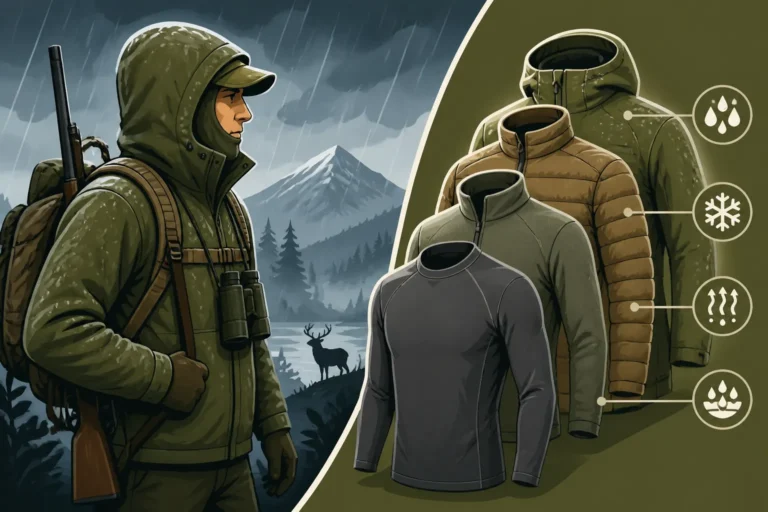
Washington's early fall weather is famously unpredictable. A crisp, sunny morning can quickly give way to a cold, blustery, and wet afternoon, especially at higher elevations. Proper layering is essential for comfort, safety, and staying focused during long hours of glassing or stalking. Start with a moisture-wicking base layer made of merino wool or synthetic fabric; this will keep you dry even if you're hiking hard.
Add an insulating mid-layer, such as a fleece jacket or a lightweight synthetic puff jacket, for warmth. The outermost layer should be a waterproof and windproof shell that can withstand sudden downpours and biting winds while remaining quiet enough for stalking. Brands like Sitka, Kuiu, or First Lite offer excellent systems designed for these conditions. Your footwear is equally critical: waterproof, sturdy boots with excellent ankle support and aggressive traction are a must for navigating steep, potentially slick terrain. Don't forget a warm hat, gloves (possibly a waterproof pair), and gaiters to keep brush and moisture out of your boots. Finally, a comfortable pack with enough volume to carry your optics, layers, water, food, and eventually, the bear meat, is a non-negotiable item.
| Layer Type | Purpose | Material Examples | Benefits |
|---|---|---|---|
| Base Layer | Wicks moisture away from skin | Merino wool, Synthetic | Dries fast, regulates temperature, reduces odor |
| Mid Layer | Provides insulation | Fleece, Down/Synthetic | Traps warm air, lightweight, compressible |
| Outer Shell | Protection from wind and rain | Gore-Tex, Pertex Shield | Waterproof, windproof, breathable (critical for active hunting) |
| Headwear | Heat retention, sun protection | Wool beanie, Ball cap | Prevents heat loss, shields eyes |
| Gloves | Hand warmth, dexterity | Fleece, Waterproof | Keeps hands functional in cold/wet, protects from brush |
| Footwear | Support, traction, waterproofing | Leather/Synthetic boots | Prevents slips, keeps feet dry, crucial for steep terrain |
Mastering the Spot-and-Stalk Technique
Spot-and-stalk hunting for bears is a game of patience, stealth, and acute observation. It's a method that rewards meticulous planning and the ability to adapt to dynamic situations in the field.
Strategic Glassing and Patience
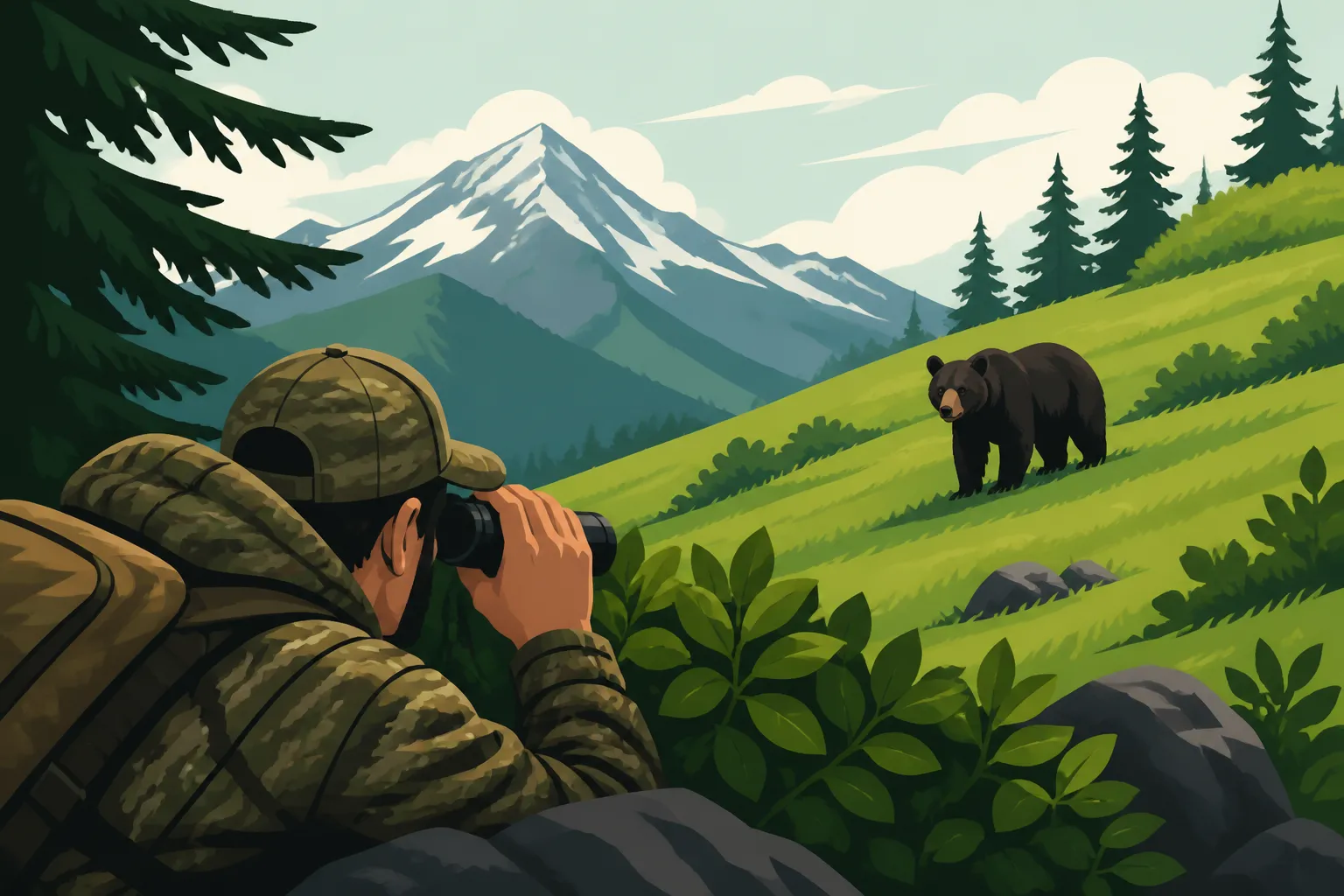
The hunt begins long before you even consider a stalk: it starts with diligent glassing. Find a high vantage point that offers a commanding view of multiple green-up slopes, clearcuts, and avalanche chutes. Set up your spotting scope or binoculars on a tripod and begin a systematic scan. Don't just glance; methodically grid search every square foot of terrain, paying close attention to shadows, areas of transition between timber and open ground, and any patches of different color or texture.
Patience is your most powerful ally. Bears often feed for hours in one area, then bed down, sometimes in plain sight, sometimes just at the edge of the timber. You might glass an area for two hours before a bear emerges from the trees or stands up from a daybed. Use the sun to your advantage, glassing with it at your back in the morning and evening to minimize glare. Look for subtle signs: a patch of fur that seems out of place, a flicker of movement, or a flash of black against the green and brown landscape. Many hunters utilize digital mapping systems, like the robust features on GoHunt, to mark potential feeding areas, optimal glassing knobs, and even access routes during their pre-season e-scouting, giving them a significant advantage once they are in the field. For more insights on pre-season prep, check out Public Land Scouting in Washington Before Opening Day.
The Approach: Wind, Terrain, and Stealth
Once you've spotted a bear and determined it's a legal animal (more on this in the ethics section), the real challenge—the stalk—begins. The wind direction is the single most critical factor; a bear's nose is legendary, and one whiff of human scent will send it scattering. Always approach with the wind in your face or quartering, never at your back.
Study the terrain carefully to plan your route. Identify features like ridges, draws, dense timber patches, or rock outcroppings that can conceal your movement. Your goal is to remain out of sight and unheard as you close the distance. Your walking pace must be slow and deliberate, placing each footfall with care to avoid breaking twigs or dislodging rocks. A common scenario might involve spotting a bear feeding on a distant south-facing slope across a deep canyon. Your plan might entail a significant detour, dropping into the drainage, climbing the other side, and circling wide through thick timber to approach from above, keeping the wind in your favor. This can take hours, but rushing will almost certainly spoil the hunt. If the bear moves during your approach, you must be prepared to freeze, adjust your plan, or even pull back and wait for another opportunity.
Shot Placement and Post-Shot Protocol
When you've successfully completed your stalk and are within ethical shooting range, precise shot placement is absolutely critical. A black bear's vitals are positioned slightly differently than a deer's—they are typically further forward in the chest cavity, closer to the front leg. Aim for a broadside or slightly quartering-away shot, targeting the crease behind the front shoulder to hit both lungs and potentially the heart. Avoid quartering-to shots, and head-on shots are generally too risky for a clean kill.
After the shot, immediately reload your rifle or prepare another arrow (if archery hunting) and observe the bear. Don't rush in. Bears can be incredibly tough and may run a short distance even with a lethal hit. Watch for the bear's reaction, listen for crashing, and mark the exact spot where the bear was when you shot and where you last saw it if it ran. Give it time—15 to 30 minutes for a good hit, longer for a questionable hit, especially if it was a bow shot. When approaching, do so cautiously and with your weapon ready. Bears often don't leave much of a blood trail, especially with heavy fat, so look for disturbed earth, broken branches, or patches of hair. If the trail is sparse, consider consulting Blood Trailing in Salal and Devil's Club for expert advice on tracking in dense vegetation.
Safety and Ethical Considerations
Hunting black bears in Washington is a privilege that comes with significant responsibilities, particularly concerning safety, ethical conduct, and proper meat handling. These considerations are not just guidelines; they are fundamental to responsible hunting.
Identifying Sows with Cubs and Legal Lines
This cannot be stressed enough: it is absolutely illegal and profoundly unethical to shoot a sow with cubs in Washington. This regulation protects the bear population and ensures responsible wildlife management. Positive identification is paramount before you ever put your crosshairs on a bear. Cubs can vary in size depending on their age, but they will always be smaller than the sow and will often be seen in close proximity, either following her, playing nearby, or nursing.
The challenge comes when cubs might be obscured by vegetation, hiding behind the sow, or simply not visible from your angle. This is where your high-quality optics and extreme patience become crucial. Spend extra time glassing the animal, looking for any accompanying young. If there is any doubt about whether cubs are present, do not take the shot. It's simply not worth the legal ramifications or the ethical breach. A bear hunt isn't about collecting a hide; it's about the experience and responsible harvest. Prioritizing clear identification over a hurried shot is a hallmark of an ethical hunter.
Bear Safety in the Field
While black bears are generally shy and more interested in avoiding humans, unexpected encounters can happen, especially in dense cover. Carrying bear spray and knowing how to quickly deploy it is a wise precaution, especially when hunting alone or in areas with high bear densities. When walking through thick brush or areas with limited visibility, make noise to announce your presence and avoid surprising a bear.
In the rare event of a close encounter, stay calm. Do not run. Make yourself appear as large as possible, make noise (shout, clap), and slowly back away. Most black bear encounters end with the bear retreating. It's also critical to store all food, scented items, and game meat properly at your camp, well away from your sleeping area, to avoid attracting bears. If you manage to wound a bear, extreme caution is necessary during the follow-up, as a wounded animal can be dangerous. Consider hunting with a partner if possible, especially in remote wilderness areas, for an extra layer of safety and assistance. For more detailed information on solo hunting, refer to Solo Hunting Safety Precautions.
Field Dressing and Meat Care in Early Fall
Early fall in many parts of Washington can still bring warm temperatures, which means meat spoilage is a significant concern for bears. Bear meat, particularly the fat, can spoil very quickly in heat, potentially tainting the entire carcass. Therefore, rapid field dressing and cooling are absolutely essential. Many hunters opt for the gutless method, which involves skinning and quartering the bear without removing the internal organs. This can be a faster, cleaner process, especially if you're working alone or on steep, uneven terrain. The principles of this method, often used for larger game, are well-described in The Gutless Method on an Elk.
Once the bear is field dressed, remove all hide and as much fat as possible, as bear fat holds heat and can contribute to spoilage. Place the quarters immediately into high-quality game bags to protect the meat from flies, dirt, and debris. The absolute priority is to get the meat cooled down as fast as humanly possible. This often means packing it out immediately, even if it's late in the day, or finding a shaded, cool spot to hang it if packing out needs to wait until morning. Never stack meat on the ground. Once home, bear meat must always be cooked thoroughly to an internal temperature of at least 160°F (71°C) to kill any potential parasites, such as Trichinella. This is a critical health safety measure that should never be overlooked, as detailed in Bear Meat and Trichinosis Risk.
Planning Your Washington Bear Hunt with Resources
A successful Washington bear hunt starts long before you ever step foot in the woods. It begins with thorough research and strategic planning, leveraging available resources to maximize your chances.
Utilizing WDFW and Mapping Tools
The Washington Department of Fish and Wildlife (WDFW) website is your primary source for all official hunting regulations, season dates, and GMU-specific information. Always download and thoroughly review the most current Big Game Hunting pamphlet. It will outline harvest reporting requirements, weapon restrictions, and any changes to regulations. Beyond the official pamphlet, WDFW often provides online maps and resources that can help identify public lands and historical harvest data for certain GMUs, which can hint at bear densities.
Supplementing official WDFW resources with advanced mapping applications like GoHunt can significantly enhance your planning. These platforms allow you to overlay private and public land boundaries, identify topographic features, analyze satellite imagery for vegetation types and clearcuts, and mark potential glassing points and access roads. You can effectively e-scout an entire unit from home, identifying promising "green-up" slopes, potential bedding areas, and logical travel corridors bears might use. This pre-season digital scouting is invaluable for narrowing down your focus and making the most of your limited time in the field.
Scouting and Preparing Your Hunt Area
While digital mapping is powerful, there's no substitute for real-world, boots-on-the-ground scouting. If possible, visit your chosen GMU before the season opens. Look for active bear sign: tracks in soft earth, fresh scat (which can tell you what they're currently eating), rubbed trees, or disturbed ground where bears have dug for roots or grubs. This firsthand knowledge will confirm your e-scouting observations and reveal nuances that maps can't.
Identify the specific green-up slopes in person, checking for the abundance of preferred forage. Find good vantage points for glassing that offer a wide, unobstructed view and are easily accessible. Plan your potential stalk routes, noting any natural features that could provide cover or present challenges. During this scouting, it's also crucial to verify access. Check for any private timberland regulations, such as those that might require permits from companies like Weyerhaeuser or Hancock, or confirm whether a Discover Pass is needed for Washington DNR lands. Understanding these requirements, as discussed in Timber Company Permits in Western Washington, can prevent unwelcome surprises on opening day. Don't forget to check the status of Green Dot roads, as some may be seasonally closed to motor vehicles, requiring longer hikes to reach prime areas.
Disclaimer
Please note: Hunting regulations and seasons can change. Always consult the most current Washington Department of Fish and Wildlife (WDFW) hunting pamphlet and regulations before planning any hunt. This guide is for informational purposes only and does not supersede official WDFW regulations. Ensure you have all necessary licenses and tags, and practice ethical hunting at all times.