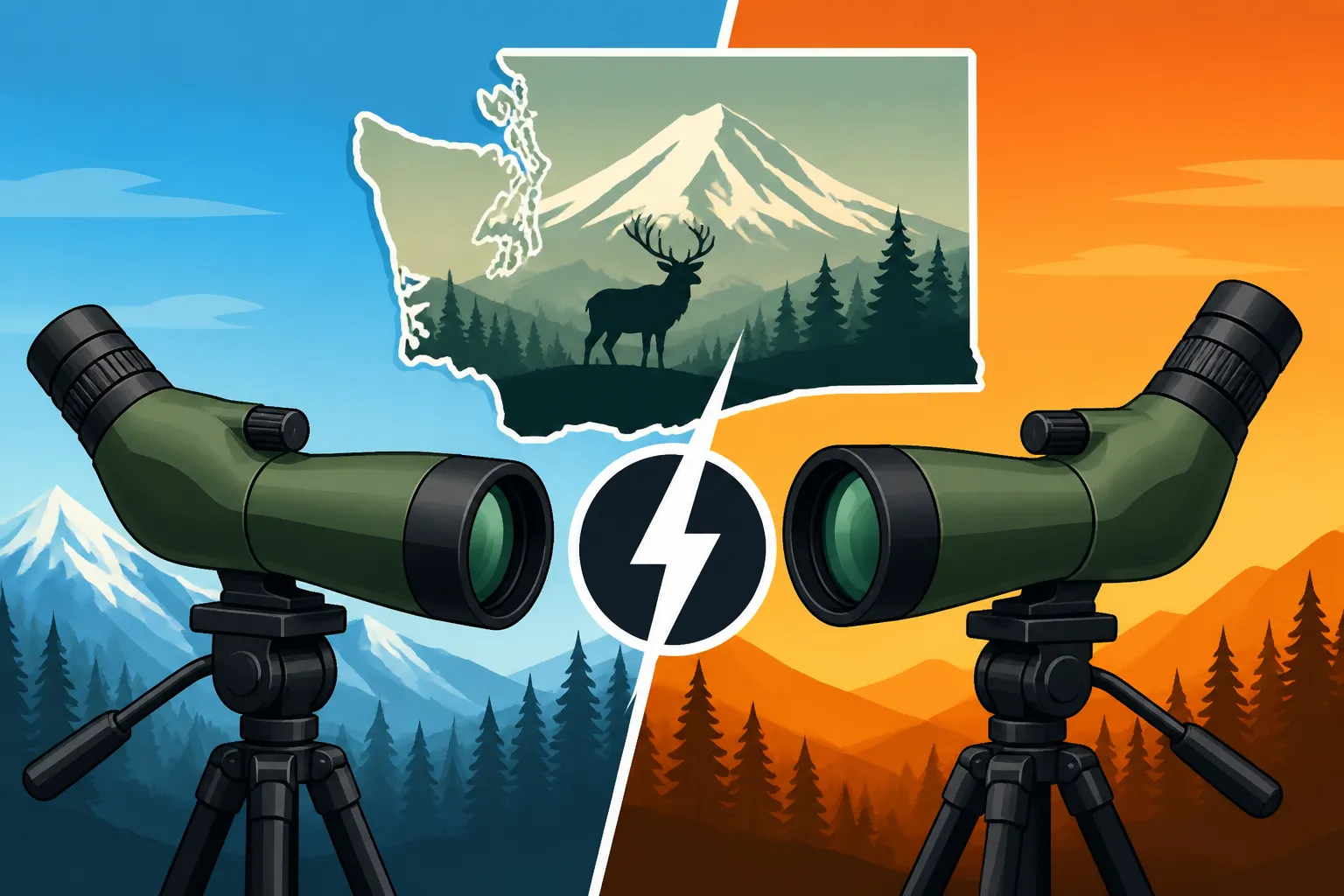
Straight Versus Angled Spotting Scopes
Choosing a spotting scope for your Washington hunt can often feel like trying to decide between two equally good hunting partners—both have their strengths, but which one fits your specific style best? This guide aims to clear up the common confusion between straight and angled spotting scopes, helping you understand the practical implications of each design for the diverse and challenging terrain found across Washington State.
Understanding the Core Difference: Straight Versus Angled Eyepieces
When you're out in the field, whether it's the vast sagebrush country of Eastern Washington or the dense, rain-soaked timber of the Westside, your spotting scope is a critical tool for extending your vision. The primary physical difference between models boils down to the eyepiece orientation: either it's in a straight line with the objective lens, or it's angled upwards, typically at 45 degrees. This seemingly small design choice actually has a huge impact on how you use the scope, how comfortably you can glass for hours, and how it integrates with your overall hunting setup.
The Straight-Through Advantage: Simplicity and Speed
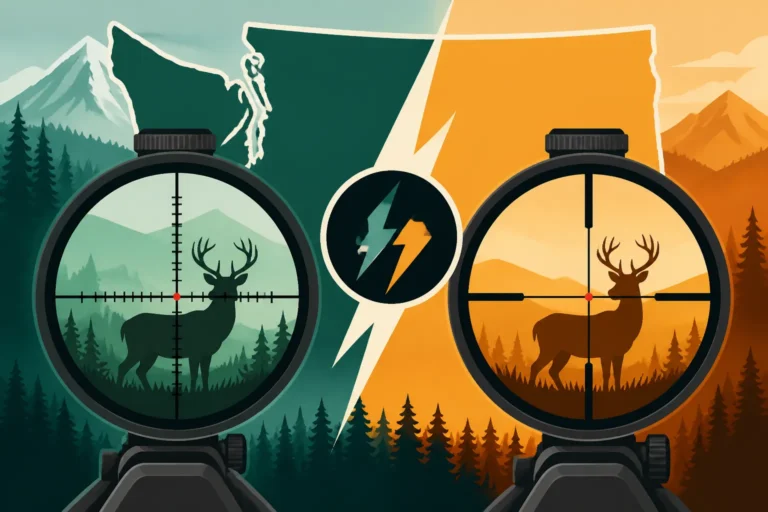
A straight spotting scope, as the name suggests, has an eyepiece that aligns directly with the scope's body. Imagine looking through a rifle scope; it's a very similar, direct line of sight. For many hunters, this straightforward design offers immediate benefits, especially in situations where quick target acquisition and a natural viewing position are paramount.
Think about those moments when you're glassing a distant ridge line, perhaps in the Colockum Elk Herd area, and suddenly a flicker of movement catches your eye. With a straight scope, you can often pick up the target faster because your eye naturally follows the line of the scope from the rear, much like aiming a rifle. If you're standing or positioned higher up, like on a vehicle roof or a high rock outcropping, a straight scope allows you to look horizontally without craning your neck downwards. This can be a game-changer when you're trying to rapidly scan large areas or quickly verify an animal spotted with your binoculars. It's also often favored for impromptu glassing sessions where you might be resting the scope on a fence post or a backpack for a few quick peeks, rather than setting up a full tripod. For hunters who prioritize speed and a very intuitive point-and-look experience, the straight eyepiece is often the preferred choice. It mimics the natural motion of pointing and looking, which can feel more familiar and less cumbersome for those who aren't constantly glued to their glass.
The Angled Advantage: Comfort and Adaptability
Conversely, an angled spotting scope features an eyepiece that's typically set at a 45-degree angle to the main body. While it might feel less intuitive at first glance, this design unlocks a world of comfort and adaptability, especially during those long, grueling glassing sessions common in Washington's more open hunting units.
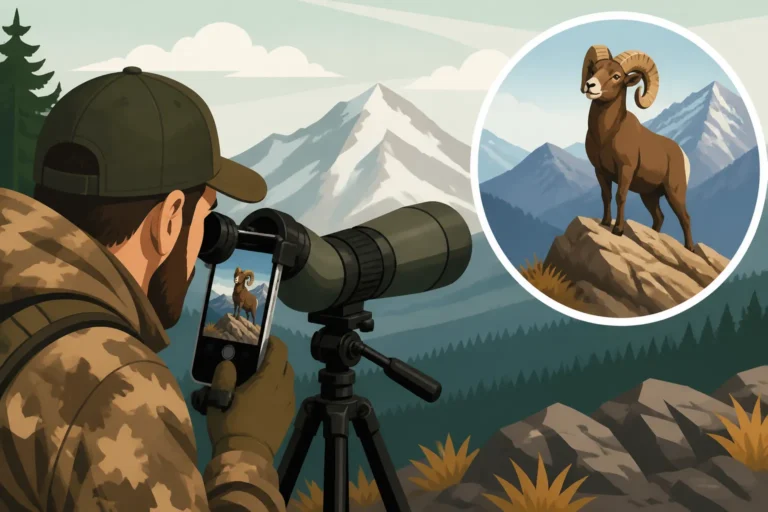
Picture yourself lying prone in the Okanogan Unit Mule Deer Country, tucked into a patch of sagebrush on a cold, windy morning, systematically picking apart a distant hillside for mule deer. With an angled scope, you can keep your head in a much more natural, comfortable position, rather than craning it up and back to look through a straight eyepiece. This significantly reduces neck strain over hours of glassing. This comfort factor extends to sitting positions as well; you can often use a lower tripod, or even just rest the scope on your pack, and still view comfortably. It also shines in situations where you're sharing the scope with others. If you're hunting with a partner or mentoring a new hunter, an angled scope means less tripod height adjustment between users, as individuals of different heights can often just adjust their seating or crouching position to look into the eyepiece. For activities like digiscoping – attaching a phone or camera to the eyepiece for photography – the angled view can also be more convenient, allowing for a more stable and ergonomic setup. An angled scope lets you stay hidden better too, as you can often observe from a lower profile without needing to elevate your whole body.
Practical Considerations for Washington Hunters
The choice between a straight and an angled spotting scope isn't just about personal preference; it's deeply tied to the type of hunting you do in Washington, the terrain you navigate, and even the social dynamics of your hunting party. Understanding these practical considerations will help you make an informed decision that truly enhances your time afield.
Terrain and Glassing Positions
Washington's hunting landscape is incredibly diverse, ranging from the vast, open expanses of the Columbia Basin to the dense, steep timber of the Olympic Peninsula. Your chosen terrain will heavily influence which spotting scope design serves you best.
In Eastern Washington, where game often holds tight in the expansive coulee breaks, sagebrush flats, and wheat fields, long-range glassing is the name of the game. If you're spending hours scanning the Beezley Unit in the Columbia Basin from a high vantage point, picking apart distant pockets of cover for mule deer or looking for elk in the Blue Mountains Elk Herd country, an angled scope's comfort becomes invaluable. You'll likely be sitting or lying prone for extended periods, and the ability to maintain a relaxed neck position can prevent fatigue that leads to missed details. Furthermore, if you're Glassing Sage and Wheat Edges for Washington Mule Deer, you might be tucking in behind minimal cover, and an angled scope allows you to keep a lower profile. However, if you're primarily hunting the more broken, steeper terrain, moving frequently, and making quick observations from standing positions on ridges overlooking canyons, a straight scope might offer faster acquisition and a more natural feel for quick scans.
Conversely, in Western Washington's dense timber and clearcuts, like those found in the Willapa Hills Elk Herd or Blacktail Deer Hunting in Western Washington Timber, you're often looking at shorter distances, often into dark timber edges or the "reprod" (reproduction timber) of clearcuts. While a spotting scope might not be used as constantly as in the Eastside, it’s still crucial for judging antlers or confirming an animal's identity in challenging light. Here, if you're making quick observations from a standing position, or peeking over a log, a straight scope can feel more intuitive for a rapid glassing session. But if you're planning to sit on a clearcut edge for an hour, patiently waiting for a Roosevelt Bulls and Why They Bugle Less to step out, an angled scope could still provide that crucial comfort.
Group Dynamics and Shared Viewing
Hunting is often a shared experience, whether it's with family, friends, or a new hunting partner. The design of your spotting scope can significantly impact how easily and comfortably multiple people can use it.
With an angled spotting scope, sharing the view is generally much simpler. Imagine you've spotted a bachelor group of mule deer way across the valley, and you want your son or daughter to see them, or your hunting buddy to confirm a buck's point count. With an angled scope, you can set the tripod height to a comfortable viewing level for yourself while sitting, and others can simply crouch, kneel, or stand and still view through the eyepiece without major adjustments. This is fantastic for teaching new hunters how to spot game or for simply enjoying the shared experience of observing wildlife. Everyone can easily take turns looking without constantly fiddling with the tripod legs, which can be noisy and time-consuming.
A straight spotting scope, on the other hand, is generally less forgiving for shared viewing. If one person is tall and viewing while standing, and another is shorter or wants to view from a sitting position, the tripod height needs to be adjusted significantly. This can be disruptive, and if you're in a critical moment trying to judge a bull's antler configuration, repeated adjustments can frustrate everyone involved. If you primarily hunt solo, or your hunting partners bring their own dedicated optics, this might not be a concern. But for family hunts, mentorship, or just a more relaxed social glassing experience, an angled scope definitely wins out.
Packing and Portability
When you're trekking through Washington's backcountry, every ounce and every inch of gear matters. The physical design of your spotting scope, particularly whether it's straight or angled, can influence how easily it packs into your Pack Volume for a Washington Spike Camp or deploys from your vehicle.
Straight scopes tend to have a slightly more streamlined profile, which some hunters find easier to slide into a pack's side pocket or a dedicated spotting scope sleeve. Because the body is one continuous line, it can sometimes feel less bulky. For hunters who prioritize quick deployment and minimal snagging when moving through brush or tight spaces, this can be an advantage. Think about trying to get your scope out quickly from a pack to confirm a Blacktail Rut Timing in Western Washington buck that just materialized on a logging road.
Angled scopes, due to their bent eyepiece, can sometimes feel a bit more awkward to pack for some people. The angled section protrudes, which might require a bit more careful positioning in your pack to prevent it from snagging or taking up odd space. However, many modern pack designs are accommodating, and with a good padded case, this becomes less of an issue. The benefit often outweighs the minor packing consideration, especially if you consider how much less height you need from your tripod in the field, potentially allowing you to carry a smaller, lighter tripod overall. When comparing Carbon Versus Aluminium Tripods, a more compact angled scope and tripod setup can really shave weight and bulk for those long hauls into places like the Pasayten Wilderness Hunting Access.
Here’s a quick overview to help you weigh the options:
| Feature/Scenario | Straight Spotting Scope | Angled Spotting Scope |
|---|---|---|
| Glassing Comfort | Requires more neck craning for low positions; best standing. | Highly comfortable for prolonged sitting/prone glassing; natural head position. |
| Target Acquisition | Faster, more intuitive "point and shoot" alignment. | Slightly less direct alignment, may take a moment to orient. |
| Shared Viewing | Requires frequent tripod height adjustments for different users. | Easier for multiple users of varying heights to share. |
| Packing Profile | Often more streamlined, can be easier to slide into packs. | Eyepiece angle can create a slightly bulkier shape; may need more careful packing. |
| Tripod Height Needed | Often requires taller tripods for comfortable standing viewing. | Can use lower, more compact tripods for comfortable viewing from sitting/prone. |
| Digiscoping Ease | Can be slightly awkward depending on camera setup and angle. | Generally more ergonomic and stable for attaching cameras/phones. |
| Observation Angle | Best for looking horizontally or slightly downwards. | Excellent for looking upwards (e.g., steep hillsides, mountain goats). |
Setting Up Your Spotting Scope in the Field
Having the right spotting scope is only half the battle; knowing how to set it up effectively in the field is crucial for maximizing its performance. Your choice between a straight or angled eyepiece will directly influence your tripod setup and even your approach to digiscoping.
Tripod and Mount Compatibility
A spotting scope is only as steady as the tripod it sits on. This is especially true in Washington, where windy ridge lines and uneven terrain are common companions. When choosing a tripod for your spotting scope, consider the design of your scope.
For an angled spotting scope, you can often get away with a shorter, lighter tripod because you don't need to extend the legs as high to comfortably view through the eyepiece while sitting or lying prone. This can be a huge advantage for backpack hunters counting ounces for a multi-day trip into the Alpine Lakes Wilderness Hunting Rules. You’ll typically use a pan head or a ball head that allows for smooth, precise adjustments. A pan head offers excellent control for tracking moving animals or scanning horizontally, while a ball head offers quick, fluid movement in all directions, though it might take a bit more practice to lock down precisely. Regardless of the head type, ensure it has a quick-release plate so you can rapidly attach and detach your scope, a feature you’ll appreciate when that elk suddenly steps out from behind a tree. You'll want a sturdy setup that won't wobble in a stiff breeze, especially when trying to discern antler points on a distant bull during Judging Antler Points Before the Shot. Many hunters utilize the resources available on GoHunt to research gear like tripods, checking reviews and compatibility before making a purchase.
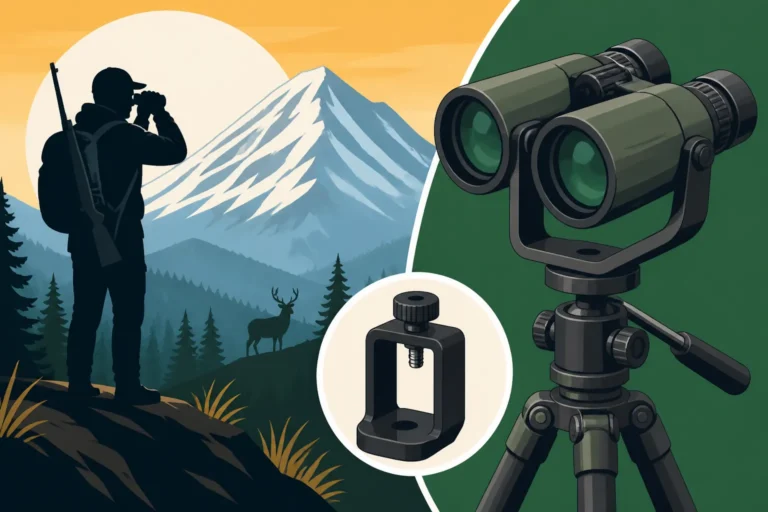
With a straight spotting scope, you might find yourself needing a taller tripod, particularly if you prefer to glass from a standing position. This can mean a heavier, bulkier tripod, which is a trade-off some are willing to make for the natural viewing angle. Again, a sturdy pan head is usually the best choice for smooth scanning, but a quality ball head can work too. When you're dealing with Washington's unpredictable weather, from high winds to sudden downpours, a stable tripod is non-negotiable. Don't skimp here; a flimsy tripod will negate the benefits of even the most expensive spotting scope. Consider how you'll be deploying the scope: from a truck bed, a rocky perch, or the bottom of a steep canyon. Each scenario might favor different tripod characteristics, but stability and ease of adjustment are universal requirements. You might also consider a Tripods and Binocular Adapters if you plan to use a higher magnification binocular in conjunction with your spotter.
Digiscoping and Photography Potential
In the age of smartphones and social media, "digiscoping" – taking photos or videos through your spotting scope with a camera or phone – has become incredibly popular. It’s a fantastic way to document your hunt, share observations, or get a closer look at a distant animal without disturbing it. The design of your spotting scope definitely impacts this pursuit.
Angled spotting scopes tend to be the champions of digiscoping. The upward angle of the eyepiece means that when your phone or camera is attached, it's typically positioned more comfortably, allowing you to view the screen and operate the controls without bending awkwardly. This ergonomic advantage is significant for maintaining a steady shot and preventing fatigue during longer photography sessions. You can keep your tripod at a lower, more stable height, which also helps with minimizing shake. Many digiscoping adapters are designed to clamp directly onto the eyepiece, and the angled design often provides more clearance and a more natural viewing angle through the phone's screen. After spending countless hours scouting new units on GoHunt, successfully capturing an image of that trophy buck you've been chasing can be incredibly rewarding.
While it's certainly possible to digiscope with a straight spotting scope, it can be a bit more challenging. The direct alignment of the eyepiece often means your camera or phone will be pointing straight out, which can require you to position yourself directly behind it. This might necessitate a taller tripod setup, potentially making it less stable, and you might find yourself in an awkward position trying to view the screen and trigger the shutter. It's not impossible, but it demands a bit more forethought and perhaps a more specialized adapter to achieve comfortable and stable results. Ultimately, for serious digiscopers who want to capture high-quality images of Washington's Cougars in Washington and How Many There Are or Washington Moose in the Selkirks, an angled scope will likely offer a smoother, more enjoyable experience.
In conclusion, both straight and angled spotting scopes have their merits, and the "best" choice truly depends on your individual hunting style, the terrain you frequent in Washington, and how you plan to use this powerful optical tool. Consider your primary glassing positions, whether you hunt solo or with a group, and how crucial digiscoping is to your outdoor adventures. By weighing these factors, you’ll be well on your way to making an informed decision that will serve you faithfully in the diverse hunting grounds of Washington State.
Disclaimer
This article is for general informational purposes only and does not constitute professional advice. Laws, prices and regulations vary by location and change over time. Consult a qualified professional for guidance on your specific situation.