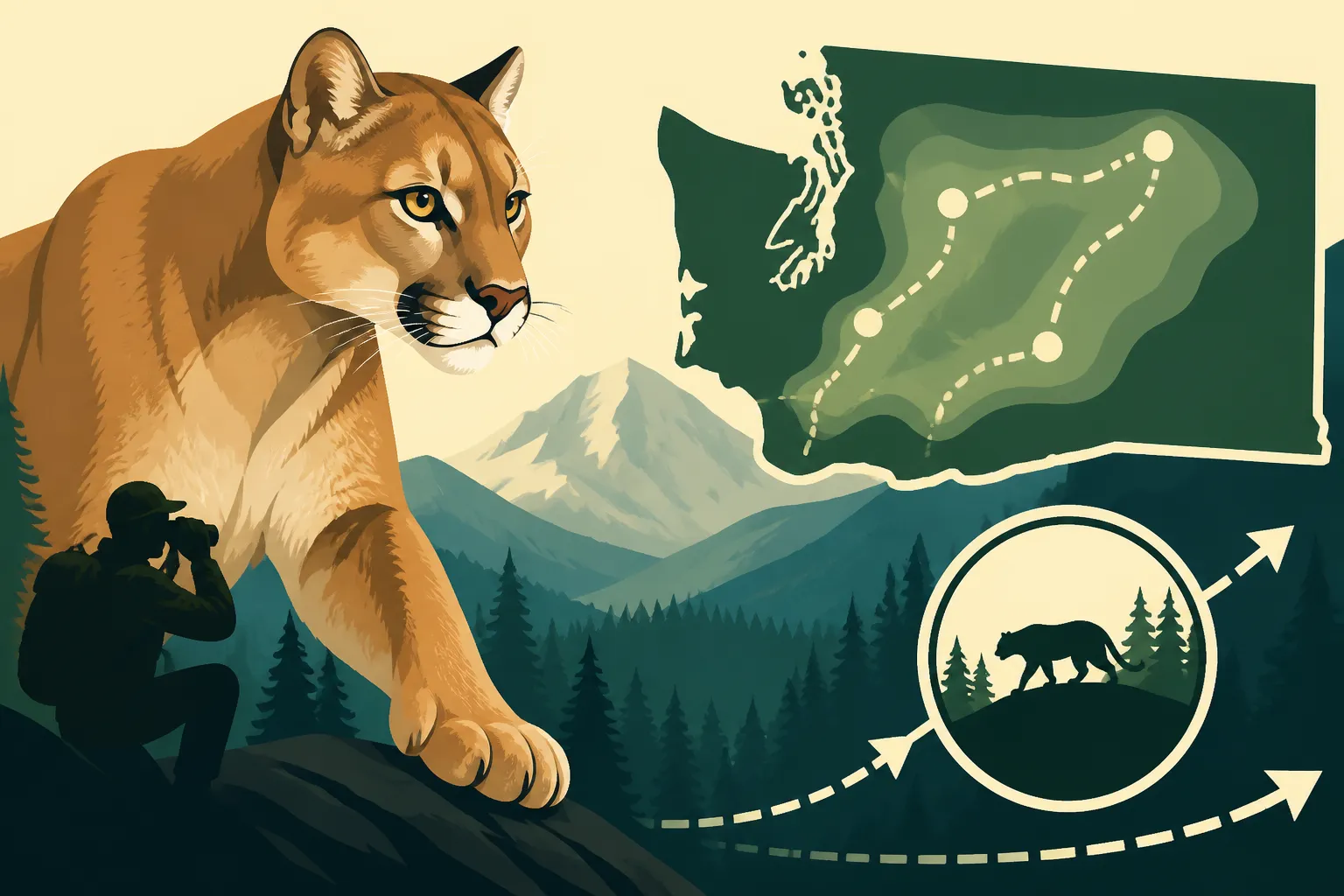
Cougar Territory and Movement
Understanding the mysterious movements and vast territories of cougars in Washington can feel like trying to solve a puzzle with half the pieces missing. It’s incredibly frustrating when you’re out in the woods, seeing fresh tracks one day and nothing for weeks, making you wonder if you’ll ever get a consistent read on these incredible predators. This guide aims to pull back the curtain on cougar territory and movement patterns, offering you a deeper understanding of how these big cats live, travel, and hunt across our diverse Washington landscapes, and how that knowledge can help you in the field.
The Elusive Nature of Cougar Territory in Washington
Cougars are creatures of immense adaptability, and their territorial habits are no exception. Unlike some other game animals that might stick to more predictable patterns, a cougar's 'home' isn't a fixed, small plot. It's a vast, dynamic space, constantly being patrolled and redefined based on a multitude of environmental and social factors. This is why pinning them down can feel like such an impossible task for hunters and wildlife enthusiasts alike.
Defining Home Range and Core Areas
When we talk about a cougar's territory, what we're really discussing is its home range – the total area an individual animal uses for all its activities: hunting, mating, resting, and raising young. Within this broader home range, there are often smaller, more intensely utilized sections known as core areas. These are the spots where a cougar spends most of its time, perhaps where they've made a fresh kill, have a den, or simply feel the safest and most concealed. Think of it like your own property: you own the whole parcel, but you spend most of your time in your house and yard, not necessarily the far corner of your back forty every single day.
For a cougar in Washington, particularly in the dense forests of the Olympic Peninsula or the rugged canyons of Eastern Washington, these core areas might be dense thickets, rocky outcroppings, or steep, brushy slopes that offer superior cover and vantage points. A hunter might spend days scouting a particular basin, finding old sign, only to realize the cougar's core area has shifted slightly due to prey movement or human disturbance. This ever-changing nature is part of the challenge and allure of pursuing these animals. Recognizing the difference between a fleeting travel corridor and a consistent core area is a key step in unraveling their secrets.
Factors Influencing Territory Size
The size of a cougar's home range is not static; it's a fluid measurement influenced by several critical factors. Topography plays a massive role – a cougar in the steep, broken country of the Blue Mountains might have a different-sized range than one navigating the relatively flatter, yet densely timbered, areas of Western Washington. More fragmented habitats, especially those near human development or high recreational use, can force cougars to expand their territories to find sufficient resources and escape disturbance.
Perhaps the most significant factor, however, is prey availability. Where deer and elk populations are abundant, like in parts of the Colockum or Yakima elk herds' range, a cougar might be able to maintain a smaller, more concentrated territory. Conversely, in areas where prey is scarcer, a cougar must range much wider to secure enough food. For instance, in the dry cougar country of the Columbia Basin, a male cougar's territory could encompass hundreds of square miles, stretching across multiple ridges and drainages. The presence of other cougars, especially dominant males, also dictates boundaries, with younger or subordinate cats often pushed into marginal habitats or forced to adopt larger, less resource-rich ranges.
How Cougars Mark and Defend Their Domain
Cougars aren't sending out mailers or putting up "No Trespassing" signs, but they are incredibly sophisticated in how they communicate their presence and territorial claims to other cats. For hunters, learning to read these subtle — and sometimes not so subtle — clues is like deciphering a secret language. It’s what separates a lucky encounter from a strategic one when you're Reading Cougar Sign in the Snow.
Scrapes, Scats, and Scent Posts
The most commonly recognized form of cougar communication is the scrape. These are small piles of dirt, leaves, or pine needles, typically about 6-12 inches long and a few inches wide, often with a distinct "paw swipe" indentation on top. Both male and female cougars create scrapes, usually with their hind feet, and they'll often urinate or deposit scat on or near them. These scrapes are essentially signposts, proclaiming "I was here!" to any passing cougar. They are especially prevalent along game trails, ridgelines, and at the confluence of drainages – natural travel corridors where other cats are likely to pass.
Beyond scrapes, cougar scat itself holds a wealth of information. Unlike dog scat, cougar droppings are often segmented, rope-like, and typically contain hair and bone fragments from their prey. The size and freshness of the scat can give clues to the size of the animal and how recently it passed through. Additionally, cougars will use specific trees or rocks as scent posts, rubbing against them or scratching them to leave their scent. Finding these indicators, especially multiple forms of sign in a concentrated area, is a strong signal that you've stumbled into a cougar's regular patrol route.
The Role of Vocalizations and Visual Cues
While primarily solitary and known for their stealth, cougars do use vocalizations, though far less frequently than wolves or coyotes. These can range from a low growl or hiss when agitated, to a chirp-like sound that females use with their kittens, and occasionally, a distinctive scream that can be unnerving if heard in the wilderness. While you might not often hear a cougar, if you do, it’s a direct communication that you’re in their immediate presence.
Visual cues extend beyond just scrapes and scent posts. Scratch marks on trees, particularly on the rough bark of conifers like Douglas firs or cedars common in Washington's forests, serve a dual purpose. They help cougars sharpen their claws, but they also act as visual and olfactory markers, indicating their presence and size. A large, deeply gouged scratch mark tells other cougars a big cat is in the area. Imagine a cougar stretching up a tree, raking its claws down the trunk to leave a lasting impression. These marks are often found in conjunction with scrapes, creating a comprehensive "billboard" that broadcasts a cougar's identity and claim over its territory. Keep your eyes peeled for these along well-used game trails or near natural choke points in the terrain.
Understanding Cougar Movement Patterns
To truly hunt cougars effectively, you need to understand not just where they live, but how they move through their world. These aren't random wanderings; cougar movements are calculated, strategic, and often dictated by the most fundamental need: survival. This requires a different kind of scouting than you might use for deer or elk, focusing on the subtler rhythms of the predator.
Daily Travel and Hunting Circuits
Cougars are crepuscular, meaning they are most active during dawn and dusk, but they can be active at any time of day or night. Their daily movements are largely driven by hunting. A cougar typically follows a circuitous route within its home range, continually checking for fresh sign of prey. These circuits often involve covering significant distances, sometimes 10-20 miles in a single night, particularly for a dominant male. They'll typically stick to areas with good cover, utilizing ridgelines, benches, and the edges of clearcuts or dense timber for stealth. This makes Still-Hunting Blacktails in Wet Washington Brush an exercise in cougar awareness as well.
When a cougar makes a kill, its movement pattern changes dramatically. It will often stay with the carcass for several days, feeding on it until it's consumed, often caching it under leaves or snow between meals. This is a critical time for hunters, as the cougar's movements become much more localized and predictable around the kill site. Once the carcass is depleted, the cougar resumes its wider patrols, constantly searching for the next meal. Understanding these daily and post-kill patterns is vital for any hunter hoping to intercept a cougar. You might not see the cougar, but finding a fresh kill site is like finding a giant "X" on a treasure map.
Seasonal Shifts and Prey Availability
Cougar movements are also heavily influenced by seasonal changes and, consequently, prey availability. In Washington, particularly in the mountainous regions, deer and elk herds often migrate to lower elevations as snows deepen in the late fall and winter. Cougars, being opportunistic predators, will often follow these migrations. If you know that deer are wintering in a particular drainage in the Okanogan, you can bet cougars will be focusing their efforts there.
During the warmer months, especially in areas like the Olympic Mountains or the Cascade foothills, cougars might target a wider variety of prey, including deer, elk calves, bighorn sheep, and even smaller game. This diversification can lead to more dispersed cougar activity. In areas with high numbers of Roosevelt Elk of Western Washington, cougars will key in on those animals, and their movements will reflect the elk's preferred habitat and travel routes. A hunter might use resources like GoHunt to analyze historical elk and deer distribution maps, overlaying that data with topographical features to predict where cougar activity might be concentrated during different times of the year, providing an invaluable e-scouting advantage before even setting foot in the field.
Sex, Age, and Social Dynamics in Cougar Movement
Cougars are generally solitary animals, but their movements and territorial behaviors are far from independent. They are constantly interacting, albeit indirectly, with other cougars in their vicinity, and these interactions profoundly shape their lives, especially for the younger and more vulnerable cats.
Male vs. Female Territories and Dispersal
There's a significant difference in how male and female cougars utilize and maintain their territories. Adult male cougars typically maintain much larger territories than females, often overlapping with the ranges of several females. This makes sense from a reproductive standpoint; a male needs access to multiple females to ensure successful breeding. These male territories can range from 50 to 200 square miles or even more in areas of lower prey density or fragmented habitat, such as parts of the Colville National Forest.
Female cougars, especially those with dependent kittens, have smaller, more exclusive territories, typically 10 to 60 square miles. They are more focused on protecting their young and ensuring a consistent food supply within a manageable area. A female's territory might shift slightly year to year based on available resources and the needs of her growing litter. Younger cougars, particularly males, after leaving their mother's care (a process called dispersal), will embark on long, sometimes hundreds-of-miles-long, journeys to find an unoccupied territory or to challenge an existing male. This is a perilous time for young cougars, as they are often forced into less ideal habitats and face higher mortality rates, including conflicts with established cougars or humans.
Interactions Between Resident and Transient Cougars
The social structure of cougars, though largely solitary, involves a delicate balance between resident cats and transients. A resident cougar, particularly a dominant male, will actively defend its territory against intruding males. While violent confrontations are rare, the territorial markings (scrapes, scent posts, tree rubs) are crucial in minimizing direct conflict. These "advertisements" allow cougars to largely avoid each other while still acknowledging boundaries. If a younger, transient male stumbles into an established male's territory, it will often quickly move on after picking up the resident's scent, though sometimes a challenge is inevitable, resulting in a fight for dominance.
For hunters, understanding this dynamic is important. If you're consistently finding sign of a large, dominant male in an area, you're likely dealing with a resident cat with a well-established pattern. Conversely, if you find sporadic, inconsistent sign that doesn't seem to follow a strong pattern, you might be encountering a transient cougar passing through, or a dispersing sub-adult. These transients are often less predictable and might be found in more marginal habitats, like edges of recent burns or areas near human activity, as they try to avoid established territories. This nuanced understanding of Cougar Territory and Movement is key to piecing together their presence in a given area.
Technology and Scouting for Cougar Sign
Gone are the days when a compass and paper map were your only companions for scouting. Modern technology has provided hunters with an arsenal of tools to better understand cougar territories and movement patterns before, during, and after a hunt. It’s about working smarter, not just harder, in the vastness of Washington's wilderness.
Utilizing Modern Mapping Tools and E-Scouting
E-scouting is revolutionizing how hunters approach cougars, and platforms like GoHunt are at the forefront of this shift. By using detailed satellite imagery, topographical maps, and public/private land ownership overlays, you can virtually explore vast landscapes from your couch. For cougars, this means identifying key terrain features that dictate their movement: dense timber stands for cover, steep drainages and canyon systems for travel, saddles between ridges that act as natural funnels, and areas of high deer or elk density. You can pinpoint potential bedding areas, ambush points, and travel corridors where cougars are most likely to intersect with their prey.
For example, looking at a GMU map for the Naneum unit, you could identify a series of north-facing slopes with dense conifer growth adjacent to south-facing slopes known for wintering mule deer. This kind of feature analysis, performed digitally, allows you to narrow down your boots-on-the-ground scouting to the most promising areas, rather than blindly wandering. You can mark potential scrape lines, locate historical kill sites if data is available, and plan strategic routes for tracking or calling. This foresight, combined with real-world experience, makes a huge difference in cracking the code of cougar movements.
Interpreting Tracks and Other Field Sign
While e-scouting gets you in the ballpark, nothing beats boots on the ground for finding definitive cougar sign. Tracks are the most obvious and telling clue. A cougar track is typically rounder than a dog's, lacks claw marks (unless it's sprinting or on ice), and usually shows a clear, asymmetrical arrangement of toes. The size of the track can give you an indication of the animal's size – a 3-4 inch pad likely belongs to a large male, while smaller tracks are indicative of females or juveniles. Fresh tracks in mud, dust, or snow are like reading a newspaper headline: they tell you exactly where the cougar was, and how recently.
Beyond tracks, you need to be observant of all other forms of sign. Look for the aforementioned scrapes, but also pay attention to rubbed trees or posts. Keep an eye out for scattered deer or elk hair, or even partially buried carcasses, which signal a kill site. Knowing Where Bears Feed in Early Fall can also indirectly help, as bears and cougars often share similar prey bases and habitat preferences, so where you find one, the other might not be far behind. The more sign you can piece together over time and across an area, the clearer picture you'll get of a cougar's preferred travel routes and core hunting grounds. It's about connecting the dots to paint a detailed picture of their invisible highway.
Hunting Implications: Using Knowledge of Territory and Movement
Understanding cougar territory and movement isn't just academic; it's a fundamental part of a strategic hunting plan. For those pursuing these incredible animals, this knowledge transforms random walks into purposeful searches, increasing your chances of a successful and ethical hunt.
Strategic Stand Placement and Tracking
When it comes to hunting cougars, whether through traditional methods or by Calling Cougars Without Dogs in Washington, knowing their territorial tendencies is paramount. If you've identified a consistent travel corridor – perhaps a narrow bench along a steep hillside in the Gifford Pinchot National Forest, or a well-used game trail connecting two drainages – these are prime locations for strategic stand placement. A cougar will often use these natural funnels as part of its daily hunting circuit, offering opportunities for ambush, especially during those crepuscular hours.
Furthermore, if you're tracking a cougar, knowing its typical movement patterns can help you anticipate its next move. For instance, if you're on a fresh track heading into a dense bedding area, you might circle downwind to get ahead of the animal or set up in a strategic position where it's likely to exit. Or, if the track leads towards a known wintering ground for deer, you can infer the cougar is likely on the hunt. This is where understanding Tracking Bucks in Fresh Eastern Washington Snow can translate directly to cougar hunting, as the principles of following and interpreting tracks are remarkably similar.
Adaptability in Different Washington Landscapes
Washington offers an incredibly diverse range of habitats, from the dense rainforests of the Olympic Peninsula to the sagebrush steppes of Eastern Washington. Cougar movement and territory use will adapt to these varied landscapes, and so must the hunter. In the thick, wet timber of Western Washington, cougars often utilize old logging roads, game trails, and clearcut edges for easier travel and hunting. Their territories might be smaller due to higher prey density and consistent cover, but their movements are often more concealed.
In contrast, the more open, broken country of Eastern Washington, like the Okanogan or the Blue Mountains, might see cougars using steep, rocky canyons and timbered draws as travel corridors, moving between large expanses of more open ground. Here, their territories are often much larger, and successful hunting might involve extensive glassing from a high point, similar to Glassing Eastern Washington Breaks for Mule Deer. The key is to recognize that while the core behaviors remain the same, the manifestation of those behaviors – how they use the terrain – changes dramatically. Being adaptable and understanding these regional nuances is what separates a truly effective cougar hunter from one who is simply hoping for luck.
Comparing Cougar Territory Dynamics
The dynamics of cougar territory and movement are complex, influenced by a blend of biological imperatives and environmental factors. Understanding these differences can significantly improve a hunter's ability to locate and pursue cougars in Washington's diverse ecosystems.
| Factor | Male Cougar Territory | Female Cougar Territory (with kittens) | Transient/Dispersing Cougar Movement |
|---|---|---|---|
| Typical Size | 50-200+ square miles (can overlap multiple female ranges) | 10-60 square miles (more exclusive, focused on den/prey for young) | Highly variable, often hundreds of miles in search of open territory |
| Primary Driver | Reproductive access, prey acquisition, dominance | Rearing young, consistent prey access, protection of offspring | Survival, avoidance of established cats, finding suitable habitat |
| Movement Pattern | Wide-ranging, regular circuits covering entire territory, frequent scrape lines | More localized movements around den/kill sites, expanding as kittens grow | Erratic, less predictable, often through marginal habitat |
| Significance to Hunter | Indicates a resident, dominant animal; predictable travel corridors along ridgelines/drainages | Localized activity around kills or dense cover, often with smaller tracks | Less predictable, but can indicate areas of less cougar pressure |
| Washington Example | Dominant male in the Methow Valley, overlapping several female ranges | Female with cubs near a consistent deer winter range in the Colockum Unit | Young male moving through the outskirts of Spokane, seeking new range |
Disclaimer
Please remember that hunting regulations and wildlife behaviors can change. Always consult the most current Washington Department of Fish and Wildlife (WDFW) regulations and season pamphlets before planning any hunt. This information is intended for educational purposes and should not replace official WDFW guidance.