Washington Cougar Population and Density
Washington's vast and diverse landscapes are home to an array of incredible wildlife, but few animals command as much mystery and respect as the cougar. For many hunters, hikers, and rural residents, questions about cougar numbers, where they roam, and their impact on other game species are constant. Pinning down exact figures for these elusive predators can feel like chasing a ghost, often leading to more speculation than clear answers. This comprehensive guide will shed light on what we actually know about the cougar population and density across Washington, offering realistic insights into their distribution, the factors influencing their presence, and how wildlife managers work to understand and sustain them.
Understanding Washington's Cougar Population Dynamics
Cougars, also known as mountain lions or pumas, are apex predators that play a crucial role in Washington's ecosystems. Their very nature – stealthy, solitary, and wide-ranging – makes them incredibly challenging to study and count accurately. However, the Washington Department of Fish and Wildlife (WDFW) dedicates significant resources to estimating these populations to ensure healthy management.
Historical Context and Current Estimates
Looking back, cougar populations in Washington faced severe pressure throughout the 19th and early 20th centuries. Bounty hunting, driven by fears for livestock and perceived threats to human safety, pushed their numbers to critically low levels. It wasn't until the mid-20th century, with the cessation of bounties and improved habitat management, that cougars began a slow but steady recovery. This rebound has been a testament to their adaptability and the resilience of natural ecosystems when given a chance.
Today, WDFW estimates the statewide cougar population to be in the range of 2,500 to 3,000 adult animals. It's vital to remember that these figures are dynamic estimates, not precise counts like you might get for a census of people. They fluctuate based on birth rates, mortality from natural causes, disease, and regulated hunting. These estimates are continually refined through scientific studies, including DNA analysis from scat, remote camera surveys, and harvest data submitted by hunters. Knowing these numbers helps wildlife managers set sustainable hunting seasons and manage potential conflicts with humans or livestock, aiming for a balance that protects both cougars and community interests.
Challenges in Population Counting
Imagine trying to count every squirrel in your neighborhood, let alone every highly camouflaged, nocturnal predator that might cover hundreds of square miles in a single year. That's essentially the challenge wildlife biologists face with cougars. Their solitary nature means they don't congregate in easily countable groups, and their incredible ability to avoid detection makes direct observation rare. A typical cougar's home range can span vast territories, often from 50 to 150 square miles for males, making tracking individual animals a monumental task.
Traditional methods like aerial surveys, effective for deer or elk, simply don't work for cougars hiding in dense cover. Instead, biologists rely on a combination of indirect techniques. This includes snow tracking to identify individuals by unique paw prints, using GPS collars on captured animals to monitor movement patterns, and collecting genetic samples (like scat) for DNA analysis to identify individual animals and estimate population sizes in specific areas. Additionally, harvest data from legal hunting seasons provides a valuable index of population trends. Tools like GoHunt's mapping features can sometimes overlay historical harvest data or habitat information, giving a more visual understanding of where animals might be, though it doesn't directly count them. This multi-faceted approach, while labor-intensive, provides the most reliable picture possible of these elusive creatures.
Estimating Cougar Density Across the State
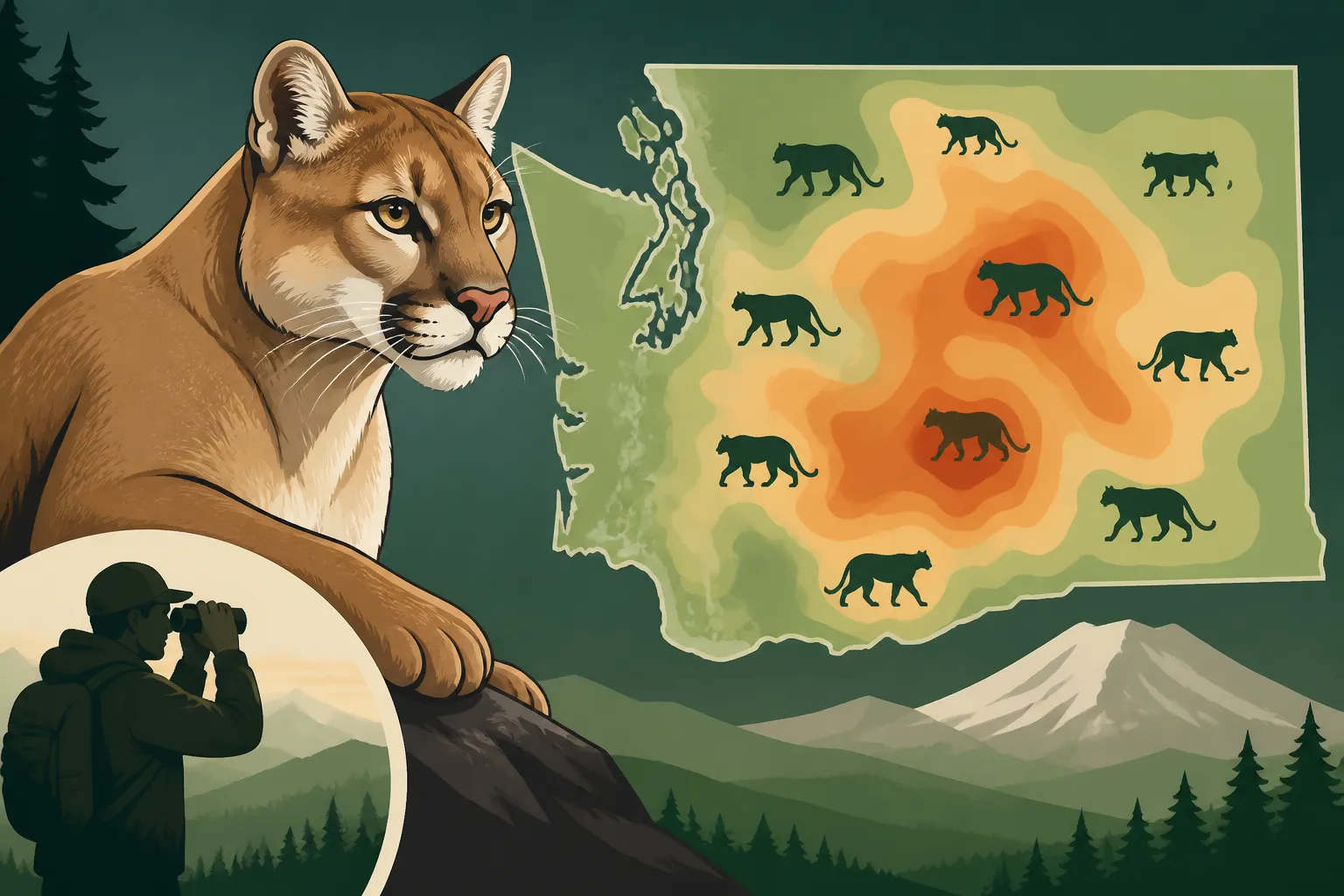
When we talk about cougar density, we're really looking at how many cougars occupy a given area, which can vary dramatically across Washington's diverse landscapes. It's not a uniform distribution; instead, it's a mosaic shaped by habitat quality, prey availability, and human presence.
Regional Differences East vs. West
Washington is broadly divided by the Cascade Mountain Range, creating two distinct ecological zones that influence cougar density. In Western Washington, with its dense, wet forests, lush undergrowth, and abundant Columbian Blacktail Deer in Western Washington, cougars often inhabit smaller, more intertwined territories. The sheer volume of cover means cougars can thrive even in areas with some human activity, as long as there's good prey and sufficient wild space. The coastal ranges, like the Willapa Hills and Olympic Peninsula, offer prime habitat.
Conversely, Eastern Washington's drier, more open landscapes, characterized by sagebrush steppe, pine forests, and agricultural lands, typically support cougars with much larger home ranges. Here, prey such as Mule Deer of Eastern Washington and white-tailed deer can be more spread out, forcing cougars to travel further to find food. While the overall numbers might be similar, the density – cougars per square mile – can appear lower in the east due to the larger areas they need to roam. However, river drainages, broken country, and forest edges in regions like the Blue Mountains and the Okanogan can concentrate deer and, consequently, cougars.
Habitat Influence on Density
Cougars are intrinsically linked to their prey base. Areas with robust populations of deer and elk will naturally support higher densities of cougars. This often means thick, protective cover where prey can hide, interspersed with open areas for hunting. In Western Washington, this might be vast tracts of timber company land or national forest with a mix of old growth, clearcuts, and dense reprod. These areas provide excellent ambush cover and escape routes for cougars and their prey.
In Eastern Washington, prime cougar habitat often includes steep, rocky canyons, rimrock, and timbered slopes adjacent to agricultural fields or river bottomlands where deer feed. These geographic features offer both vantage points for hunting and secluded resting sites. As the landscape changes, so does the carrying capacity for cougars. Areas heavily impacted by human development, extensive clearcutting without subsequent regeneration, or intense agricultural practices tend to see lower cougar densities because the critical elements of cover and prey become scarcer.
Specific High-Density Areas
While WDFW doesn't typically publish exact cougar densities for every single Game Management Unit (GMU), certain patterns emerge. Regions with high deer and elk populations, limited human disturbance, and extensive public lands often support higher cougar numbers. For instance, forested areas within the Olympic National Forest on the Olympic Peninsula, portions of the Gifford Pinchot National Forest in Southwest Washington, and the rugged, roadless country of Northeast Washington (where moose, elk, and white-tailed deer are common) are known cougar strongholds.
Similarly, the broken, timbered country in the Blue Mountains in Southeast Washington, home to the Blue Mountains Elk Herd, provides excellent habitat. Hunters using tools like GoHunt to analyze game populations and terrain features can get a sense of where cougar activity might be higher, even if specific cougar density maps aren't readily available. It’s always about finding the intersection of dense cover, available water, and abundant prey.
Here's a simplified look at how cougar density might generally compare across Washington's ecological regions:
| Region | Primary Habitat Types | General Prey Base | Typical Cougar Home Range Size (Approx.) | Relative Density (General) |
|---|---|---|---|---|
| Western Washington | Dense coniferous forests, rainforests, coastal ranges | Blacktail Deer, Roosevelt Elk, smaller mammals | 50-100 sq miles | Moderate to High |
| Eastern Washington | Pine forests, sagebrush steppe, river canyons, shrub-steppe | Mule Deer, Whitetail Deer, Rocky Mountain Elk, bighorn sheep | 75-150+ sq miles | Low to Moderate |
| Northeast Washington | Mixed coniferous forests, wetlands | Whitetail Deer, Moose, Rocky Mountain Elk | 60-120 sq miles | Moderate |
| South-Central WA | Dry pine forests, shrub-steppe, riparian areas | Mule Deer, Rocky Mountain Elk | 70-130 sq miles | Low to Moderate |
Note: These are general characterizations and actual densities can vary greatly within each region based on microhabitats and specific prey availability.
Factors Influencing Cougar Numbers
Cougar populations are not static; they are complex systems influenced by a variety of environmental and anthropogenic factors. Understanding these dynamics is crucial for effective wildlife management and for anyone recreating or living in cougar country.
Prey Availability and Ecosystem Health
At the heart of any predator population is its prey base. Cougars in Washington primarily subsist on deer – both blacktail and mule deer being favorites – and elk, but they will also opportunistically hunt smaller mammals like raccoons, coyotes, and even porcupines. The health and abundance of these prey populations directly influence cougar numbers. When deer herds are thriving, cougars have more food, leading to higher survival rates for kittens, stronger adults, and potentially more successful breeding. Conversely, a decline in prey due to habitat degradation, harsh winters, or disease outbreaks (like blue tongue in deer) can lead to a decrease in cougar populations, as fewer young survive and adult cougars struggle to find enough to eat.
Beyond just the numbers of prey animals, the overall health of the ecosystem plays a significant role. Intact, diverse forests and shrublands provide cover for both predators and prey, offer varied food sources for herbivores, and support a robust food chain. When ecosystems are fragmented or degraded, it creates stress for all wildlife, including cougars. This interconnectedness highlights why broad conservation efforts benefit not just iconic species like elk but also their top predators. Hunters often recognize these connections too; a healthy Yakima Elk Herd or Colockum Elk Herd is a sign of a thriving landscape that likely supports cougars as well.
Human Interactions and Habitat Loss
The increasing human footprint across Washington inevitably impacts cougar populations. As urban and suburban areas expand, and as more people build homes in formerly wildlands, cougar habitat shrinks and becomes fragmented. This directly reduces the amount of space available for cougars to establish territories and find prey without encountering humans. Roads, in particular, pose a significant threat, both as a source of mortality (vehicle collisions) and as barriers that can limit cougar movement and genetic exchange between populations.
Beyond direct habitat loss, human activity can lead to increased conflicts. Cougars are generally shy and avoid people, but when their natural prey base is scarce or their territories overlap with human settlements, they may predate on livestock or pets. These incidents often lead to public safety concerns and can result in the removal of cougars. Managing these interactions requires a balanced approach, focusing on public education, responsible pet and livestock management, and strategies to minimize attractants that draw cougars into human areas. Understanding these complexities is paramount for wildlife agencies like WDFW, which constantly navigates the tension between conservation and public safety.
Harvest Guidelines and Hunter Impact
Regulated hunting is one of the primary tools WDFW uses to manage cougar populations. Unlike many other species, Washington's cougar hunting framework operates under harvest guidelines rather than strict season dates and bag limits alone. The goal is to manage cougar numbers to maintain a healthy population while minimizing conflicts with humans and livestock. Each GMU has a specific harvest guideline, which is essentially a quota. Once that quota is reached or approached, the season for that GMU is typically closed. You can usually check the WDFW website or consult resources like the GoHunt platform for up-to-date information on Washington Cougar Harvest Guideline Closures.
The impact of hunters is designed to be selective and sustainable. Hunting seasons are structured to target a percentage of the population, often focusing on areas where cougar densities are higher or where conflicts have been reported. The ban on using hounds for cougar hunting in Washington, implemented through Initiative 655 in 1996, significantly changed hunting methods. Now, hunters predominantly rely on still-hunting or calling, which requires a deeper understanding of cougar behavior and tracking skills. This means that Cougar Hunting in Washington After the Hound Ban relies heavily on skills like Reading Cougar Sign in the Snow to be successful. This adaptive management approach allows WDFW to respond to real-time population data and reduce harvest when needed, ensuring the long-term viability of cougars across the state.
Monitoring and Management Efforts
The Washington Department of Fish and Wildlife (WDFW) is the primary agency responsible for monitoring and managing cougar populations. Their work is a blend of cutting-edge science, adaptive management, and community engagement, all aimed at fostering a healthy balance between cougars, their environment, and human residents.
WDFW's Role and Data Collection Methods
WDFW biologists are constantly at work, collecting data to refine population estimates and understand cougar ecology. This isn't just about counting heads; it's about understanding health, age structure, reproductive rates, and movement patterns. They employ a suite of sophisticated techniques. DNA analysis, often from scat samples collected in the field, allows researchers to identify individual cougars without ever seeing them. This provides valuable genetic information for population modeling. Remote camera traps, strategically placed in known cougar travel corridors, capture images that can help identify individuals by unique markings and provide insights into their activity patterns and approximate densities in certain areas.
Telemetry studies, where cougars are safely captured, fitted with GPS collars, and then released, offer a wealth of data on home range size, movement corridors, habitat use, and interactions with prey. This direct observation of their movements provides invaluable insights into how they navigate human-dominated landscapes and wild country alike. Furthermore, every harvested cougar contributes data through mandatory reporting. Hunters provide information on location, date, and sex, and often WDFW biologists examine the animal for biological samples, adding to the overall knowledge base. This commitment to robust data collection is the backbone of informed cougar management in Washington.
Harvest Quotas and Adaptive Management
Unlike many game species with fixed season dates and bag limits, cougar hunting in Washington often operates under an adaptive harvest guideline system. This means that each Game Management Unit (GMU) is assigned a specific quota, or guideline, for the maximum number of cougars that can be harvested within a given period. These guidelines are carefully set based on population estimates, previous harvest data, and local conditions, including reports of livestock depredation or human encounters. The goal is to ensure that hunting doesn't significantly impact the overall cougar population while also addressing potential conflict hotspots.
WDFW actively monitors the harvest in real-time. As hunters report successful kills, the agency tracks the cumulative take for each GMU. Once a GMU's guideline is met or is very close to being met, WDFW will announce a closure for that specific unit, sometimes with very little notice. This dynamic approach allows for quick adjustments based on current data and ensures that the harvest remains within sustainable limits. It’s a delicate balancing act to manage a species as ecologically important and politically sensitive as the cougar. Hunters serious about pursuing cougars need to stay vigilant about checking the WDFW website or using online resources like GoHunt, which often integrates WDFW closure data, to know if a season is still open. This adaptive management ensures the long-term health of cougar populations while providing opportunities for hunting and addressing public concerns.
Public Awareness and Coexistence Programs
Beyond direct wildlife management, WDFW invests in public awareness and education programs, recognizing that human behavior is a critical factor in cougar conservation. These initiatives focus on teaching residents and recreationists how to live safely in cougar country. This includes advice on preventing conflicts, such as securing pets and livestock, removing potential attractants like pet food or garbage from yards, and understanding cougar behavior.
Educational materials often cover what to do if you encounter a cougar – making yourself look large, making noise, and fighting back if attacked. These programs also aim to dispel myths and reduce fear, fostering a greater understanding and appreciation for cougars as a natural and vital component of Washington's ecosystems. Encouraging prompt reporting of cougar sightings or conflicts helps WDFW respond appropriately and collect more data on cougar presence, particularly near human-populated areas. By empowering the public with knowledge, WDFW seeks to build a culture of coexistence that minimizes negative interactions and supports the ongoing presence of cougars in the wild.
Living and Hunting with Cougars in Washington
For many Washingtonians, living and recreating in cougar country is a part of life. Understanding these majestic predators, from their behavior patterns to the regulations governing their pursuit, is key to both safety and responsible wildlife engagement.
Understanding Cougar Behavior for Safety
Cougars are incredibly powerful and efficient predators, but they are also naturally wary of humans. Encounters are rare, and attacks are even rarer. However, knowing how to react if you do see one can make all the difference. The primary rule is to never run; this can trigger a chase instinct. Instead, make yourself look as large as possible by waving your arms, opening your jacket, and making loud noises. Maintain eye contact, and slowly back away, giving the cougar an escape route. If you have children or pets, pick them up immediately.
It’s also crucial to avoid attracting cougars to your property. Secure garbage, do not leave pet food outdoors, and keep pets indoors, especially at dawn and dusk. If you live in an area with known cougar activity, consider installing motion-activated lights or fencing for livestock. These common-sense precautions, along with educating yourself about Cougar Sightings Near Washington Towns, can significantly reduce the potential for conflict. Remember, cougars are just doing what cougars do – hunting to survive – and it’s our responsibility to minimize opportunities for negative interactions.
Hunting Regulations and Ethical Practices
For those who choose to hunt cougars in Washington, understanding and strictly adhering to all WDFW regulations is paramount. This includes possessing the correct Washington Big Game Licence and Tag Costs, understanding the harvest guidelines for your chosen GMU, and ensuring your equipment meets legal standards (such as carrying a rifle that meets Washington's Minimum Rifle Caliber Rule). As mentioned earlier, because the use of dogs is prohibited, success hinges on keen observational skills and often involves covering significant ground.
Ethical hunting practices extend beyond legal requirements. It means making every effort for a clean, humane kill and being prepared for tracking challenges. Unlike deer or elk, cougars can be incredibly difficult to track, especially in thick timber or across varied terrain. Hunters also need to be aware of What I-655 Banned for Cougar Hunters and the implications for hunting methods. Part of ethical hunting is respecting the animal, its habitat, and fellow outdoor enthusiasts. Responsible hunters contribute valuable data through harvest reports, which in turn helps WDFW manage populations effectively and sustainably for future generations.
Reading Cougar Sign in the Snow
Winter months, especially after a fresh snowfall, offer a unique opportunity to learn about cougar presence and movement. Snow acts as a natural canvas, revealing the stories of the forest. Learning to identify cougar tracks is a fundamental skill for anyone interested in these animals, whether for hunting or simply for observation. Cougar tracks are typically roundish, lacking claw marks (as claws are usually retracted), and show distinct toe pads and a clear heel pad with a characteristic M-shape. They are generally larger than bobcat tracks but smaller than wolf tracks.
Beyond just individual tracks, looking for patterns can tell you a lot. A cougar might make a direct line of travel, sometimes covering significant distances, or it might meander through dense cover if it’s actively hunting. Scat (feces) can also be a tell-tale sign; cougar scat often contains hair and bone fragments of their prey and is usually segmented. Kill sites, identified by scraped-over carcasses or disturbed ground, are another strong indicator of cougar activity. Taking the time to observe and interpret these signs, perhaps even learning from resources like Finding Cougar Tracks Without Hounds, enriches your understanding of these secretive animals and their vital role in Washington's wild places.
Disclaimer
The information provided in this guide is for general informational purposes only and is subject to change. Hunting regulations, population estimates, and season dates are determined by the Washington Department of Fish and Wildlife (WDFW) and can be modified at any time. Always consult the official WDFW hunting regulations pamphlet and website for the most current and accurate information before planning any hunting trip or engaging in outdoor activities in cougar country.