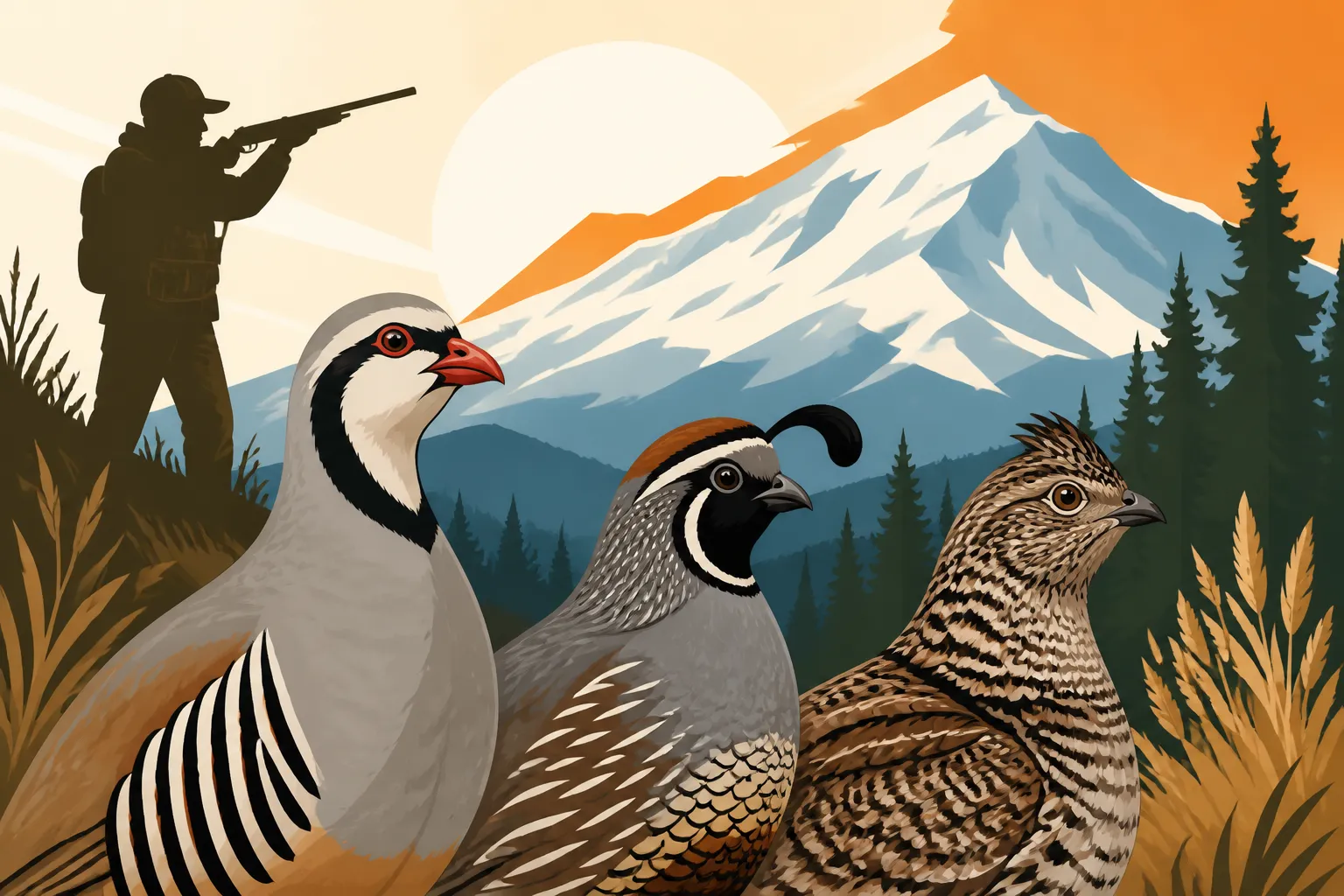
Chukar, Quail and Grouse in Washington
It's no secret that Washington is a big game hunter's paradise, but for those of us who appreciate the thrill of wing-shooting, the state offers some incredible opportunities for upland birds. However, chasing chukar, quail, and grouse across Washington's diverse landscapes can be incredibly challenging, from the steep, rocky draws of the eastside to the thick, damp timber of the west. This guide aims to pull back the curtain on hunting these elusive birds, giving you a comprehensive look at their habitats, behaviors, and the best strategies to put some birds in your vest.
Chukar Hunting in Washington's Arid Canyons
If you've ever heard a chukar's distinctive "chuk-chuk-chuk-kar" call echo through an arid canyon, you know the addiction. These birds are legendary for their preference for steep, rocky, unforgiving terrain, and hunting them is often described as a brutal, exhilarating workout. But oh, the reward! Their speed and the difficulty of accessing their habitat make them a truly coveted bird for many Washington upland enthusiasts.
Locating Chukar Habitat and Habits
Chukar thrive in specific, often harsh, environments. Think steep, rocky slopes, canyon country, and dry, open areas with scattered sagebrush and cheatgrass. You'll find them predominantly east of the Cascade Mountains, especially in the central and southern parts of Eastern Washington. Areas like the Columbia River breaks, the Snake River canyon, and many of the smaller tributary canyons offer classic chukar country. These birds are very dependent on water sources, so scouting out springs, seeps, and small creeks is crucial. Even a tiny, hidden trickle can hold a covey, especially during dry spells. They prefer to run uphill when spooked, using their strong legs to escape danger, often leading hunters on grueling climbs.
Their daily routine often involves feeding on seeds, grasses, and insects in the morning and late afternoon, often near a water source, then loafing on rocky outcrops during the heat of the day. Understanding this pattern is key to intercepting them. Early mornings are often your best bet, catching them as they move from roosting areas to feeding grounds. As the day warms, they'll seek shade and shelter, making them harder to find unless you know their preferred loafing spots on steep, rugged slopes. A solid e-scouting platform like GoHunt can be invaluable for pinpointing these water sources and identifying promising terrain from home.
Effective Strategies for Chukar Success
Hunting chukar demands a different kind of fitness and mental fortitude. It's not a casual stroll. You'll be climbing, descending, and traversing steep, uneven ground all day. Good footwear is paramount – think sturdy, ankle-supporting boots with excellent traction, perhaps something like the specialized boots recommended for "Boots for Steep Eastside Country". A reliable bird dog, typically a strong-ranging setter or pointer, is almost a necessity for chukar. They can cover vast amounts of ground and pinpoint scent in the swirling canyon winds, but even the best dog will be pushed to its limits by the terrain and the birds' tendency to run.
When you find a covey, be prepared for an explosive flush. They often hold tight until you're right on top of them, then explode in multiple directions, often flying downhill at incredible speeds. If you get a shot, take it, but don't dwell on misses. Instead, pay close attention to where the birds fly. Chukar will often fly down and across a canyon to land on another steep slope, where they'll immediately start running uphill again. Mark their landing spot mentally, then make a plan to get to that location, understanding it might involve a significant climb or descent. Carrying enough water for yourself and your dog is non-negotiable, and trekking poles can save your knees on those brutal descents. Remember, sometimes finding one bird from a scattered covey is success enough; they often won't regroup in the same spot immediately.
Quail Hunting Across Washington's Diverse Habitats
Quail hunting in Washington is a fantastic experience, offering fast-paced action and the joy of working a good bird dog. While not as brutal as chukar, it still presents its own set of challenges and rewards. Washington is home to several species, but the California Quail (also known as the Valley Quail) and Gambel's Quail are the most commonly pursued, with Bobwhite Quail also present in some localized areas. Each offers a slightly different hunting scenario, making quail a varied target for upland hunters.
Identifying Quail Species and Their Environments
California Quail are perhaps the most widespread and recognizable quail species in Washington, found primarily in Eastern Washington, but also in some pockets west of the Cascades. They prefer brushy habitats, often near agricultural fields, riparian zones along rivers and creeks, and dense cover like blackberry thickets or old orchards. Their iconic "chi-ca-go" call is a common sound in these areas. You'll frequently find them in larger coveys, often 20-50 birds, which makes for exciting flushes. They are known for both running and flying, sometimes leading you on a merry chase through the cover.
Gambel's Quail are less common and more restricted in their range, primarily found in the extreme southeastern corner of the state, often in truly desert-like terrain. They tend to be a bit larger and more vibrant in color than California Quail, with a distinctive topknot. Their habitat often overlaps with chukar in the lower, less steep sections of arid canyons, but they also use denser brush and prickly pear cactus patches. Bobwhite Quail are a non-native species with very limited, localized populations, primarily around cultivated fields and dense brush. Knowing the difference helps you identify prime real estate on your e-scouting maps, perhaps using tools similar to those described for "E-Scouting Washington GMUs Before the Draw".
Tactics for Locating and Flushing Quail
Quail hunting is often a game of "hide and seek" in dense cover. A good, close-working bird dog is incredibly valuable here, helping to pinpoint scent and hold birds. California Quail, especially, will run extensively before flushing, using thickets and brush lines to evade predators. It's not uncommon for a covey to run several hundred yards through a fenceline or ditch bank before finally taking to the air. Walking edges, particularly where brushy cover meets open fields or water, is a highly effective strategy. Think about those transitional zones where they can feed easily but quickly duck into dense protection.
When a covey flushes, it's usually an explosive, noisy affair, with birds scattering in all directions. This can be disorienting, but try to pick out a single bird and focus on it. Unlike chukar, quail often don't fly as far, and they tend to land in nearby cover. This allows for excellent "re-flushing" opportunities. After the initial covey rise, mark where individual birds land and then systematically work those areas with your dog. These singles often hold tighter than the original covey, offering a better shot. Sometimes, two hunters working parallel lines, 20-30 yards apart, can effectively push coveys out of thick cover and create flushing opportunities. A smaller gauge shotgun, like a 20-gauge, is often preferred for quail due to their speed and the closer shooting distances, and quick, intuitive shooting is a must.
Grouse Hunting in Washington's Forests
Grouse hunting offers a completely different experience than chasing chukar or quail. Instead of arid canyons or brushy fields, you'll find yourself immersed in Washington's vast forests, from the dense conifer stands of the westside to the mixed forests and aspen groves of the east. Washington is home to several species of grouse, including Ruffed Grouse, Dusky (Blue) Grouse, Spruce Grouse, and the less common Sharp-tailed and Sage Grouse. Each presents a unique challenge and habitat preference, making for a diverse and engaging hunt.
Where to Find Washington's Forest Grouse
Ruffed Grouse are arguably the most iconic forest grouse and are found across much of forested Washington, both east and west of the Cascades. They prefer young, regenerating forests with a mix of deciduous and conifer trees, often near water sources, creek bottoms, and dense alder or willow thickets. Their signature "drumming" sound is a familiar part of the fall woods. They are known for flushing explosively, often putting a tree between themselves and the hunter, making for notoriously difficult shots.
Dusky Grouse, sometimes still referred to as Blue Grouse, are typically found at higher elevations in mature conifer forests. Eastside hunters often find them on ridge tops and south-facing slopes, particularly where huckleberry patches thrive. Westside hunters might find them along old logging roads higher up in the mountains. They are often more terrestrial than Ruffed Grouse, sometimes walking rather than flying, and can be notoriously "foolish" or surprisingly wild. Spruce Grouse are found in the colder, higher-elevation evergreen forests, often quite a bit further north in the state. They are known for being very tame, almost oblivious to human presence. Ruffed Grouse in Washington Forests provides more insight into their specific behaviors.
Strategies for Still-Hunting and Dog Work
Hunting forest grouse often involves a blend of still-hunting and dog work. For Ruffed Grouse, slowly walking through prime habitat, pausing frequently, and using your ears is key. Listen for rustling leaves, wing beats, or their distinctive "poot" call. These birds can be incredibly hard to spot until they burst into the air. A flushing dog, like a Springer Spaniel or a well-trained Labrador, can be very effective at getting them to fly, but be prepared for rapid shots in dense cover. For the foot hunter, move at a snail's pace, constantly scanning for movement and signs of birds. Look for areas with dense undergrowth, old logging roads that have grown in, and the edges of clearings.
Dusky Grouse, especially the "foolish" ones, can sometimes be spotted walking along logging roads or perched in trees. They may allow you to approach quite closely before taking flight, often in a more deliberate, less explosive manner than a Ruffed. For these, a careful approach with a small gauge shotgun or even a .22 rifle can be effective. However, be aware that many grouse, especially in heavily hunted areas, will be much wilder. A good strategy for all grouse is to target transitional zones where different forest types meet, or where timber meets a small opening. These edge habitats are often preferred by multiple species of game. For those who enjoy a more solitary hunt, still-hunting through thick timber, similar to some techniques described in Still-Hunting Blacktails in Wet Washington Brush, can be very productive.
Planning Your Washington Upland Adventure
Now that you've got a handle on the different species and their preferred haunts, it's time to put together a plan. Washington's vast public lands offer incredible opportunities, but success often hinges on good preparation, understanding regulations, and being equipped for the challenge.
Essential Gear and Regulations
Upland hunting in Washington requires some specific gear. For shotguns, a 12 or 20 gauge with improved cylinder or modified chokes is generally versatile enough for all three species. Bring plenty of shells; these birds can be missed! Good walking boots are crucial, especially for chukar, and reliable rain gear is a must for westside grouse hunts, or even unexpected eastside showers. You'll also need a hunting vest with a game bag, a water bottle, and a first-aid kit. If you're hunting with a dog, don't forget their water, food, and protective gear if needed.
Always consult the most current Washington Department of Fish and Wildlife (WDFW) hunting regulations pamphlet for season dates, bag limits, and specific unit restrictions. These can change annually, and it's your responsibility to know the rules. For example, some areas might have restrictions on specific species or weapon types. You'll also need a valid Washington hunting license and a Washington Small Game Licence. You can often buy these online through the WDFW licensing system.
| Species | Preferred Habitat | Typical Terrain | Hunting Style | Shotgun Gauge Suggestion | Dog Type |
|---|---|---|---|---|---|
| Chukar | Arid, rocky canyons, sagebrush, cheatgrass, water sources | Steep, rugged, open slopes | Aggressive walking, climbing, dog-assisted flushing | 12 or 20 gauge | Ranging Pointer/Setter |
| California Quail | Brushy draws, riparian zones, agricultural edges, dense cover | Rolling hills, creek beds, fencelines | Walking edges, dog-assisted flushing, re-flushing singles | 20 or 28 gauge | Close-working Flusher/Pointer |
| Dusky Grouse | High-elevation mature conifer forests, huckleberry patches | Ridge tops, steep slopes, old logging roads | Still-hunting, slow walking, dog-assisted pointing/flushing | 12 or 20 gauge | Pointing or Flusher |
| Ruffed Grouse | Young, regenerating forests, creek bottoms, dense deciduous cover | Mixed timber, brushy clearings, alder thickets | Still-hunting, slow walking, flushing dog | 12 or 20 gauge | Close-working Flusher |
| Spruce Grouse | Cold, high-elevation evergreen forests | Dense conifer stands | Still-hunting, opportunistic encounters | .22 rifle or small gauge | Not typically used |
Finding Public Access and Using Technology
Washington boasts an impressive amount of public land accessible for hunting. This includes National Forests, DNR lands, and WDFW Wildlife Areas. However, identifying legal access points and understanding land ownership can be tricky. Tools like GoHunt or similar mapping applications are invaluable here. They allow you to overlay land ownership data, identify public/private boundaries, and locate roads and trails. You can mark potential water sources for chukar, dense cover for quail, or specific timber stands for grouse. This is especially helpful for finding access points to areas like the Gifford Pinchot National Forest Units or the Okanogan-Wenatchee Forest Access.
Remember that some private timber companies in Western Washington require permits or have specific access rules. Always check current conditions before you head out. Even on public lands, familiarize yourself with "Washington Green Dot Road Systems" and other access restrictions. Getting out and physically scouting before the season, or at least during early seasons, is incredibly beneficial. This allows you to identify active areas, find fresh sign, and get a feel for the terrain, which a map can only partially convey. Don't be afraid to put in the miles; the best upland hunting spots are often off the beaten path.
The Unique Challenges and Rewards of Upland Hunting
Upland hunting is truly a passion sport, often more about the experience than the harvest. It pushes you physically, challenges your shooting skills, and builds an incredible bond with your hunting partners and, especially, your dog.
Embracing the Grind and Celebrating Success
Chasing chukar in Washington is often called a "poor man's sheep hunt" for a reason – the vertical miles you put in can be staggering. You'll be tired, your legs will burn, and you might come home with an empty vest more often than not. But the moments of success, the explosive flush of a covey of quail or the heart-stopping thunder of a ruffed grouse, are etched into your memory. It's about adapting to the conditions, reading the landscape, and celebrating every bird you put in the bag. These are often solitary pursuits, making the camaraderie with a hunting buddy even more meaningful when you share a hard-earned success.
The beauty of Washington's diverse landscape means you can spend one weekend chasing chukar in the dry, expansive coulees of the east, and the next weekend hiking through misty, old-growth forests for grouse on the Olympic Peninsula. This variety keeps things fresh and ensures there's always a new challenge. It’s a great way to explore parts of Washington you might otherwise never see, often connecting you deeply to the natural world.
Contributing to Conservation and Ethical Hunting
As upland hunters, we play a crucial role in conservation. License fees directly fund WDFW efforts in habitat management and species research. Practicing ethical hunting, including respecting private property, knowing your target, and making clean shots, is paramount. Always retrieve downed birds quickly and ensure you adhere to bag limits. Taking care of the land, by packing out what you pack in, and even picking up stray garbage you find, helps preserve these incredible opportunities for future generations.
If you're new to upland hunting, consider reaching out to experienced hunters in your area or joining local conservation groups like Pheasants Forever or the Ruffed Grouse Society. They often have mentors and resources that can help you get started on the right foot. Washington's upland birds offer some of the most exciting and rewarding hunting experiences available, provided you're willing to put in the effort.
Disclaimer
This article is for general informational purposes only and does not constitute professional advice. Laws, prices and regulations vary by location and change over time. Consult a qualified professional for guidance on your specific situation.