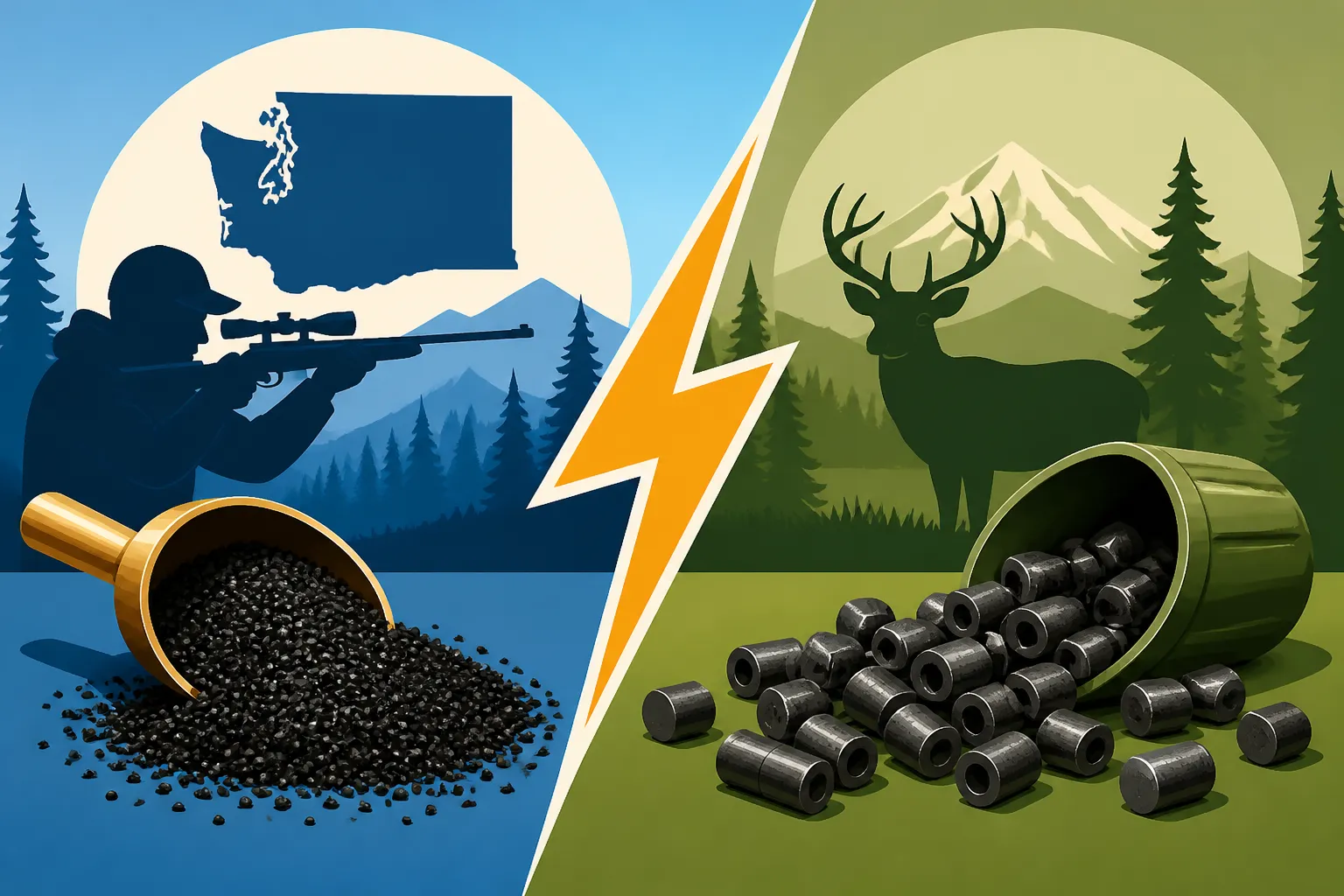
Loose Powder Versus Pellets
Muzzleloader hunting in Washington offers a unique challenge and a deep connection to the hunt, but deciding between loose powder and pre-formed pellets can feel like stepping into a historical debate with modern implications. Hunters often grapple with balancing tradition, accuracy, convenience, and the unpredictable weather of our state. This guide will meticulously break down the pros and cons of both options, helping you make an informed choice for your next Washington muzzleloader season.
Understanding Muzzleloader Propellants: The Foundation of Your Shot
Choosing the right propellant is arguably one of the most critical decisions a muzzleloader hunter makes, impacting everything from accuracy to safety. Many new to muzzleloading, or even seasoned hunters crossing over from modern firearms, might not fully grasp the nuances that differentiate various powder options. It's not just about making the bullet go bang; it's about making it go bang consistently and accurately, especially when a trophy animal is in your sights.
How Muzzleloaders Work with Powder
At its core, a muzzleloader is a remarkably simple firearm. You load the projectile and propellant from the muzzle, hence the name. The propellant, whether loose powder or a pellet, sits at the bottom of the barrel, followed by a wadding (in some cases), and then the projectile itself. The firing pin strikes a primer (for percussion or inline systems) or a spark ignites the pan (for flintlocks), sending a flame or hot gas into the breech plug, which then ignites the main powder charge. This rapid burning creates enormous pressure, expelling the projectile down the barrel and towards your target. The key is consistent, reliable ignition and a predictable burn rate to ensure the bullet travels true.
Traditional black powder muzzleloaders, often still seen in reenactments or by purists, can be quite finicky. The powder needs to be kept absolutely dry, and the loading process, while meditative, requires practice to achieve consistent results. Modern inline muzzleloaders, on the other hand, have closed breech systems and use 209 shotgun primers, making them far more weather-resistant and reliable for hunting. Understanding the specific type of muzzleloader you’re using is paramount to selecting the appropriate propellant and ensuring safe, effective operation in the field.
Types of Black Powder and Substitutes
When we talk about muzzleloader propellants, we're primarily looking at two main categories: genuine black powder and its modern substitutes. Genuine black powder, often referred to as "Goex" or "Schuetzen," is a mixture of potassium nitrate, charcoal, and sulfur. It's graded by grain size (e.g., Fg for cannons, FFg for large bore rifles, FFFg for pistols and smaller rifles, FFFFg for priming pans) and burns very dirty, leaving behind a corrosive residue that demands immediate and thorough cleaning. The distinct, dense smoke cloud it produces is part of its nostalgic appeal but can obscure your view for a follow-up shot.
Black powder substitutes, like Hodgdon's Pyrodex, Triple Seven (often abbreviated as 777), and the increasingly popular Alliant Black MZ or Hodgdon BH209, were developed to offer similar ballistic performance with less fowling and easier cleanup. These substitutes are generally less corrosive and some, like BH209, are almost smokeless and can even be cleaned with modern solvent. However, each substitute has its own quirks regarding recommended loads, storage, and cleaning solutions. For example, Triple Seven can generate higher pressures than real black powder, requiring careful load reduction, while BH209 needs a specific primer and often a clean-out jag before each shot for best accuracy. Navigating these options is part of the muzzleloader journey, and knowing what your rifle prefers is key to a successful hunt.
The Art and Precision of Loose Powder
For many dedicated muzzleloader hunters, especially those chasing big game in Washington's rugged terrain, loose powder isn't just a choice; it's a commitment to precision and tradition. There's a certain satisfaction that comes from carefully measuring each charge, knowing you've tailored it exactly to your rifle's preferences. It’s an art form that pays dividends in accuracy, particularly when ethical shot placement is your top priority.
Advantages of Loose Powder for Customization and Accuracy
The primary appeal of loose powder lies in its unparalleled ability to be customized. Unlike pre-formed pellets, which come in fixed charge weights, loose powder allows you to fine-tune your load down to a single grain. This granular control means you can experiment to find the "sweet spot" for your particular rifle, barrel harmonics, and chosen projectile. You might discover that your rifle groups best with, say, 95 grains of FFFg Pyrodex, rather than the 100-grain equivalent offered by a pellet. This meticulous process often results in tighter groups on the target, translating directly to increased confidence in the field. When you're planning a challenging hunt, perhaps for Roosevelt Elk of Western Washington, and every shot counts, that level of precision can make all the difference.
Furthermore, hunters can adjust powder charges for different projectiles, conditions, or even game animals. A lighter load might be perfect for deer, while a heavier charge is more appropriate for elk. This flexibility is a huge advantage for those who truly want to wring every bit of accuracy out of their muzzleloader. Resources like GoHunt, with its extensive forums and community knowledge, can be invaluable for researching load data and seeing what combinations other Washington hunters have found success with. It's all about matching the load to your individual setup and hunting scenario.
The Skill and Challenges of Using Loose Powder
While the precision of loose powder is enticing, it demands a higher level of skill and attention to detail, both at the range and especially in the field. Measuring consistent charges requires a quality powder measure and careful technique. Any variation in powder compression or seating can significantly affect accuracy. Imagine trying to reload quickly during a sudden rain shower on a brisk November morning in the Blue Mountains; fumbling with a powder measure and flask while trying to keep everything dry can be a frustrating experience. Muzzleloader Loading and Ignition in Rain highlights these very difficulties, emphasizing the need for practice in less-than-ideal conditions.
Cleaning is another major consideration. While some modern loose substitutes offer easier cleanup, traditional black powder is notoriously corrosive. If not thoroughly cleaned immediately after shooting, it can quickly pit and damage your barrel. This means carrying cleaning supplies in the field, or at the very least, a quick field swab, if you plan on multiple shots or even just testing your load. The extra steps involved with loose powder, from measuring to cleaning, add to the overall time commitment and can be a deterrent for hunters prioritizing convenience. It's a trade-off: unparalleled customization for a bit more effort and meticulousness.
The Convenience and Consistency of Pellets
On the other end of the propellant spectrum are pellets, which have revolutionized muzzleloader hunting for many, offering a streamlined approach that appeals to both newcomers and seasoned hunters alike. They address many of the practical challenges associated with loose powder, making the loading process faster, cleaner, and often more consistent in the heat of the moment.
Benefits of Pre-Measured Pellets for Ease of Use
The most obvious advantage of pellets is their sheer convenience. They come in pre-measured, compressed charges, typically 50-grain equivalents, designed to stack in your barrel. This eliminates the need for a powder flask and measure, significantly speeding up the reloading process. Imagine you’ve taken a shot at a bull elk in thick timber, and for whatever reason, you need a quick follow-up. Fumbling with loose powder in a high-stress situation, especially with cold, wet hands, is the last thing you want. With pellets, it's a simple matter of dropping them down the barrel, seating your projectile, and capping your primer. This ease of use greatly reduces the potential for human error in charge measurement, leading to more consistent performance from shot to shot, particularly for hunters new to muzzleloading or those who don't spend countless hours at the range.
Furthermore, pellets are much cleaner to handle than loose powder. There's no spilled powder to worry about, no residue on your hands or equipment. This is a huge benefit when you're trying to keep your gear tidy in a backcountry camp or when loading in dusty or muddy conditions. For Washington hunters concerned about Keeping a Muzzleloader Dry in Washington Rain, the sealed, pre-formed nature of pellets can offer a small but significant advantage in maintaining powder integrity until ignition, reducing the chance of moisture compromising your charge.
Limitations and Considerations for Pellets
While pellets offer undeniable convenience, they do come with certain limitations. The biggest is the lack of flexibility in load development. You're typically stuck with fixed increments, most commonly 100 or 150 grains (two or three 50-grain pellets). If your muzzleloader shoots its best groups with, say, 110 grains of powder, you're out of luck with pellets. This fixed nature can sometimes lead to slight compromises in absolute accuracy compared to a meticulously developed loose powder load. While the consistency of pellets is generally good, some rifles just don't "like" them, and finding the perfect projectile/pellet combination might still require experimentation.
Another common concern revolves around potential air gaps. When stacking pellets, especially in a dirty barrel, there's a chance a small air gap can form between pellets or between the top pellet and the projectile. While not necessarily dangerous with modern inline rifles and substitutes, it can sometimes affect accuracy. Also, certain pellets, particularly those designed for specific primer types, might not perform optimally in all muzzleloader systems. It's crucial to consult your rifle's manual and the pellet manufacturer's recommendations. Finally, some pelletized propellants are more expensive per shot than loose powder, which can add up over a season of practice and hunting. Understanding Washington's Muzzleloader Equipment Rules is vital, as they outline acceptable propellants, calibers, and other specifications.
Choosing Your Muzzleloader Fuel for Washington Hunts
The decision between loose powder and pellets isn't about one being inherently "better" than the other; it's about finding the best fit for your specific hunting style, your muzzleloader, and the unique challenges presented by Washington's diverse hunting grounds. Both options have distinct advantages that, when understood, can significantly enhance your muzzleloading experience.
Matching Your Choice to Washington's Diverse Conditions
Washington hunting conditions are as varied as its geography. On the western side of the Cascades, you're often battling persistent rain, fog, and dense, wet vegetation. Here, the convenience and relative moisture resistance of pellets can be a significant advantage, reducing the worry of damp powder when reloading. The faster loading time could also be beneficial if you're trying to quickly capitalize on a fleeting opportunity in the thick timber. For Eastside hunters, particularly in the arid sagebrush or high country, keeping powder dry might be less of a challenge, allowing more freedom to explore the accuracy benefits of loose powder. However, wind can be an issue, potentially affecting loose powder measurement.
Your hunting style also plays a huge role. If you're a patient spot-and-stalk hunter meticulously working through open country, perhaps glassing from a ridge, you might prioritize the pinpoint accuracy loose powder offers for those longer shots. Muzzleloader Accuracy at 100 Yards becomes paramount in such scenarios. However, if you're still-hunting in dense coastal timber where shots are often up close and fast, the rapid reloading of pellets could be more appealing. Consider how you hunt and where you hunt, as these factors should heavily influence your propellant choice.
Legality, Testing, and Practice
Regardless of whether you choose loose powder or pellets, understanding Washington's specific regulations for muzzleloader hunting is non-negotiable. The state has clear rules regarding minimum caliber (like Washington's .45 Caliber Muzzleloader Minimum), projectile types, and even what optics are permissible (often no magnified scopes, as covered in Why Washington Restricts Muzzleloader Scopes). Always consult the current WDFW regulations pamphlet before the season. Missing a critical detail could mean a ruined hunt or worse.
The most critical step after making your choice of propellant is extensive range testing. Your muzzleloader will have its own personality, and what works wonders for one rifle might be mediocre in another. Spend time at the range, trying different powder charges (within safe limits), different projectiles, and various loading sequences. This is where you really dial in your rifle for Sighting In Before the Opener. Practice not just from a bench, but from realistic field positions like kneeling or offhand, as detailed in Practicing Offhand and Kneeling Shots. Pay close attention to consistency and group sizes. Consider using mapping and planning tools like GoHunt to scout potential hunting units, which can help you anticipate shot distances and terrain, further informing your practice sessions. Remember, a Washington Multi-Season Tags and Three Chances gives you opportunities across different weapon types, so mastering your chosen muzzleloader setup is key. Don't forget to confirm your zero, especially after any travel or rough handling, as discussed in Zeroing at 100 or 200 Yards.
| Feature | Loose Powder | Pellets |
|---|---|---|
| Customization | High (exact charge weights) | Low (fixed increments, usually 50 gr) |
| Accuracy | Potentially higher with fine-tuning | Generally good, consistent |
| Loading Speed | Slower (requires measuring) | Faster (pre-measured) |
| Cleanliness | Messier (potential for spills) | Cleaner (contained charges) |
| Moisture Res. | Lower (requires careful handling) | Higher (compressed, less exposed) |
| Field Use | Requires more steps, practice under pressure | Simpler, quicker reloading |
| Cost | Generally lower per shot | Often higher per shot |
| Availability | Varies (often specialty stores) | Widely available, popular |
| Cleaning | Specific to powder type, critical for BP | Specific to substitute type |
Disclaimer
This article is for general informational purposes only and does not constitute professional advice. Laws, prices and regulations vary by location and change over time. Consult a qualified professional for guidance on your specific situation.