Using a Light to Track After Dark
There are few moments in hunting more gut-wrenching than watching a good hit animal disappear into the timber as daylight fades, leaving you with a sparse, fading blood trail and the creeping anxiety of an unrecovered animal. This guide is dedicated to helping you master the art of using artificial light sources to meticulously follow that trail, ensuring you fulfill your ethical obligation and bring your hard-earned wild game home, even when darkness falls over the rugged landscapes of Washington.
The Critical Importance of Tracking After Dark
The sun dipping below the horizon doesn't magically erase your responsibility as a hunter. In fact, it often intensifies it. Losing a trail simply isn't an option, especially in Washington's varied and often unforgiving terrain.
Ethical Responsibility and Meat Salvage
Every hunter understands the deep, ethical obligation to recover any animal they shoot. It’s not just about filling the freezer; it's about respecting the animal, the land, and the privilege of hunting. When darkness falls, this responsibility becomes even more pressing. The clock starts ticking on meat spoilage, particularly during Washington’s warmer early seasons for deer and elk. A warm night in September or early October can turn perfectly good game meat into a biological hazard surprisingly quickly. Imagine the despair of finding your animal in the morning, only to realize the meat is tainted. It’s a devastating scenario we all want to avoid. That initial shot is only the beginning of the hunt; the recovery is the culmination, and it demands our full effort, day or night.
Safety Considerations When Tracking at Night
Tracking a wounded animal after dark isn't just physically demanding; it carries significant safety risks that can easily be overlooked in the adrenaline rush. Navigating Washington's diverse terrain—from the steep, rocky slopes of the Blue Mountains to the dense, tangled undergrowth of the Olympic Peninsula—becomes exponentially more dangerous when visibility is limited. A simple twisted ankle can quickly escalate into a serious problem when you're miles from the truck, especially in areas with limited cell service.
Beyond navigation, there's the very real concern of wildlife encounters. A wounded animal, particularly a bear or cougar, can be dangerous, and approaching a bedded, injured animal in the dark is a situation that demands extreme caution. Even elk or deer, when cornered and hurt, can be unpredictable. Being mentally prepared for these possibilities, and having a plan, is paramount. Furthermore, it's incredibly easy to become disoriented in the dark, especially in vast national forests like the Okanogan-Wenatchee or Gifford Pinchot. Before you even head out, ensure your First Aid Kit for a Remote Hunt is well-stocked and accessible, and that someone knows your general hunting area and expected return time. Knowing Getting Cell Service in a Washington Unit can be tricky, always have a backup communication plan, like a satellite messenger, if you're venturing deep into the backcountry.
Essential Lighting Tools for Night Tracking
When the light fades, your lighting tools become your most crucial allies. Don't skimp here; reliable, powerful illumination is non-negotiable for successful night tracking.
Headlamps Your Primary Illuminator
A good headlamp is, without a doubt, the most important piece of gear for tracking after dark. The hands-free operation it provides is absolutely critical, allowing you to carry your weapon safely, use trekking poles for stability, or manipulate flagging tape without juggling a flashlight. When choosing a headlamp, consider its lumen output. While you don't need spotlight intensity all the time, having a high-lumen setting (200-500+ lumens) is invaluable for scanning wider areas or penetrating dense brush to pick up distant signs. Look for models with adjustable brightness settings, so you can dial it down for close-up blood trailing without blinding yourself or others, conserving battery life in the process.
The beam type is also important. Many headlamps offer a combination of a focused spot beam for distance and a wide flood beam for peripheral vision. A flood beam is excellent for finding the general direction of travel, while a spot beam helps pick out specific drops of blood or disturbed ground. Battery life is another huge factor; always carry spare batteries or a fully charged power bank for rechargeable models. Lithium batteries tend to perform better in cold Washington weather. Finally, given our often-damp environment, ensure your headlamp is water-resistant, if not fully waterproof. You'll be thankful for it when the inevitable rain starts falling, making the task of Blood Trailing in Salal and Devil's Club even more challenging. Reliable brands like Petzl, Black Diamond, or Fenix are popular choices among Washington hunters for their durability and performance.
Handheld Flashlights and Lanterns
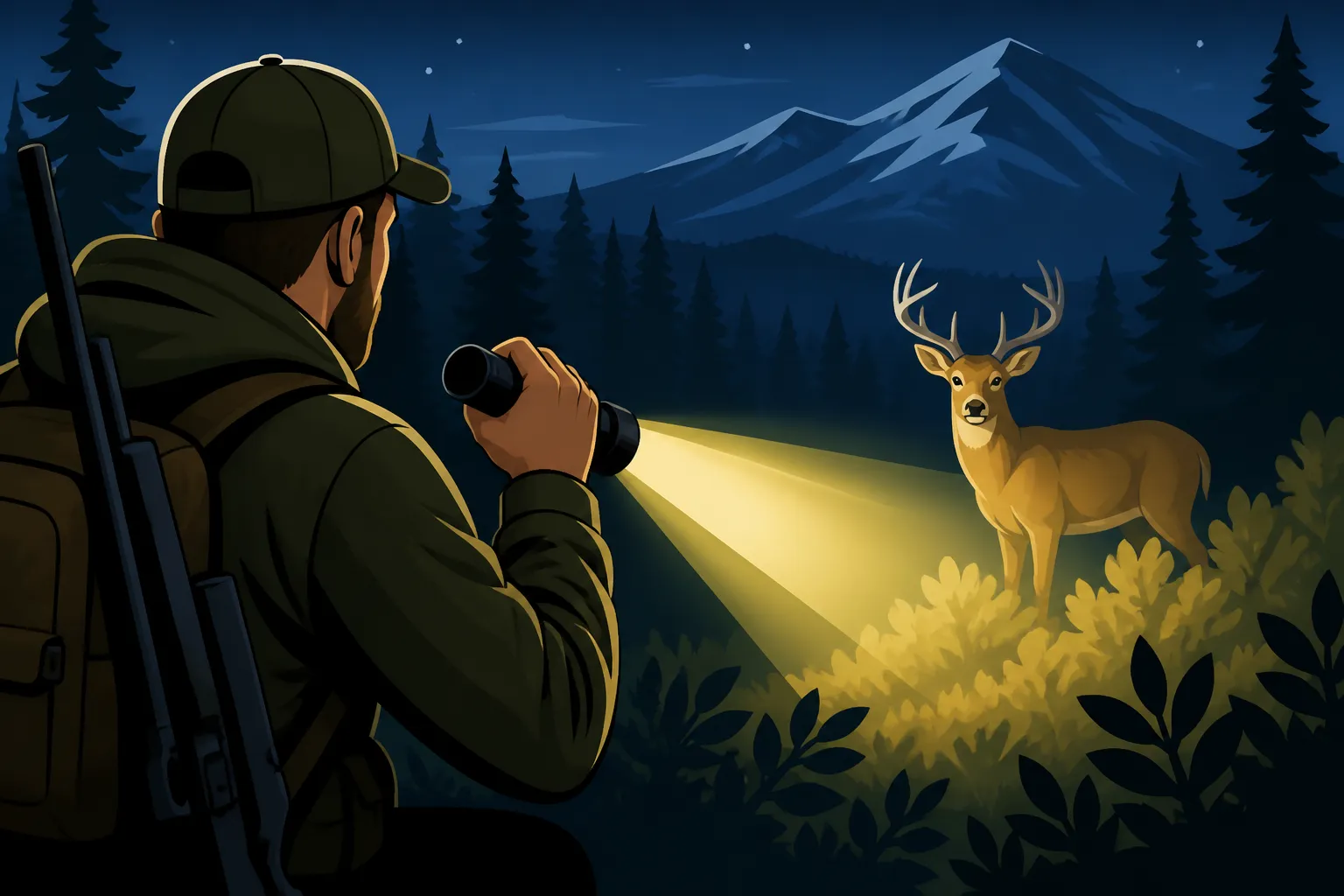
While a headlamp handles your primary illumination, a powerful handheld flashlight serves as an excellent secondary light source and can often be a game-changer. A strong handheld beam, typically 500-1000+ lumens, can cut through fog or dense timber more effectively than a headlamp, allowing you to sweep larger areas or pinpoint specific blood spatter. It’s particularly useful for a hunting partner to use while you’re focusing on the trail with your headlamp. One person can focus on the minute details, while the other can scan ahead or to the sides for larger disturbances or a bedded animal.
Lanterns, though not for active tracking, are invaluable once the animal is recovered. They provide ambient light for field dressing, quartering, and preparing the meat for transport. Imagine trying to perform the gutless method in pitch black with just a headlamp; a lantern dramatically improves visibility and safety around sharp knives. Brands like Streamlight or Maglite offer robust handheld options that can withstand the rigors of a Washington hunt. Always ensure these tools are built tough and have reliable battery life; carrying extra batteries for all your devices is simply good practice.
UV Lights A Debated but Useful Tool
The topic of UV lights for blood trailing often sparks debate among hunters, and for good reason. The theory is that blood, and other bodily fluids, will fluoresce or "glow" under UV light, making it easier to spot on certain backgrounds. In practice, however, it's rarely a magic bullet. While some hunters swear by them, many find their effectiveness highly situational.
UV lights can work on some surfaces, particularly light-colored rocks, dry leaves, or certain types of soil. They can sometimes highlight very faint, dried blood. However, their limitations are significant. On wet leaves, dark soil, or blood that has been diluted by rain, a UV light often performs poorly. Furthermore, a strong white light often does a better job of reflecting off the sheen of fresh blood. The biggest issue is managing expectations; a UV light should be considered a supplemental tool, not a replacement for a powerful white light. If you decide to carry one, integrate it into your strategy cautiously, perhaps for those truly frustrating moments when the trail seems to vanish completely. But don't rely on it as your primary method for Using a Light to Track After Dark.
Strategies for Effective Night Tracking in Washington
Successful night tracking isn't just about having the right gear; it's about having the right mindset and a systematic approach. Panic is the enemy of efficient blood trailing.
Preparing for the Worst Before the Shot
The most effective night tracking begins well before you even pull the trigger. After you take a shot, don't just immediately charge after the animal. Take a moment to compose yourself and thoroughly mark the exact spot you were standing when you shot, and the exact spot where the animal was standing (or where you last saw it). Use bright flagging tape, or better yet, drop a GPS waypoint using a mapping app like GoHunt. This simple act of marking the shot site precisely is the single most critical step you can take. It creates a solid anchor point from which to begin your search.
Next, pay close attention to the animal's immediate reaction and direction of travel. Did it flinch? Did it stumble? Did it run uphill, downhill, or parallel to a ridge? Note any obvious landmarks in its path. Did it enter a specific thicket, cross a clearcut, or disappear over a ridgeline? Mentally mapping its initial escape route, even if it's just for 50 yards, can save hours of searching later. For instance, if you're hunting blacktail deer in Western Washington's dense timber, knowing if it hit a specific Reading Clearcuts and Reprod for Blacktail Bucks can be vital. Finally, consider a waiting period. While adrenaline might scream "go!", waiting an appropriate amount of time (often 30 minutes to an hour for a well-hit deer, or even longer for an elk with a questionable hit) can allow the animal to bed down and expire, rather than being pushed further. Always have a small "track kit" ready with flagging tape, a good headlamp, gloves, and a small first-aid kit.
Systematic Tracking Techniques After Dark
Once you're ready to hit the trail after dark, move slowly and systematically. Your primary goal is to find the last confirmed blood sign and then methodically expand your search from there. Start at the impact site and slowly follow the animal’s known direction of travel. Use your headlamp to constantly sweep the ground in front of you, looking for any sign of blood. Blood is usually easiest to spot on light-colored leaves, moss, or bare earth. Don't just look for bright red drops; sometimes it's dark clots, splashes, or even tiny smears on vegetation.
When you find a spot of blood, mark it with flagging tape, and then continue looking in the direction of travel. If you have a hunting partner, one person can stay at the last mark while the other searches ahead, creating a "leapfrog" effect. If the trail becomes sparse or disappears entirely, conduct a meticulous grid search around the last known blood. Expand outwards in concentric circles or in a systematic grid pattern. Look not just for blood, but for disturbed moss, overturned leaves, broken twigs, scuff marks on the ground, or even hair. In very dense cover, using your hands to feel for disturbed ground can sometimes reveal a faint trail that light alone misses. On particularly stubborn trails, GoHunt's map features allow you to mark each spot you find blood, creating a visual breadcrumb trail on your device, which is invaluable if you need to retreat and regroup. Patience is paramount; a hasty search will almost always result in a lost animal. Remember, it's often a case of Blood Trailing in Salal and Devil's Club, where every tiny clue matters.
Overcoming Specific Challenges in Washington Terrain
Washington's diverse landscapes throw unique challenges at night trackers. In thick timber and dense undergrowth, like the infamous salal and devil's club of Western Washington, lights can sometimes work against you. The strong beam can create a "ghosting" effect, where reflections off wet leaves or a myriad of shadows make it harder to discern the subtle sheen of blood. Here, a softer flood beam on your headlamp can be more effective than a piercing spot. Move slowly, literally parting the brush with your hands while sweeping the ground.
Wet conditions are another beast. Rain can quickly dilute and wash away blood, making the trail incredibly difficult to follow. In these situations, focus intensely on physical signs: broken branches, tracks in soft mud, or disturbed vegetation. If there's fresh snow, blood becomes easier to see, but tracks can be misleading, especially in the dark. Be cautious when Tracking a Buck After a Fresh Snow, as fresh flakes can quickly obscure tracks, and faint impressions can be misinterpreted. Steep, rocky terrain, common in Eastern Washington's breaks, presents a different hazard. Not only is it easy to slip and fall, but blood can drip into crevices or run quickly downhill, making its original location hard to pinpoint. In these scenarios, always prioritize safety over speed. If the terrain becomes too dangerous, it’s always better to retreat and return at first light. Marking your progress on a mapping application can help identify potential escape routes and avoid unnecessary backtracking in treacherous areas.
| Light Type | Lumens Range | Beam Type | Battery Life (High) | Pros | Cons |
|---|---|---|---|---|---|
| Headlamp | 100-1000+ | Flood/Spot | 2-8 hours | Hands-free, adjustable, essential for primary tracking. | Lower lumens than handhelds, reflections can be an issue in dense cover, limited throw. |
| Handheld Flashlight | 500-2000+ | Spot/Flood | 1-6 hours | Powerful throw, cuts through fog, great for scanning, excellent secondary light. | Requires a free hand, can be cumbersome with a weapon, strong beam can over-illuminate close-up blood. |
| UV Light | N/A | Wide flood | 4-12 hours | Can make blood fluoresce on certain surfaces, potentially useful for dried/faint blood. | Highly situational, often ineffective on wet/dark surfaces, not a replacement for white light, can cause eye strain. |
When to Call for Help or Return at Dawn
Knowing when to keep pushing and when to make the tough call to retreat is a sign of a responsible and experienced hunter. There comes a point where continued tracking in the dark becomes counterproductive or even dangerous.
Recognizing Your Limits
It's crucial to be honest with yourself about your physical and mental state. Exhaustion, cold, and frustration can lead to poor decisions, mistakes, and even injury. If the blood trail vanishes completely, despite your best efforts and systematic searching, and you've covered a reasonable area, it might be time to admit defeat for the night. Deteriorating weather conditions, such as heavy rain, dense fog, or new snow, can quickly make further tracking impossible and dangerous. The risk of hypothermia, particularly on a wet hunt in Washington's unpredictable weather, is very real.
Furthermore, if the terrain becomes too treacherous—think steep, rocky cliffs or dense, impassable blowdowns—it's not worth risking a serious fall or injury. Your safety, and the safety of any hunting partners, should always be the top priority. While the ethical obligation to recover the animal is paramount, pushing beyond your limits can jeopardize your own well-being and potentially lead to a worse outcome for the animal if you become incapacitated. In such cases, carefully mark your last known blood sign with multiple pieces of flagging tape and a GPS waypoint, and make a plan to return at first light. The fresh perspective of daylight often reveals what hours of frantic night searching missed.
Contacting Fellow Hunters or WDFW
The value of having a hunting partner during recovery cannot be overstated. Two sets of eyes and two headlamps are exponentially more effective than one. If you're hunting solo and find yourself in a bind, don't hesitate to reach out to other hunters you know in the area, if possible. Often, a fresh pair of eyes and renewed energy can make all the difference. Many hunters on the Washington hunting forums are often willing to assist when it comes to recovering an animal, understanding the shared ethical responsibility.
It's also important to be aware of the Washington Department of Fish and Wildlife (WDFW) regulations regarding unrecovered animals. While there's no penalty for losing an animal you've made a diligent effort to recover, reporting an unrecovered big game animal is often required within 72 hours. This helps WDFW track harvest data and manage wildlife populations accurately. In some areas, or for certain species, WDFW may even offer guidance or assistance, or permit the use of tracking dogs, though rules vary by location and species. Always check the current regulations in your specific Washington Game Management Units Explained. If the animal crosses onto private property, remember to respect those boundaries and obtain Getting Written Permission on Private Land before continuing your search. Never trespass, even with the best intentions.
Disclaimer
The information provided in this guide is for educational purposes only and is not a substitute for official regulations. Hunting laws and regulations in Washington can change, and it is the hunter's responsibility to review and comply with all current WDFW rules and proclamations before engaging in any hunting activity. Always prioritize safety, ethical hunting practices, and responsible wildlife stewardship.