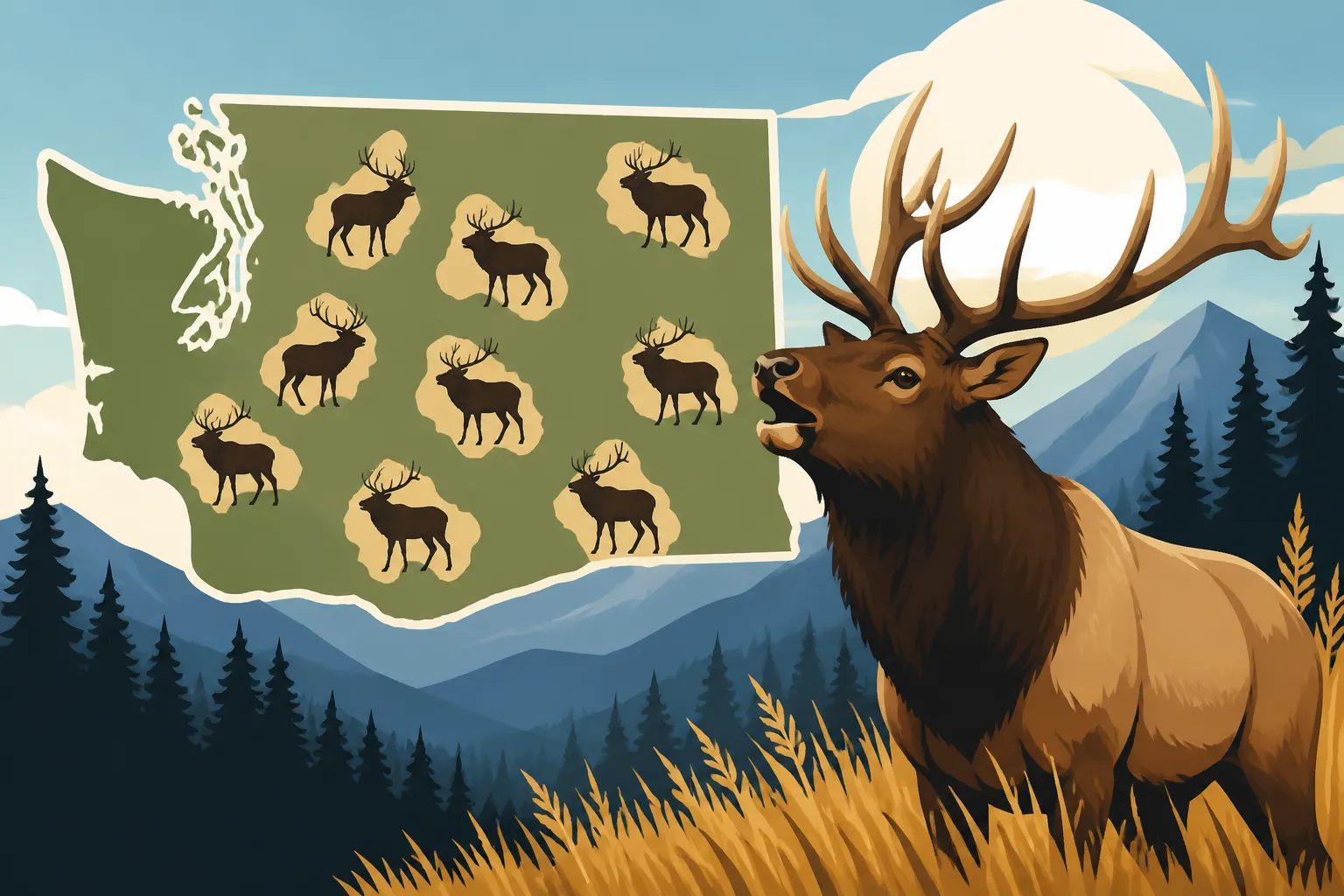
Washington’s Ten Major Elk Herds
It's tough, isn't it? You spend countless hours dreaming of that Washington elk hunt, pouring over regulations, maybe even drawing that coveted tag, only to feel lost when it comes to actually finding the animals. Understanding where Washington's elk live, specifically within its major herds, is the foundational knowledge that separates a hopeful hunter from a consistently successful one. This guide will walk you through the state's ten primary elk herds, dissecting their locations, behaviors, and what their health means for your hunting prospects.
The Big Picture: Why Understanding Elk Herds Matters
Before you even think about packing your gear or heading out to your chosen Game Management Unit (GMU), having a solid grasp of Washington's major elk herds is absolutely paramount. It’s not just about knowing a few numbers; it’s about understanding the lifeblood of our state’s elk hunting opportunities. These herds are dynamic, constantly influenced by habitat, weather, disease, and human activity.
Why Herd Knowledge is Crucial for Success
Think about it: you wouldn't go deer hunting in the desert if you were targeting blacktails, right? The same logic applies to elk, but on a much larger scale. Each of Washington's major elk herds has its own unique characteristics, population trends, and specific challenges. Knowing these details can drastically narrow down your search area, inform your scouting efforts, and even help you choose the right tag or special permit application. For instance, if a particular herd is experiencing a decline due to factors like Elk Hoof Disease in Western Washington, that might influence your decision to hunt in an adjacent, healthier unit. Without this foundational knowledge, you're essentially just wandering aimlessly, hoping to stumble into a bull. That might work once, but it's not a sustainable strategy for consistent success.
The East-West Divide: Roosevelt Versus Rocky Mountain
Washington is a unique state, bisected by the Cascade Mountains, which largely dictates the two distinct subspecies of elk we hunt: Roosevelt elk on the western side and Rocky Mountain elk on the eastern side. This isn't just a minor detail; it's a game-changer for hunting strategy. Roosevelt elk, often larger-bodied, thrive in the dense, wet coastal rainforests and timbered mountains of Western Washington. Their behavior is often more elusive, and hunting them typically involves still-hunting through thick cover or finding small openings. On the other hand, Rocky Mountain elk, known for their impressive antlers, prefer the more open, drier Ponderosa pine forests, sagebrush steppe, and agricultural lands of Eastern Washington. Hunting these elk often involves extensive glassing, covering vast distances, and being prepared for longer shots. Understanding the differences between Roosevelt Elk of Western Washington and Rocky Mountain Elk East of the Washington Cascades is critical, as their habits, habitats, and even their vocalizations can vary significantly, requiring entirely different approaches.
Western Washington's Roosevelt Elk Strongholds
Western Washington is defined by its rugged, rain-soaked mountains and dense timber, perfect habitat for the magnificent Roosevelt elk. These herds face their own set of challenges, from habitat fragmentation to disease, but they continue to offer incredible hunting opportunities for those willing to brave the thick brush and steep terrain.
Willapa Hills and Olympic Peninsula Herds
The Willapa Hills elk herd, primarily located in southwestern Washington, is a classic Roosevelt elk area. This region is characterized by private industrial timberlands, small farms, and a mix of public lands managed by DNR and Forest Service. The Willapa Hills are known for their dense cover, which makes locating elk a serious challenge. Hunters often rely on finding fresh sign in clearcuts, around reprod, or along gated logging roads. Despite the thick cover, these elk can be found in good numbers if you know where to look. Their population trends tend to be stable, but access can be a hurdle, as much of the prime hunting ground is on private timber company land, often requiring permits or careful navigation of access points.
Further north and west, the Olympic Peninsula boasts another robust Roosevelt elk population. These are truly iconic animals, living in some of the most spectacular, yet challenging, terrain Washington has to offer. Units like the Olympic and Matheny are prime examples. The sheer vastness of the Olympic National Forest, combined with pockets of state and private timberland, provides ample habitat. Hunting here often means dealing with significant rainfall, steep canyons, and incredibly dense rainforest. While the numbers here are generally healthy, the terrain itself weeds out many hunters. Successfully hunting the Olympic Peninsula requires dedication, physical fitness, and a willingness to embrace the deep woods, often far from roads. These herds offer some of Washington's most wild and remote hunting experiences.
Mount St. Helens and South Cascades Herds
Moving inland slightly, the Mount St. Helens elk herd represents a fascinating study in resilience and adaptation. Emerging from the volcanic blast zone of 1980, this herd has thrived in the regenerating landscape. The dynamic habitat, with its mosaic of young clearcuts, established timber, and designated wilderness areas, provides diverse opportunities. This herd spans several GMUs, including the Cowlitz and Margaret units, offering a mix of accessible and remote hunting. The early successional habitat in the blast zone itself offers great forage, drawing elk in. However, the terrain can be brutal, with steep, unstable slopes and thick regeneration. Hunter harvest here needs to be carefully managed to maintain a healthy bull-to-cow ratio, and WDFW continually monitors this unique herd.
The South Cascades, encompassing herds like the Coweeman and Lewis River, also host significant Roosevelt elk populations. These areas are characterized by heavily timbered slopes, deep drainages, and high-elevation basins. Access often involves navigating extensive logging road systems, many of which are gated, or venturing into designated wilderness areas. While these herds don't always garner the same attention as the Willapa or Olympic elk, they offer consistent opportunities for hunters willing to put in the effort. Tracking these animals in the deep timber or setting up calling sequences in the steep canyons requires a different approach than Eastern Washington's open country. Hunters targeting these areas should also be mindful of Washington's Multi-Season Tags and Three Chances, which can allow for a longer pursuit if you understand the season structure.
Eastern Washington's Rocky Mountain Elk Domains
Cross over the Cascades, and the landscape dramatically changes, as do the elk. Eastern Washington is home to several distinct Rocky Mountain elk herds, each with its own character, influenced by the drier climate, more open terrain, and different land use patterns.
Yakima and Colockum Herds
The Yakima elk herd is arguably the most well-known and sought-after herd in Washington. Spanning a vast region from the Cascade crest eastward into the shrub-steppe and Ponderosa pine forests, it includes iconic GMUs like the Naneum, Umtanum, and Wenas. This herd is famous for producing large bulls, drawing hunters from across the state and beyond for its special permit opportunities. The terrain is diverse, ranging from steep, rugged mountain slopes to rolling hills and vast expanses of sagebrush. Hunters often rely on glassing open hillsides and clearcuts at first and last light. The sheer size and healthy population of the Yakima herd make it a perennial favorite, but competition is stiff, and draw odds for quality tags can be long. Success here demands extensive e-scouting, deep knowledge of elk movements between summer and winter range, and an ability to cover ground.
Northeast of the Yakima herd lies the Colockum elk herd, another significant Rocky Mountain population. This herd resides in a mix of state, federal, and private lands, characterized by Ponderosa pine forests, bitterbrush, and some agricultural interfaces. GMUs like the Colockum and Mission are key components of this herd's range. The Colockum herd has seen its share of ups and downs, but generally provides solid hunting. Similar to the Yakima, glassing is a primary tactic, but hunters also find success still-hunting through timbered draws or setting up on water sources in dry periods. Understanding their migration patterns between high summer range and lower wintering grounds is key for maximizing your chances, especially during the general seasons. Many hunters utilize tools like GoHunt to analyze draw odds for specific GMUs within these productive herd areas, giving themselves a competitive edge.
Blue Mountains and Selkirk Herds
In the far southeastern corner of Washington, nestled against the Oregon border, are the Blue Mountains elk herds. These herds, including those in GMUs like the Wenaha, Tucannon, and Mount Emily, are legendary for their potential to produce massive Rocky Mountain bulls. The Blues are characterized by expansive Ponderosa pine and Douglas fir forests, deep canyons, and high plateaus. Elk here can be incredibly wary, often seeking refuge in dense timber or remote drainages. Hunting the Blue Mountains typically involves hard work, physical conditioning, and a willingness to get far from roads. Hunters often use horses or llamas to access the deeper wilderness areas. These units are highly competitive for special permits, and general season opportunities can be challenging but rewarding. Learning about Hunting Washington's Wilderness Areas can be particularly useful for those targeting the remote sections of the Blues.
Finally, in the extreme northeastern corner of Washington, primarily within Pend Oreille County, resides the Selkirk elk herd. While not as large as the Yakima or Blue Mountains herds, the Selkirks represent a growing and important Rocky Mountain elk population, sharing habitat with other unique species like moose. GMUs like the Selkirk and 49 Degrees North are home to these elk. This region is a mosaic of dense timber, private forestlands, and agricultural fields. The herd here faces challenges from increasing predator populations, but overall, it's a stable and managed population. Hunting in the Selkirks often involves a mix of still-hunting, glassing smaller openings, and sometimes even tracking in fresh snow during late seasons. It's a quieter corner of Washington, offering a different elk hunting experience away from some of the more pressured units.
Here's a quick overview of Washington's major elk herds:
| Herd Name | Subspecies | General Location | Key GMUs Involved | Primary Habitat Type | Typical Hunting Challenge | Population Trend |
|---|---|---|---|---|---|---|
| Willapa Hills | Roosevelt | SW Washington | 506 | Dense industrial timber, reprod | Thick cover, private access | Stable |
| Olympic Peninsula | Roosevelt | NW Washington | 602, 603, 615 | Rainforest, dense timber, steep terrain | Remote, wet, rugged | Stable |
| Mount St. Helens | Roosevelt | South Cascades, blast zone | 530, 560, 568 | Post-eruption regenerating forests | Steep, unstable slopes | Stable/Growing |
| South Cascades | Roosevelt | Central-South Cascades West | 517, 520, 550 | Heavy timber, steep drainages | Road closures, dense cover | Stable |
| Yakima | Rocky Mtn. | Central Washington | 340, 342, 346, 356 | Ponderosa, shrub-steppe, high mountains | High pressure, wary elk | Stable/Growing |
| Colockum | Rocky Mtn. | Central Washington | 328, 335, 336 | Ponderosa, bitterbrush, mixed forest | Migration, varied access | Stable |
| Blue Mountains | Rocky Mtn. | SE Washington | 154, 162, 166, 172 | Deep canyons, Ponderosa, high plateaus | Remote, physical demand | Stable |
| Selkirk | Rocky Mtn. | NE Washington | 117, 121, 124 | Dense timber, mixed private/public | Predator pressure, remote | Growing |
Note: Population trends are generalized and can fluctuate based on annual factors.
Key Factors Affecting Elk Herd Health and Hunting
Elk herds are not static; they are complex biological systems influenced by a myriad of factors. Understanding these elements helps hunters anticipate changes in elk distribution, density, and overall hunting success. This knowledge can also help you predict what kind of hunt you might have, from a challenging year to a banner one.
Habitat, Disease, and Predation Impacts
Habitat is the cornerstone of any healthy wildlife population. For Washington's elk, this means access to quality forage, water, and secure cover. Habitat fragmentation due to development, logging practices, and even large-scale wildfires can significantly impact elk herds by reducing food sources or creating barriers to migration. When elk are confined to smaller areas, they can overgraze, and disease transmission becomes a greater risk.
One of the most persistent and heartbreaking challenges for Western Washington elk, particularly the Willapa Hills and Mount St. Helens herds, is Elk Hoof Disease Symptoms. This debilitating bacterial infection causes severe lameness, making it difficult for elk to forage, escape predators, and survive harsh winters. WDFW continues to monitor and research the disease, but its presence can undeniably impact herd health and local hunting opportunities. Hunters often report seeing limping elk, which highlights the disease's prevalence in some areas.
Predation, primarily by cougars and, increasingly, by wolves in Eastern Washington, also plays a significant role. While predators are a natural part of the ecosystem, their numbers and impact can affect Elk Calf Survival in Washington, potentially slowing herd growth. In areas with high predator densities, elk might become warier or shift their distribution to areas with less predatory pressure. Hunters need to be aware of these dynamics as they can influence where and how elk behave, often pushing them into thicker, harder-to-reach cover.
WDFW Management and Hunter Harvest
The Washington Department of Fish and Wildlife (WDFW) plays a crucial role in managing these herds through harvest strategies, habitat projects, and disease monitoring. Each year, WDFW sets season dates, bag limits, and special permit allocations based on population surveys, recruitment rates, and hunter harvest data. For instance, in areas where calf survival is low or populations are declining, WDFW might reduce antlerless permits or shorten seasons to allow the herd to rebound. Conversely, in thriving herds like parts of the Yakima, more permits might be issued.
Hunter harvest itself is a vital management tool, helping to control population numbers within ecological carrying capacities, reduce damage to agricultural lands, and maintain healthy bull-to-cow ratios. By accurately reporting your harvest through the Washington Harvest Reporting Requirements, you contribute directly to the data WDFW uses to make these critical management decisions. Understanding how WDFW manages these herds, often detailed in their annual Big Game Hunting Pamphlet, is like having a roadmap to potential hunting success. It’s their best guess at where the opportunities will be, based on years of data and research.
How to Use Herd Information for Better Hunting
Knowing about Washington's elk herds is one thing; applying that knowledge to your hunt planning is another. This isn't just academic information; it's a strategic advantage that can save you time, effort, and frustration. Leveraging this understanding can help you make more informed decisions from application to field.
Using WDFW Resources and Online Tools
The WDFW website is a treasure trove of information that directly relates to elk herd management. Beyond the general hunting pamphlet, delve into GMU-specific statistics, annual harvest reports, and population surveys. Many of these resources provide insights into specific herd trends, success rates in particular units, and even details on Washington's Ten Major Elk Herds. These reports often highlight where bull-to-cow ratios are healthy, where calf recruitment is strong, or where special permit opportunities might be increasing.
Online tools like the WDFW Hunt Planner map layers or third-party applications like GoHunt become incredibly powerful when combined with herd knowledge. You can overlay GMU boundaries with public land ownership, identify potential winter ranges or migration corridors, and even pinpoint areas with historical elk activity. For example, if you know the Yakima herd migrates between high summer range and lower wintering areas, using these digital maps to identify those transition zones could be a highly effective strategy for early or late season hunts. These resources allow you to virtually scout areas and identify promising terrain features, water sources, and bedding areas before you ever set foot in the woods.
Scouting Strategies Based on Herd Dynamics
Once you've done your homework and understand the dynamics of the elk herd in your chosen area, your scouting becomes much more focused and efficient. Instead of just randomly hiking, you'll be looking for specific indicators based on the herd's known behaviors and habitat preferences.
If you're targeting a Roosevelt elk herd in dense timber, your scouting might focus on identifying historical bedding areas, rubs, wallows, and trails through the thickest cover, rather than expansive glassing. This might involve Still-Hunting Blacktails in Wet Washington Brush or similarly dense areas, meticulously searching for fresh sign. For Rocky Mountain elk in more open country, your scouting might lean heavily on identifying prime glassing knobs that overlook expansive feeding areas, migration routes, or secluded pockets of timber. Looking at aerial imagery on GoHunt can reveal hidden clearings or draws that hold elk.
Consider the time of year and how it relates to herd movements. Early season elk, particularly those in the Yakima or Colockum herds, might still be in high-elevation summer range. As the seasons progress and snow begins to fall, you'll need to adjust your scouting to focus on transition zones and Washington Winter Range Closures That End Late Hunts areas. Understanding these seasonal shifts, driven by the herd's natural instincts, will allow you to be in the right place at the right time. For example, knowing that elk seek thermal cover during cold snaps means you'll focus your efforts on south-facing slopes with dense timber, rather than exposed ridges. Effective scouting, informed by deep herd knowledge, is the true secret to unlocking Washington's elk hunting potential.
Disclaimer
Please remember that hunting regulations and herd dynamics can change. Always consult the most current Washington Department of Fish and Wildlife (WDFW) regulations, proclamations, and herd reports before planning any hunt. This guide is for informational purposes only and does not constitute legal hunting advice.