Why Washington Restricts Muzzleloader Scopes
It can be incredibly frustrating to prepare for a Washington muzzleloader hunt, diligently practicing your shots and scouting your unit, only to realize the high-tech scope you planned to use isn't actually legal. Many hunters come to Washington from states with more liberal optics rules for muzzleloaders, and the specific restrictions here can feel like an unnecessary hurdle. This guide will dive deep into why Washington places limits on muzzleloader scopes, what those specific regulations entail, and how you can still be successful and ethical in the field, even with a more traditional setup.
The Philosophy Behind Muzzleloader Scope Restrictions in Washington
Washington's hunting regulations, especially for primitive weapon seasons like muzzleloader, aren't just arbitrary rules. They are deeply rooted in a philosophy that prioritizes traditional hunting challenges and fair chase principles. It's about preserving a certain style of hunting that emphasizes woodsmanship, tracking skills, and getting close to your quarry. For many, the challenge of a muzzleloader hunt is precisely what draws them in, a deliberate step back from the technological advantages of modern firearms.
Maintaining Traditional Hunting Ethics
Think about the history of muzzleloader hunting. It dates back centuries, to a time when optics were rudimentary, if they existed at all. The very essence of hunting with a muzzleloader is to embrace that heritage. By restricting advanced scopes, Washington aims to keep the "primitive" aspect of the season intact. This means relying more on your eyes, your knowledge of game behavior, and your ability to stalk within a reasonable range. It encourages hunters to slow down, observe more, and become more intimately connected with the hunting experience. It's not just about the kill; it's about the journey and the skills honed along the way. When you're glassing for deer in the vast open breaks of Eastern Washington or trying to pick apart the dark timber for elk in the west, your traditional muzzleloader setup forces a different kind of focus. You learn to appreciate the subtle movements and the nuances of the landscape in a way that a high-magnification, illuminated reticle might inadvertently diminish.
Ensuring Fair Chase Principles
The concept of "fair chase" is central to ethical hunting, and it's a driving force behind many regulations. Fair chase essentially means giving the animal a reasonable chance to evade the hunter. When you introduce highly advanced optics, especially those with significant magnification, ranging capabilities, or illuminated reticles, you can drastically increase a hunter's effective range and accuracy, even in low light conditions. This can tip the scales too far in the hunter's favor, moving away from what many consider a fair contest between hunter and hunted.
For muzzleloaders, which are inherently slower to reload and often less accurate at extreme distances than modern rifles, limiting scope technology helps maintain that balance. It reinforces the idea that a successful muzzleloader hunt should come from careful planning, skillful stalking, and precise shot placement within a relatively close range. It's about making a deliberate, ethical shot, not taking advantage of technology to push ethical boundaries. Hunting Washington's Three-Point Minimum Units often requires careful identification, and restrictive scopes can make judging antlers a greater challenge, reinforcing the fair chase ideal. This approach encourages hunters to be absolutely certain of their target before squeezing the trigger, reducing the chance of mistaken identity or a poor shot that leads to wounded game.
Specific Washington Regulations on Muzzleloader Optics
Understanding the why is one thing, but knowing the what is critical for staying legal in the field. Washington's regulations on muzzleloader scopes are quite specific and differ significantly from those for general modern firearm seasons. You can't just slap your favorite high-power rifle scope on your muzzleloader and call it a day; that could land you in serious trouble. Always double-check the current hunting regulations pamphlet or the WDFW website before heading out, as rules can occasionally be updated. GoHunt can be a helpful resource for navigating specific GMU regulations that might have additional local restrictions.
Magnification Limits and Scope Types
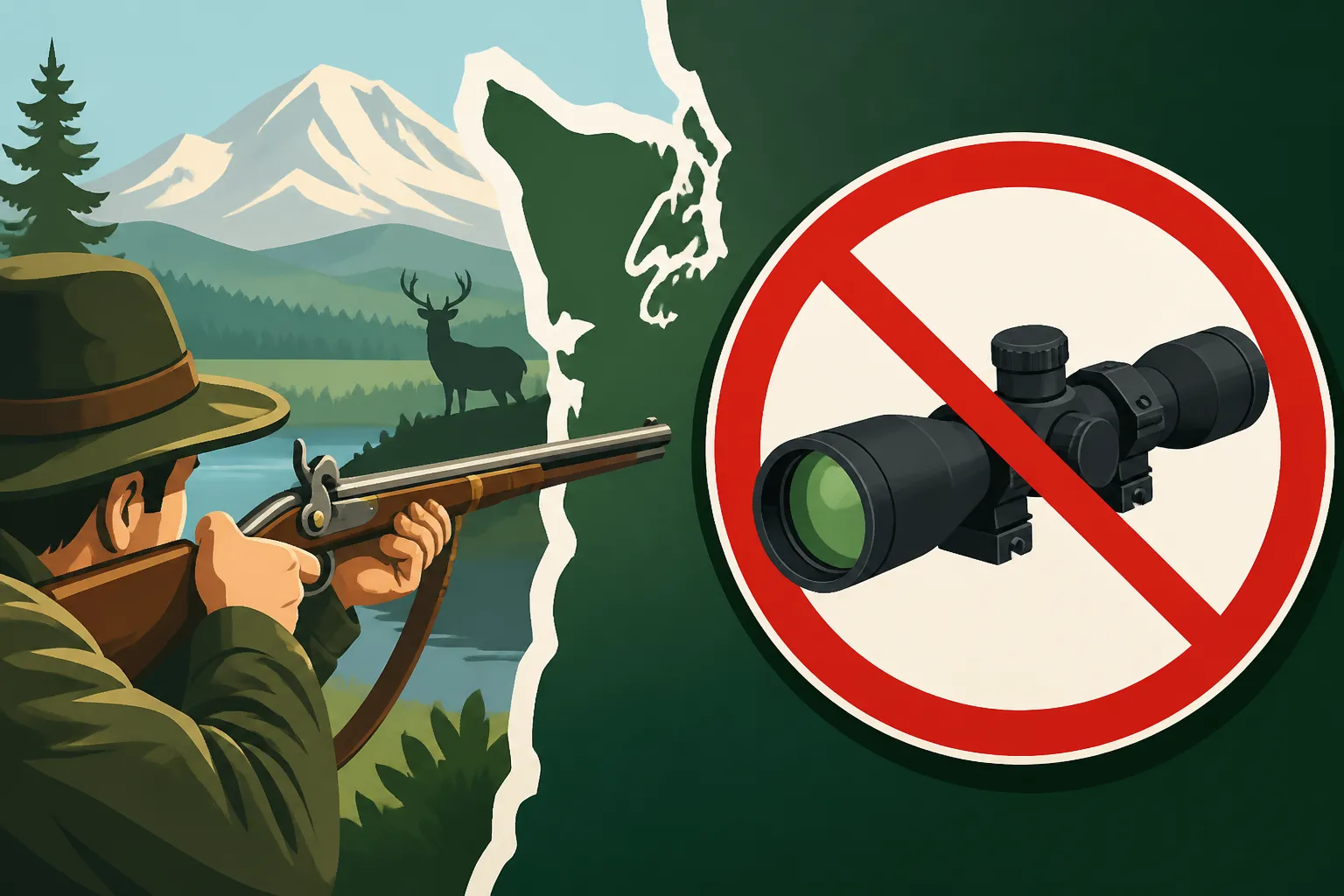
The primary restriction for muzzleloader scopes in Washington revolves around magnification. For big game, the rule is generally that any scope used on a muzzleloader must be a fixed power scope with no more than 1x magnification. This essentially means it must be a non-magnifying sight, functioning more like a red dot or a peep sight with some eye relief, rather than a traditional magnifying rifle scope. Some exceptions for specific disability permits may exist, but for the vast majority of hunters, a traditional magnifying scope is a no-go.
This means those variable power scopes (3-9x, 4-12x, etc.) that are so common on modern firearms are completely out. Even a fixed 4x scope, which many might consider modest, is not permitted. The intent is clear: to ensure the hunter is primarily relying on their own vision and skill for target acquisition and aiming. It pushes you to truly master your muzzleloader, understanding its trajectory and your personal limitations without the aid of magnification. It also means practice is even more crucial. You'll want to be intimately familiar with your Muzzleloader Accuracy at 100 Yards or less, practicing from various field positions.
Illuminated Reticles and Electronic Enhancements
Beyond magnification, Washington's muzzleloader rules also typically prohibit any electronic enhancements or illuminated reticles. This means no red dots, no green dots, no battery-powered illumination in your crosshairs. Again, this falls back on the traditional hunting ethic. These features greatly aid in low-light conditions, at dawn or dusk, or in dense cover where light is limited. By disallowing them, hunters are put on a more even footing with the primitive weapon itself, requiring them to make the most of natural light and their own aiming ability.
It pushes you to consider your shot window much more carefully. You can't just wait until it's nearly dark and rely on an illuminated reticle to see your aiming point. You need sufficient ambient light to clearly see your target and your iron sights or non-magnifying scope's reticle. This can often mean planning your hunt to coincide with optimal light conditions, perhaps focusing on mid-day movement in certain terrain, or ensuring you're in a position early enough in the morning to make a clean, ethical shot. The simplicity of a non-illuminated reticle or simple iron sights forces a different kind of focus, encouraging a more deliberate and considered approach to every shot opportunity. When you're loading your Powder, Bullets and Sabots it's good to know exactly what kind of sighting system you'll be using.
Here's a quick overview of what's generally allowed versus prohibited for muzzleloader optics in Washington:
| Feature/Type | Generally Permitted | Generally Prohibited | Rationale |
|---|---|---|---|
| Magnification | 1x (non-magnifying) | 2x, 3x, 4x, etc. (any mag) | Maintains traditional challenge, fair chase. |
| Variable Power | No | Yes (e.g., 3-9x, 4-12x) | Fixed power aligns with primitive weapon intent. |
| Illuminated Reticles | No | Yes | Prevents unfair advantage in low light. |
| Red/Green Dot Sights | Yes (if 1x) | No (if magnifying) | Allowed if non-magnifying, but check specific rule for electronic enhancements. |
| Fiber Optic Sights | Yes | No | Passive light gathering is often permitted. |
| Iron Sights | Yes | N/A | The most traditional form of aiming. |
| Electronic Ranging | No | Yes | Separates aiming from ranging. |
Always consult the current WDFW regulations for the most up-to-date and precise rules.
Practical Implications for Hunters
So, you're committed to hunting Washington's muzzleloader season. Great! It's a fantastic experience. But the scope restrictions mean you can't just treat your muzzleloader like a short-range rifle. You need to adjust your mindset, your gear choices, and your hunting strategy. This isn't necessarily a bad thing; it simply means you'll develop a different set of skills and appreciation for the hunt. Washington's Muzzleloader Equipment Rules covers a lot of the other gear you'll need to consider.
Adjusting Your Hunting Strategy
With a 1x or iron sight setup, your effective range will naturally be reduced compared to what you might be accustomed to with a magnified rifle scope. This means your hunting strategy needs to shift towards getting closer to the game. Forget those 200-yard shots; you're now thinking in terms of 50-100 yards, maybe a bit more if you've practiced extensively and are very confident. This translates to more emphasis on:
- Stalking Skills: You'll need to become a master of moving quietly, reading the wind, and using terrain and vegetation to your advantage. Every rustle of leaves, every snapped twig, becomes more critical. Still-Hunting Blacktails in Wet Washington Brush or even Tracking a Buck After a Fresh Snow become paramount skills.
- Patience and Observation: You'll spend more time observing from a distance with your binoculars or spotting scope, waiting for the animal to move into a position that allows for a close, ethical shot.
- Calling: For elk, getting a bull to commit to coming within muzzleloader range can be thrilling. Your calling sequences, like those described in Cow Calls That Pull a Bull Off His Herd, become even more important for drawing game in close.
- Understanding Terrain: Knowing the subtle contours of the land, where a ridge might offer cover for an approach, or where a slight dip in the ground creates a natural funnel, becomes vital. E-scouting can help identify these potential close-range ambush points. E-Scouting Washington GMUs Before the Draw can be a huge advantage.
It's a more immersive, hands-on style of hunting. You're not just aiming and pulling; you're actively engaging with the landscape and the animal in a more direct way.
Choosing the Right Optic for Washington Muzzleloader Seasons
While you're limited to 1x magnification, you still have choices. "1x" doesn't necessarily mean just iron sights, though iron sights are always a solid, reliable option. Many hunters opt for some form of "red dot" or "holographic" sight. These sights typically offer a 1x, non-magnifying view with an illuminated aiming point (like a red dot or circle-dot reticle). However, remember the rule about illuminated reticles: if it's considered an "electronic enhancement" to an aiming point within a scope, it might be disallowed. The key is that it shouldn't magnify. Always check the specific wording in the current WDFW regulations regarding electronic aiming devices and illuminated reticles on muzzleloaders to ensure compliance. Some passive fiber optic sights are generally acceptable because they gather ambient light without a battery.
Here are some common choices and considerations:
- Open Iron Sights: The most traditional. Simple, robust, and completely legal. Requires good sight picture fundamentals and practice.
- Peep Sights: A step up from open sights for many, offering a clearer sight picture by blurring the rear aperture. Excellent for accuracy at closer ranges.
- 1x Red Dot/Holographic Sights (Check legality of illumination!): These can be very fast for target acquisition and work well in varying light conditions as long as the illumination is permissible. Be absolutely certain your chosen model complies with the "no electronic enhancement" and "no magnification" clauses. The crispness of a red dot can make a big difference in target clarity compared to iron sights, especially if you have aging eyes.
- "Ghost Ring" Sights: Similar to a peep sight, but often with a larger aperture, allowing for very fast target acquisition at close range.
When choosing, consider durability for Washington's often wet weather. A simple iron sight or a rugged, waterproof peep sight might be more reliable than an electronic red dot in a torrential downpour, even if that red dot is advertised as waterproof. Keeping your Muzzleloader Loading and Ignition in Rain requires attention, and so does keeping your sight picture clear.
Navigating the Regulations and Making the Best of It
It's easy to get frustrated with regulations that seem overly complex or restrictive, but they're part of hunting in Washington. Instead of letting them discourage you, view them as an opportunity to become a more skilled and adaptable hunter. The challenge of a muzzleloader hunt, especially with a traditional sighting system, offers a deeply rewarding experience that many modern firearm seasons can't quite match. Embrace the challenge, and you might find it becomes your favorite season.
Resources for Staying Up-to-Date
The regulations are a living document, meaning they can change. It's crucial to always work with the most current information.
- WDFW Hunting Regulations Pamphlet: This is your bible for the season. Pick up a physical copy wherever licenses are sold, or download the PDF directly from the Washington Department of Fish and Wildlife website. Read it thoroughly, especially the sections pertaining to muzzleloader equipment.
- WDFW Website: The official source for all regulations, season dates, and any emergency closures or rule changes.
- Reputable Hunting Forums and Blogs: While these aren't official sources, they can be great places to ask questions and learn from experienced Washington hunters. Just remember to verify any information you find against the official WDFW regulations. GoHunt offers detailed information on specific GMUs and can help you plan your hunt with all the regulations in mind.
- Local Sporting Goods Stores: The staff at shops catering to Washington hunters are often very knowledgeable about local regulations and can offer practical advice on compliant gear.
Never assume. If you're unsure about a piece of equipment, reach out to WDFW directly for clarification. It's far better to ask a question than to risk a violation in the field.
Embracing the Challenge
The muzzleloader season offers a unique window of opportunity in Washington, often preceding or extending beyond general firearm seasons. While the optics restrictions might seem like a disadvantage, they force you to become a better hunter overall. The skills you develop in stalking, observation, and close-range shooting with a muzzleloader will absolutely transfer to other hunting endeavors, making you a more proficient hunter across the board.
Think of it as a return to roots. There’s a profound satisfaction that comes from successfully harvesting an animal with a primitive weapon, knowing you had to outsmart it at its own game, often at very close quarters. It deepens your connection to the landscape and the traditions of hunting. So, load up your powder, prepare your sights, and get out there. The Washington muzzleloader season, despite its limitations, offers some of the most rewarding hunting experiences you can find. It's a chance to truly test your woodsmanship and enjoy the hunt in a uniquely challenging way.
Disclaimer
This article is for general informational purposes only and does not constitute professional advice. Laws, prices and regulations vary by location and change over time. Consult a qualified professional for guidance on your specific situation.