Why Blacktails Are Hard to See
Anyone who has spent time chasing Blacktail deer in Washington knows the feeling: you’re moving through what looks like perfect habitat, your senses are on high alert, and then, poof, a deer materializes out of nowhere, or worse, you hear the crash of an escape you never saw coming. It’s an incredibly frustrating experience that makes you question your skills, but the truth is, Blacktails are arguably the hardest deer to spot, and this guide will dive deep into why they are such masters of invisibility and what you can do to tip the odds in your favor.
Their Natural Habitat Makes Them Masters of Disguise
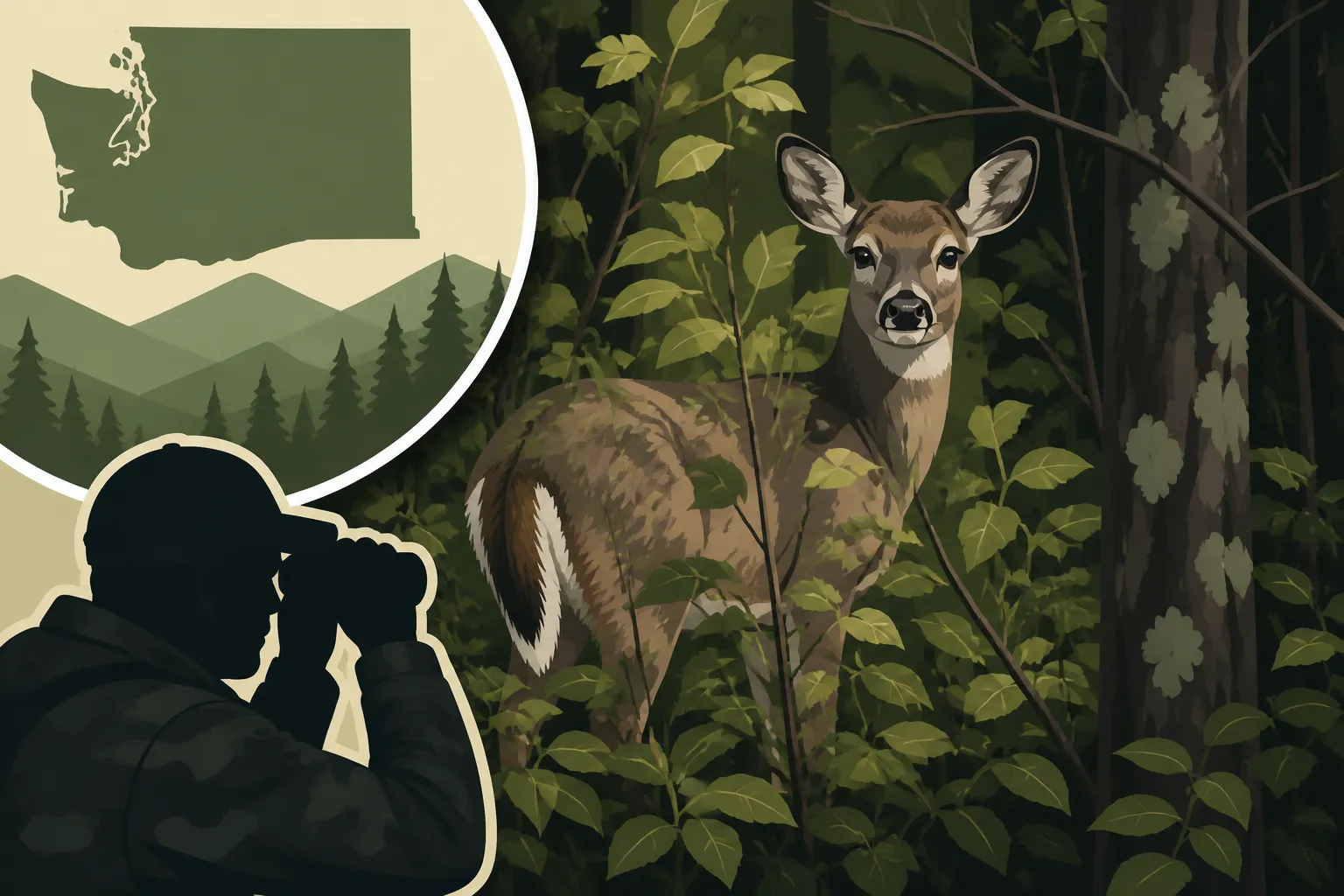
Washington's Blacktail deer primarily inhabit the dense, often relentless, evergreen forests of Western Washington. This isn't your open, rolling eastern Washington mule deer country. This is a world of thick timber, tangled undergrowth, and perpetually damp conditions, all of which play perfectly into the Blacktail's natural ability to disappear.
Dense Cover is Their Fortress
Imagine walking through a jungle gym of Douglas fir saplings, interwoven with salal, sword fern, and devil's club. That’s the Blacktail’s living room. They thrive in this kind of dense, almost impenetrable cover, using it not just for food but as their primary defense mechanism. A mature Blacktail, even a decent buck, can stand broadside to you at 30 yards in this environment and remain utterly unseen. Their ability to melt into the shadows and broken lines of the forest is nothing short of extraordinary. It's a stark contrast to the more open country where you might chase a whitetail or a mule deer, where visibility can stretch for hundreds of yards. Here, your effective range might be 50 feet, and the deer knows it, using every single branch and clump of brush to its advantage. This makes a hunt for these elusive animals a completely different ballgame, requiring immense patience and an understanding of how they use this cover. It's why success often comes down to intimate knowledge of specific areas, like those you might scout thoroughly using advanced mapping tools, perhaps even with a platform like GoHunt to understand terrain and cover types before you ever step foot in the woods.
When you're exploring areas for Blacktail Deer Hunting in Western Washington Timber, you're often looking at clearcuts that have "reprodded" – grown back into thick young trees – or older timber with a dense understory. These spots offer ideal bedding and escape routes. A Blacktail doesn't need to run far; it just needs to take a few steps into an impossibly thick stand of evergreens, and it's gone. Hunters often describe seeing just a flash of a tail or a glimpse of an ear before the animal simply vanishes. This dense vegetation breaks up their outline completely, making them almost impossible to distinguish from the surrounding foliage, even when you're looking directly at their last known position.
The Perpetual Twilight of the Westside Forests
The deep evergreen forests of Western Washington, particularly in areas like the Olympic Peninsula or the lower Cascades, often exist in a state of perpetual twilight. The tall, ancient trees create a canopy that filters sunlight, casting long, shifting shadows and creating a subdued, low-light environment even in the middle of a sunny day. This natural dimness is a Blacktail's best friend. Their dark coats blend seamlessly into the shadows and the muted greens and browns of their environment.
Think about hunting in the early morning or late evening, when light is at its poorest. Now imagine that low light amplified by a thick forest canopy throughout the entire day. This constant play of light and shadow makes it incredibly difficult for the human eye to pick out an animal that is specifically evolved to exploit these conditions. A Blacktail standing perfectly still against a backdrop of moss-covered trees or a dark downed log simply disappears. Their coat, often a rich reddish-brown in summer, darkens to a deep grey-brown in winter, perfectly matching the somber tones of their habitat. This incredible natural camouflage is a huge reason why they earn their reputation as ghosts of the forest. Understanding how to navigate and hunt effectively in these conditions is crucial, as is having good optics and the patience to scan every single shadow.
Behavioral Adaptations for Evasion
Beyond their physical traits and habitat, Blacktail deer have developed specific behaviors that further enhance their elusiveness. These aren't just random acts; they are ingrained survival strategies perfected over generations of living under predator pressure in challenging terrain.
Subtlety in Movement
Unlike a whitetail that might flag its tail and bolt when spooked, or a mule deer that might bound away in distinctive jumps, Blacktails are masters of subtle movement. When they perceive a threat, their first instinct is often not to run, but to melt away, taking just a few silent steps deeper into cover, freezing, and waiting to see if they've been detected. They move with incredible stealth, picking their way through brush without making a sound that betrays their presence.
This measured, quiet retreat is a huge part of why they're so hard to see. You might hear a rustle, but by the time your eyes pinpoint the source, the deer has already taken two steps behind a log or into a patch of salal and become invisible. They don't give you long, clear sightings. Instead, you get glimpses, flickers, and then nothing. This requires a hunter to constantly process fleeting information and make quick decisions. If you're still-hunting, for example, your pace should be agonizingly slow, perhaps only a few steps every minute, mirroring the Blacktail's own cautious movements, as detailed in approaches like Still-Hunting Pace in Wet Brush. Their quiet nature means you often won't hear them until they are right on top of you, or until they decide to crash out of their hiding spot, leaving you stunned.
The Art of Freezing and Blending
Perhaps the most frustrating and effective Blacktail defense is their uncanny ability to freeze absolutely still, blending seamlessly into their surroundings. When a Blacktail feels threatened but not yet detected, it will often stop dead in its tracks, holding perfectly still, sometimes for minutes on end. In the dense, broken terrain they call home, this tactic is incredibly effective. Their muted coloring, combined with the shadows and texture of the forest floor, makes them virtually indistinguishable from a stump, a patch of brush, or a downed tree.
It's common for hunters to walk past a Blacktail standing just yards away, only realizing it later when the deer finally breaks its freeze and bolts, or when they backtrack and spot tracks where no deer should have been. This is where patience on the hunter's part becomes paramount. Learning to slow down, stop frequently, and glass the cover ahead of you in small, detailed sections is critical. You're not looking for a whole deer; you're looking for an antler tip, an ear twitch, the horizontal line of a back, or the unnatural curve of a leg amidst the vertical chaos of the forest. This behavior is so ingrained that even when you know they are in an area, finding them requires extreme focus and a sharp eye, often leading to moments where you feel like you're hunting ghosts.
Understanding Their Camouflage
Beyond their behavior and habitat, the very physical attributes of Blacktail deer contribute significantly to their elusive nature. Their size, coat color, and overall build are perfectly adapted for vanishing in the thick Pacific Northwest woods.
Coat Color and Texture
A Blacktail's coat is a marvel of natural camouflage. During the spring and summer, they typically sport a reddish-brown coat, which shifts to a darker, grayish-brown in the fall and winter. This seasonal change perfectly matches the evolving hues of their environment – from the vibrant greens of summer to the muted, somber tones of late fall and winter forests. What's more, their fur isn't uniformly colored; it has subtle variations and mottling that break up their outline, preventing them from appearing as a solid block of color against a complex background. This is particularly effective in dappled light, where shadows and highlights constantly play across their bodies.
When you're trying to pick one out of the shadows, this textured coat makes it incredibly difficult. It's not just a brown target; it's a brown target that looks like a hundred other brown, textured things in the forest – tree bark, dead leaves, shadowed rocks. This natural blending is enhanced by the often-wet conditions in Western Washington, which can make their fur appear even darker and less reflective, further aiding their concealment. When you're trying to distinguish between a deer and a stump, often in the mist or light rain typical of Hunting Blacktails in Fog and Rain, every tiny advantage the deer has makes a huge difference.
Smaller Stature, Bigger Challenge
Blacktail deer are generally smaller than their Rocky Mountain Elk cousins or even many of the mule deer found east of the Cascades. A mature Blacktail buck, while impressive, doesn't carry the sheer bulk of a large mule deer or a whitetail, let alone a Roosevelt elk like those discussed in Roosevelt Elk of Western Washington. This smaller stature allows them to navigate and hide more effectively in dense cover. They can slip through incredibly tight spaces, duck under low-hanging branches, and position themselves behind relatively small obstacles that would barely conceal a larger animal.
Consider the challenge of trying to spot something deer-sized in a clearcut that's grown up to head-high alders and firs. A smaller animal simply has more options for concealment. This also makes judging antler size, especially when you consider specific regulations like Washington's three-point minimum units, incredibly difficult if you only catch fleeting glimpses. They are built for concealment, for navigating the broken terrain, and for disappearing into the very fabric of the forest, making them a unique challenge for any hunter. Their compact size means less visible real estate to pick out from the environment, compounding the difficulty of spotting them.
Comparison of Deer Species and Concealment
| Trait / Species | Blacktail Deer | Mule Deer | Whitetail Deer |
|---|---|---|---|
| Primary Habitat | Dense, wet Western WA forests, reprod, clearcuts | Open Eastern WA breaks, sagebrush, timber fringes | Northeastern WA mixed forests, agricultural edges |
| Coat Color (Fall/Winter) | Dark grayish-brown, mottled | Tan to gray, often uniform | Grayish-brown, white belly/throat/tail |
| Movement Style | Silent, subtle, melting into cover, freezing | Distinctive bounding gait, often in open | Flags tail and bolts, can also sneak in cover |
| Size | Medium-small, compact | Medium-large, robust | Medium, often smaller than mule deer, variable |
| Visibility Challenge | Extreme: dense cover, subtle movement, perfect camouflage | Moderate: open country allows more spotting, but can hide | Moderate: utilizes thickets, but often gives away presence with flag |
Overcoming the Challenge: Tips for the Hunter
Hunting Blacktail deer is an exercise in patience, meticulous observation, and often, humility. While they are incredibly difficult to spot, it's not an impossible task. By adjusting your approach and honing specific skills, you can significantly increase your chances of success.
Slow Your Roll: The Still-Hunting Advantage
The single most effective strategy for finding Blacktail deer is to move incredibly slowly, often referred to as "still-hunting." This isn't about covering ground; it's about seeing the deer before it sees you, or before it moves. Imagine taking one or two steps, then stopping for several minutes to scan, listen, and process the environment. This methodical approach allows your eyes to adjust to the subtle nuances of the forest and gives you time to pick apart the broken lines and shadows where a Blacktail might be hiding. Many successful Blacktail hunters advocate a pace so slow that you might only cover a few hundred yards in an hour or two. It's mentally taxing, but it's how you unlock the secrets of the dense timber.
This kind of hunting demands absolute concentration. You're not just walking; you're actively searching for any anomaly – a horizontal line in a vertical world, a patch of fur that doesn't quite match the bark, or the glint of an eye. This slow pace also allows you to hear the subtle sounds that Blacktails make, like a rustle of leaves or a snapped twig, which can be easily missed if you're moving too quickly. When you combine this method with an understanding of where these deer typically bed down, perhaps in a thick Reading a Three-Year-Old Clearcut for Bucks or in dense reprod, your chances go up exponentially. It's truly a test of mental fortitude, but the rewards of finally picking out that elusive buck are immense.
Sharpen Your Observation Skills
Given how well Blacktails blend in, your observation skills need to be razor-sharp. It's not enough to just look; you need to actively "pick apart" the landscape. Focus on smaller sections of terrain, mentally dissecting each patch of brush, each cluster of trees, and every shadowed nook. Look for pieces of a deer, rather than the whole animal. That might mean spotting the curve of a blacktail's back, a single ear twitching, or the dark patch of an eye. Binoculars, even low-power ones like 8x or 10x, are invaluable for this, helping you resolve details in the shadows that your naked eye might miss. Optics for Washington Elk and Deer Hunting are essential gear for this very reason.
Practice makes perfect. The more time you spend in Blacktail country, even without a weapon, just observing, the better your eyes will become at identifying deer sign and eventually, the deer themselves. Pay attention to how light falls through the canopy, how shadows play tricks, and how deer use specific terrain features for cover. Utilize mapping tools like those offered by GoHunt to identify potential bedding areas, travel corridors, and escape routes. By understanding the lay of the land, you can anticipate where a Blacktail might be, rather than just randomly wandering. It’s about developing an intuition, a sixth sense for deer, born from countless hours of diligent observation and a deep respect for the incredible elusiveness of Washington’s Blacktail deer.
Disclaimer
This article is for general informational purposes only and does not constitute professional advice. Laws, prices and regulations vary by location and change over time. Consult a qualified professional for guidance on your specific situation.