Whitetail Versus Mule Deer Identification
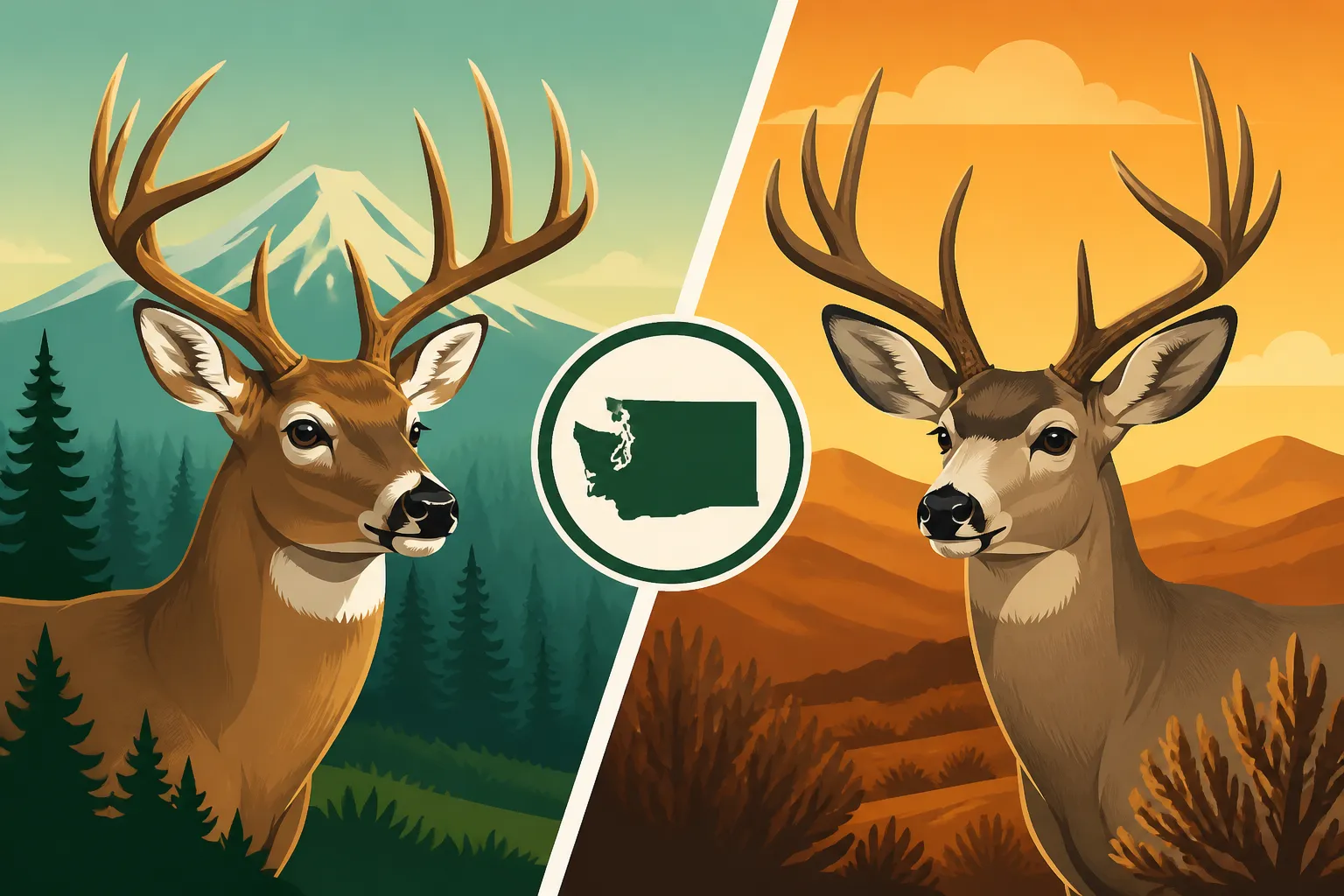
For hunters in Washington, few things are as frustrating as staring through binoculars at a deer and second-guessing whether it’s a whitetail or a mule deer. That moment of uncertainty can cost you a shot, lead to a violation, or simply leave you wondering what you truly saw. This comprehensive guide is designed to equip you with the knowledge and observational skills to confidently distinguish between these two magnificent species, ensuring you make informed decisions in the field.
The Washington Hunter's Dilemma: Why Accurate Identification Matters
It might seem like a small detail, but knowing whether you're looking at a whitetail or a mule deer isn't just about showing off your nature knowledge; it has real, tangible consequences for hunters in Washington. The rules, seasons, and even the tags themselves can hinge on this crucial identification.
Legal Ramifications and Tag Specifics
Imagine the heartbreak of taking a magnificent buck only to discover it was the wrong species for your tag. Washington State has very specific regulations that often differentiate between whitetail and mule deer. For instance, you might have a general season tag for one, but the other might only be legal with a special permit or within a very specific Game Management Unit (GMU). Having the wrong animal on your tag isn't just a fine; it can result in confiscation of your harvest, loss of hunting privileges, and a black mark on your record that could impact future draw opportunities. It's a tough lesson to learn, and one we absolutely want you to avoid.
Understanding GMU-Specific Rules
Washington's hunting landscape is incredibly diverse, and so are its regulations. Many GMUs in Eastern Washington, for example, have different harvest criteria for mule deer versus whitetail. Some areas might have antler point restrictions for mule deer – like the common three-point minimum – while whitetail in the same unit might be fair game as any legal buck. Not knowing which species you're looking at can lead to accidental violations of these often nuanced rules. It pays to do your homework before the season, utilizing resources like the WDFW hunting pamphlet and tools like GoHunt to scout and understand specific GMU boundaries and regulations. Without that preparation, even the most experienced hunter can find themselves in a bind. You can learn more about how to navigate these specific regulations in our guide on Hunting Washington's Three-Point Minimum Units.
Ethical Considerations and Species Management
Beyond the legalities, there's an ethical component to accurate identification. Wildlife management in Washington relies on hunters taking the correct animals to maintain healthy herd populations and achieve conservation goals. Mistaken identity can undermine these efforts. For example, if a GMU is trying to boost its mule deer population, inadvertently harvesting mule deer bucks on a whitetail tag could impact the species' recovery. Responsible hunting means understanding the animals you pursue and contributing positively to their future. It's about respecting the game and the land we hunt on, ensuring that future generations have the same incredible opportunities we do.
Tail Tales: The Most Obvious Visual Cue
When it comes to telling these two species apart, the tail is often the first and most reliable indicator, especially when a deer is running away or flicking its tail in alarm. It's like their personal flag, signaling their identity. Pay close attention to its color, shape, and how it's carried.
Whitetail's Flagging Behavior and Tail Shape
The whitetail deer is aptly named because its tail is, quite literally, a white flag. When alarmed or running, a whitetail will raise its tail straight up, flashing the bright white underside. This "flagging" motion is a clear signal to other deer in the area that danger is present. The tail itself is broad at the base, tapers to a point, and is usually reddish-brown on top, with that striking pure white underneath. It's almost like a brush that they can switch on and off. If you see a deer high-tailing it through the timber with a big white flag waving behind it, you're almost certainly looking at a whitetail, common in areas like those described in White-Tailed Deer in Northeast Washington. This behavior is incredibly distinctive and often gives them away even in dense cover where other features are obscured.
Mule Deer's Rope-Like Tail and Black Tip
In stark contrast, the mule deer's tail is much narrower, more like a thin rope, and typically lacks the dramatic white underside. There are two main types: the classic black-tipped "rope" tail, common across most of their range, and the less common, all-white "flag" tail found in some desert mule deer subspecies (though less prevalent in Washington). For our purposes in Washington, most mule deer you encounter in places like the Okanogan or Columbia Basin will have that distinctive, relatively short, narrow tail, often with a prominent black tip. When a mule deer runs, its tail is usually held down, sometimes flicking from side to side, but it never "flags" upright like a whitetail. It's a much more understated appendage, and that black tip is the giveaway. If you're glassing the open sage country, learning to spot that dark tip is a game-changer.
Regional Variations and Exceptions
While these tail characteristics are generally reliable, it's worth noting that regional variations can exist, and there can be some visual anomalies. Occasionally, a whitetail's tail might be matted with mud or obscured by vegetation, making the white less obvious. Conversely, some mule deer might have more white on the underside of their tail than others, which can cause momentary confusion. Moreover, in areas where both species coexist, like parts of Eastern Washington, hybrids can sometimes occur, displaying a mix of characteristics. However, these are rare exceptions rather than the rule. Focus on the typical presentation: a broad, flagging white tail for the whitetail, and a narrower, non-flagging, often black-tipped tail for the mule deer. If you're on a multi-species hunt, understanding these nuances is critical.
Antler Architecture: Branching Patterns and Brow Tines
After the tail, the antlers of a mature buck offer the next most definitive clues for identification. The way the main beams grow, and how the tines branch off them, is fundamentally different between the two species.
Whitetail's Forward-Sweeping Main Beam and Individual Tines
A whitetail buck's antlers are characterized by a main beam that grows back from the head and then sweeps forward. From this single main beam, individual tines (or points) grow upwards. Imagine a branch with smaller sticks growing straight up from it. All points typically originate from the main beam, without further forking. They often have noticeable brow tines, though not always. This classic "tree branch" structure is a hallmark of the species. When you see a buck whose main beams curve forward and all points come off that single beam, you're looking at a whitetail, especially prevalent in the areas discussed in Whitetail Numbers in Northeast Washington. This is a strong, definitive indicator for hunters trying to make a quick decision in the field.
Mule Deer's Bifurcated (Forking) Antlers
Mule deer antlers, by contrast, are famous for their "bifurcated" or "forking" pattern. The main beam typically grows upwards and then forks, and each of those forks can then fork again. It's a double-forking or even triple-forking pattern, creating a more complex, branching structure where points don't just grow individually from a main beam. Instead, they divide and re-divide. While they also have brow tines, they're often less prominent than on a whitetail. If you spot a buck with antlers that appear to fork and re-fork, creating a "crab claw" or "Y-shaped" appearance on each side, that's a classic mule deer. This is a common sight in the vast landscapes where Mule Deer of Eastern Washington thrive. This distinctive growth pattern is probably the clearest antler differentiator.
Challenges with Immature Bucks and Broken Antlers
While antler structure is a great identifier, it's not foolproof, especially with younger deer or those with damaged antlers. Immature mule deer bucks might only show a single fork, which could be mistaken for a whitetail spike or fork if not observed carefully. Similarly, a whitetail yearling might only have small spikes or short forked antlers that haven't developed the classic forward sweep and individual tines. Then there are the bucks who've been in a fight or had an accident, resulting in broken tines or even a completely broken-off antler. When faced with these challenges, you have to rely on other identifying characteristics, particularly the tail and body shape. This is where patience and observation become paramount, emphasizing why it’s critical to thoroughly read a deer before pulling the trigger, especially when considering Counting Points on a Live Buck for harvest regulations.
Body Build and Ear Size: Beyond the Obvious
Sometimes, the deer isn't moving, and its tail isn't visible. This is when you need to start looking at its overall physique. The subtle differences in their body shape, and especially their ears, can be highly telling.
Mule Deer's Larger Ears and Robust Frame
Mule deer get their name from their large, mule-like ears. These ears are noticeably larger than a whitetail's, often appearing to be about two-thirds the length of their head. They're almost constantly swiveling, picking up sounds from all directions. Beyond the ears, mule deer typically have a more robust, stocky build. They tend to be heavier-bodied with broader chests and a thicker neck, particularly mature bucks. Their facial coloring often appears more uniformly gray or tan, with less of the stark white around the muzzle and eyes that whitetails often display. This substantial build is an adaptation to the often rugged, open country where Mule Deer Numbers in Eastern Washington are found, requiring strong legs and endurance.
Whitetail's Sleeker Profile and Smaller Ears
In contrast, whitetail deer have smaller, more proportionate ears – not nearly as large as their mule deer cousins. Their overall body shape is often described as more slender, graceful, and athletic. They tend to have longer necks and a more refined facial structure. While still a powerful animal, they generally appear less "stocky" than a mule deer of comparable size. The whitetail's coat often has a more distinct reddish-brown hue in summer, transitioning to a grayer brown in winter, and they usually have prominent white rings around their eyes and a white muzzle area that stands out more sharply against their darker fur. These features are perfectly suited for the dense, wooded habitats where they thrive, allowing for agile movement through thick brush.
Age, Sex, and Seasonal Coat Changes
It's important to remember that a deer's appearance can change with age, sex, and the season. A young mule deer fawn might have ears that don't seem as disproportionately large as an adult's, and a mature whitetail doe can sometimes appear quite stout. Both species change their coat color seasonally; they're typically reddish-brown in summer and turn a duller, grayish-brown in winter. These variations mean you shouldn't rely on a single characteristic for identification. Instead, try to combine multiple observations. Is it a stocky deer with big ears and a black-tipped tail? Bingo – mule deer. Is it a more slender deer with smaller ears and a broad, white flag of a tail? That’s your whitetail. GoHunt's detailed GMU maps can help you determine which species are more prevalent in your specific hunting zone, aiding in your pre-hunt preparation and understanding of potential sightings.
Locomotion and Gait: How They Move
Observing how a deer moves is another fantastic way to identify it, especially when it's spooked or covering ground. Their natural gaits are strikingly different and can be a dead giveaway.
Whitetail's Classic Run and Bounding
When a whitetail deer decides to flee, it generally employs a classic running gait. This involves a series of long, powerful strides, keeping its body low to the ground and its head down, weaving through cover. You'll often see the characteristic "flagging" of its white tail as it bounds away, making it easier to track visually through dense timber or brush. Their agility allows them to quickly change direction and navigate obstacles with ease, disappearing almost silently into the woods. This running style is particularly effective in the broken terrain and thick forests of Washington's whitetail strongholds, where stealth and quick evasive maneuvers are key to survival.
Mule Deer's Distinctive Stotting or Pronking Gait
The mule deer's most distinctive movement is its "stotting" or "pronking" gait. When alarmed, rather than running in a fluid motion like a whitetail, a mule deer will often bounce on all four feet simultaneously. It's a stiff-legged, spring-loaded jump where all four hooves hit the ground at roughly the same time, giving them a bouncy, almost pogo-stick-like appearance. While this might seem less efficient than a whitetail's run, it allows them to gain elevation quickly to spot predators in open country and navigate rocky, uneven terrain with precision. If you see a deer hopping away with all four feet off the ground at once, that’s almost certainly a mule deer. This is a clear adaptation to the more open, mountainous, and rugged landscapes they inhabit, providing a tactical advantage for quickly surveying their surroundings.
Contextual Clues from Movement Patterns
Beyond their primary escape gaits, you can also glean clues from their general movement patterns. Whitetails are often more secretive, preferring to slink through heavy cover, using every available piece of vegetation for concealment. They're masters of sneaking and can often be harder to spot unless they are actively flagging. Mule deer, while still cautious, tend to be more comfortable in open areas, often relying on their eyesight and incredible hearing (those big ears!) to detect threats from a distance. You might see them feeding or traveling more openly on hillsides or in clearings. Learning these subtle behavioral differences, often gleaned from extensive scouting or E-Scouting a Washington GMU From Home, can give you an edge in identifying the species even before they make a run for it. This knowledge helps you anticipate their movements and habitat use, making you a more effective and ethical hunter.
Habitat Preferences and Geographical Distribution in Washington
Understanding where each species typically lives in Washington is a powerful identification tool. While there are overlap zones, their core habitats are quite distinct, influencing everything from their behavior to their physical adaptations.
Whitetail's Northeast Washington Strongholds
In Washington, the primary stronghold for white-tailed deer is in the northeastern corner of the state, particularly in counties like Stevens, Pend Oreille, and Spokane. These areas are characterized by mixed coniferous and deciduous forests, agricultural lands, river bottoms, and brushy draws. Whitetails thrive in this kind of "edge" habitat, where dense cover for bedding and escape is close to food sources like agricultural fields, forest clearings, and riparian areas. They are masters of using this cover to their advantage, often remaining unseen until they "bust" out. If you're hunting in the Colville National Forest or along the Pend Oreille River, the deer you're seeing are predominantly whitetail. This geographical knowledge, combined with visual cues, significantly narrows down your identification challenge, especially as you explore areas known for their Whitetail Rut Timing in Washington.
Mule Deer's Eastern Washington Domain
Mule deer, on the other hand, dominate the more arid, rugged, and open landscapes of Eastern Washington. Their range extends from the shrub-steppe country of the Columbia Basin to the eastern slopes of the Cascade Mountains, and into the Blue Mountains in the southeast. Think of vast sagebrush flats, canyons, rimrock, ponderosa pine forests, and wheat country edges. They are well-adapted to this type of terrain, often preferring to browse on shrubs and forbs rather than exclusively grazing. They rely on their excellent eyesight and hearing to spot predators in the more open environment. When you're glassing the Okanogan, the Colockum, or the Beezley Hills, you are primarily in mule deer country, where you'll often find them utilizing specific features of the landscape, as detailed in Mule Deer Winter Range and Survival. Using apps like GoHunt can help you overlay public land and habitat types, giving you a clearer picture of where each species is likely to be.
Overlap Zones and Hybrid Concerns
While their core habitats are distinct, there are certainly areas in Washington where the ranges of whitetail and mule deer overlap. These overlap zones typically occur where the dense timber of whitetail habitat transitions into the more open, broken country favored by mule deer, particularly along the fringes of the Cascade foothills in Eastern Washington. In these transitional areas, it's possible to encounter both species within the same GMU, and this is where identification becomes trickiest. In rare cases, hybridization between the two species can occur, though it's not common. A hybrid deer might display a mix of characteristics – perhaps a whitetail-like tail but mule deer-like antlers, or vice-versa. When hunting in these overlap areas, like those near the Spokane River or where timber meets open sage, it's absolutely crucial to slow down, observe all characteristics, and be 100% certain of your identification before making a move. When in doubt, let the deer walk. Understanding Washington Game Management Units Explained and specifically Reading a Washington GMU Boundary will give you a clear advantage in these challenging zones.
Summary Table: Whitetail vs. Mule Deer Identification
To help you quickly recall the key differences, here's a handy table summarizing the most important identification characteristics:
| Feature | Whitetail Deer | Mule Deer |
|---|---|---|
| Tail | Broad, reddish-brown on top, pure white underneath; "flags" upright when alarmed. | Narrow, rope-like, often with a black tip; held down, does not "flag" |
| Antlers | Main beam sweeps forward, individual tines grow upward from main beam. | Main beam forks, then each fork can fork again (bifurcated pattern). |
| Ears | Smaller, proportionate to head. | Very large, mule-like, often 2/3 length of head. |
| Body Build | More slender, graceful, athletic. | Stockier, more robust, heavier-bodied. |
| Gait | Classic fluid run, body low to ground. | "Stotting" or "pronking" (all four feet bounce simultaneously). |
| Face Color | Often distinct white rings around eyes and muzzle. | More uniformly gray or tan, less stark contrast. |
| Primary Habitat | Northeast Washington: forests, river bottoms, agricultural edges, dense cover. | Eastern Washington: arid shrub-steppe, canyons, open ponderosa, rimrock. |
This table provides a quick reference, but remember that combining all observations is key to confident identification in the field.
Disclaimer
The information provided in this article is for educational and informational purposes only and is not a substitute for official Washington Department of Fish and Wildlife (WDFW) regulations. Hunting laws and regulations can change annually. Always consult the most current WDFW hunting pamphlet and specific GMU regulations before planning or undertaking any hunting activity. The author and publisher are not responsible for any actions taken based on the information in this article.