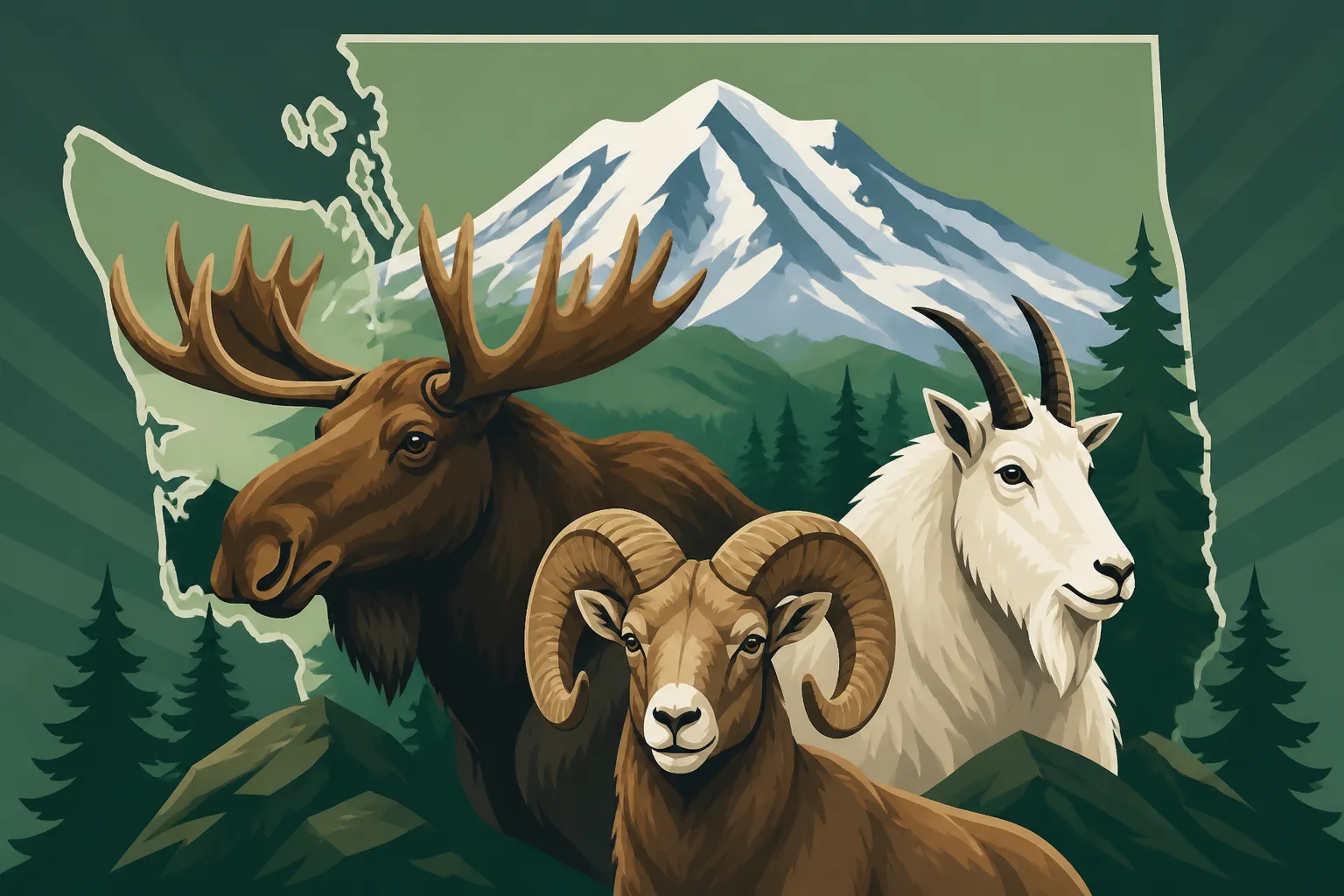
Washington Moose, Sheep and Mountain Goat
For many hunters, the dream of drawing a tag for Washington’s true trophy big game species—moose, bighorn sheep, and mountain goat—feels like a lottery ticket win. These animals represent the pinnacle of North American hunting, not just for their majestic presence, but for the incredible challenge and often extreme luck required to even get a chance to pursue them. This guide will walk you through everything you need to know about these iconic species, from where they live to the complicated process of applying for one of these coveted permits in Washington State.
The Elusive Giants of Washington: Moose Hunting
There's something truly awe-inspiring about a moose, their sheer size and distinctive antlers making them unmistakable. While not as numerous as deer or elk, Washington does boast a growing moose population, primarily found in the northeastern corner of the state. For those lucky enough to draw a tag, a Washington moose hunt is an experience unlike any other.
Where Washington Moose Live
When you talk about moose in Washington, you're almost exclusively talking about the northeastern portion of the state, particularly the Selkirk Mountains. This region, bordering Idaho and British Columbia, provides the ideal habitat of dense timber, wetlands, and abundant browse that moose thrive on. While they are occasionally sighted in other areas, such as the northern Cascades, the vast majority of Washington's moose population, and thus the hunting opportunities, are concentrated in the Selkirk range within Pend Oreille and Stevens counties. These gentle giants prefer areas with dense cover for bedding and plenty of willow, aspen, and aquatic vegetation to feed on. They’re less likely to be found in wide-open country and more often tucked away in brushy creek bottoms or dense timber stands, making them quite a challenge to locate even if you have a tag in your pocket.
Over the past few decades, Washington has seen a significant increase in its moose population, which has steadily expanded its range. This growth is a testament to effective wildlife management and suitable habitat. For more detailed information on their distribution and growth, you might find our article on Washington Moose Population Growth in Washington insightful. However, despite this positive trend, moose numbers are still relatively low compared to states like Alaska or Maine, which is precisely why drawing a tag here is such a rare feat. Hunters applying for a permit need to focus their efforts on the specific Game Management Units (GMUs) designated for moose hunting in this region, such as those within the Selkirk GMU. Knowing these areas intimately, even through extensive E-scouting, is crucial to understanding your chances and planning your hunt should you be successful in the draw.
Understanding Washington Moose Permit Applications
Applying for a Washington moose permit is not for the faint of heart, or for those expecting easy success. These are true "once-in-a-lifetime" type hunts for most individuals. The application process is part of the Washington Department of Fish and Wildlife's (WDFW) special permit draw system, which governs access to these highly sought-after hunts. Unlike general season tags that can often be purchased over the counter, moose permits are limited in number and awarded through a lottery system. This means that even with perfect planning and research, luck plays a significant role.
To even be considered for a moose permit, you first need to purchase a valid Washington hunting license that includes a big game endorsement. Then, during the annual application window, typically from April 20 to May 27, you submit your special permit application. You'll specify your first and second choices for moose units, keeping in mind that there are generally only a handful of permits available across the entire state. The application fee is per species, so if you're also applying for sheep or goats, each requires a separate fee. It’s a painstaking process, but the potential reward—a moose tag—makes it worth the yearly ritual for many dedicated hunters. Understanding the full scope of the application process is key, so consider reading up on Washington Special Hunt Permits and How to Apply for a broader view.
One of the unique aspects of Washington's draw system is that it doesn't utilize a preference point system for these species. Instead, it's a completely random draw, meaning every applicant, regardless of how many years they've applied, has an equal chance each year. This can be both frustrating and encouraging. It means a first-time applicant has the same mathematical odds as someone who's been applying for twenty years. This also means that researching draw odds for Washington Moose Permit Applications doesn't necessarily get easier because past success doesn't predict future outcomes in the same way a point system might. Many hunters use tools like GoHunt's Insider platform to analyze application data and identify which units historically offer slightly better odds or more consistent permit numbers, although for moose, the numbers are always incredibly low across the board. The important thing is consistency: you can't win if you don't play, so submitting an application every year is the only way to keep your dream alive.
Moose Biology and Behavior
Moose are fascinating creatures, perfectly adapted to their cold, northern environments. They are the largest members of the deer family, with bulls typically weighing between 800 and 1,200 pounds, though some can exceed 1,500 pounds, and standing over six feet tall at the shoulder. Their diet primarily consists of browse—twigs and leaves from shrubs and young trees like willow, aspen, and birch—as well as aquatic plants found in bogs and ponds. In Washington, particularly in the Selkirks, they spend a good portion of their year browsing on fir and pine needles when other forage is scarce.
Their immense size and dense coats make them particularly well-suited for cold winters, but they can struggle in warmer temperatures. During hot spells, moose often seek out water to cool off, or dense, shaded timber. Unlike deer and elk, moose are generally more solitary animals, though you might occasionally see a cow with her calf, or bulls gathering loosely during the rut. The rut, or breeding season, typically occurs in late September and October, during which time bulls can become more vocal and aggressive as they seek out cows. Their immense antlers, which can span over six feet, are shed each winter, usually in late December or January, only to be regrown bigger the following year.
Hunting moose is less about covering vast distances and more about systematic searching of prime habitat, often using binoculars or a spotting scope from high vantage points to pick apart dense timber or brushy creek bottoms. Understanding their daily patterns – where they feed, where they bed down during the day, and their travel corridors between these areas – is crucial. They are not known for being skittish like deer, but their incredible hearing and sense of smell, combined with their ability to seemingly vanish into thick cover, make them challenging to approach. A successful moose hunter often combines careful glassing with patient still-hunting through thick areas, focusing on fresh sign like tracks and chewed browse.
Chasing Bighorns: Washington's Sheep Hunting Opportunity
To stand on a rugged mountainside and spot a bighorn sheep ram is an unforgettable experience. These magnificent animals, with their iconic curled horns, embody the spirit of the wild, high-country wilderness. In Washington, hunting bighorn sheep is perhaps the most exclusive and physically demanding of all big game pursuits, reserved for an extremely lucky few.
California and Rocky Mountain Bighorns in Washington
Washington is home to two subspecies of bighorn sheep: the California bighorn and the Rocky Mountain bighorn. Both are truly impressive animals, but they occupy distinct geographic regions and exhibit some differences in their habitat preferences and behaviors. The California bighorn sheep herds are primarily found in the dryer, more rugged canyons and open slopes of Central Washington, specifically in areas like the Yakima River Canyon, the Sinlahekin Valley, and along the breaks of the Columbia River. These sheep tend to inhabit lower elevations with broken, rocky terrain and sparse vegetation, where their incredible agility and eyesight give them a distinct advantage.
The Rocky Mountain bighorn sheep, on the other hand, are found in the extreme southeastern corner of the state, primarily within the Blue Mountains. This region offers higher elevation, forested slopes interspersed with rocky outcroppings and steep canyons. Rocky Mountain bighorns are often larger-bodied than their California counterparts and generally inhabit more timbered, higher-elevation terrain, although they still rely heavily on escape terrain that offers open visibility and protection from predators. Both subspecies, however, face similar challenges, including habitat fragmentation and disease. For those interested in the unique characteristics of the two subspecies and their locations, articles detailing California Bighorn Sheep in Washington and Rocky Mountain Bighorn Herds in Washington can provide deeper insights.
Despite their different ranges, both populations have faced significant challenges over the years, particularly from disease. Outbreaks of pneumonia, often linked to contact with domestic sheep, have devastated bighorn herds in Washington and across the West. These events highlight the fragile nature of bighorn populations and the critical importance of careful management. The WDFW works tirelessly to monitor herd health, conduct translocations to establish new populations, and manage potential conflicts with domestic livestock. These efforts are crucial to maintaining the limited hunting opportunities that exist.
The Challenges of Bighorn Permit Applications
If moose permits are hard to draw, bighorn sheep permits are in a league of their own. These are often considered the holy grail of big game tags, with statewide draw odds typically less than 1% for residents, and even lower for non-residents. Like moose, bighorn sheep permits are allocated through Washington's special permit draw. The application process runs concurrently with other special permits during the spring application period, generally from April to late May. Each year, only a handful of permits, sometimes as few as one or two per unit, are issued across all bighorn hunting units in the state.
The sheer rarity of these tags means that most hunters will apply for decades without ever drawing one. As with moose, Washington uses a random draw system, meaning no preference points accumulate over time. This makes every year a fresh start, which is a double-edged sword: it offers hope to new applicants but can be disheartening for long-time hopefuls. The application fee is per species, and you can apply for multiple bighorn units, but the overall number of permits available ensures the odds remain astronomically low. It is absolutely critical to accurately fill out your application, including your hunt choices, as any mistake could invalidate your chance. Detailed guidance for navigating this can be found in resources about Washington Bighorn Sheep Permits.
Given the extreme odds, many aspiring bighorn hunters consider purchasing raffle tickets as another avenue to a tag. Organizations like the Wild Sheep Foundation often offer raffle permits for Washington bighorns, where purchasing multiple tickets can significantly improve your chances compared to the statewide draw, though the cost can be substantial. For those who choose to pursue a bighorn tag through the regular draw, meticulous research into each unit's historical harvest success rates, terrain, and sheep density is paramount, even if the draw odds are universally low. GoHunt's data, for example, can show which units have offered a tag in recent years, helping applicants make informed, albeit still long-shot, decisions about their choices. It's a game of patience, persistence, and a healthy dose of luck, but the reward of hunting these magnificent animals in their rugged domain is considered worth every year of applying for many.
Bighorn Habitat and Conservation
Bighorn sheep are masters of their mountainous environment. Their cloven hooves, with their rough pads and sharp edges, provide incredible traction on steep, rocky slopes, allowing them to navigate terrain that most other animals (and certainly most hunters) would find impassable. They rely on this escape terrain to evade predators like cougars and coyotes. Their diet consists primarily of grasses, forbs, and shrubs, which they find in the open, often windswept slopes and ridges that make up their home range.
Conservation efforts for bighorn sheep are particularly vital due to their susceptibility to disease and habitat loss. As mentioned, pneumonia outbreaks, often transmitted from domestic sheep, have caused significant declines in bighorn populations. Organizations like the Wild Sheep Foundation, in partnership with WDFW, are actively involved in efforts to prevent disease transmission, restore habitat, and translocate sheep to establish new, healthy herds. These efforts are often funded, in part, by the revenue generated from special hunt permit fees and conservation raffle tickets, directly linking hunting opportunities to conservation success. Hunters play a crucial role in financially supporting the health and future of these iconic species.
A significant aspect of bighorn management involves studying and mitigating the spread of disease. Our piece on Bighorn Pneumonia Die-Offs in Washington delves deeper into these critical issues, providing context for the careful management decisions made by WDFW. For a hunter, understanding these conservation challenges not only deepens appreciation for the rarity of a bighorn tag but also underscores the responsibility that comes with it. Ethical hunting practices and adherence to all regulations are paramount to ensuring these populations continue to thrive for future generations.
Scaling the Heights: Mountain Goat Hunting in Washington
Standing high on an exposed ridge, watching a mountain goat navigate impossible cliffs, is an experience that puts life into perspective. These incredibly hardy animals are perfectly designed for the extreme alpine environments they call home. In Washington, mountain goat hunting is an exceedingly rare opportunity, reserved for those who truly embrace the challenge of high-altitude wilderness.
Washington Mountain Goat Herds and Ranges
Mountain goats in Washington are creatures of the high Cascades, inhabiting the most rugged, inaccessible peaks and alpine bowls. Their range extends throughout the Cascade Mountain Range, from the North Cascades all the way down to the southern portions of the range, including areas in the Gifford Pinchot National Forest. They prefer steep, rocky terrain above the tree line, often near glaciers or permanent snowfields, where they can find forage and security from predators. Unlike moose or even bighorns, goats are almost exclusively found in the true alpine, making their pursuit a physically demanding endeavor in extreme weather conditions.
Their populations, while stable in many areas, are closely monitored. The WDFW manages mountain goats through targeted surveys and careful permit allocation to ensure sustainability. Interestingly, the Olympic Mountains once had a significant mountain goat population, but these were introduced non-native animals that began to impact sensitive alpine vegetation. In a controversial but necessary move, those goats were systematically removed, with some translocated to other Cascade ranges to augment existing populations. This translocation program, discussed in more detail in our article on Mountain Goat Translocations in Washington, is a key component of Washington's management strategy for this species.
The challenge of hunting mountain goats isn't just drawing the tag, but physically accessing their remote habitats. Many goat units require significant backpacking into designated wilderness areas, often involving multi-day trips and navigating extremely steep, loose terrain. These hunts demand a high level of physical fitness and self-reliance, as goats rarely venture far from their rocky strongholds. Understanding the specific mountain ranges and high-altitude areas where these goats thrive is the first step for any hopeful applicant.
Applying for Washington Mountain Goat Permits
Like moose and bighorn sheep, Washington mountain goat permits are among the hardest to draw in the state. These are strictly managed special permits, with very few tags issued each year. The application process mirrors that of other premier big game species, taking place during the WDFW's annual spring permit application window. To apply, you'll need a current Washington hunting license with the appropriate endorsements, and then you can submit your special permit application, designating your preferred mountain goat units.
The draw odds for mountain goats are consistently among the lowest in Washington. It's not uncommon for units to have a single tag available for thousands of applicants. Washington's random draw system means that every applicant, regardless of previous attempts, has an equal shot each year. This system can be frustrating for those who've been applying for many seasons, but it also means that a first-time applicant could theoretically draw a tag in their first year. For a deep dive into the specifics of this process, our guide on Washington Mountain Goat Permits is an excellent resource.
Many dedicated hunters meticulously analyze historical draw odds and unit information available through resources like GoHunt, hoping to find any slight edge in their application choices. However, for species as rare as mountain goats, even a "better" unit might still have odds in the sub-1% range. The dedication to apply year after year is a testament to the allure of these hunts. It’s a marathon, not a sprint, and for the vast majority, securing a mountain goat tag is truly a once-in-a-lifetime opportunity that requires unwavering persistence and a healthy dose of good fortune.
Mountain Goat Ecology and Unique Adaptations
Mountain goats are biological marvels, uniquely adapted to survive and thrive in some of the harshest environments on Earth. Their thick, shaggy white coats provide exceptional insulation against extreme cold, wind, and snow, making them perfectly camouflaged against their snowy backdrops. Their robust build and specialized hooves are perhaps their most impressive adaptation. Their hooves are dual-toed, with soft, padded soles that provide excellent grip on slick rock, and sharp, hard outer edges that act like crampons for traction. This design allows them to traverse near-vertical cliffs and icy ledges with an ease that seems impossible.
Their diet consists of various alpine grasses, mosses, lichens, and high-altitude shrubs, which they find by meticulously picking their way across treacherous slopes. They are often found near mineral licks, seeking out essential salts and minerals that are scarce in their diets. Mountain goats are relatively solitary, though nannies (females) will often be seen with their kids, sometimes in small groups. Billies (males) are generally larger and have thicker horns that show more annual growth rings. Telling a billy from a nanny in the field can be crucial for legal harvest, as many permits are for a specific sex or age class.
Hunting mountain goats is not merely a test of shooting skill; it’s a test of mountaineering ability, endurance, and mental fortitude. The pursuit often takes hunters into incredibly remote and dangerous terrain, far from any roads or easy access. This requires specialized gear, extensive planning, and a deep respect for the mountain environment. Successfully hunting a mountain goat is the culmination of years of applying, coupled with an arduous physical challenge, making it one of the most rewarding and memorable hunts a person can undertake.
The Permit Puzzle: Navigating Special Hunt Applications
Drawing a special permit for moose, bighorn sheep, or mountain goat in Washington feels like winning the lottery, and for good reason—the odds are truly stacked against you. But if you don't play, you can't win. Understanding the application process is your first step towards making that dream a reality. It's not just about filling out a form; it's about strategic choices and consistent effort.
Key Dates for Washington Special Hunt Permit Applications
Navigating the WDFW special permit application process requires keen attention to dates. Missing a deadline means waiting another year, which for these species, can feel like an eternity. The most critical period for applying for Washington's premier big game permits, including moose, bighorn sheep, and mountain goat, is the annual application window. This typically opens around April 20th and closes on May 27th. It's vital to mark these dates on your calendar and set reminders well in advance. The WDFW website will have the exact dates for the current year's draw, and it's always best practice to check directly with their official regulations pamphlet.
While the application window is the most crucial, there are other dates to be aware of. The WDFW usually posts the hunt choices and regulations pamphlet several weeks before the application period opens, giving you time to research units and plan your strategy. After the application closes, there's a period of anticipation before the draw results are announced. Typically, results are posted by mid-June, and applicants can check their WILD account online to see if they've drawn a coveted tag. For more detailed information on the specific opening and closing dates for applying, our article on Washington's April 20 to May 27 Application Window offers further clarification. Don't leave it to the last minute; technical glitches or unforeseen circumstances can easily derail an application if you wait until the final hours.
Maximizing Your Washington Special Hunt Choices
Washington allows applicants to submit up to four choices for most species on their special permit application, although for some quality deer and elk hunts, this might be restricted to two. For moose, sheep, and goat, you typically get multiple choices, which is incredibly important for optimizing your chances. The key here isn't just picking your favorite unit; it's about strategic planning. While everyone dreams of drawing a tag for the unit with the biggest animals or highest success rates, those often come with the lowest draw odds.
To maximize your chances, it's wise to research historical draw odds for each unit. Platforms like GoHunt provide invaluable data on previous years' draw statistics, including how many tags were offered, how many applicants there were, and the resulting odds. This allows you to stack your choices strategically. For example, your first choice might be a dream unit with extremely low odds, but your second, third, and fourth choices could be units with slightly higher (though still low) odds, or units that you might consider less desirable but still offer a quality hunt. Remember, for these rare species, any tag is a trophy. Understanding How Many Hunt Choices Washington Allows and using them wisely can be the difference between a perpetual applicant and a successful hunter.
Understanding Washington's Random Draw System
Perhaps the most frustrating, yet also democratizing, aspect of Washington's special permit system for moose, sheep, and goat is its random draw. Unlike many other states that use preference or bonus point systems, Washington awards these tags through a true lottery. This means that every applicant, regardless of how many years they've applied, starts fresh each year with essentially the same mathematical chance of drawing a tag. There are no points to build up, no seniority; it's pure luck of the draw. This can be especially frustrating for hunters who have been applying for decades without success, feeling like their years of dedication count for nothing.
On the flip side, this random system means that a brand-new hunter applying for the first time has just as much of a chance as an old veteran. This provides a glimmer of hope to everyone, making the annual application process exciting rather than a foregone conclusion based on point totals. While it removes the strategic element of building points, it emphasizes consistent application. The only way to win a random lottery is to buy a ticket every year. This system is in contrast to those that prioritize longevity, but WDFW's aim is to ensure broad, albeit rare, access to these limited hunting opportunities. For more information on why Washington opted for this system, our article on Why Washington Uses a Random Draw explains the rationale.
| Species | Primary Range | Typical Tags Annually | Draw System | Physical Demand |
|---|---|---|---|---|
| Moose | Northeast Washington (Selkirks) | 10-20 | Random Draw | Moderate-High |
| Bighorn Sheep | Central WA (California) & SE WA (Rocky Mtn) | 5-15 | Random Draw | High-Extreme |
| Mountain Goat | Cascade Mountain Range | 10-25 | Random Draw | Extreme |
Conservation and Management of Washington's Iconic Species
The continued existence of moose, bighorn sheep, and mountain goats in Washington is a testament to dedicated conservation efforts. These species face unique challenges, and their management requires a careful balance of scientific research, habitat protection, and regulated hunting. Hunters play a vital, often understated, role in funding and supporting these critical conservation programs.
Washington Wildlife Disease Surveillance and Impacts
Disease can be a devastating factor for wildlife populations, especially for species like bighorn sheep that are highly susceptible to certain pathogens. Washington, like other Western states, maintains a robust wildlife disease surveillance program, continuously monitoring for illnesses that could impact moose, sheep, and goats. For bighorns, pneumonia is a recurring threat, often linked to interactions with domestic sheep. Outbreaks can decimate entire herds, wiping out years of population growth in a single season. The WDFW closely monitors these events, often conducting research to understand disease dynamics and implementing measures to prevent transmission, such as separating bighorns from domestic livestock where feasible.
Moose populations can also be affected by various parasites and diseases, though they generally seem less prone to widespread, catastrophic die-offs in Washington compared to bighorns. Winter tick infestations, for instance, can weaken moose, especially calves, contributing to mortality in severe winters. Mountain goats, while hardy, can also be impacted by certain pathogens or environmental stressors. The WDFW’s efforts in disease surveillance and management are crucial not only for the health of these specific populations but also for maintaining the ecological balance of Washington’s wild landscapes. Understanding Washington Wildlife Disease Surveillance practices highlights the complex challenges faced by wildlife managers and how hunters contribute to solutions.
Habitat Preservation Efforts
For species that rely on specific, often rugged, habitats, preservation and enhancement are paramount. Moose need dense timber and wetland areas, bighorns require open, rocky escape terrain, and mountain goats depend on high-alpine wilderness. As human populations grow and development expands, these critical habitats can become fragmented or degraded. WDFW, in partnership with federal agencies like the US Forest Service and Bureau of Land Management, as well as private land trusts, works to protect and restore these vital landscapes. This includes efforts to acquire key winter range, manage timber harvests to benefit wildlife, and ensure access corridors between different habitat areas.
Habitat preservation isn't just about setting aside land; it's also about active management. This can involve prescribed burns to rejuvenate vegetation, invasive species removal, or water source development in arid areas. For mountain goats, ensuring the integrity of their remote alpine habitat, often within designated wilderness areas, is crucial. For bighorns, maintaining corridors that prevent contact with domestic sheep while ensuring access to critical forage and mineral licks is a delicate balancing act. These efforts are long-term and require sustained investment, much of which is funded by hunting and fishing license sales, as well as special permit fees.
The Role of Hunters in Conservation Funding
It’s a powerful truth that hunters are among the most dedicated conservationists, not just in Washington, but across North America. The very permits that are so hard to draw for moose, sheep, and goats contribute directly to the financial backbone of wildlife management. Every dollar spent on a hunting license, tag, or special permit application fee goes directly into funds that support WDFW's work. This includes population surveys, disease research, habitat restoration, law enforcement, and wildlife translocations – all programs that benefit these magnificent species.
Beyond direct financial contributions, hunters also act as eyes and ears in the field, often reporting unusual wildlife observations or potential disease issues to WDFW. Many also volunteer for habitat projects or participate in advisory committees. The Pittman-Robertson Act, a federal excise tax on firearms, ammunition, and archery equipment, further channels millions of dollars annually into state wildlife agencies for conservation. Without the financial and ethical commitment of hunters, many of Washington's most iconic and vulnerable species, including moose, bighorn sheep, and mountain goats, would face an even more uncertain future. After a successful hunt, Washington Harvest Reporting Requirements are a critical final step, providing essential data for wildlife managers to make informed decisions for future seasons.
Preparing for a Once-in-a-Lifetime Hunt
Drawing a moose, bighorn sheep, or mountain goat tag in Washington is just the beginning of the adventure. These hunts are physically and mentally demanding, often taking hunters into remote, rugged, and unforgiving terrain. Proper preparation is not just recommended; it's absolutely essential for safety and success.
Physical Conditioning for High-Altitude Hunts
Let's be blunt: these are not armchair hunts. Mountain goat and bighorn sheep hunts, in particular, demand peak physical condition. You will be hiking, climbing, and packing heavy loads over extremely steep, rocky, and often high-altitude terrain. The air is thinner, the footing is treacherous, and the weather can change in an instant. A successful hunter needs strong cardiovascular endurance, leg strength, and core stability. Training should begin months, if not a year, in advance. This means incorporating activities like hiking with a weighted pack, stair climbing, trail running, and strength training focused on your legs and back.
Don't underestimate the impact of altitude. If you live at sea level, even a few thousand feet of elevation gain can significantly reduce your stamina. Training at elevation, if possible, is ideal, but otherwise, rigorous training at home will help. Simulated climbs with a heavy pack, even up and down hills in your local park, are invaluable. Many hunters who draw these tags hire a guide, not just for their expertise in finding animals, but also to help manage the strenuous physical demands and safety aspects of the hunt. This hunt will push your limits, so prepare accordingly.
Essential Gear for Steep Terrain and Remote Camps
The gear you choose for a Washington moose, sheep, or goat hunt can make or break your experience, and in some cases, determine your safety. For mountain goats and bighorn sheep, durable, lightweight, and reliable equipment is paramount. Your pack system needs to be capable of comfortably carrying heavy loads over long distances, often through extremely broken country. A good internal or external frame pack with excellent adjustability is a must. For optics, you'll want high-quality binoculars (10×42 or 12×50) for scanning vast landscapes, and a powerful spotting scope (20-60x or 20-70x) with a sturdy tripod to identify animals from miles away and evaluate their trophy potential. Rangefinders with angle compensation are also critical for accurate shots in steep terrain.
Footwear is another non-negotiable area. Invest in high-quality, waterproof, sturdy mountaineering boots that are well broken-in before your hunt. Good ankle support and stiff soles are crucial for traversing rocky, uneven ground. Layered clothing, utilizing merino wool or synthetic base layers, fleece mid-layers, and a bombproof waterproof and windproof outer shell, is essential for dealing with rapidly changing mountain weather, from driving rain to freezing snow. For camping, especially for multi-day backcountry trips, ultralight but durable tents, sleeping bags rated for freezing temperatures, and a reliable water filtration system are necessary. Considering our article on Backcountry Camps in Washington Wilderness will provide excellent context for what to expect and how to prepare. Remember, for these remote hunts, self-sufficiency is key; you are your own rescue team.
Scouting and E-Scouting for Trophy Animals
Whether you've drawn a tag or are simply planning for future applications, thorough scouting is a critical component of success. For moose, this might involve identifying prime browse areas and thick timber pockets in the Selkirks. For sheep and goats, it means studying maps, identifying escape terrain, and marking potential bedding and feeding areas high in the Cascades or Blue Mountains. While physical scouting trips can be incredibly valuable, especially for understanding the terrain, they aren't always feasible for remote areas or for hunters who live far away.
This is where E-scouting comes into its own. Using satellite imagery, topographic maps, and hunting apps like onX Hunt or GoHunt, you can virtually explore your chosen GMU from the comfort of your home. Look for hidden basins, north-facing slopes that hold snow later into the year, mineral licks, and trails that access high country. Identify potential glassing points and plan your approach routes. While GoHunt's data for Washington is invaluable for application strategy, their mapping tools are also excellent for dissecting a unit once you've drawn a tag. Mark potential camp locations, water sources, and areas of dense cover where animals might bed. This detailed virtual groundwork can save you precious time and effort once you're on the ground, and greatly increase your chances of finding that once-in-a-lifetime animal.
Disclaimer
Please note that hunting regulations, season dates, and permit application processes are subject to change annually by the Washington Department of Fish and Wildlife (WDFW). It is the hunter's responsibility to consult the most current WDFW regulations pamphlet and official website before planning or participating in any hunting activity. This guide provides general information and should not be considered a substitute for official WDFW regulations.