Rangefinders for Steep Washington Terrain
Hunting in Washington is an incredible experience, but let's be honest, it's rarely flat. Whether you're chasing mule deer in the steep coulees of Eastern Washington or slipping through the dense, rain-soaked timber of the Olympic Peninsula for a Roosevelt elk, the terrain is almost always working against you. Judging distance accurately on those steep uphill or downhill shots is a constant headache, and a miscalculation can mean a missed opportunity or, worse, a wounded animal. This guide will dive deep into how to pick and use the right rangefinder to conquer Washington's challenging topography, ensuring you get the most accurate shot placement every time.
The Unique Challenges of Rangefinding in Washington's Topography
When you're out there, boots on the ground in Washington's wild country, you quickly realize that a simple line-of-sight rangefinder, the kind that just spits out a raw distance, often isn't enough. Our state's varied and often brutal landscape presents a whole host of problems that can throw off even the most seasoned hunter's yardage estimate.
Dealing with Steep Angles and Elevation Changes
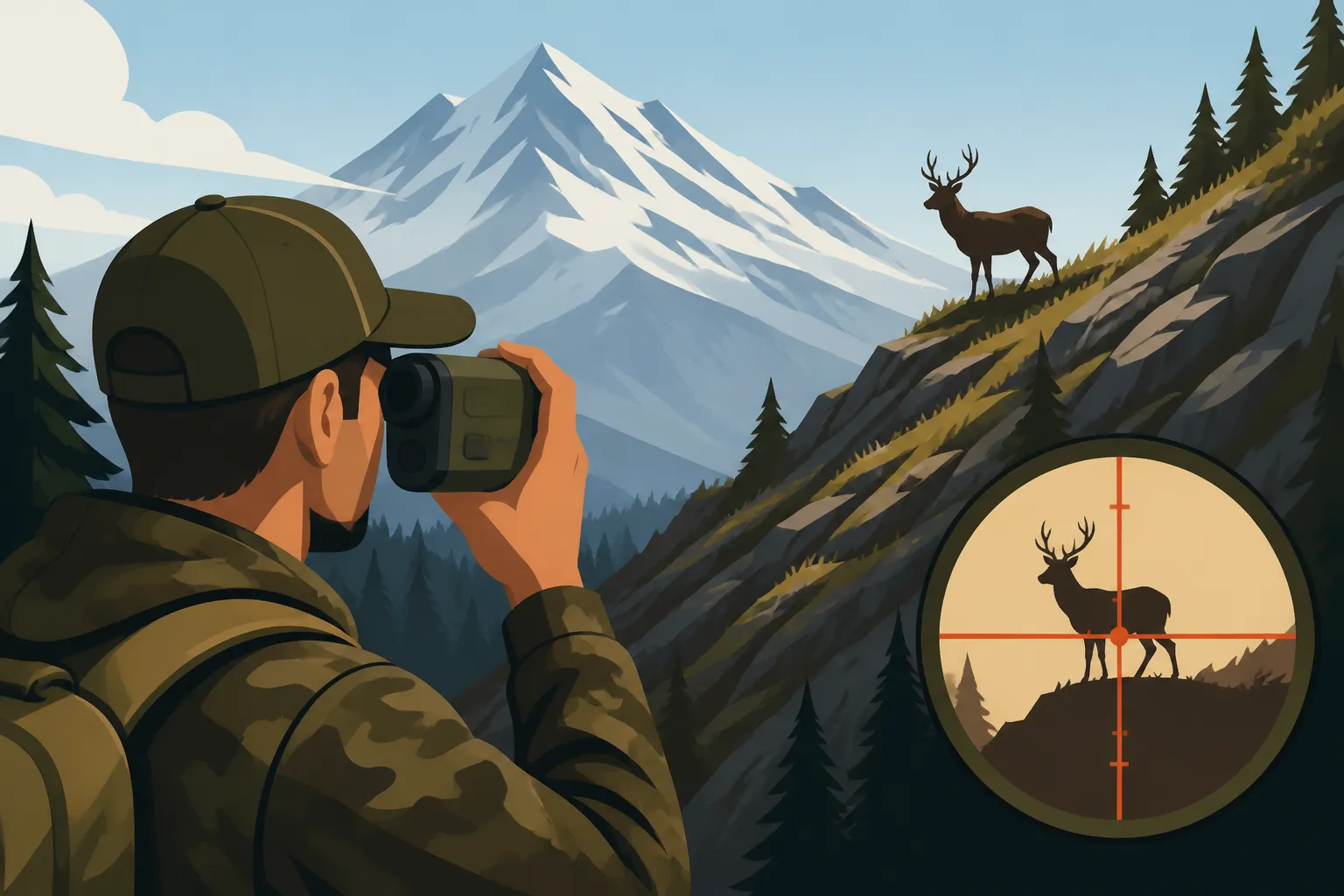
Imagine you're tucked into a rocky outcrop in the Blue Mountains, glassing across a canyon. Suddenly, a beautiful mule deer steps out on the opposing hillside, directly across from you, but a good 300 yards downhill. Your rangefinder says 300 yards. Now, picture that same deer 300 yards away, but standing on a ridge above you, an equally steep uphill shot. Both scenarios give you a 300-yard line-of-sight reading. However, the effect of gravity on your bullet or arrow means that a 300-yard shot straight across flat ground is vastly different from a 300-yard shot at a steep angle.
Gravity has less time to act on your projectile when shooting at a steep angle, whether up or down. This means your bullet or arrow won't drop as much as it would over the same distance on flat ground. If you hold for a true 300-yard shot, you're going to shoot high. This is where the frustration really kicks in. You've practiced diligently, you know your rifle's ballistics or your bow's pin gaps, but throw in a 30-degree incline or decline, and all that hard-won knowledge can go right out the window if your gear isn't up to the task. It's not just about the distance to the target, but the effective horizontal distance your projectile actually travels under the influence of gravity.
Obstructions and Clutter in Dense Cover
Western Washington, especially the coastal areas and the west slope of the Cascades, is famous for its thick, tangled forests. We're talking about salal, devil's club, sword ferns, and dense stands of conifer saplings. Still-Hunting Blacktails in Wet Washington Brush is a common tactic, and it often means you're trying to range through a veritable jungle. You spot a blacktail buck through a small window in the reprod, try to get a reading, and your rangefinder bleeps back 17 yards. You look closer, and realize you just ranged a fern leaf, or a tiny branch five feet in front of the buck's chest.
This kind of clutter is incredibly frustrating. The laser beam needs a clear path to the target. In open country, like the sagebrush flats of Eastern Washington where you might be Glassing Sage and Wheat Edges for Washington Mule Deer, this is less of an issue. But in the dark timber, where every shot opportunity is fleeting and often through a tight lane, getting a clean, accurate reading on the animal itself can be a real challenge. You're constantly fighting with foreground and background interference, trying to ensure your laser is hitting the animal, not the twig in front of its nose or the tree trunk behind its tail. It demands a rangefinder that's not only accurate but also smart enough to prioritize the actual target.
Variable Weather Conditions and Their Impact
Washington weather is legendary for its unpredictability. One minute it's crisp and clear, perfect for glassing. The next, a thick fog rolls in, or a steady drizzle turns into a downpour. These conditions are par for the course, but they play havoc with optical devices, including rangefinders. Moisture in the air – fog, mist, heavy rain, or even falling snow – can scatter the laser beam, making it difficult for the rangefinder to get a strong return signal from your target. This results in inconsistent readings, or worse, no reading at all, right when you need it most.
Imagine you've been sitting on a ridge, patiently waiting for a break in the weather, and a bull elk finally steps out from cover in a momentary clearing. The air is still thick with mist, and your old rangefinder just gives you an error message, or wildly inconsistent numbers. You're left guessing the distance, which is never a good feeling when an animal's life is on the line. Having a rangefinder that can cut through some of this atmospheric clutter, or at least give you a consistent reading even in less-than-ideal light, is absolutely critical for successful and ethical hunting in Washington. Reliable gear in all conditions, from the sunny slopes to the Late-Season Hunting in Washington Snow, is an investment that truly pays off.
Understanding Angle Compensation Technology
If you take one thing away from this guide, it should be the importance of angle compensation in your rangefinder for hunting Washington's diverse and often steep terrain. This isn't just a fancy feature; it's a necessity for ethical and accurate shot placement.
How Angle Compensation Works
At its core, an angle-compensating rangefinder uses an internal inclinometer (a fancy word for a tilt sensor) to measure the angle between you and your target. It then takes this angle, along with the raw line-of-sight distance, and uses some clever internal ballistics calculations to provide you with what's often called the "true ballistic range" or "horizontal equivalent distance" (HED). This HED is the distance your arrow or bullet "thinks" it's traveling, as far as gravity is concerned.
Think of it this way: if you're standing at the bottom of a steep hill, looking up at a deer 50 yards away (line of sight), the horizontal distance, the one your arrow actually reacts to, might only be 40 yards. Holding for 50 yards would cause you to shoot high. Conversely, if you're on a cliff looking down at that same deer, 50 yards away line of sight, the HED might also be 40 yards, and again, holding for 50 would result in a high shot. The rangefinder essentially "flattens" the shot for you, telling you the distance to hold for as if you were shooting on level ground. It takes the guesswork out of complex angular shots, which are incredibly common in places like the Cascade foothills or the steep river breaks of Eastern Washington.
Why You Need It for Washington Hunting
For Washington hunters, particularly those venturing into mountainous or deeply contoured terrain, angle compensation isn't a luxury – it's practically mandatory. Consider the dramatic elevation changes in the Cascade Mountain Range, where you might be shooting across deep valleys or up massive clear-cuts. Without angle compensation, a 400-yard shot on a 20-degree incline could lead you to hold for a distance that's too far, resulting in a shot sailing over your target. Conversely, a steep downhill shot might seem easier, but the same principle applies; without the compensated distance, you're likely to shoot high.
For archers, the need is even more critical. At closer ranges, even small angular differences have a much more pronounced effect on arrow impact. A 20-yard shot at a 45-degree angle feels completely different than a flat 20-yard shot. An angle-compensating rangefinder can literally mean the difference between a clean pass-through and a marginal hit. Whether you're hunting blacktail deer in the incredibly steep, brushy canyons of the Olympic Peninsula or pursuing a Rocky Mountain elk in the rugged Wenaha-Tucannon Wilderness in Washington, this technology drastically improves your chances of an ethical, accurate shot. It empowers you to make confident decisions in situations where guesswork is simply not an option.
Features to Look For in Angle Compensating Rangefinders
When you're shopping for an angle-compensating rangefinder, there are several key features beyond the core technology itself that will enhance your hunting experience in Washington.
First, look for models that offer specific modes tailored to your hunting style. Many rangefinders include a "bow mode" which typically gives a very precise angle-compensated distance ideal for short-range archery. Some also have a "rifle mode" that might incorporate more advanced ballistic data, allowing you to input your specific cartridge and environmental factors for even more accurate holdover solutions. Being able to toggle between these, or having a dedicated mode for your weapon of choice, is a huge plus.
A "scan mode" is incredibly useful in Washington's varied cover. This allows you to continuously sweep the landscape and get multiple readings as you move the rangefinder, which helps in dense timber where it's hard to get a single, clear shot at an animal. You can scan around the animal, or even through small openings, to increase your chances of getting a good reading on the intended target. Look for fast acquisition speeds in scan mode; you don't want to wait several seconds for a reading when an animal is on the move.
Finally, consider the display clarity and overall ease of use. Can you easily read the numbers in low light, bright sun, or even through a bit of mist? Some models offer red LED displays, which are excellent in dim conditions, while others use black LCDs that perform well in bright light but can be harder to see in the shadows. Buttons should be large enough and tactile enough to operate easily with cold, gloved hands, which is a common occurrence during late-season hunts in Washington.
Practical Application of Rangefinders in the Field
Having a great rangefinder is only half the battle. Knowing how to effectively use it in dynamic hunting situations, especially in Washington's often unforgiving landscape, is where true skill comes in.
Pre-Hunt Practice with Your Rangefinder
Just like you practice your shooting, you need to practice with your rangefinder. Don't just take it out of the box, range a tree in your backyard, and assume you're good to go. Washington's terrain demands more. Head to a local shooting range or a safe, permitted area with varied topography. Practice ranging targets at different distances and, critically, at steep uphill and downhill angles. Set up targets at 20, 50, 100, 200, and even 400 yards, and then practice shooting them using the compensated distance your rangefinder provides.
For bowhunters, set up your 20-yard target on a steep slope, then range it with your angle-compensating rangefinder. Note the difference between the line-of-sight distance and the compensated distance. Shoot at the compensated distance. You'll be amazed at how much difference even a slight incline or decline makes, especially at those critical close-range archery distances. This kind of practice builds confidence and muscle memory, so when that moment of truth arrives on opening morning, ranging becomes second nature. It's a critical step to ensure your Archery Practice for Wet Coastal Conditions translates to success in the field.
Rangefinding Strategies for Steep Country
When you're actively hunting in Washington's steep country, you can't always just point and shoot your rangefinder at the animal. There are smarter ways to use it. One effective strategy is to "pre-range" your surroundings. When you set up in a stand or a good glassing spot, range various landmarks – a distinctive tree, a rock outcropping, a patch of brush – at known distances in multiple directions. If an animal appears near one of these landmarks, you'll already have a good idea of the range.
In dense cover, like the thick timber often found in Western Washington, it can be hard to get a direct reading on an animal without hitting intervening brush. Try ranging past the animal to a clear spot on the ground or a tree behind it, then estimate the animal's distance relative to that clear point. Many advanced rangefinders have features that allow them to prioritize the closest target, which can be immensely helpful when trying to get a reading on an animal through light brush, rather than the tree 50 yards behind it. Utilize the scan mode to get multiple readings, especially if an animal is moving; this helps you pick up a consistent, accurate range. Tools like those found on GoHunt can help you research rangefinders with these specific features, making your pre-hunt preparation even more effective. This careful ranging ties directly into thorough E-Scouting Washington GMUs Before the Draw and understanding the terrain before you even set foot in it.
Combining Rangefinders with Other Optics
Your rangefinder isn't meant to be used in isolation; it's part of a powerful optical system. For hunters who spend a lot of time glassing open country, like the breaks of Eastern Washington for mule deer or high-elevation basins for elk, combining binoculars with a rangefinder is incredibly efficient. Rangefinding binoculars integrate both functions into a single unit, saving weight and reducing the number of pieces of gear you need to pull out of your pack. While often a higher investment, the convenience and speed of glassing and instantly ranging without breaking your field of view can be a game-changer. Choosing Binoculars for Washington Glassing is a key part of this strategy.
Alternatively, you can use a high-powered spotting scope, like those often employed for Glassing Eastern Washington Breaks for Mule Deer, to first locate and evaluate an animal at extreme distances. Once you've identified your target, you can then quickly switch to a handheld rangefinder to get your precise compensated distance. For long-range rifle hunting, this two-step approach can be very effective. Regardless of your setup, the key is to practice transitioning smoothly between your optics so that ranging becomes a natural, quick extension of spotting your game.
Key Features and Considerations for Washington Hunters
Beyond the essential angle compensation, Washington's rugged environment and varied hunting styles demand certain qualities from your rangefinder. It needs to be tough, reliable, and user-friendly.
Durability, Waterproofing, and Ergonomics
Let's face it, hunting in Washington means your gear is going to take a beating. From the perpetually damp conditions west of the Cascades to the dusty, rocky terrain of the east, your rangefinder needs to be built to last. Look for models with a rugged, armored housing – rubberized coatings are excellent for absorbing impacts and providing a secure grip, even when wet. A hard-shell case is a good idea for transport, but the unit itself should be able to withstand accidental drops and bumps.
Waterproofing is non-negotiable. Washington gets rain, often a lot of it, and often when you least expect it. An IPX rating of 7 or 8 indicates excellent waterproofing, meaning the device can be submerged for a period without damage. Anything less, and you run the risk of water ingress ruining your electronics. Rain Gear and Layering for Washington Hunts is critical for you, and waterproofing is critical for your gear.
Ergonomics also play a big role. Can you comfortably hold the rangefinder with one hand? Are the buttons easy to reach and manipulate, even with thick gloves on during a late-season hunt? A compact, lightweight design is always a plus, especially if you're Packing an Elk Out of Washington's Backcountry and every ounce counts. Consider the battery type; common CR2 batteries are often preferred for their availability, but ensure you always carry spares, as cold weather can zap battery life faster.
Maximum Range and Target Acquisition Speed
When manufacturers advertise a rangefinder's "max range," they often refer to its ability to range a highly reflective target, like a building or a road sign. The real-world performance on a non-reflective target, such as an animal hide, will almost always be less. For hunting in Washington, especially if you're pursuing mule deer in wide-open country or elk across large clear-cuts, you'll want a rangefinder with a robust maximum range on game animals. If you anticipate shots out to 500-600 yards, look for a rangefinder advertised with a maximum reflective range of 1,000-1,200 yards or more to ensure it performs adequately on an animal at your desired distance.
Target acquisition speed is also crucial. When that bull elk finally steps out, you don't have time to wait several seconds for your rangefinder to process the reading. Look for devices that provide near-instantaneous readings. Fast acquisition means less movement on your part, reducing the chance of spooking the animal, and allows you to confirm the range quickly before taking the shot. Reputable gear review sites, including resources like GoHunt, often provide objective tests of real-world ranging capabilities and acquisition speeds, which can be invaluable when making your selection.
Understanding Brand-Specific Technologies and Cost
The rangefinder market is filled with various brands, each touting their proprietary technologies. Some offer advanced ballistic engines that can factor in temperature, barometric pressure, and even provide custom ballistic profiles for your specific rifle and ammunition. While these features can be incredibly useful for long-range precision shooting, they often come with a higher price tag. Others focus on simpler, robust angle compensation, which might be perfectly adequate for most Washington hunting scenarios, especially within typical ethical shooting ranges.
It's important to balance desired features with your budget. You can find excellent angle-compensating rangefinders across a wide spectrum of price points. A basic, reliable unit that provides accurate HED is a tremendous upgrade over relying on guesswork. High-end models might offer superior glass quality, longer effective ranges, advanced ballistic solvers, or integrated GPS, but these additions aren't always necessary for every hunter. Do your research, understand what features truly benefit your hunting style and the terrain you'll be in, and then make an informed decision. Online communities and resources like GoHunt can be excellent places to compare models and read user reviews.
| Feature | Description | Importance for Washington Hunters |
|---|---|---|
| Angle Compensation | Calculates the "true ballistic range" (horizontal equivalent distance) by factoring in incline/decline. | Critical: Eliminates guesswork on steep uphill/downhill shots, crucial for ethical and accurate shot placement, especially with bows and muzzleloaders where trajectory is more affected by angles. |
| Maximum Range (on game) | The effective distance a rangefinder can accurately read a non-reflective target (e.g., an animal). | High: Washington offers both tight timber and open country. Need sufficient range for Eastern WA mule deer or Western WA clear-cut elk, typically 400-800 yards on game. |
| Target Acquisition Speed | How quickly the device provides a reading once activated. | High: Faster acquisition reduces movement and allows quicker, more confident shots when an animal presents itself, especially in fleeting opportunities or while ranging a moving animal. |
| Scan Mode | Continuously ranges as you pan across the landscape, providing multiple readings. | High: Very useful in dense timber to find gaps or range through light brush, or to track a moving animal for updated distances. |
| Waterproofing (IPX Rating) | Resistance to water ingress (e.g., IPX7 means submersible for short periods). | Critical: Washington weather is notoriously wet. A waterproof unit is essential to protect electronics from rain, mist, and snow, ensuring functionality throughout the season. |
| Ergonomics & Durability | How comfortably the unit fits in hand, ease of button use, and robust construction to withstand impacts. | High: Needs to be easy to handle with gloves, resist drops and bumps from rugged terrain, and maintain grip in wet conditions. |
| Display Type (Red vs. Black) | Red LED displays offer clarity in low light; Black LCDs are better in bright conditions. | Moderate: Choose based on primary hunting times (dawn/dusk vs. midday). Red displays often preferred for low-light hunting prevalent in Washington's forests. |
| Battery Life/Type | Longevity of the battery and ease of finding replacements (e.g., CR2, AA). | High: Always carry spares. Good battery life, especially in cold, is important for multi-day hunts in remote areas. Common battery types are a plus. |
Maintenance and Troubleshooting in the Field
A rangefinder is an investment, and like any other critical piece of hunting gear, it needs proper care to perform when it counts. Being able to troubleshoot minor issues in the field can also save your hunt.
Keeping Your Rangefinder Clean and Dry
Washington's environment can be tough on optics. Dust, mud, rain, and snow are all common adversaries. After a day in the field, always take a moment to gently wipe down your rangefinder. Use a soft, lint-free cloth, ideally a microfiber cloth, to clean the objective and ocular lenses. Avoid using your shirt or anything abrasive, as this can scratch the coatings over time and degrade performance. If there's mud or grime, a slightly damp cloth can help, followed by a dry wipe.
Store your rangefinder in a protective case, harness, or pouch when not in active use. This prevents scratches, keeps moisture out, and protects it from accidental bumps. If your unit gets thoroughly soaked in a downpour, remove the battery, let it air dry in a warm, dry place (but not extreme heat), and consider placing it in a sealed container with desiccant packets (like silica gel) overnight to draw out any remaining moisture. This proactive approach ensures your rangefinder is ready for the next challenge Washington throws your way.
Battery Management and Cold Weather Performance
Nothing is more frustrating than a dead battery when you're trying to range an animal. Always, and I mean always, carry spare batteries. For multi-day hunts, carry more than one. Before each hunt, check your battery level. Many rangefinders have a battery indicator; don't push your luck if it's showing low.
Cold weather can significantly reduce battery performance, a common issue during late-season hunts in the Washington mountains. Keep your spare batteries, and even the rangefinder itself when not in immediate use, in an inner pocket close to your body heat. This can help extend their life and ensure consistent operation. If your rangefinder seems sluggish or isn't giving readings in cold conditions, a quick warm-up in your pocket might be all it needs. If you're encountering persistent issues, try swapping out the battery before assuming a more serious problem.
Dealing with Inconsistent Readings
Sometimes, even with the best rangefinder, you might get inconsistent readings. This often happens in challenging conditions or dense cover. If you get a wildly different number, don't panic. First, try ranging again. Sometimes a second or third attempt will yield a more consistent result. If you're in heavy timber, try using the scan mode to get multiple readings, or try ranging a different part of the animal (e.g., the shoulder instead of the head, if it provides a clearer path).
If brush or small twigs are the problem, try ranging past the animal to a clearer target like a tree or the ground behind it, then visually estimate the difference. Many modern rangefinders are designed to ignore closer objects if they have "brush mode" or "first target priority," but they're not foolproof. Understanding the limitations of your specific rangefinder in varying conditions is key. If your unit consistently gives errors or very short readings, it could indicate lens obstruction, low battery, or an actual malfunction – but typically, it's environmental interference. Take a deep breath, reassess your shot, and try to get a clear line of sight to the target.
Rangefinding for Different Washington Game and Weapon Choices
The way you use your rangefinder, and the specific features that become most critical, can vary significantly depending on what you're hunting and the weapon you're carrying. Washington offers a diverse range of opportunities, each with its own ranging nuances.
Archery Specifics: Critical Short-Range Accuracy
For Washington bowhunters, the rangefinder is arguably the most critical piece of optical equipment after the bow itself. When you're Archery Elk Hunting in Washington's September Season, shots are typically within 20 to 60 yards. At these close distances, even a slight miscalculation in yardage due to angle can lead to a significant miss or a poor hit. An arrow's trajectory is much more sensitive to angle at short ranges than a high-velocity rifle bullet. For example, a 30-yard shot straight down a steep canyon could effectively be a 20-yard shot for your arrow's flight path.
This is why angle compensation is not just a nice-to-have, but an absolute must-have for bowhunters in Washington. Without it, relying on instinct or guessing the "hold under" on steep shots is a recipe for heartbreak. Your rangefinder needs to provide that true ballistic distance instantly and reliably. Look for models with a dedicated "bow mode" that prioritizes this angle-compensated reading. Practice extensively with your rangefinder and your bow on steep terrain to truly ingrain the compensated distances into your shooting process. This will ensure you're confident when that Shot Placement on a Bull at Twenty Yards moment arrives in the dense timber of Western Washington.
Rifle Hunting: Longer Range Considerations
While angle compensation is still valuable for rifle hunters, especially when engaging targets at intermediate to long distances in steep terrain (think 200-500 yards in the vast coulees of Eastern Washington), the impact of angle error is generally less pronounced than with an arrow, thanks to higher bullet velocities. However, ignoring angle on a 400-yard shot at a 30-degree incline can still result in a significant elevation error. For hunters using modern, flat-shooting rifles, the angle-compensated distance helps you confidently dial your turrets or use your holdover reticle.
When building your Rifle Setup for Washington Elk and Deer, integrating your rangefinder's angle compensation with your rifle's ballistic data becomes paramount for precision. Many higher-end rangefinders offer advanced ballistic calculators that can be synced with your specific ammunition, factoring in not just angle but also temperature, altitude, and even wind to provide a precise holdover solution. For the average Washington rifle hunter, a solid angle-compensating rangefinder that consistently provides HED is more than sufficient, allowing you to focus on solid shooting fundamentals.
Muzzleloader Challenges: Slower Projectiles, Unique Needs
Muzzleloader hunting in Washington offers unique challenges, particularly during the Muzzleloader Hunting Washington's Special Seasons. These weapons typically fire heavier, slower projectiles than modern rifles, making their trajectory more arcing and therefore more susceptible to the effects of gravity and angle. An angle-compensating rangefinder becomes incredibly important for muzzleloader hunters for similar reasons as archers – the slower velocity means that the effective horizontal distance plays a bigger role in where your projectile impacts.
Because muzzleloader shots are often taken within 150-200 yards, the angle compensation feature ensures that you're holding for the correct distance, preventing high shots on steep terrain. Many muzzleloader hunters rely on simpler ballistic calculations or holdover marks that are less forgiving than those of a high-power rifle. Accurate angle-compensated ranging simplifies this, allowing you to use your familiar holdovers with confidence. Keeping your Muzzleloader Loading and Ignition in Rain clean and dry is one thing, but knowing the true range is equally vital for a successful shot with these traditional weapons.
Disclaimer
This article is for general informational purposes only and does not constitute professional advice. Laws, prices and regulations vary by location and change over time. Consult a qualified professional for guidance on your specific situation.