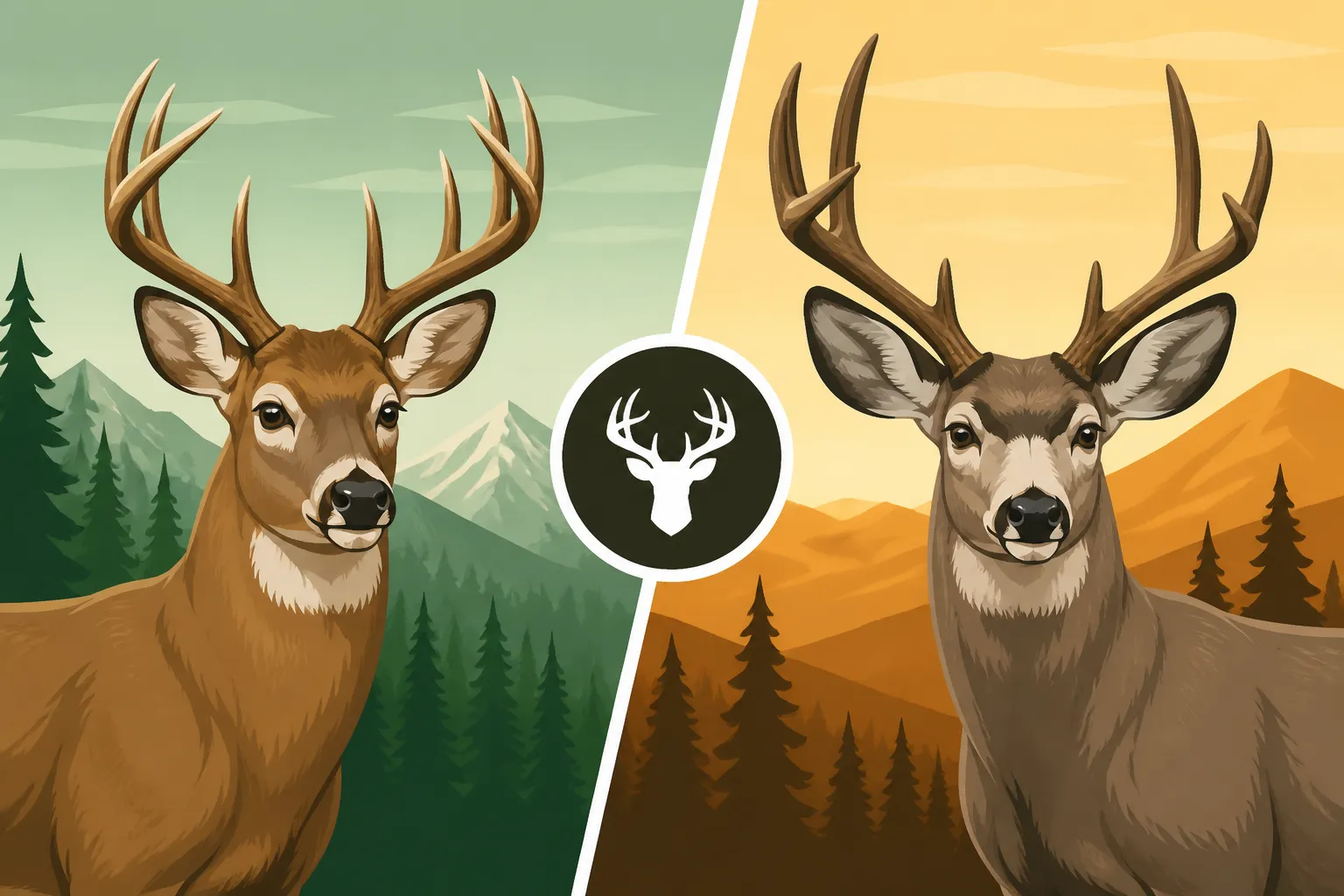
Telling a Whitetail From a Mule Deer
It's a classic hunter's dilemma out here in Washington: you spot a deer, your heart rate spikes, and then you have that split second of confusion. Is it a mule deer or a whitetail? Sometimes it feels like they're playing a cruel trick on you, especially when you're on the edge of their overlapping ranges. This guide is here to untangle that knot of uncertainty, helping you confidently identify your quarry and know what you're legally chasing.
The Tale of the Tail, Ears, and Antlers: Your First Clues
When you're trying to figure out if you've got a whitetail or a mule deer in your sights, there are three primary features that stand out: the tail, the ears, and for the bucks, their antler configuration. These aren't just subtle differences; they're often dead giveaways if you know what to look for.
The Tail: The Most Obvious Identifier
Let's be honest, the tail is usually the first thing that catches your eye, especially if the deer is alarmed and on the move. A whitetail deer, true to its name, possesses a broad, flat tail that is dark brown on top and brilliantly white underneath. When it senses danger or bolts, it will often raise this tail high, waving it like a bright white flag as it bounds away. This "flag" is an unmistakable signal, flashing through the timber or across a field. It's almost as if they're saying, "Here I am! Follow me!" to any other deer in the area, or perhaps "Catch me if you can!" to you. If you see that big, fluffy white flag, you can be pretty sure you're looking at a whitetail.
In stark contrast, the mule deer's tail is much narrower and rope-like, often appearing more cylindrical. It's usually a creamy white color, but critically, it will always have a distinctive black tip. When a mule deer runs, its tail tends to be held down, sometimes swishing from side to side, but it never flashes that bright white "flag" that a whitetail does. Instead, you'll see that narrow tail with its dark brushy end, a completely different visual signature. If the tail is mostly white with a black tip and held relatively low, you're almost certainly looking at a mule deer.
Ear Size and Shape
Another feature that gives the mule deer its name is its ears. They are noticeably large, often appearing disproportionately big compared to the deer's head. Think of a mule's ears – long, broad, and constantly swiveling to catch every sound. These large ears are a crucial adaptation for life in more open, expansive country, allowing them to detect predators from a distance. When you see a deer with ears that look like they belong on a much larger animal, you're likely observing a mule deer. They're like oversized satellite dishes, always on alert.
Whitetail deer, on the other hand, have ears that are much more modest in size. They are still quite functional, of course, but they are proportionally smaller and rounder in comparison to their head. They don't have that prominent, "mule-like" appearance. When you're trying to distinguish between the two, pay attention to how those ears sit on the deer's head. If they seem to dominate the head profile, go with mule deer. If they blend in more naturally, it's probably a whitetail. It might seem subtle at first, but once you've seen both side-by-side, the difference becomes incredibly apparent.
Antler Configuration for Bucks
For the bucks, their antlers provide another strong identifier, though this is only applicable during the seasons when they are carrying headgear. Mule deer bucks typically have antlers that "fork" or "bifurcate." This means that the main beam comes off the head and then divides into two, which then divide again, creating a series of "Y" shapes. It's a double-forking pattern that gives their antlers a complex, branching look, often without a distinct main beam running straight back.
Whitetail bucks, in contrast, usually have a main beam that curves forward and outward from the head. All of the individual tines, or points, then grow upward from this single, unbranched main beam. It's more like a rake or a candelabra, with points rising independently off that main curve. While there can always be abnormal points or broken antlers that complicate things, this fundamental difference in antler growth pattern is a very reliable way to differentiate between the two species when observing a buck. A quick glance at a buck's rack can tell you almost instantly whether it's a whitetail or a mule deer. For those serious about understanding the nuances of deer populations, tools like GoHunt provide valuable resources for mapping typical ranges and understanding the characteristics of deer in specific regions.
Understanding Habitat and Behavior in Washington
Beyond the physical appearance, the environments these deer prefer and how they act within those environments offer significant clues to their identity. Washington's diverse landscape means both species have carved out distinct niches, though there are areas where their worlds certainly collide.
Habitat Preferences in Washington
In Washington, the habitat preferences of these two deer species are largely dictated by the Cascade Mountain range, which acts as a natural divide. Whitetail deer thrive in areas with dense cover, riparian zones along rivers and streams, and agricultural edges. If you're hunting in the thick timber of northeastern Washington, particularly in areas like Pend Oreille or Stevens County, or along river bottoms with plenty of brush and deciduous trees, you are squarely in prime White-Tailed Deer in Northeast Washington country. They love areas where they can melt into the shadows and disappear quickly, relying on their stealth and camouflage. They're often found in relatively flat or gently rolling terrain, preferring to avoid wide-open spaces where they feel exposed.
Mule deer, on the other hand, are the deer of the high desert, open sagebrush flats, and broken, rugged terrain of eastern and central Washington. Think of the vast landscapes of the Okanogan, Yakima, or the arid parts of the Columbia Basin, especially where you find steep coulees and rimrock. This is classic Mule Deer of Eastern Washington habitat. They are built for navigating rocky slopes and expansive visibility, using terrain to their advantage rather than dense cover. While you might find them in pine forests at higher elevations, they generally favor more open country, where their keen eyesight and large ears give them an edge.
Gait and Movement Patterns
One of the most distinctive behavioral differences you'll notice when a deer is alerted is its gait. A mule deer has a unique, stiff-legged bounding motion called "stotting" or "pronking." When a mule deer senses danger and decides to flee, all four of its feet will often leave the ground simultaneously, landing together in a rhythmic bounce. It's an incredibly efficient way for them to cover broken ground and put distance between themselves and a threat, often allowing them to see over obstacles as they go. This peculiar, spring-loaded hop is a dead giveaway that you're watching a mule deer. It's almost comical until you realize how quickly they can disappear over a ridge.
Whitetail deer, by contrast, move with a more traditional bounding run. When they take off, they will push off with their hind legs, then their front legs, in a powerful, driving motion. Their tail, as we discussed, will often be raised high as a white flag, distinguishing their escape from the mule deer's bouncy retreat. They use their speed and agility to weave through dense cover, often disappearing into the underbrush with incredible efficiency. If you see a deer gracefully bounding through the trees with that white flag waving, you're almost certainly observing a whitetail. These differences in movement are not just interesting observations; they're critical for tracking and predicting where a deer might go after being jumped.
Social Patterns and Groupings
While both species can exhibit variations in social behavior depending on the season, their general tendencies can also provide clues. Whitetail deer are often seen in smaller family groups, typically a doe with her fawns, or occasionally a small group of does. Bucks tend to be more solitary outside of the rutting season, though younger bucks might form bachelor groups. They are generally more secretive and rely on cover, making larger group sightings less common, particularly in the dense environments they inhabit. You might see a lone whitetail ghosting through the timber, or a small cluster emerge from a thicket at dawn or dusk.
Mule deer, especially in more open country, can sometimes be observed in larger groups, particularly during the late summer and fall outside of the intense rut period, or on their winter ranges. Does and fawns might gather in more substantial herds, and bachelor groups of bucks can be quite impressive. Their tendency to inhabit more exposed landscapes means they often rely on group vigilance for safety, with many eyes and ears scanning for danger. However, once the hunting pressure increases, even mule deer become much more wary and scattered. Knowing the typical social groupings can help you assess the general behavior of the deer you encounter, though it's less a definitive identifier and more a supporting piece of evidence.
Washington's Overlap Zones and Critical Distinctions for Hunters
Washington is a unique state where the ranges of whitetail and mule deer, while generally separated by the Cascades, do overlap in significant hunting areas, particularly in the central and eastern parts of the state. This is where identification becomes truly crucial for hunters.
Where the Ranges Meet
The general rule of thumb for Washington is whitetails east and north, mule deer east and south, with the Cascades dividing them from the Roosevelt elk and blacktails of the west side. However, this is an oversimplification. You'll find significant whitetail populations in the northeastern counties like Pend Oreille, Stevens, and Ferry, but as you move south and west into areas like the Okanogan or the Columbia Basin, the mule deer become more prevalent. The critical "overlap zones" are often found in the more central eastern portions of the state, where agricultural lands meet more rugged, arid uplands. Think of units around the Okanogan River, or areas bordering the foothills of the Cascades on the east side.
In these transition zones, it's not uncommon to see both species in the same general area, sometimes even on the same property. This overlap can be challenging for hunters who might be accustomed to one species exclusively. It requires a keen eye and a solid understanding of all the identification points we've discussed. Before heading out, utilizing e-scouting tools, including those found on platforms like GoHunt, can help you visually dissect a unit before you even step foot in it, giving you a better idea of the predominant deer species in specific terrain features like river bottoms versus sagebrush hillsides.
Body Shape, Coloration, and Subtleties
While the tail, ears, and antlers are the primary identifiers, there are some secondary characteristics that can sometimes help, though they are often less reliable due to individual variation, lighting, and environmental factors. Mule deer generally appear more robust and stockier in build than whitetails, with a more muscled, deeper chest. Their face often appears a bit darker, with a more pronounced brow, and they have a distinct, large rump patch that is white, often extending quite high up their hindquarters, but not usually bordered by black like a whitetail's.
Whitetails tend to have a sleeker, more streamlined appearance. Their coloration can vary, but they generally have a more reddish-brown coat in summer, fading to a grayer brown in winter. The white on their throat, belly, and around their eyes is often quite striking. The size of the rump patch on a whitetail is typically smaller than a mule deer's, and when their tail is down, you might notice a less prominent white rump area. However, these factors can be very subjective. A young mule deer might look sleek, and a mature whitetail buck can be quite beefy. Always prioritize the tail, ears, and antlers as your most reliable cues.
The Importance for Washington Hunters
Correctly identifying your deer is not just an academic exercise; it's absolutely critical for hunters in Washington to stay legal and ethical. Many Washington Game Management Units (GMUs) have specific regulations for mule deer versus whitetail, or may even be managed for one species over the other. For example, understanding Washington's Three-Point Rule and What Counts is essential, as some units might apply it differently or exclusively to mule deer. Accidentally harvesting the wrong species, or a buck that doesn't meet the antler restrictions for its species, can lead to severe penalties, including fines, loss of hunting privileges, and confiscation of your harvest.
Consulting resources like the Washington Big Game Pamphlet Release is your first step. It provides detailed maps and regulations for each GMU. Beyond that, utilizing digital mapping tools like GoHunt or the Washington WDFW Hunt Planner Map Layers for Washington can overlay GMU boundaries and species distribution information directly onto satellite imagery, helping you prepare. Before Washington Deer Season Opening Day, take the time to study the specific rules for your chosen unit. If you're hunting in an overlap zone, it's paramount to be able to make that distinction quickly and accurately in the field. Don't let uncertainty lead to a mistake.
Here's a quick summary table of the key differences:
| Feature | Whitetail Deer | Mule Deer |
|---|---|---|
| Tail | Broad, flat, dark on top, bright white underneath; often "flags" when alarmed. | Narrow, rope-like, white with a distinct black tip; held low when fleeing. |
| Ears | Proportionately smaller, rounded, blend in with head size. | Very large, long, "mule-like"; disproportionate to head size. |
| Antlers (Bucks) | Main beam curves forward; tines rise individually from the main beam. | Antlers fork or bifurcate, creating "Y" shapes. |
| Gait (Alarmed) | Bounding run, often with tail flagging. | Stiff-legged "stotting" or "pronking" bounce. |
| Body Shape | Generally more slender, streamlined. | Typically more robust, stockier build. |
| Rump Patch | Smaller, often surrounded by brown hair (not always prominent when tail is down). | Larger, prominent white patch, sometimes extending high up hindquarters. |
| Typical Habitat | Dense cover, riparian zones, agricultural edges, timber. | Open country, sagebrush, broken terrain, high desert. |
By familiarizing yourself with these distinct traits, observing the deer's movement, and understanding their preferred environment, you can approach your Washington hunting season with much greater confidence. Whether you're chasing the elusive whitetail in the thickets or glassing for a big muley in the breaks, knowing your target makes all the difference. Remember, the goal is always a responsible and successful hunt, and that starts with knowing exactly what you're looking at. Understanding the specific habits, like Mule Deer Winter Range and Survival patterns or Whitetail Rut Timing in Washington, will further hone your identification skills and hunting strategy in Washington's diverse landscape.
Disclaimer
This article is for general informational purposes only and does not constitute professional advice. Laws, prices and regulations vary by location and change over time. Consult a qualified professional for guidance on your specific situation.