10×42 Versus 15×56 for Washington Open Country
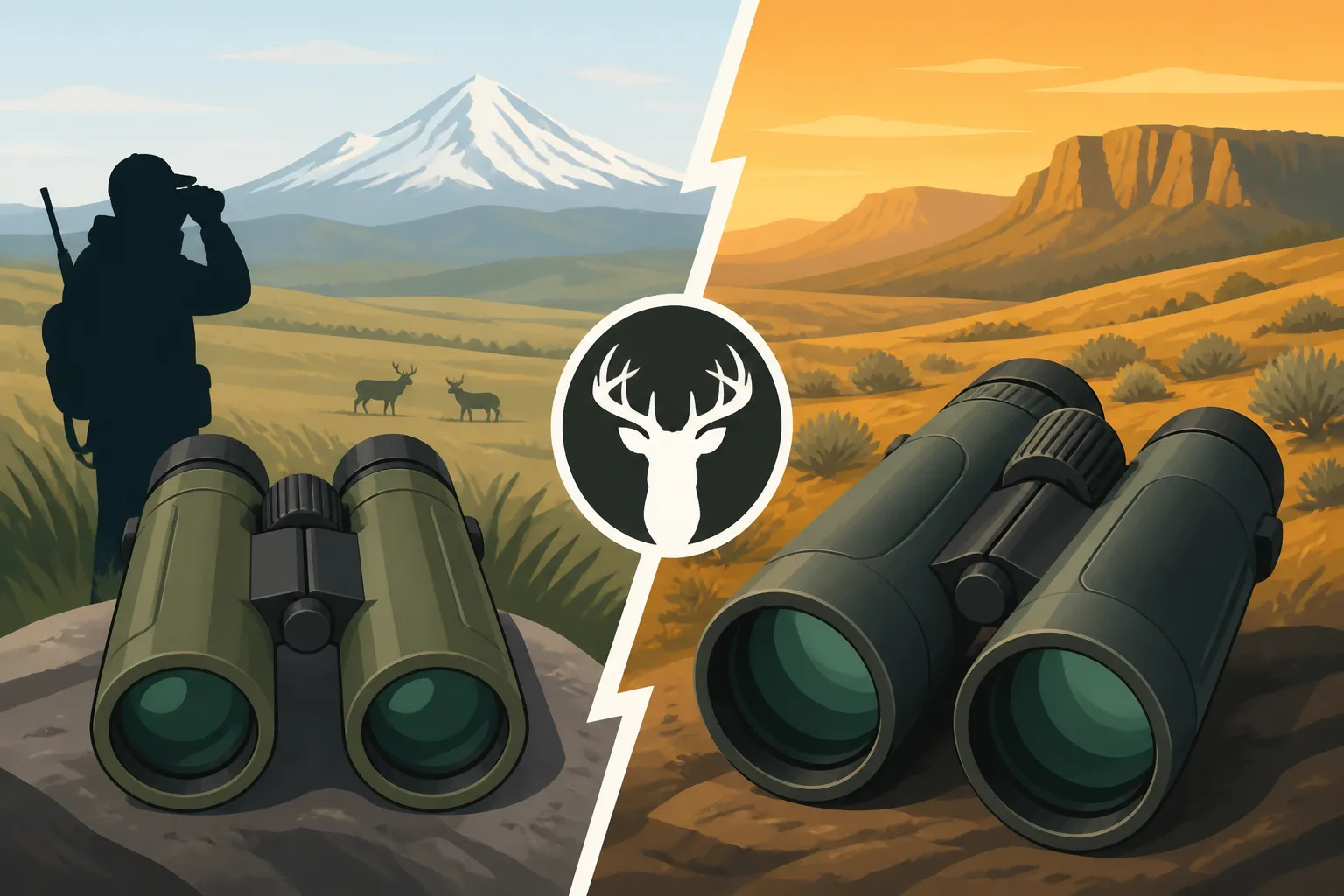
One of the biggest head-scratchers for Washington hunters, especially those new to the varied landscapes, is figuring out what binoculars will actually serve them best. It's frustrating to invest in optics only to find they're either not powerful enough for the vast eastern Washington breaks or too cumbersome for dense western Washington timber. This guide will dive deep into the age-old debate between 10×42 and 15×56 binoculars, helping you understand their strengths and weaknesses so you can make an informed choice for your next hunt.
Understanding Binocular Basics for Washington Terrain
Before we can even begin to compare specific models, it's crucial to grasp what those numbers like "10×42" and "15×56" actually signify. They're not just arbitrary figures; they tell you a lot about how the binoculars will perform in the field, especially across the diverse hunting conditions Washington state throws at us.
Magnification Explained for Hunters
The first number, "10x" or "15x", refers to the magnification power. A 10x binocular will make an object appear ten times closer than it is to the naked eye. So, something 1,000 yards away will look as though it's 100 yards away. Similarly, a 15x binocular brings that 1,000-yard object into view as if it were only about 66 yards away.
For a hunter, this difference in magnification is huge. When you're picking apart a distant hillside on the east side, trying to determine if that tan speck is a mule deer or just a rock, that extra 5x magnification can be the deciding factor. It allows you to resolve finer details, like antler points or an animal's posture, at ranges where a 10x might leave you guessing. However, higher magnification also amplifies hand shake, making it harder to hold steady, which we’ll discuss more later. Think about glassing the Glassing Eastern Washington Breaks for Mule Deer for hours – every bit of stability counts.
Objective Lens Diameter: The 42mm vs. 56mm Difference for Light Gathering
The second number, "42mm" or "56mm", represents the diameter of the objective lenses in millimeters. These are the larger lenses at the front of your binoculars, the ones pointing towards your target. The objective lens's primary job is to gather light. Generally speaking, the larger the objective lens, the more light it can collect.
Why does this matter in Washington? Because we often hunt at dawn and dusk, or in heavily timbered areas like those found during Blacktail Deer Hunting in Western Washington Timber where ambient light is already limited. A 56mm objective lens has a significantly larger surface area than a 42mm lens, meaning it can draw in more available light. This results in a brighter, clearer image, especially during those critical low-light periods when game is most active. While a 42mm can still perform admirably, the 56mm objective truly extends your effective glassing time at the fringes of the day.
Exit Pupil and Low Light Performance
The exit pupil is a critical, though often overlooked, specification for hunters. It's the diameter of the light beam that exits the eyepieces and enters your eye. You can calculate it by dividing the objective lens diameter by the magnification. So, for a 10×42, the exit pupil is 42/10 = 4.2mm. For a 15×56, it's 56/15 = 3.7mm.
Our pupils dilate in low light, usually up to around 5-7mm for adults. If the exit pupil of your binocular is smaller than your eye's dilated pupil, you're essentially not receiving all the light the objective lens gathered; your eye becomes the limiting factor. In brighter conditions, this isn't an issue as your pupils are constricted. However, at first light or last light, a larger exit pupil (closer to or larger than your eye's pupil) means you'll perceive a brighter image. While the 10×42 technically has a larger exit pupil in our example, the raw light-gathering capability of the 56mm objective on the 15×56 often makes it appear brighter, especially as the eye adjusts. It's a nuanced point, but for hunters trying to identify a Roosevelt Elk of Western Washington silhouette in thick fog, every photon counts.
The Case for 10×42 Binoculars in Washington
When you talk to most seasoned hunters, particularly those who navigate Washington's dense timber and rugged terrain, a good 10×42 binocular is often seen as the workhorse of their optics kit. It strikes a balance that makes it incredibly practical for a vast array of hunting situations, particularly when mobility and a steady image are priorities.
Versatility and Portability
A 10×42 binocular really shines in its versatility. It's powerful enough to effectively scan across reasonable distances yet compact and light enough that you'll barely notice it hanging from your bino harness. For hunters who are constantly on the move, covering ground, and perhaps Still-Hunting Blacktails in Wet Washington Brush, this combination is invaluable. You can quickly bring them up to your eyes, assess a situation, and move on without feeling like you're lugging around a pair of bricks. They fit comfortably in most bino harnesses, protecting them from the elements – a crucial factor when you're caught in one of Washington's notorious rain showers. This kind of balance means you're more likely to have your binoculars out and in use, rather than tucked away in your pack because they're too heavy or cumbersome.
Field of View and Stability
One of the often-underestimated benefits of 10x magnification is the wider field of view it typically offers compared to higher magnification optics. This means you see more of the landscape through your lenses at any given moment. For glassing timber fringes, scanning thick reprod, or quickly locating an animal after it's been spooked, a wider field of view makes a significant difference. It’s easier to pick up movement and track game without constantly panning.
Furthermore, 10x binoculars are considerably easier to hold steady by hand. The slight tremor that's natural when holding optics is far less pronounced at 10x than at 15x. This stability means you can glass for longer periods without eye strain and maintain a clearer image, which is vital when you're trying to Count Points on a Live Buck before making a decision. For many hunting scenarios, especially when you're moving stealthily and need to react quickly, the ability to rapidly acquire a stable image without a tripod is a huge advantage.
Typical Washington Scenarios for 10×42
Think about the varied hunting conditions in Washington, and you'll quickly see where the 10×42 excels. If you're chasing blacktail deer in the thick, often rainy, coastal timber of Western Washington, you're rarely going to be making observations beyond 200-300 yards. The dense vegetation limits long-range visibility, and the quick, close encounters require fast target acquisition. A 10×42 is perfect for picking apart shadows in the dense cedar and fir, identifying game within the tangled undergrowth, and following an animal through tight openings.
Even on the east side, in units with more open timber or rolling hills, the 10×42 still holds its own for general scanning and when you're in closer quarters. For instance, if you're still-hunting a timbered ridge for a Rocky Mountain Elk East of the Washington Cascades, or trying to locate birds after Upland Bird Hunting After Deer Season closes, the 10×42 offers sufficient magnification to identify targets without being overkill. It's the go-to for many general season deer and elk hunters who prioritize light weight and ease of use throughout a long day of hiking. For many, it's the all-around "can't go wrong" choice.
When 15×56 Binoculars Shine in Washington Open Country
While the 10×42 is a fantastic generalist, there are specific hunting situations in Washington where you simply can't beat the raw power and light-gathering capability of a 15×56 binocular. These optics are specialized tools, designed for maximum performance at extended ranges and in challenging light, making them invaluable for certain types of hunts.
Unmatched Detail at Distance
The most obvious advantage of a 15×56 binocular is its ability to reveal incredible detail at long distances. When you're glassing vast open country, like the sagebrush flats of the Columbia Basin or the sprawling wheat fields bordering timber on the east side, those extra 5x of magnification make a profound difference. You can pick apart a distant coulee, identify the subtle twitch of an ear at 800 yards, or discern the exact antler configuration on a mule deer buck bedded a mile away. This level of detail resolution is simply not possible with a 10x binocular.
For hunters who spend hours perched on a vantage point, systematically scanning for game, the 15×56 allows them to cover exponentially more ground effectively. It reduces the need to move as frequently, minimizing disturbance and conserving energy. When you're trying to find Mule Deer of Eastern Washington in their vast habitat, this enhanced ability to "stretch your eyes" and see further with clarity translates directly into increased scouting and hunting efficiency.
Light Gathering Prowess
Beyond magnification, the 56mm objective lenses are a game-changer for light gathering. As discussed earlier, these larger lenses pull in significantly more ambient light, which directly impacts image brightness, especially during low-light conditions. For a dedicated hunter, those first and last 30 minutes of legal shooting light are often the most productive. This is when animals are most active, moving between bedding and feeding areas.
A 15×56 binocular excels during these critical windows. It allows you to glass effectively when a 10×42 might start to fade, extending your effective hunting and scouting time. Imagine sitting on a ridge overlooking a vast canyon as the sun dips below the horizon, or before it crests the peaks. With 15×56 glass, you can still resolve details on distant hillsides, spotting deer or elk moving that would otherwise remain hidden in the gloom. This can be the difference between heading home empty-handed and pinpointing that trophy animal.
Ideal Washington Terrains for 15×56
So, where do these big binos truly shine in Washington? Primarily, in the expansive, open landscapes east of the Cascade crest. Think of the sprawling Columbia Basin Hunting in Washington, the high desert plateaus of the Okanogan, or the rolling hills and coulees of the Blue Mountains. These are areas where animals can be spotted from miles away, and successful hunting often hinges on methodical, long-range glassing.
For those chasing Mule Deer of Eastern Washington or Rocky Mountain Elk East of the Washington Cascades across these wide-open spaces, a 15×56 paired with a sturdy tripod is an indispensable tool. It allows you to methodically grid distant slopes, search river bottoms, and dissect brushy draws without having to hike every single one. If your hunting style involves finding an advantageous overlook and letting your optics do most of the walking, then the 15×56 is your absolute best friend. Tools like GoHunt can also aid in identifying these types of glassing vantage points during your E-Scouting efforts before you even leave home.
Practical Considerations and Trade-offs
Choosing between a 10×42 and a 15×56 isn't just about magnification and light. There are very real, practical trade-offs involved that can impact your comfort, your mobility, and ultimately, your success in the field. Understanding these aspects will help you make a choice that truly fits your hunting style and the specific demands of Washington's wild country.
Weight and Bulk
This is perhaps the most immediate and noticeable difference. A 10×42 binocular is generally much lighter and more compact than a 15×56. While specific weights vary between brands and models, you're typically looking at a few ounces to potentially a pound or more difference. Those few extra ounces or that larger footprint might not seem like much on paper, but after miles of hiking, especially through Washington's steep and rugged terrain, every bit of weight adds up.
For hunters covering long distances in search of Washington Elk Herds and Where They Live or traversing dense forests, a lighter 10×42 can be a blessing. It reduces fatigue, allows for quicker transitions, and is less cumbersome to carry all day. A 15×56, with its larger objective lenses and more robust construction, will inevitably be heavier and bulkier. This means it might feel more noticeable on your chest in a bino harness, and it will take up more space in your pack. You have to consider if the benefits of the extra magnification outweigh the added physical burden for your typical hunt.
Tripod Dependency
Here’s where the 15×56 really demands a commitment: stability. At 15x magnification, even the steadiest hands will struggle to hold a perfectly still image. The natural tremors in our hands are amplified, leading to a shaky, fatiguing view that makes it difficult to pick out fine details. For this reason, 15×56 binoculars are almost universally used with a tripod.
While adding a tripod (and a binocular adapter) to your kit significantly increases stability and allows you to unlock the full potential of these powerful optics, it also adds weight, bulk, and a setup time. You can't just snatch your binos up for a quick look; you need to deploy your tripod, attach the adapter, and then glass. This is fine for methodical, long-range glassing sessions from a fixed position, common in Glassing Sage and Wheat Edges for Washington Mule Deer. However, for dynamic, on-the-move hunting where quick glances are often needed, a tripod can be a hindrance. A 10×42, on the other hand, can be effectively hand-held for extended periods, offering instant access to your magnified view. While you can use a 10×42 on a tripod for ultimate stability, it's rarely a necessity. Consider if your hunting style accommodates a tripod, or if you prefer the freedom of handheld glass. You can find excellent options for Tripods and Binocular Adapters that are lightweight enough for backcountry use.
Cost Implications and Value
As with most hunting gear, quality optics come with a price tag, and generally, more power and larger lenses translate to higher costs. A premium 15×56 binocular will almost certainly be more expensive than a comparable quality 10×42 from the same manufacturer. This is due to the larger glass elements, more complex optical designs required for higher magnification, and the sheer volume of materials.
When you factor in the additional necessity of a sturdy tripod and adapter for the 15×56, the total investment increases further. It's important to consider your budget and what value each option brings to your hunting style. If you primarily hunt dense timber and rarely make long-range observations, investing heavily in a 15×56 might be overkill, and that money could be better spent on other essential Boots and Packs for Washington Backcountry or high-quality Rain Gear and Layering for Washington Hunts. Conversely, if you're a dedicated eastern Washington mule deer hunter, the 15×56 might be the single most impactful piece of gear you own, justifying the expense. Don't forget, there are also some fantastic Budget Gear That Works in Washington options if you know where to look, sometimes found in the used market.
Eye Relief and Eyeglass Wearers
Eye relief is the distance from the eyepiece lens to where your eye needs to be to see the full field of view. This is a critical specification for anyone who wears eyeglasses or sunglasses while hunting. Binoculars with longer eye relief (typically 15mm or more) allow eyeglass wearers to keep their glasses on and still see the entire image without vignetting.
While most modern binoculars, regardless of magnification, offer decent eye relief, it's something to pay attention to. If you wear glasses, always test binoculars with them on. Some higher magnification binoculars can sometimes have slightly less generous eye relief, which can make for an uncomfortable and compromised viewing experience if you can't get close enough to the eyepiece. When you're out in the field for hours, comfort is paramount.
| Feature | 10×42 Binoculars | 15×56 Binoculars |
|---|---|---|
| Magnification | 10x (10 times closer) | 15x (15 times closer) |
| Objective Lens | 42mm (Good light gathering) | 56mm (Excellent light gathering) |
| Exit Pupil | 4.2mm (Generally good in low light) | 3.7mm (Smaller, but 56mm lens compensates with more light) |
| Field of View | Wider (Easier to scan and find targets) | Narrower (More focused on distant details) |
| Stability | Easier to hand-hold steadily | Requires a tripod for optimal stability |
| Weight/Bulk | Lighter, more compact, easier to carry | Heavier, bulkier, more noticeable |
| Low Light | Good for general conditions | Superior for dawn/dusk and deep shadows |
| Resolution | Good for ranges up to ~400 yards | Excellent for ranges beyond ~400 yards |
| Ideal Use | Timber, brush, mobile hunting, general scouting | Open country, long-range glassing, stationary observation |
| Cost | Generally less expensive for comparable quality | Generally more expensive, plus tripod cost |
Choosing the Right Binocular for Your Washington Hunt Style
Ultimately, the best binocular for you isn't about which one is inherently "better," but which one aligns best with your specific hunting style, the terrain you frequent in Washington, and the species you pursue. It's a personal decision that impacts your effectiveness and enjoyment in the field.
Matching Optics to Your GMU and Species
Consider the typical landscape of your preferred Washington Game Management Units Explained. Are you primarily hunting dense timber on the Olympic Peninsula for Roosevelt Elk of Western Washington? If so, long-range glassing is rarely the primary tactic, and a nimble 10×42 will likely serve you better. You'll be picking apart close-up brush and focusing on quick, quiet movements. In this scenario, the added weight and tripod dependency of a 15×56 would mostly be a burden.
However, if your passion lies in chasing Mule Deer of Eastern Washington across the vast, rolling coulees of the Colockum or the arid landscapes near the Hanford Reach, then the argument for 15×56 becomes much stronger. Here, success often hinges on spotting game from great distances, analyzing animals for antler characteristics, and patiently watching movement patterns. The ability to sit on a knoll for hours with a 15×56 on a tripod, dissecting every nook and cranny of a mile-long canyon, is invaluable. Many hunters in these areas even carry both a 10x for quick close-ups and a 15x or spotting scope for detailed long-range work.
Complementing Your Kit
Your binocular choice isn't made in a vacuum; it should complement your entire optics kit. Many serious hunters opt for a two-tier system: a lighter 10x binocular for general scanning and quick checks, paired with a powerful spotting scope for detailed inspection of distant animals. In this scenario, a 10×42 makes perfect sense as your primary binocular, as the spotting scope handles the extreme magnification needs. You can get more information on this pairing in Spotting Scopes and When You Need One.
Alternatively, some hunters prefer to use their binoculars for all their glassing and might forgo a spotting scope altogether, especially if they're trying to reduce pack weight or simplify their setup. If this describes you and you hunt open country, then the 15×56 can act as a bridge between a traditional binocular and a spotting scope, offering significant magnification while still providing a stereo image (two eyes, which reduces fatigue). Platforms like GoHunt can provide maps and resources that help you determine if a spotting scope is truly needed in your chosen GMU, or if powerful binos will suffice.
Testing Before You Buy
Here’s the absolute, non-negotiable truth about optics: you must try them before you buy them, especially for such a significant investment. Specifications on paper are one thing, but how a binocular feels in your hands, how it balances, how comfortable the eyepieces are, and how your eyes perceive the image are all highly personal.
Visit a reputable outdoor gear store that allows you to take binoculars outside and view distant objects. Can you comfortably hold the 10×42 steady? Does the 15×56 feel too heavy or bulky for your frame? If you wear glasses, can you see the full field of view with them on? Pay attention to things like edge-to-edge clarity, chromatic aberration (color fringing), and overall image brightness. Don't be swayed by marketing alone; trust your eyes and your hands. Think about the conditions you typically hunt in – if you’re usually in the rain, does the armor feel secure even when wet? If you're on a budget, consider renting or borrowing different models to get a feel for them on an actual hunt before making a final decision. Your eyes are unique, and your optics should be too. You're investing in clear vision in the field, which is critical for safety and success in Washington's diverse hunting landscape.
Disclaimer
This article is for general informational purposes only and does not constitute professional advice. Laws, prices and regulations vary by location and change over time. Consult a qualified professional for guidance on your specific situation.