Eastern Washington Hunting Country
Eastern Washington presents a vast and diverse hunting landscape, from the arid sagebrush flats and deep coulees of the Columbia Basin to the towering pines of the Selkirk Mountains and the rolling, timbered hills of the Blue Mountains. This incredible variety, while offering a wealth of opportunities, also brings unique challenges for hunters trying to understand where to go, how to access land, and what to expect. This guide aims to demystify Eastern Washington's hunting country, helping you plan more effectively and increase your chances of success, no matter if you're chasing mule deer, Rocky Mountain elk, or a wily whitetail.
Understanding Eastern Washington's Diverse Landscape
When we talk about "Eastern Washington," it's easy to picture one monolithic landscape, but that couldn't be further from the truth. This half of the state is a tapestry of distinct ecosystems, each demanding a different approach from the hunter. From the dry, basalt-laced breaks of the central plateau to the lush, coniferous forests bordering Idaho, understanding these regional nuances is paramount to a successful hunt.
Northeast Washington: Mountains, Forests, and Whitetails
Journey to the northeast corner of Washington, and you'll find a world far removed from the desert plains. Here, the landscape is dominated by the Selkirk and Kettle River mountain ranges, an extension of the Rocky Mountains. This region is characterized by dense conifer forests – Ponderosa pine, Douglas fir, and grand fir – interspersed with clearings, agricultural fields, and abundant water sources. Elevations vary significantly, from river valleys to high mountain peaks, offering a mix of timber hunting and open slopes.
This is prime habitat for white-tailed deer, particularly in Pend Oreille, Stevens, and Ferry counties. These whitetails thrive in the timbered draws and brushy creek bottoms, often utilizing the patchwork of private farms and public forest lands. While whitetails are the stars, you'll also find a healthy population of Washington Moose in the Selkirks, growing numbers of Rocky Mountain elk, and even black bears. Hunting here often involves still-hunting through thick timber, focusing on pinch points, and understanding how deer move between cover and feed. Access can be a mix of National Forest and private timber, with some WDFW lands thrown in.
Central Washington's Arid Breaks and Basins
Moving south and west, the landscape transforms dramatically into the arid and semi-arid regions of central Washington. This includes the vast Columbia Basin, the rolling scablands, and the steep, basalt-lined river breaks of the Columbia and Snake rivers. This country is defined by sagebrush, bunchgrass, and bitterbrush, with Ponderosa pine and Douglas fir clinging to higher elevations and north-facing slopes. Water is often scarce, making it a critical factor in game distribution.
This is quintessential mule deer country, where bucks can be found browsing the sagebrush flats or bedded in the deep coulees. Mule Deer of Eastern Washington are well-adapted to this open landscape, making glassing an essential hunting technique. The expansive views allow hunters to spot animals from miles away, though closing the distance can be a monumental challenge in the exposed terrain. Elk herds, particularly the famous The Colockum Elk Herd and The Yakima Elk Herd, also inhabit these central breaks, utilizing the timbered slopes of the eastern Cascade foothills and descending into the sagebrush to feed. Hunters here often rely on vehicles for initial access, followed by extensive hiking, especially when tackling the steep, unforgiving terrain of the breaks.
Southeast Washington: The Blue Mountains and Rolling Hills
Finally, in the southeast corner of the state, we encounter the Blue Mountains, often affectionately called "the Blues." This is a significant mountain range with higher elevations, characterized by vast tracts of Ponderosa pine, fir forests, and expansive meadows. As you descend from the mountains, the landscape transitions into rolling hills of wheat fields and ranchland, leading down to the Snake River breaks.
The Blue Mountains are a renowned destination for Rocky Mountain elk, supporting one of Washington's most significant herds, The Blue Mountains Elk Herd. Hunting the Blues often means navigating steep, rugged terrain, utilizing a combination of glassing and still-hunting through timber. Access is primarily through the Umatilla National Forest, interspersed with private timber and agricultural lands. Mule deer and white-tailed deer also call this area home, particularly in the lower, rolling country. Hunters must be prepared for variable weather conditions, from warm early-season days to harsh late-season snowstorms, which can concentrate elk on their wintering grounds. Understanding game movement patterns between public and private lands is crucial here.
Key Game Management Units (GMUs) of Eastern Washington
Eastern Washington is carved into numerous Game Management Units (GMUs), each with its own unique characteristics, regulations, and game populations. Navigating these units is essential for any hunter, as the specific rules and opportunities can vary dramatically from one GMU to the next. Understanding the primary draw of certain units can help you focus your scouting and application efforts.
The Colockum and Yakima: Elk Strongholds
When it comes to Rocky Mountain elk hunting in Eastern Washington, the names "Colockum" (GMU 328) and "Yakima" (GMU 335) often come up first. These units, located in the eastern foothills of the Cascade Mountains, are legendary for their substantial elk herds and rugged, challenging terrain. The landscape here is a mix of steep, timbered ridges, deep basalt canyons, and open sagebrush flats. Elk move between the higher timbered areas for cover and the lower sagebrush and agricultural lands for forage, especially as hunting pressure increases or snow drives them down.
Hunting in these units is physically demanding. Expect long hikes, often involving significant elevation gain and loss. Access is a mix of US Forest Service land, Washington Department of Natural Resources (DNR) lands, and some private parcels. Road systems, particularly the Washington Green Dot Road Systems, play a crucial role in managing access and hunter distribution, with many roads closed seasonally or year-round to protect wintering wildlife or reduce disturbance during hunting seasons. A successful hunt often involves extensive pre-season scouting, understanding elk migration patterns, and being prepared to pack out an animal from remote, steep country. Many experienced hunters will use powerful optics to glass distant slopes, then plan a strategic approach.
Okanogan and Methow: Mule Deer and High Country
Heading further north, the Okanogan and Methow Valley regions offer some of the state's most iconic mule deer hunting, along with opportunities for elk, black bear, and even moose in certain areas. GMUs like the Okanogan (GMU 204), Methow (GM218), and Chelan (GMU 224) are characterized by vast, open mountain slopes, Ponderosa pine forests, sagebrush benches, and the towering peaks of the North Cascades. The terrain ranges from accessible valley bottoms to incredibly steep, high-elevation wilderness.
Mule deer thrive in this mosaic of habitat. Mule Deer of Eastern Washington are often found in the sagebrush-bitterbrush communities, moving into timbered areas for cover during the day. High-country hunts, particularly during archery or early rifle seasons, can involve backpacking into remote basins and glassing vast open slopes for feeding or bedded deer. Lower elevation hunts might focus on public lands adjacent to agricultural fields or on finding deer that have been pushed down by early snows. Hunters in these units often spend hours behind binoculars and spotting scopes, picking apart distant hillsides. Knowledge of the Okanogan-Wenatchee Forest Access is vital, as this National Forest forms the backbone of much of the public hunting land here.
Blue Mountains Units: Multi-Species Opportunities
The Blue Mountains, spanning GMUs like the Wenaha (GMU 175), Tucannon (GMU 178), and Mt. View (GMU 181), are a premier destination in southeast Washington, especially for elk. These units comprise rolling, heavily timbered mountains, deep canyons, and expansive subalpine meadows. The Umatilla Forest Units in Washington are the primary public land base, providing vast areas for hunters to explore.
While The Blue Mountains Elk Herd draws the most attention, these units also offer excellent hunting for white-tailed deer, mule deer, and black bears. The diverse habitat supports all three deer species, making it a true multi-species hunting ground. Elk hunting here often means navigating dense timber, tracking, or setting up ambush points along known travel corridors. The ruggedness of the Blues often requires a good level of physical fitness and the ability to pack out meat from challenging terrain. Understanding elk migration timing in November is particularly important for late-season hunts, as snowfall can push animals to lower elevations or private lands. Hunters should also be aware of specific unit regulations, as antler restrictions or weapon restrictions can vary.
Public Land Access in Eastern Washington
Eastern Washington boasts an incredible amount of public land, offering hunters vast tracts to explore. However, simply knowing an area is "public" isn't enough; understanding the different agencies that manage these lands and their specific access rules is crucial. From federal forests to state wildlife areas, each type of public land presents unique opportunities and limitations.
National Forests: Colville and Okanogan-Wenatchee
The backbone of public land hunting in much of Eastern Washington is formed by the National Forests. The Colville National Forest in the northeast, and the Okanogan-Wenatchee National Forest stretching along the eastern Cascades, provide hundreds of thousands of acres of accessible hunting ground. These forests are managed by the U.S. Forest Service and are generally open to hunting unless otherwise posted. Access often involves a network of forest service roads, though many are gated seasonally or permanently as part of Washington Green Dot Road Systems to manage wildlife, reduce erosion, or limit motorized vehicle impact.
Hunting these national forests means being prepared for remote, rugged terrain. Hunters often use forest roads to access trailheads or points where they can hike into the backcountry. Always check with the local ranger district for current road conditions, fire restrictions, and any temporary closures. A Northwest Forest Pass and Washington Hunting Access might be required for parking at certain developed trailheads, so it's wise to carry one. These forests are ideal for those seeking a more solitary hunt, particularly for elk, mule deer, and whitetails, depending on the specific elevation and habitat. Using tools like onX Hunt is invaluable for overlaying current road status and land ownership with satellite imagery.
DNR Lands and State Wildlife Areas
The Washington Department of Natural Resources (DNR) manages extensive lands throughout Eastern Washington, often former timber lands or state trust lands. Many of these DNR lands are open to hunting and offer good opportunities, particularly for blacktail deer in the timbered western edge of Eastern Washington, or for whitetails and grouse in the northeast. Access to DNR lands sometimes requires a Discover Pass for vehicle parking, similar to state parks. Washington DNR Land Open to Hunting can be highly productive, but it's essential to consult DNR maps and regulations to ensure you're on accessible land and understand any specific rules, such as camping restrictions.
In addition to DNR lands, the Washington Department of Fish and Wildlife (WDFW) manages numerous State Wildlife Areas. These areas are specifically managed for wildlife habitat and public recreation, including hunting. Examples include the Wenas Wildlife Area Hunting in central Washington, known for its elk and mule deer, or the Scotch Creek Wildlife Area Hunting in the Okanogan. While often smaller than National Forests, Wildlife Areas can be very productive due to intensive habitat management. They usually have specific rules regarding vehicle access, camping, and sometimes even weapon types, so always check the WDFW Hunting and Fishing Pamphlet for the current season. A Washington Wildlife Area Parking Permits is often required for parking at these locations.
BLM and Other Federal Lands
Beyond the National Forests, the Bureau of Land Management (BLM) also manages significant acreage in Eastern Washington, particularly in the arid central and southern regions. BLM lands are typically characterized by sagebrush steppe and basalt scablands, offering prime habitat for mule deer, especially in the more remote breaks and coulees. These lands are generally open to hunting and often offer walk-in opportunities or access via primitive roads. Similar to other federal lands, check for any specific closures or restrictions before heading out.
Other federal lands might include lands managed by the Department of Defense, such as the Yakima Training Center Hunting Permits or Joint Base Lewis-McChord Hunting (though JBLM is mostly Western Washington, the Yakima Training Center is a significant Eastern WA hunting opportunity). These military lands often require special permits, extensive background checks, and adherence to strict entry and safety protocols, but can offer exceptional hunting experiences due to limited public access. Always check their specific websites well in advance, as application periods and access can be complex.
Navigating Private Lands and Access Programs
While Eastern Washington offers vast public land, a significant portion of the landscape, especially in the valleys, agricultural areas, and lower elevations, is privately owned. Successfully hunting these areas often hinges on understanding and utilizing various access programs or, more traditionally, securing direct permission from landowners. Navigating this can be one of the biggest challenges for hunters.
WDFW Private Lands Access Programs
The Washington Department of Fish and Wildlife (WDFW) has implemented several programs designed to increase hunter access to private lands. These initiatives are a boon for hunters, creating opportunities that wouldn't exist otherwise. One of the most common programs is the Feel Free to Hunt program, where landowners allow public access without prior permission for specific species and seasons. These properties are typically signed and listed on the WDFW website, sometimes even integrated into mapping apps like onX Hunt.
Another valuable program is Register to Hunt, which requires hunters to sign in (either physically at a kiosk or online) before accessing a property. This allows WDFW and landowners to manage hunter numbers and gather data. Finally, the Hunt by Reservation program allows hunters to reserve specific hunt dates on certain private properties, often through an online portal. This can be fantastic for controlling pressure and ensuring a quality experience. Understanding these programs and checking the WDFW website or the annual hunting pamphlet for current participating properties is crucial for finding Feel Free to Hunt Properties Explained and securing access.
Gaining Permission on Agricultural and Ranch Land
Beyond formal WDFW programs, directly asking for permission from private landowners remains a time-honored tradition and a highly effective way to gain access, particularly in the rich agricultural and ranching country of Eastern Washington. Farmers and ranchers, especially those dealing with game damage, might be open to allowing hunting. However, timing and approach are everything.
It's generally best to seek permission well in advance of the season, not on opening day. Dress respectfully, be polite, and clearly state your intentions. Offer to share contact information and discuss specific areas you'd like to hunt. Always respect their property, close gates, avoid driving on wet fields, and leave no trace. A critical part of this is understanding Getting Written Permission Before Opening Day – a simple, signed note can prevent misunderstandings. Building a relationship with a landowner over years can be incredibly rewarding, sometimes even leading to exclusive access or invitations. This is especially true for Finding Mule Deer in Wheat Stubble Edges or hunting whitetails that frequent crop fields.
Timber Company Access in Bordering Areas
While large industrial timberlands are more prevalent on the west side of the Cascades, companies do own significant timbered acreage on the eastern slopes and in northeastern Washington. These lands are often managed differently than public forests. Some timber companies, like Hancock or Weyerhaeuser (though primarily Westside focused), may offer recreational permits for a fee, which can include hunting access. These permits often provide access to gated roads and managed areas, which can mean less hunting pressure than open public lands.
However, these programs can be competitive, and permit availability varies. It's essential to check company websites early in the year for permit sales and access rules. Additionally, some private timber lands might have agreements with WDFW for certain access programs. Always verify land ownership and access rules before venturing onto these properties. Using an app like onX Hunt, which displays land ownership boundaries, is incredibly helpful for distinguishing between public and private timber, ensuring you don't inadvertently trespass. Understanding Timber Company Permits in Western Washington can give you a starting point, even if the specifics for Eastern Washington vary slightly.
Strategies for Different Eastern Washington Terrain Types
Eastern Washington's diverse topography demands a flexible hunting strategy. What works in a dense Ponderosa pine forest won't cut it in a vast sagebrush basin, and vice versa. Adapting your techniques to the specific terrain you're hunting is key to consistently finding game.
Glassing Vast Open Spaces
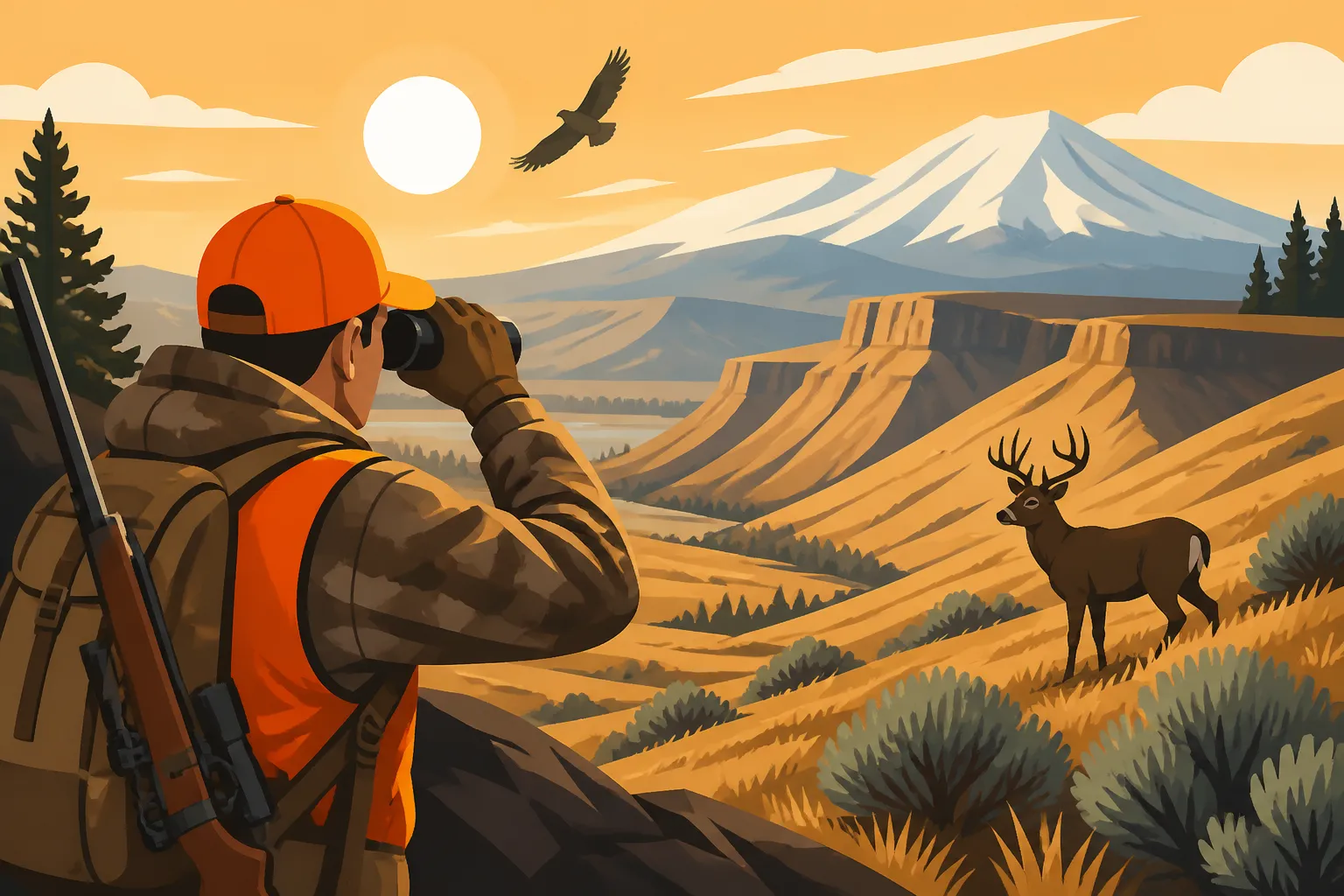
In the expansive, open landscapes of central and southeast Washington—think the Columbia Basin, the breaks of the Snake River, or the vast sagebrush flats of the Okanogan—glassing is not just a tactic; it's practically a religion. Glassing Eastern Washington Breaks for Mule Deer from a vantage point is the most efficient way to cover ground and locate animals in this type of country.
To glass effectively, you need quality optics: a good pair of 10x or 12x binoculars, often mounted on a tripod for stability, and sometimes a spotting scope for evaluating distant animals. Find a high point that offers an unobstructed view of canyons, coulees, draws, and brushy slopes. Systematically scan the entire landscape, breaking it into grids, looking for anything that seems out of place – a horizontal line in a vertical world, an ear, a flicker of movement. Pay extra attention to shaded areas, north-facing slopes, and areas near water sources, especially during warmer parts of the day. Patience is paramount; spend hours behind the glass, re-scanning areas, as animals can appear as if by magic. Once an animal is spotted, the real work begins: planning your stalk to approach undetected.
Still-Hunting Timbered Ridges and Draws
When you move into the dense forests of Northeast Washington or the higher elevations of the Colockum and Blue Mountains, the game changes. Here, still-hunting becomes a primary strategy, demanding stealth, patience, and a keen eye for detail. Still-Hunting Blacktails in Wet Washington Brush (even though this link refers to Westside, the technique is applicable to similar timbered habitats on the Eastside) involves moving slowly, taking a few steps, then pausing for several minutes to observe, listen, and scan your surroundings.
Focus on reading the terrain: look for game trails, rub lines, scrapes, and fresh tracks. Move into the wind, if possible, or across it, to keep your scent from blowing ahead of you. Pay attention to changes in cover, natural funnels, and areas where deer or elk might bed down for the day, such as dense thickets, north-facing slopes, or pockets of mature timber. Your gear should be quiet – no jingling zippers or noisy fabrics. Every step should be deliberate, testing the ground before committing your weight. This method is all about ambushing game that thinks it's safe within the timber.
Hunting Water Sources in Arid Country
In the drier regions of Eastern Washington, especially during early seasons or drought years, water becomes a critical magnet for all big game species. Focusing your efforts around known water sources can be a highly effective strategy. This includes small springs, seepages, stock tanks, river edges, or even seasonal puddles after a rain.
Animals, particularly mule deer and elk, will often travel significant distances to access water, especially during hot weather. Identify these sources during your scouting, either on maps (like those found on GoHunt or onX Hunt) or by physically exploring the area. Setting up an ambush position near a well-used water source, particularly during dawn or dusk, can be productive. Be mindful of scent control, as animals will be alert when approaching water. You might also find game trails converging on these spots, indicating high traffic. Be aware of any restrictions on hunting near water sources, as some areas may have specific regulations. Water Holes That Hold Deer in Dry Country are often overlooked but can be game-changers.
Essential Gear and Preparation for Eastern Washington Hunts
Hunting Eastern Washington isn't just about knowing the land; it's about being properly equipped for its unique demands. The right gear can make the difference between a miserable, short-lived hunt and a comfortable, successful one. From optics to footwear, preparation is key.
Optics for Long-Range Scouting
Given the vast, open nature of much of Eastern Washington, high-quality optics are not a luxury; they are a necessity. You'll spend hours behind them, picking apart distant hillsides and coulees. A good pair of 10×42 or 12×50 binoculars are your primary tool for scanning. For stability and comfort during extended glassing sessions, especially when you're perched on a ridgetop trying to spot Finding Mule Deer in Wheat Stubble Edges, mount them on a tripod. This reduces fatigue and allows you to discern subtle movements or details that would be impossible handheld.
For evaluating animals at extreme distances, especially if you're trying to count points or judge an animal's size from across a canyon, a spotting scope is invaluable. A 65mm or 80mm objective lens with 15-45x or 20-60x magnification will serve you well. Complement your binoculars and spotter with a rangefinder that has angle compensation, crucial for accurate shot placement in steep Eastern Washington terrain. Brands like Vortex, Leupold, and Maven are popular choices among hunters for their durability and optical clarity. Don't skimp on optics; they are often the most important piece of gear for eastern hunts. Choosing Binoculars for Washington Glassing is a decision that can significantly impact your success.
Footwear and Clothing for Varied Conditions
Eastern Washington's climate can be extreme, swinging from scorching hot early seasons to frigid, snowy late hunts. Your footwear and clothing system must be versatile and resilient. For boots, consider something sturdy with good ankle support and a stiff sole for navigating rocky, uneven terrain, or steep sidehills in the Blues. Depending on the season, uninsulated or lightly insulated, waterproof boots are often a good choice, allowing for layering with socks to adjust warmth. Boots for Washington's Eastside Rock and Westside Mud are essential.
Your clothing system should be built around layers. A moisture-wicking base layer is critical for managing sweat, especially on strenuous hikes. Mid-layers for insulation (fleece or synthetic puffy jackets) allow you to add or remove warmth as temperatures fluctuate throughout the day. An outer shell that is both windproof and waterproof is non-negotiable, particularly for unpredictable mountain weather. Even if the forecast is clear, a sudden thunderstorm or an unexpected cold front can quickly turn a pleasant day miserable. Avoid cotton, which retains moisture and loses its insulating properties when wet.
Navigation Tools and Off-Grid Communication
Getting lost in Eastern Washington's vastness is a real concern, and cell service is often nonexistent in remote hunting areas. Reliable navigation is paramount. A dedicated GPS unit is excellent, but a smartphone app like onX Hunt, with downloaded offline maps, has become a hunter's best friend. These apps allow you to see your precise location on a detailed map showing land ownership, roads, trails, and topographical features. Always carry a physical map and compass as a backup, and know how to use them. GPS Units Versus Phone Apps is a common debate, but having both is the safest bet.
For communication, especially if hunting solo or in a small group that might split up, two-way radios can be incredibly useful for short-range communication. For true emergency situations in areas without cell service, a satellite messenger (like a Garmin inReach or Zoleo) is a lifesaver. These devices allow you to send texts and, critically, send an SOS message to emergency services from anywhere. Make sure to test your devices and check battery life before heading into the field. Satellite Messengers for Solo Washington Hunts are a wise investment for peace of mind.
Challenges and Considerations for Eastern Washington Hunters
Eastern Washington offers incredible hunting opportunities, but it's not without its specific challenges. Being prepared for these hurdles, from unpredictable weather to shifting access rules, can significantly impact your hunting experience and success.
Weather Extremes: From Heat to Deep Snow
The climate across Eastern Washington is characterized by wide swings, sometimes even within a single hunting season. Early archery and rifle seasons (September-October) can often bring scorching hot temperatures, particularly in the central basin and lower elevations. This heat presents significant challenges for hunters, from managing personal hydration and exertion to rapidly cooling harvested game meat. Field Dressing in Warm Early-Season Weather quickly and efficiently becomes a top priority to prevent spoilage.
Conversely, late-season general hunts or special permit hunts extending into November and December can introduce deep snow, freezing temperatures, and icy conditions, especially in the higher elevations of the Blue Mountains or the eastern Cascades. This demands entirely different gear, including heavier insulation, waterproof gaiters, and traction devices for boots. Late-Season Hunting in Washington Snow requires a robust layering system and careful planning for road access, as many forest roads become impassable. Always check the forecast leading up to and during your hunt, and pack accordingly, often preparing for both extremes.
Fire Season and Access Restrictions
Wildfires are a significant concern in Eastern Washington, particularly during the dry summer and early fall months. The tinder-dry sagebrush and pine forests can ignite easily, leading to massive blazes that can devastate prime hunting habitat and, critically, lead to widespread area closures.
During severe fire seasons, public lands, including National Forests and DNR lands, may be closed to all public access to prevent new ignitions or to allow firefighters to operate safely. These closures can happen suddenly and impact hunting plans, sometimes for the entire season in affected areas. Checking Washington Fire Closures Before You Go is absolutely non-negotiable. Always check the websites of the WDFW, Forest Service, and DNR for current fire danger ratings and any active closures before you even leave home. Even without direct closures, smoke from distant fires can severely impact visibility, making glassing impossible and adding a layer of discomfort and health risk to your hunt.
Road Access and Green Dot Systems
Navigating the extensive road networks, especially in National Forests and DNR lands, is a critical component of hunting Eastern Washington. Many of these roads, particularly in elk country, are part of the "Green Dot" road system. The Washington Green Dot Road Systems are designed to manage access and reduce disturbance to wildlife, especially elk. On a Green Dot map, green dots indicate roads that are open to vehicles for the current hunting season, while other roads may be closed seasonally or year-round to motorized traffic.
It's crucial to obtain current Green Dot maps, either from WDFW, the Forest Service, or through digital mapping apps like onX Hunt. Relying on outdated maps or simply assuming a road is open can lead to frustration, wasted time, or even fines if you drive on a closed road. Road closures also impact how you plan your hunt, as what might look like easy access on a map could be a significant hike if a gate is closed. Additionally, some roads might be in poor condition, requiring a high-clearance 4×4 vehicle. Always factor road access and potential walk-in distances into your hunt planning. Roads Closed to Motor Vehicles in a Washington Unit can significantly alter your strategy.
Table: Eastern Washington Hunting Region Overview
To help visualize the distinct characteristics of Eastern Washington's diverse hunting landscapes, here's a quick overview:
| Region | Primary Terrain | Key Game Species | Common Hunting Methods | Notable GMUs / Land Types | Typical Challenges |
|---|---|---|---|---|---|
| Northeast Washington | Conifer forests, mountains, agricultural mix | Whitetail, Elk, Bear, Moose | Still-hunting, tracking, stand hunting | Colville National Forest, DNR lands, private farms | Thick cover, private land access, whitetail stealth |
| Central Washington | Sagebrush steppe, basalt breaks, canyons | Mule Deer, Elk, Bear | Extensive glassing, spot-and-stalk, water holes | Okanogan-Wenatchee NF, BLM, WDFW Wildlife Areas | Aridity, heat, long stalks, limited cover |
| Southeast Washington | Rolling timbered mountains, wheat fields | Rocky Mountain Elk, Deer | Still-hunting, tracking, glassing, ambushing migration | Umatilla National Forest, private farms, WDFW Wildlife Areas | Rugged terrain, steep climbs, variable snow cover |
Disclaimer
This article is for general informational purposes only and does not constitute professional advice. Laws, prices and regulations vary by location and change over time. Consult a qualified professional for guidance on your specific situation.